


You can listen to this piece on YouTube or read it below
Why doesn’t anybody talk about the shame of not knowing what to do in life – of being the person who hasn’t figured it out yet? And is it because this person actually has access to a fundamental source of power that threatens the very systems that try to keep them in line?
My name’s Hazel Gale. I’m a therapist, author, and co-creator of the fantasy mental health app Betwixt. And this is the third article in a series on witches, the witch archetype in psychology, and the magic that lives inside of you.
The Witch

The witch, as a psychological archetype, is the force within that wields a wild and boundless kind of power that the ordered world has tried for millennia to regulate or destroy. Thankfully, she has survived everything thrown her way, largely because she lives beyond the civilised rules of the sanctioned world.
The Witch has many faces, each speaking to a different piece of the same archetypal wisdom. Today’s witch figure is the great and complex Hecate, and her wisdom will lead us to the surprising power of being in-between.
Hecate
If you know a little about Hecate, then you may either recognise her as the Crone of the triple goddess and patron of women’s mysteries, or as the somewhat murky goddess of the crossroads, the underworld and witchcraft – associated with necromancy, ghosts, midnight terrors and the disquieting howls of black dogs. But neither of these visions is how Hecate started out. Not at all.
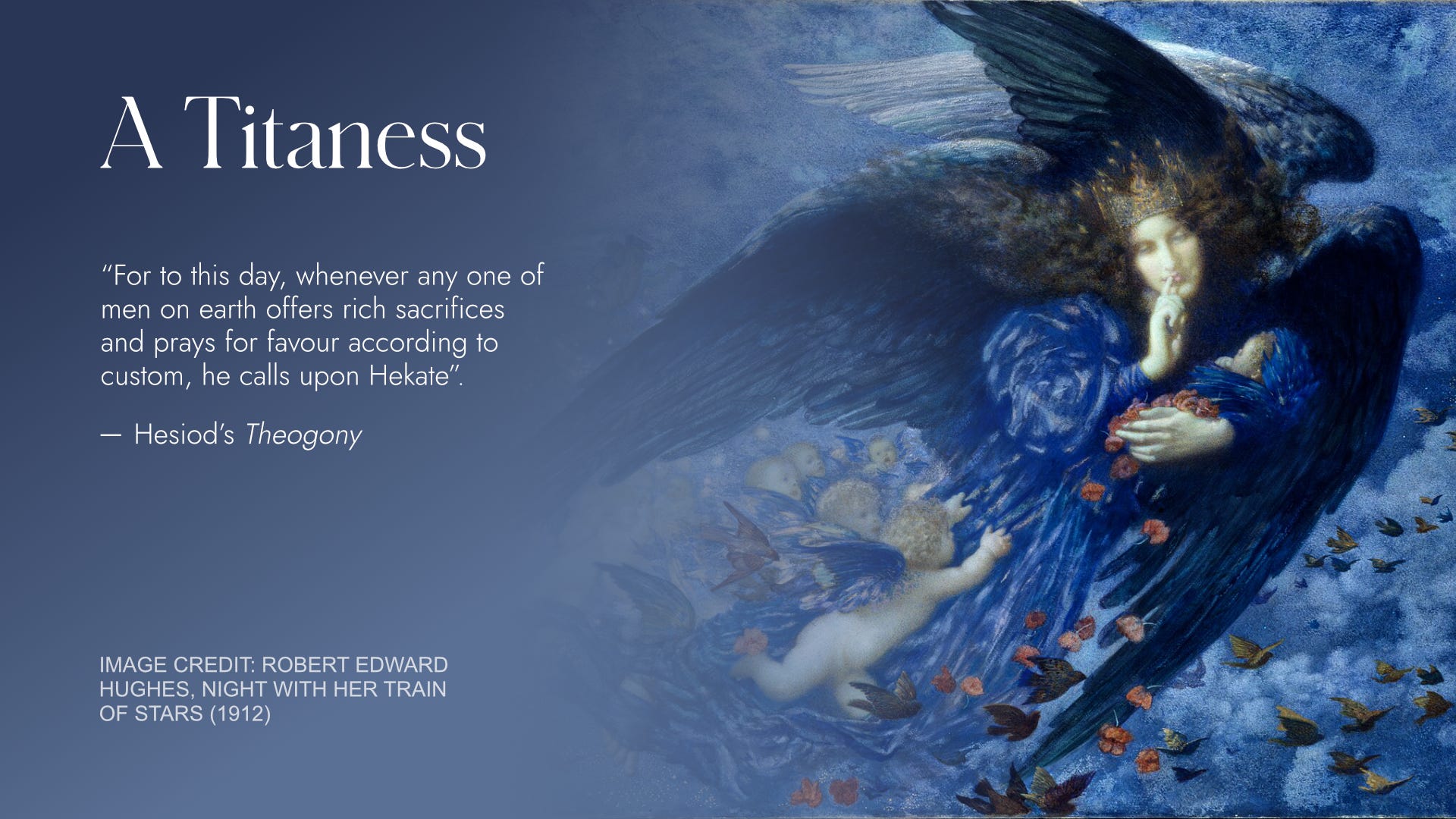
In Hesiod’s Theogony, written around 700 BCE, Hecate appears in a passage that can only be described as reverent, stating that anyone who prayed for good fortune called on Hecate first, and that she could grant wealth and favour to whomever she chose, “for the power surely is with her.”
Hesiod tells us that Zeus honoured the Titaness Hecate above all other deathless gods. As the only child of Perses, the Titan of Destruction, and Asteria, the Titaness of Falling Stars, she held power over three entire realms – the earth, the sea, and the heavens. She aided kings in judgement and warriors in battle, and she stood with athletes at the games. Hecate was nurse to the young, she brought fish to fishermen and livestock to herdsmen. So, very much *not* the deity of edges and darkness, but a sovereign of the entire world.
Fast forward a century or so, and Hecate’s stature has begun to dwindle.
In the Homeric Hymn to Demeter, Hecate appears as a mere supporting figure – one who, from her dwelling in a damp cave, no less, hears Persephone cry as she’s taken to the underworld and then meets Demeter with a torch and accompanies her in her search for her daughter. In other words, she’s described as somewhat small and secondary.
Come the classical period, Hecate has become the goddess of crossroads and night. Her triple form – three women standing back to back around a central pillar – was placed at the intersections of roads and doorways, and offerings were left at crossroads on moonless nights to propitiate her and her .
Finally, the Roman poets finished what the Homeric Hymn began. Virgil, Ovid, and Lucan stripped away what little remained of Hecate’s sovereignty and made her a goddess of blood rites, graveyards, and terror – something to be feared and appeased, not celebrated.
It’s not incidental that something similar has happened to Hecate’s stomping ground. Once considered a site of genuine ontological significance, the crossroad itself – as an archetype of liminality – has since fallen out of favour, too.
The crossroads as archetype of the liminal
In 1909, Arnold van Gennep named the three phases involved in a rite of passage separation, margin and incorporation: first, you are cut loose from what you were; then, you spend time as nobody in particular; finally, you are received back as something new.
In the 1960s, the sociologist Victor Turner gave the middle phase, shall we say, a little more dignity? Turner defines liminal experience as the middle phase of any ritual process in which an individual transitions from one social status to another. For example, growing from being a child, to going through adolescence, and then becoming an adult. In the second of the three stages – the in-between phase – we meet the state of being no longer what we were, and simultaneously not yet what we will become. This is fundamentally difficult, yes, but not, says Turner, something to shy away from. Rather, it is a state in which we can access a rare and potent kind of power.
Turner argued that the person in the margin is in an unparalleled position because, when stripped of role and rank, we become unclassifiable, and being unclassifiable means the rules that govern people with positions temporarily lose their power over us. Turner called this anti-structure; a brief but genuine state of sovereignty and strength.
In a way, the liminal figure is the only person in the system who can see the system for what it is because they have temporarily fallen out of it. Ah ha! Magic.
William Bridges brought these theories into popular consciousness in 1980, and he highlighted an important distinction between change as situational and external, and transition as psychological and internal. For him, the “neutral zone” – which is what he called the middle, liminal phase – is a time when it seems, from the outside, that nothing is happening, but during which vital internal transitions take place. His big warning is that nothing appearing to happen is actually what deep reorientation feels like, and that we can wreck our transitions by trying to skip it.
In the ancient world (and some parts of the modern world, too), cultures and communities built deliberate containers for liminal experiences that preserved the power of the in-between: rites of passage; threshold ceremonies; crossroads offerings on moonless nights. These practices demonstrate an understanding that real transformation requires both space and time for the old order to dissolve before the new one can arrive.
But we’ve largely lost touch with this wisdom today, in the West at least. To be at a crossroads is to be neither here nor there, and that apparent nothingness (when we are nobody in particular) just doesn’t mesh well with the organised, hierarchical world we live in. Where liminal spaces once represented potentiality and sacred passage, we prefer certainty and decisiveness. We want nice, quick and logical solutions, please.
As a result, we find the process of change not just uncomfortable, as it surely always has been, but also somehow loathsome, or even shameful. We rush through the in-between, rather than welcome it, by trying to plan our way out of it and treating the threshold as a problem rather than a potential source of strength. All of this means that we often miss out on the growth itself, and find ourselves, instead, feeling stuck or frozen.
This leads us to today’s shadow figure.
Jadis, the White Witch
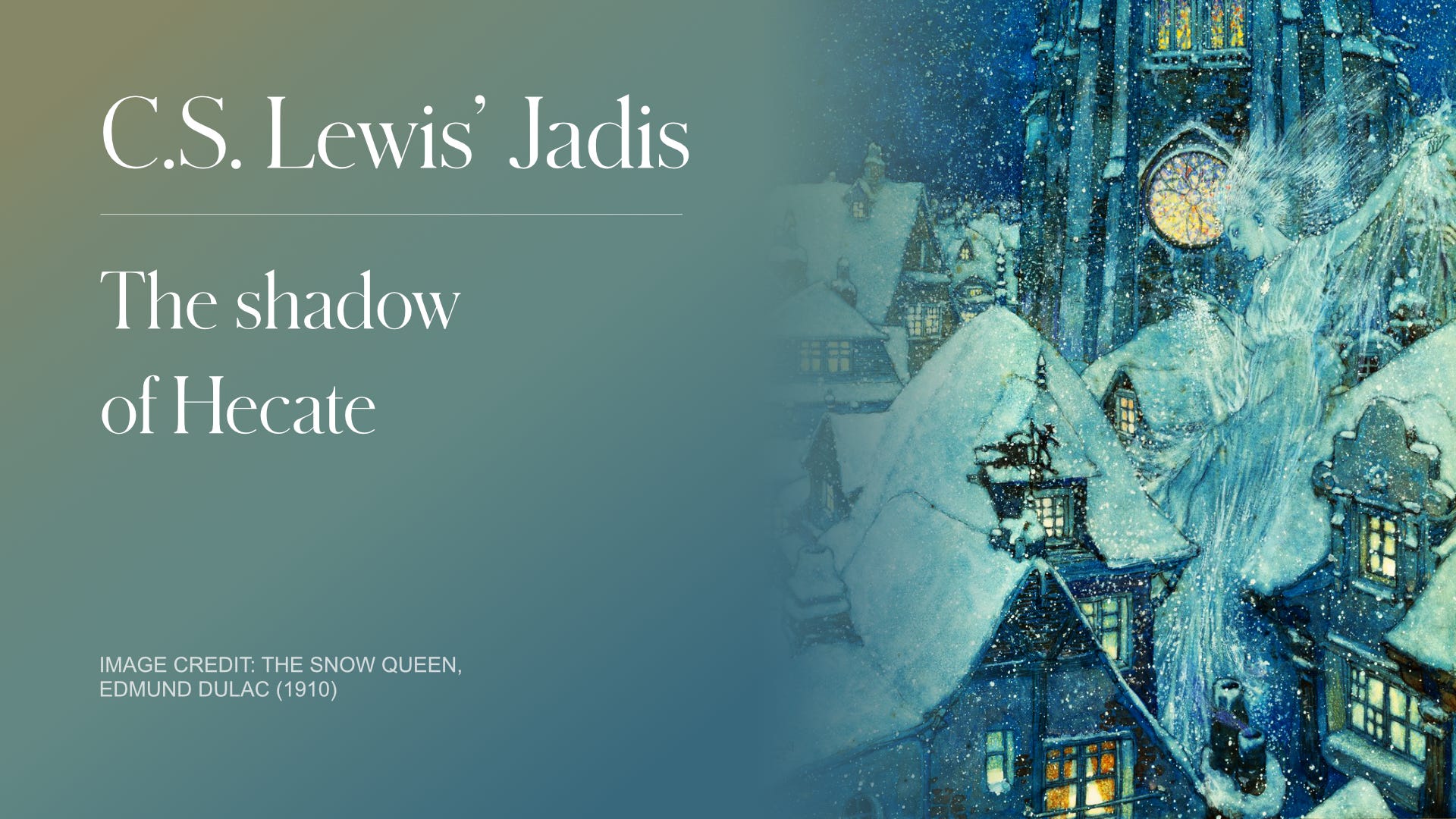
Jadis, or the White Witch, is the first major villain in C.S. Lewis’s The Lion the Witch and the Wardrobe. Towering over seven feet tall and glacially beautiful, she is a powerful sorceress under whose rule Narnia has been locked in a curse so complete it has become the only reality many living there can remember: “Always winter, never Christmas.”
Where Hecate stands at the crossroads and holds the light, Jadis essentially nullifies the threshold by holding it open indefinitely, freezing everything into a permanent stasis. In doing this, what she creates is what the anxious mind *thinks* it wants: the stability of an unchanging, and therefore predictable and certain, world.
But permanent winter is not safety. We know, intellectually, that we need both light and shade, happiness and grief, growth and failure, beginnings and endings, and we know that a whole world of nuance exists between such polarities, too. And yet there’s still a part of us that wants to resist the natural fluctuation of our inner worlds – our inner seasons – in an attempt to feel more assured.
Giving in to this resistance is a mistake because the strategies we use to resolve uncertainty are the very ones that create the anxiety we were trying to escape.
Intolerance of uncertainty
Intolerance of uncertainty has been identified across a number of studies as the engine of chronic worry, generalised anxiety and a whole bunch of other issues. When we haven’t developed the ability (because it is an ability) to withstand not knowing, ambiguity itself becomes a threat. Someone with a low tolerance of uncertainty may find a 5% chance of disaster far harder to sit with than the absolute certainty of moderate loss.
The true problem here is what we do to try and keep uncertainty at bay – we research the potentialities, check and double-check, rehearse, postpone, avoid. While in a time of uncertainty, none of these things will solve the problem. What’s worse is that they teach the mind that ambiguity genuinely is both powerful and dangerous, because look how much effort it took to try and neutralise, and it still hasn’t gone away. Worrying feels like preparation but functions as avoidance, and by busying ourselves trying to handle a threat that isn’t yet present, we never get to truly test ourselves and prove our fear wrong. Instead, we train ourselves to feel impotent – the world just gets colder and the snow deeper, until we can’t move for fear of stepping on a hidden trap.
In this mindset, we find ourselves kneeling at Jadis’s feet. Just stay in the frozen world, she says, handing us a piece of Turkish delight to keep us craving more of her false comfort; Stick with the devil you know over the horror of change and all of its unbearable maybes.
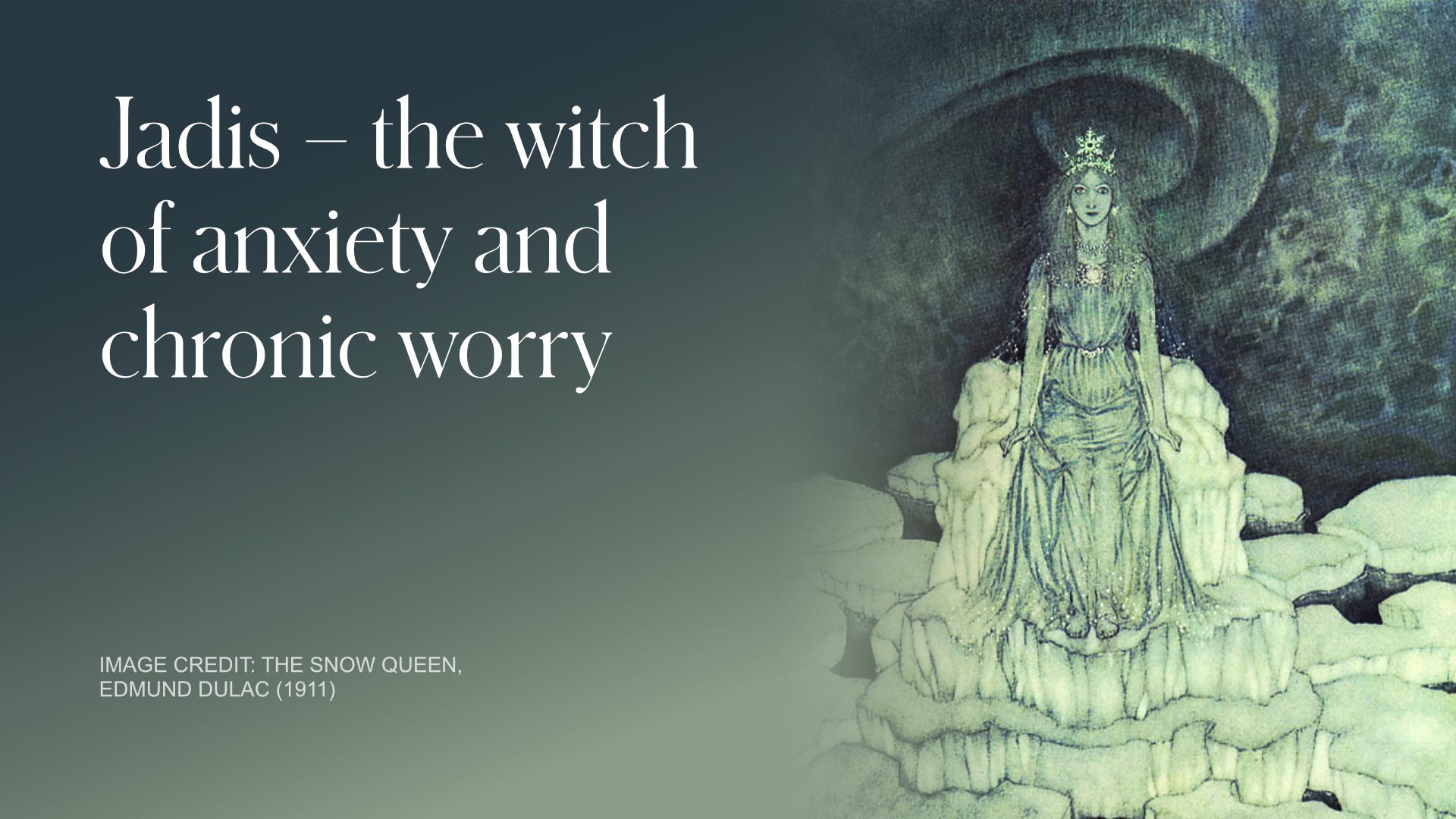
Jadis’s permanent winter holds the threshold open forever, which robs us of true liminality, because a stage can only be liminal when we are passing through it to something else. She denies us the magic of the in-between because unclassifiability is only power while we’re using it to become something. Held open indefinitely, the threshold sours: temporary freedom from the system that supports us becomes exile from every system.
“Always winter, never Christmas.”
But not all is lost.
The Return of Hecate
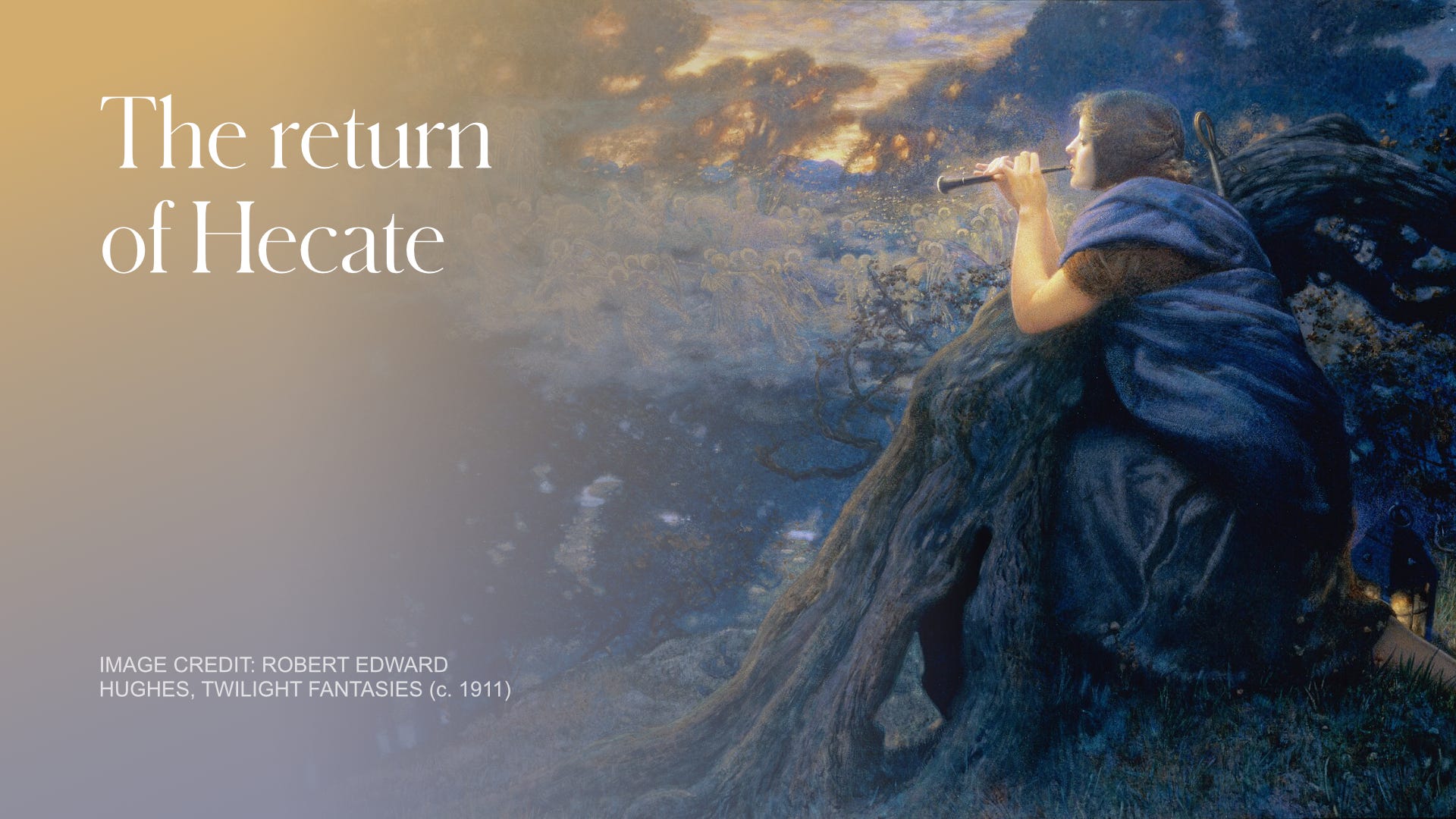
There’s more to Hecate’s story than the decline I described earlier. In the Chaldean Oracles, she returns transfigured – no longer a hedge-goddess of graveyards and black dogs, she was received by the Mystics as the World Soul herself: the animating boundary between the divine mind and the created world. And she has been reclaimed again in our own era: Wiccan and feminist witchcraft traditions from the mid-twentieth century onward have resurrected Hecate as a figure of women’s power and initiatory wisdom, particularly through her identification with the Crone.
Likewise, it is possible to reopen our minds to the power of liminality. And if we do, Hecate’s wisdom can counter the modern craving for quick fixes and linear paths that really only brings more anxiety and shame. The key to achieving this is to recreate, for ourselves, the framework that safely contains our in-between experiences.
Because even though the rituals may largely be lost, we still go through the very same process of transition when we age; when we end relationships or careers; when we get ill or struggle with our mental health; when we go through puberty or menopause; or simply when we up sticks and start a new life because the old one has started to feel a little too small for us.
What we lack, and that the initiates taking part in those ancient rites had, is an agreed container for the experience. The ancient rites involved a known ceremony, sometimes with a set duration; elders guiding the process; and a community that understood what they were going through and was ready to welcome them back at the end.
It’s the third stage of the passage – the one that the Jadis-like modern world has tried to take away – that we need to create for ourselves in order to have a container that actually contains.
We can create the space for passage by allowing ourselves a certain amount of time to be nowhere and nothing in particular: a temporal container. I don’t mean we have to a set date by which we must have completed our transition, but if we choose a time at which we’ll simply review our progress, we can allow ourselves to relax a little into the liminal stage beforehand – granting ourselves permission to not even wonder how we’re getting on in the meantime. Permission to truly be in-between.
In lieu of tribal elders, we can look to people from all over the world who have been through similar experiences. A trans child growing up in a conservative family, for example, is unlikely to have the support they need from their actual elders – and even less likely to have access to mentors with lived experience of changes like the ones they’re going through. But that doesn’t mean they can’t reach out to others who have been through the same transition, or just follow their stories online. In doing so, the nebulous third stage of the process can start to take shape and seem real.
Even when we feel truly at sea, with no idea at all what the third stage might be or who could model it, we can usually describe both what we’re moving away from and what quality of experience we’re hopefully moving towards. We need only give the third stage the vaguest of shapes to know it’s there – a feeling, a value, a single capability. We can wonder what will be finally true when we have arrived, such as being able to talk about someone we’ve lost without crying every time, or waking up in the morning and looking forward to at least one thing we have planned for the day.
To welcome the third stage into our awareness is not about knowing what it will eventually be – in fact, it mustn’t be about that kind of knowing because that would only be another way of choosing Jadis’s certainty over Hecate’s liminality. All that we need is to know that there is a transitioned state waiting after the uncertainty of the transition itself… And that, until we have reached that third state, we have all the power in the world. Because we are free to be whoever and whatever we want to be. Because we are beyond classification and therefore the judgements that belong to any specific class. Because we are outside the usual, recognised order of things, and can see the world with a clarity that isn’t available to those established others who seem like they’ve got it made.
Because when we aren’t there yet, we are in possession of magic. To be in-between is to be the Witch.
Hecate’s gift at the crossroads is the torch, not the path ahead, and winter is survivable when you know that seasons turn.
With that said, I think it’s time to meet the ancient goddess.
Meeting Hecate
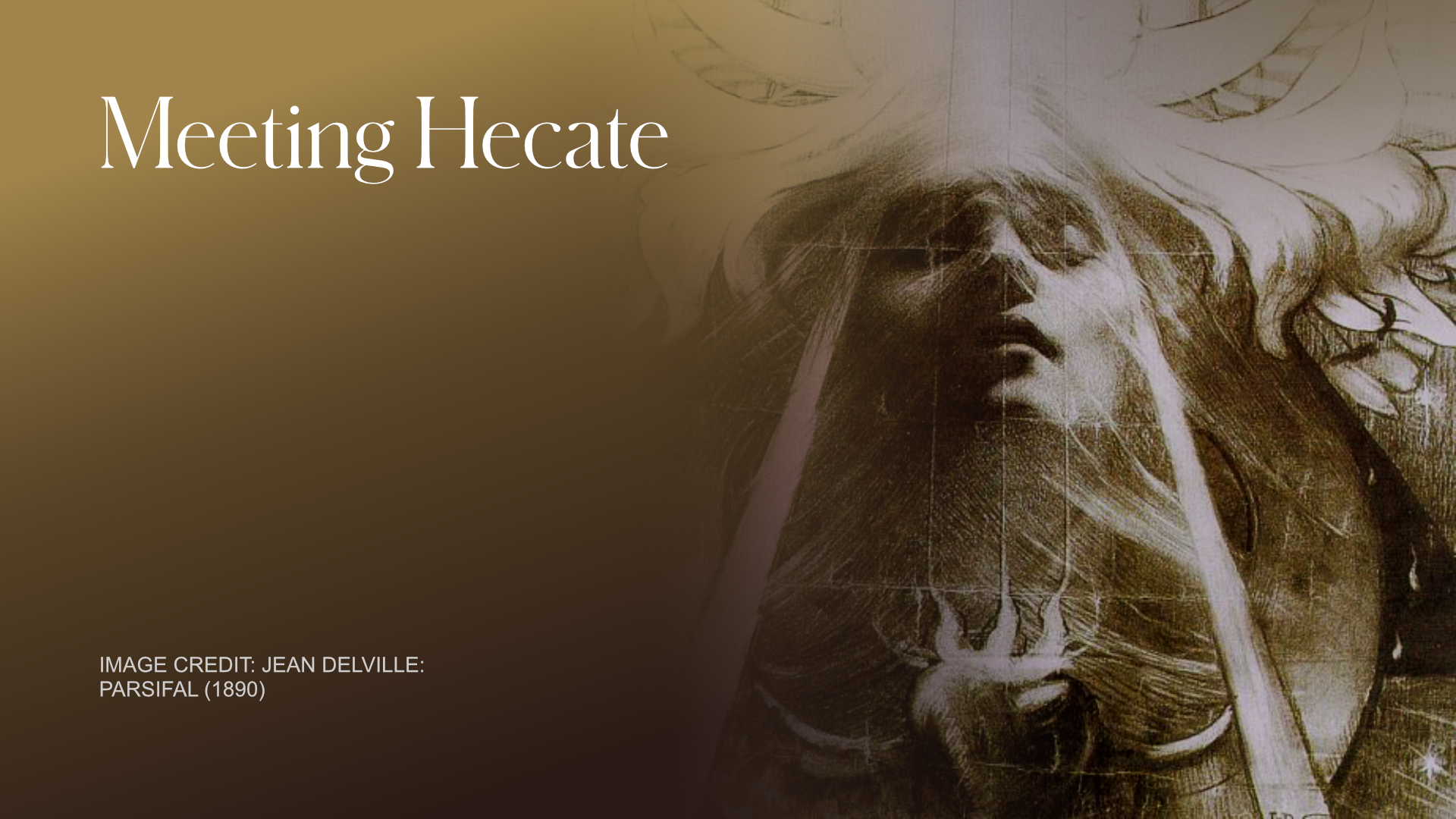
You are standing outside. It is cold, and has been for some time. Beneath your feet, the ground is icy and uneven. The air has that sharp, still quality of a winter’s morning. Trees stand naked, stripped of their leaves and the grass is paralysed by frost. It’s beautiful in its own way – a world held in glittering suspension.
You’ve been walking a certain road for some time, but now two, maybe three, paths stretch ahead of you, each one disappearing quickly into the frozen distance. You might know what these paths represent for you today – certain choices, certain options, different things you could say or do – or they may be a mystery. In either case, right now, your only job is to allow yourself to have no idea which one you’ll eventually choose.
At some stage, you notice a subtle feeling of warmth against your skin and turn to find a figure standing by your side. She’s been there the whole time, you realise; older than the ice and the silence; far older than the paths ahead. Hecate’s torch burns steadily, flame flickering but never threatening to go out.
The witch goddess doesn’t speak, but you feel her companionship regardless – a connected, grounding feeling that tells you you’re not alone in this decision, and that you’re exactly where you need to be. But equally that this choice is yours to make in whatever time it takes.
Hecate lifts her torch and a thousand tiny beams of silver light spill out across the snow to form a series of shimmering visions. First, you see the person you once were; perhaps the person you were yesterday or a version from some time further in the past. The goddess waits patiently as you observe the shape you once took – the you that you no longer are.
And you might notice certain things about that person as you watch: the ways in which you used to hold yourself; the things you used to say, do, think, want, believe.
After a time, the goddess lifts her torch a little higher still, and you find yourself looking at the people, places and systems at play in your life. These visions stream steadily by as if on a carousel, and you realise that here, at this crossroads, under the light of Hecate’s torch, the world from which you come looks different. Things that once held power over you appear less solid: certain rules become mere suggestions; fears that once overwhelmed you shrink a little; the system itself seems more fragile, arbitrary.
You might find that people you once idolised or envied seem different in this light, too: just people; not gods, not problems. It could be that the things your past self used to yearn for but could never have seem smaller, somehow. Less significant. And that’s because right now, the world of possibilities available to you is vast – so, so much bigger, more nuanced, more bright and colourful than you could ever have known before. It’s endless, you realise. The possibilities are endless.
Hecate smiles a little as she, too, looks out over the shimmering ocean of potential. And then she nods, as if to say, “Why would you want to rush through this anyway? Why would you want to close it down too soon?”
So you wait. The sun sets and rises, sets and rises again, and as the minutes, hours, days tick by, the calm stillness of the goddess beside you lulls you into a relaxed acceptance of the passage of things. “Time is all it ever needs,” she seems to say. “Time is magic.”
So you breathe, in and slowly out, as you stand in silence, just noticing the space without and within. Until, at some stage, something begins to shift: a gentle breeze, a little warmer than expected; a sound coming from somewhere far away, like water moving beneath the ice. The world, you know now, is very gently beginning to thaw.
Spring flowers come into bloom at your feet – violet crocuses peek from the melting snow, then daffodils and tulips. Life returns to the trees eventually, too: bright young green leaves, pale pink blossom. But the ice hasn’t gone completely; the world is still predominantly white. And as the paradoxical landscape settles into itself, Hecate turns your way, brows lifted in question.
Who are you when anything is possible?
What has this waiting shown you to be true?
And if there were just one thread – one single luminous thread – that could connect your liminal self to the future you can’t yet see, what would that be?
Hecate doesn’t need your answers, of course; she just needs to know that you’re wondering rather than shrinking.
This goddess – with power over the land, sea and stars – will wait until you feel ready to begin walking again. She’ll wait for you at all other crossroads you meet in life, too. She’ll wait so you feel allowed to do the same, because possibility, her gentle light and the ever-moving passage of time are all you truly need.
References
Hesiod, Theogony (c. 700 BCE), trans. Evelyn-White
Homeric Hymn to Demeter
Ovid, Metamorphoses
Majercik, R. (1989), The Chaldean Oracles: Text, Translation, and Commentary
van Gennep, A. (1909), Les Rites de Passage
Turner, V. (1964), The Forest of Symbols; (1967) Betwixt and Between; (1969) The Ritual Process: Structure and Anti-Structure
Bridges, W. (1980), Transitions
Dugas, Gagnon, Ladouceur & Freeston (1998), “Generalized anxiety disorder: A preliminary test of a conceptual model,” Behaviour Research and Therapy 36(2)
Ladouceur, Gosselin & Dugas (2000), “Experimental manipulation of intolerance of uncertainty,” Behaviour Research and Therapy 38(9)
Stenner, P. (2025), “Crisis and Sensemaking: The Relevance of Liminal Experience and Metastability for a Sociocultural Psychology of Crisis,” Integrative Psychological and Behavioral Science 59(4)
Wels, Waal, Spiegel & Kamsteeg (2011), “Victor Turner and liminality: An introduction,” Anthropology Southern Africa 34
This is exactly what I needed to read. Thank you for posting. I feel validated in some quiet musings I've been having. I feel there's been a push and pull in me to quickly define a role, a task, a some great next career step...and a small voice I've been successfully drowning out. I've also been thinking about Jadis and Hecate(rise AND fall) lately. I wouldn't have thought to compare and contrast the two. I see now that the small voice is trying its best to tell me I'm right where I need to be and to avoid becoming Jadis on accident! There's power in just being at the crossroads and hearkening.
I love this Hazel. We have a lot of liminality going on in our family right now. I really appreciate this reminder not to resist it. Your writing allows people to be kinder to themselves.