


You can watch this on YouTube or read it below.
***
Everyone has an idea of what their ideal self looks like. We may not have sat down and mood-boarded it, but we have a sense of it: a slightly more capable version of who we are; someone who’s just a bit more disciplined or virtuous or successful.
We build this image based on information from several sources, including the culture we consume, the people we love or admire, the qualities we fear we lack. And the received wisdom is that if we just want it badly enough, strive hard enough, or visualise clearly enough, we’ll get there.
But what if the very act of chasing this ideal self could be moving us in the opposite direction?
This article explores a better route to fulfilment and self-acceptance courtesy of the spectacular animated film, Spirited Away.
Quick note: there are spoilers ahead. If you haven’t seen Spirited Away and want to go in clean, then bookmark this video and come back later.
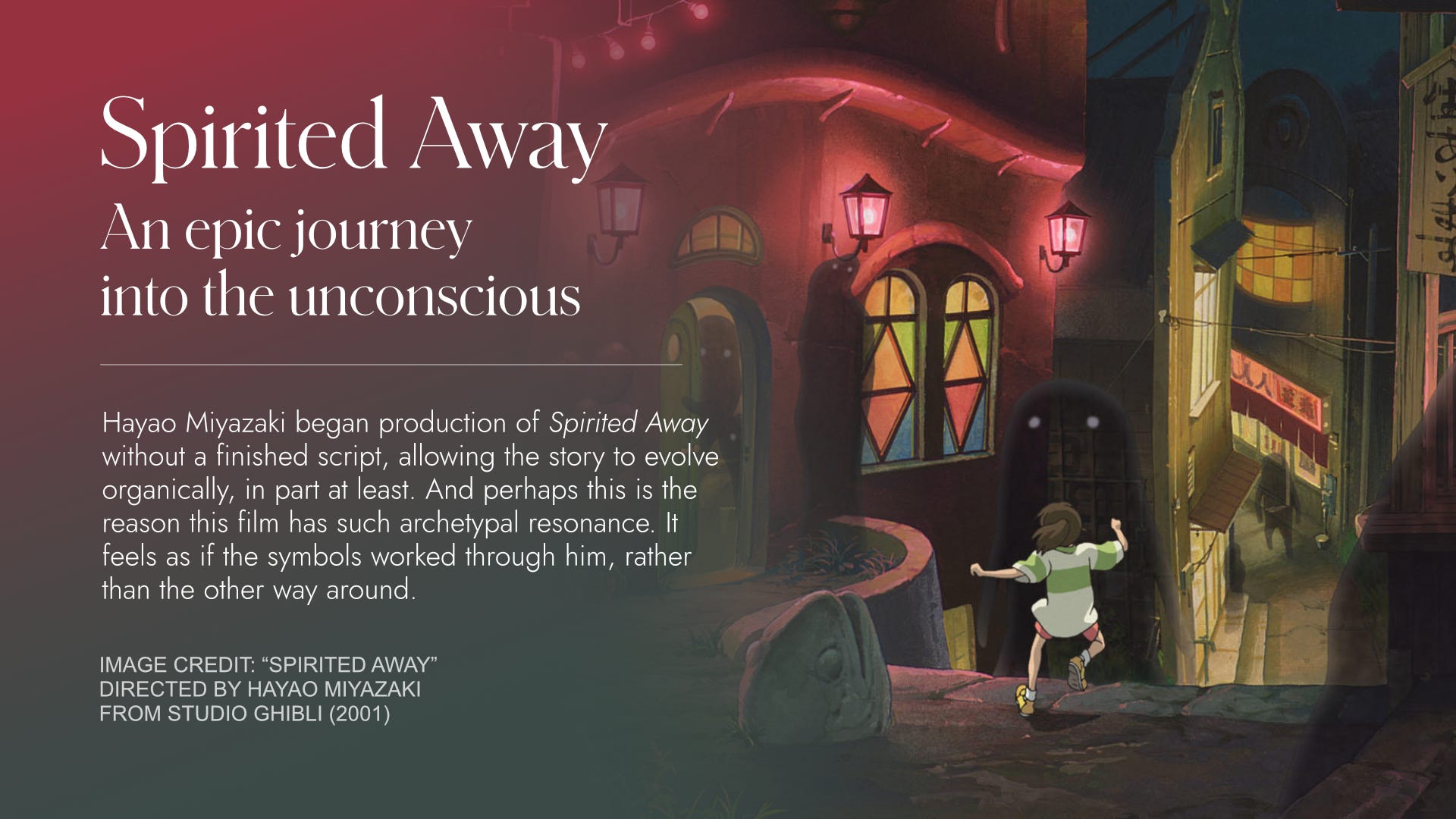
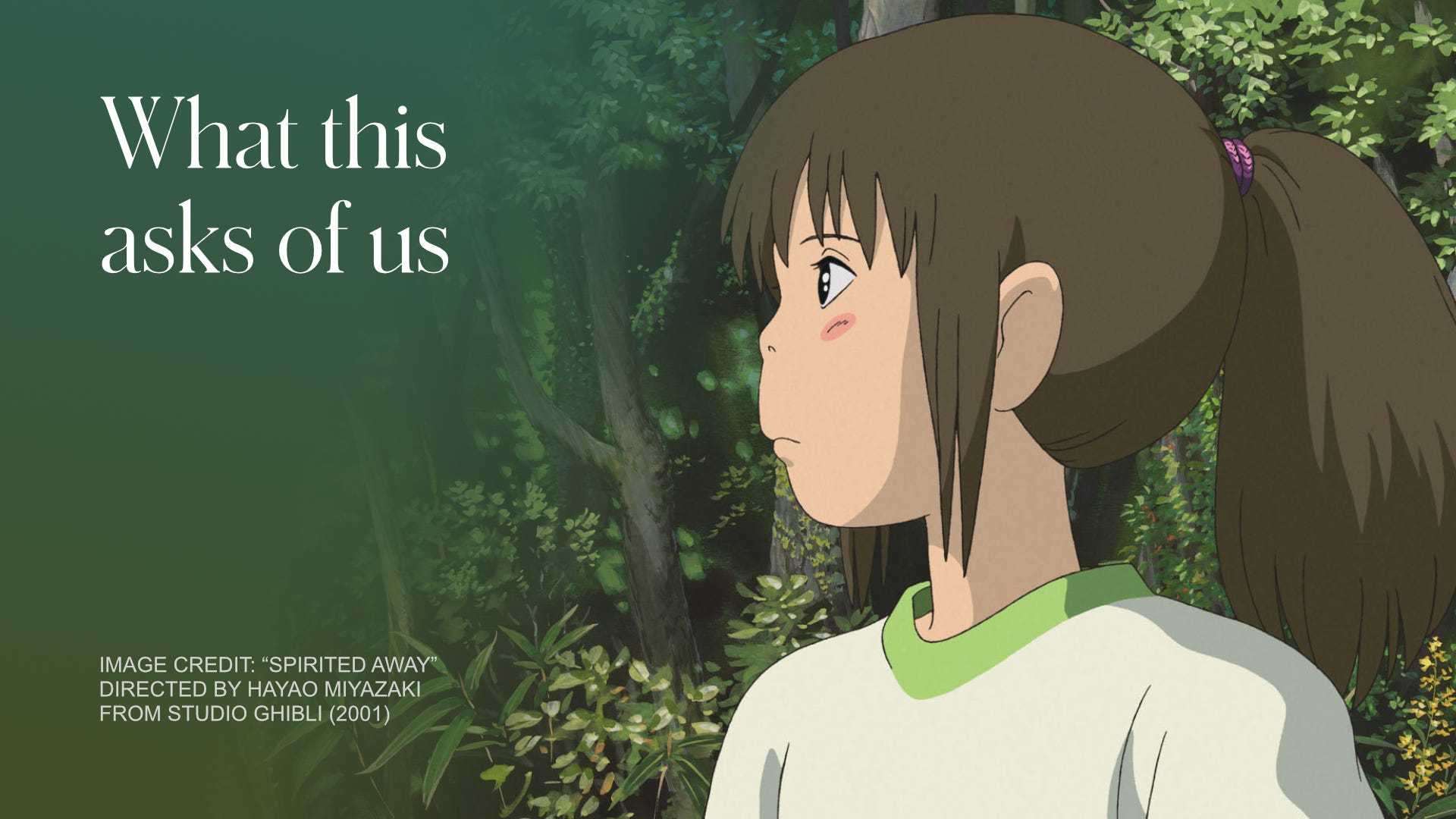
Hayao Miyazaki’s Spirited Away follows Chihiro, a ten-year-old girl who is, at the start, not especially easy to like. She’s sulky, clingy and resistant to the move her family is making to a new city. Along the way, her parents take a detour through what turns out to be an abandoned amusement park where Chihiro senses that something is wrong, and when her parents ignore her doubts, they pay the price: gorging on food that isn’t meant for them, they’re transformed into pigs.
What follows is Chihiro’s attempt to survive the spirit world – an eerie and intimidating realm governed by a powerful witch called Yubaba, whom Miyazaki based on the great Baba Yaga of Slavic folklore. Chihiro needs to find work in Yubaba’s bathhouse in order to free her parents from their curse and find her way home.
Spirited Away as a map to integration
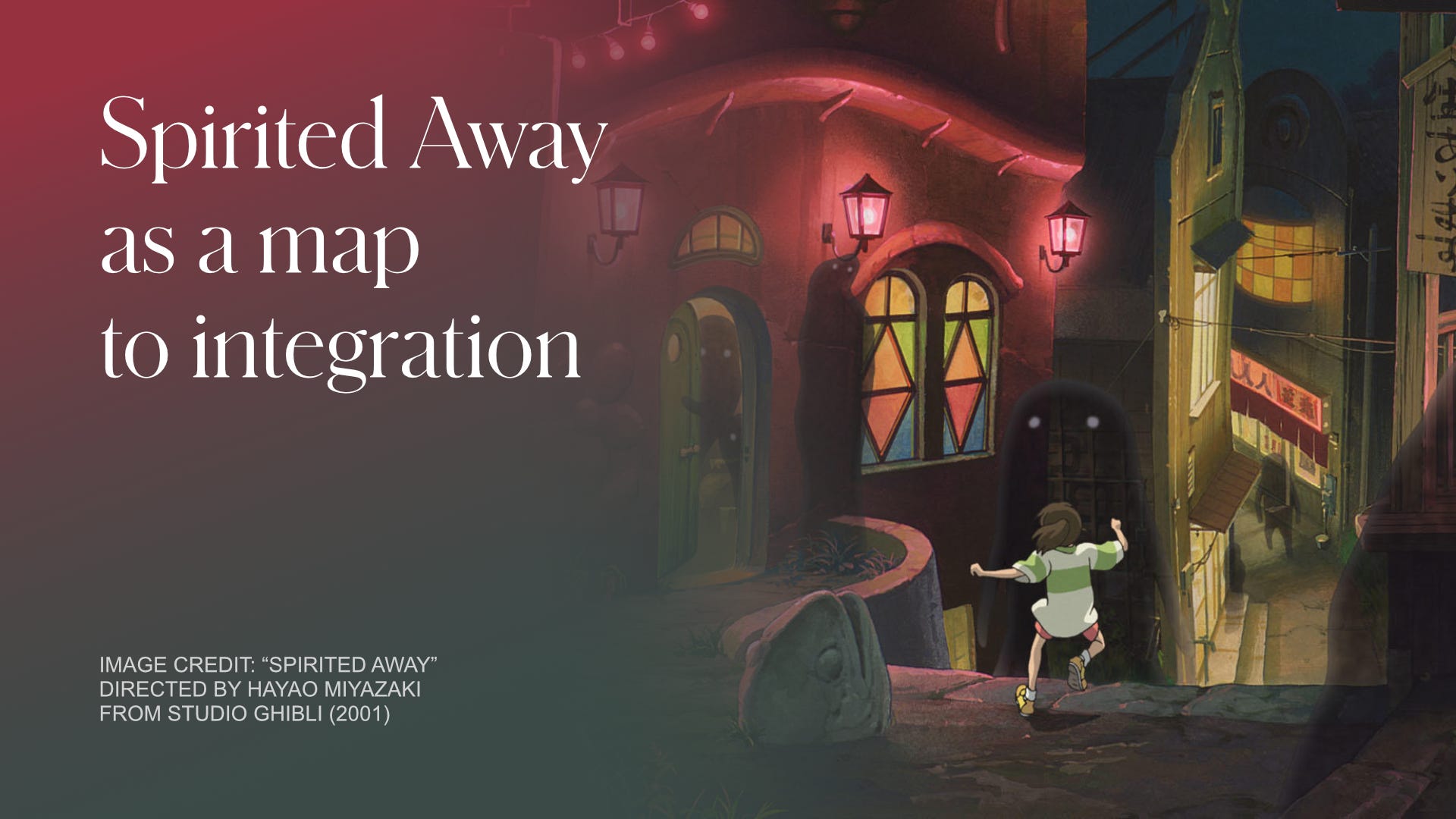
From a Jungian perspective, Spirited Away is a story of individuation and what it takes to shed our inherited familial skin and embody our more authentic selves. As such, the many symbols we find in the film can be read as musings on one simple (though not easy) question:
What actually is the authentic self, and what do we need to protect ourselves from in order to claim it?
For this video, we’re going to focus on three key characters to begin answering this question: Chihiro, as the ego; Yubaba, as the governing force of the frightening unconscious world; and Haku as the ego’s guide to the unconscious, and its most important warning.
Chihiro at the start: the unformed ego
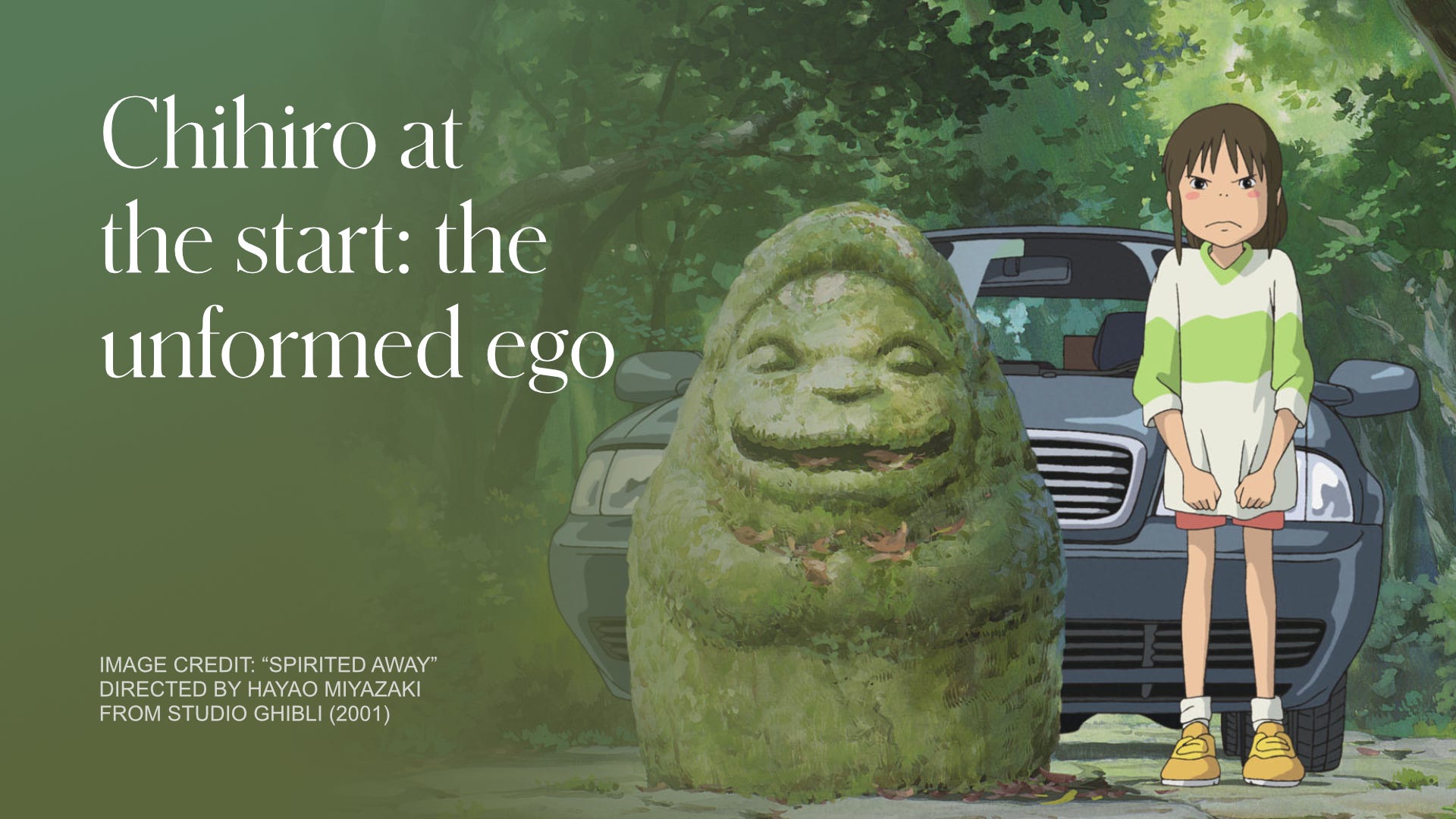
So, let’s start with Chihiro as ego. Jung used the word ego to describe our ordinary conscious sense of who we are.
At the start of the film, Chihiro’s ego is barely formed. She’s defined almost entirely by what she’s attached to and what she fears losing – she has no real sense of herself independent of her family, and the collection of rules, values and dependencies she has inherited from them. Of course, this is what we’ll see change over the course of the anime.
Yubaba as the Devouring Mother, an identity-eating system
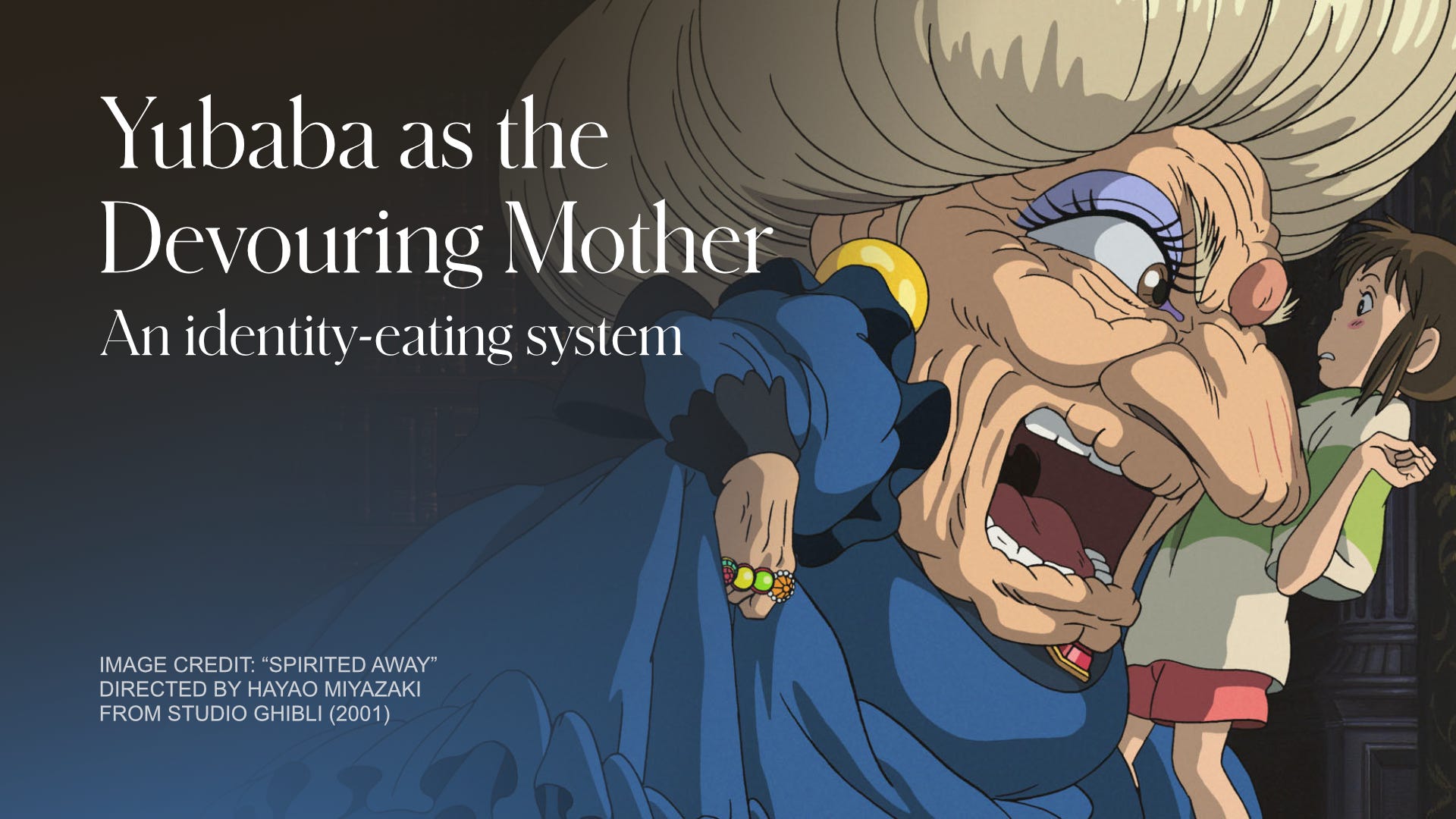
Yubaba is, archetypally, the Devouring Mother – a force that consumes and binds rather than empowers or frees. Just like Baba Yaga, she doesn’t care about those who work for her; she’s only interested in what they can do, and whether they have earned their place.
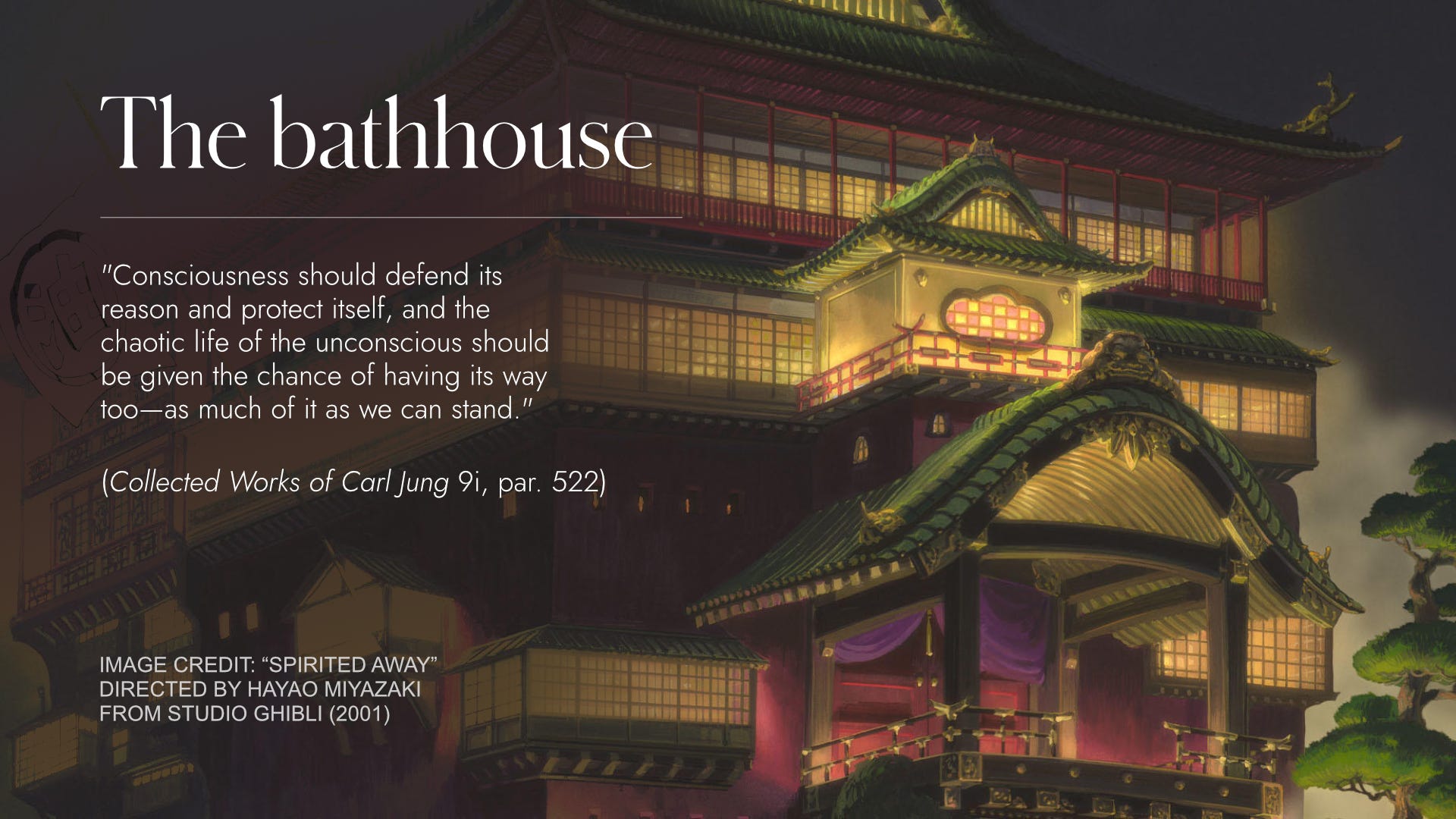
Yubaba’s bathhouse represents the collective unconscious as it appears to the undeveloped ego (because that’s where our protagonist Chihiro is currently at). As such, it is overwhelming, hierarchical, transactional, and governed by rules that are yet to be understood. To Chihiro, the bathhouse is frightening because she doesn’t yet have the resources to read it any other way. All she can do is comply and survive.
Name theft
When Chihiro meets Yubaba and begs for a job, she’s handed a contract, on which she signs her full name, “Ogino Chihiro”. Yubaba then steals three of the four Japanese characters that comprise this name. She takes the first two, which represent Chihiro’s family name, and then the very last. The one remaining character becomes Chihiro’s new name: Sen.
Like the bathhouse, many systems in the real world sustain themselves by consuming their members’ identities: families, institutions, workplaces, relationships, ideologies, etc. To fit into these systems and play by their rules, we’re often forced to trade in a little of our authenticity or individuality by wearing a uniform, for example, or operating within certain codes of conduct, and so on. Yubaba personifies this threat. Forget who you are, she says, and you can belong here. Yubaba severs her employees from the language of selfhood, cutting the thread between who they are and the web of memory, history, and relationships that made them that way.
Thus, by signing the contract, Chihiro is stripped of her identity and reduced to a mere cog in the machine. This sounds frightfully mean, and it is indeed dangerous, but it’s also exactly what Chihiro needs at this stage. She is there to discover her true self, which means the old one needs to dissolve.
Haku as guide (and warning)
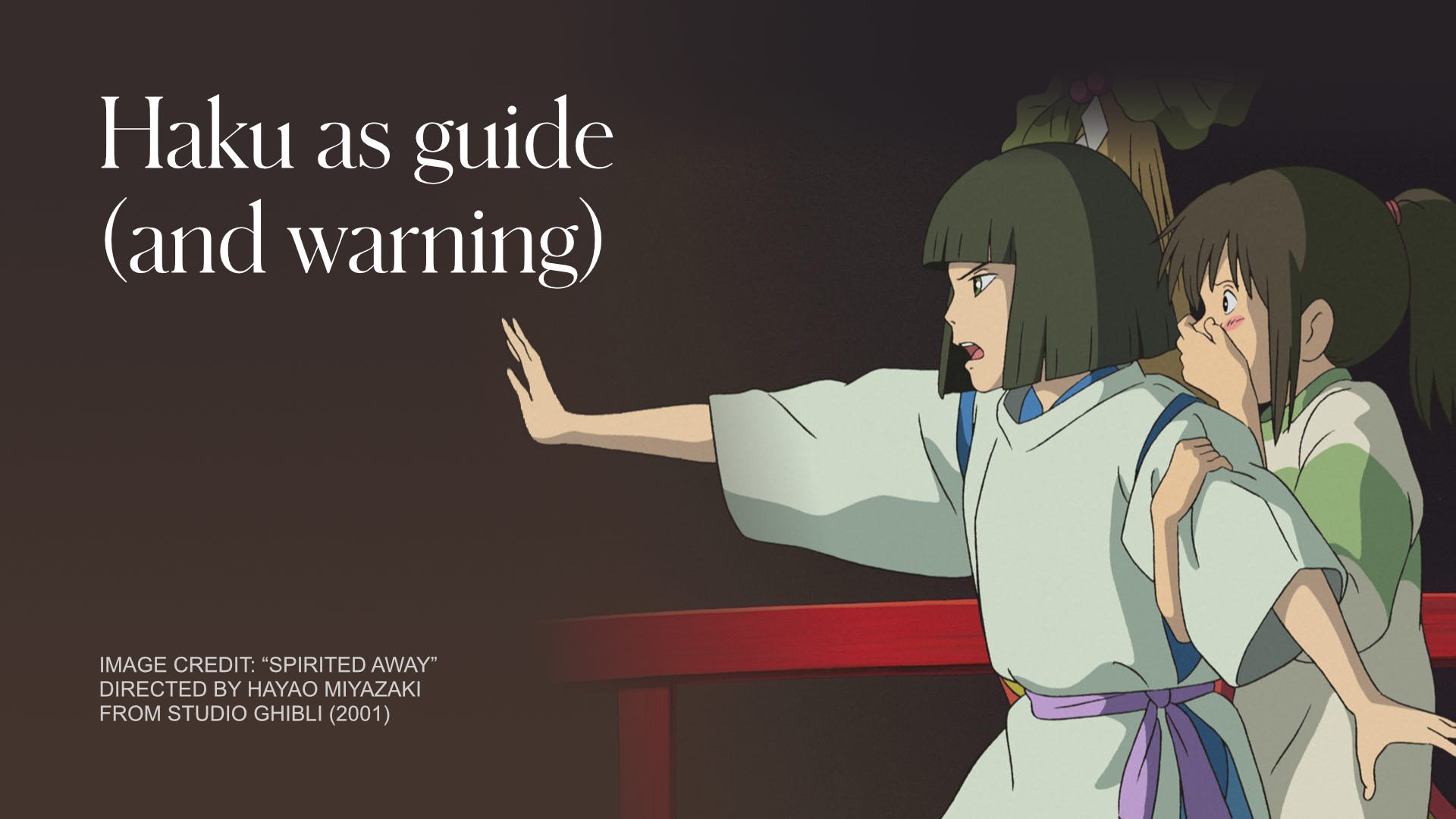
But then again, not entirely, as we can see when we meet the film’s third central figure, Haku.
Haku is Yubaba’s right-hand man. He is impressive, beautiful, capable, controlled, and seems as if he has a place in the spirit world.
When Yubaba steals Chihiro’s name, Haku warns her that she mustn’t let it slip away or she’ll never find her way home: Whatever you do, he tells her, don’t forget your real name. Haku returns the clothes Chihiro removed to don Yubaba’s uniform, and in one of the pockets, she finds a farewell card with her name written inside. A lifeline. Haku tells her to keep the card hidden so Yubaba can’t destroy it.
And Haku, we learn, understands the true threat of forgetting because he himself forgot his own name long, long ago. Now, he’s trapped in the bathhouse and tied to Yubaba with no thread to follow back to where he came from or who he truly is.
“You can’t remember your name?” Chihiro asks. “No,” he replies. “But for some reason I remember yours.”
This is a pivotal moment in the story, because it’s when we realise that while Haku may well be instrumental in Chihiro’s liberation, he’s also possibly the one who most needs saving.
Lacan’s three registers
To understand this interesting tension between Haku and Chihiro, and what it can mean for our own experiences of self, we can look to the French psychoanalyst Jacques Lacan.
Lacan described three “registers” of human experience that, together, structure the entirety of how we relate to ourselves and the world around us. These are the Imaginary, the Symbolic and the Real.
The Real – the unknowable void
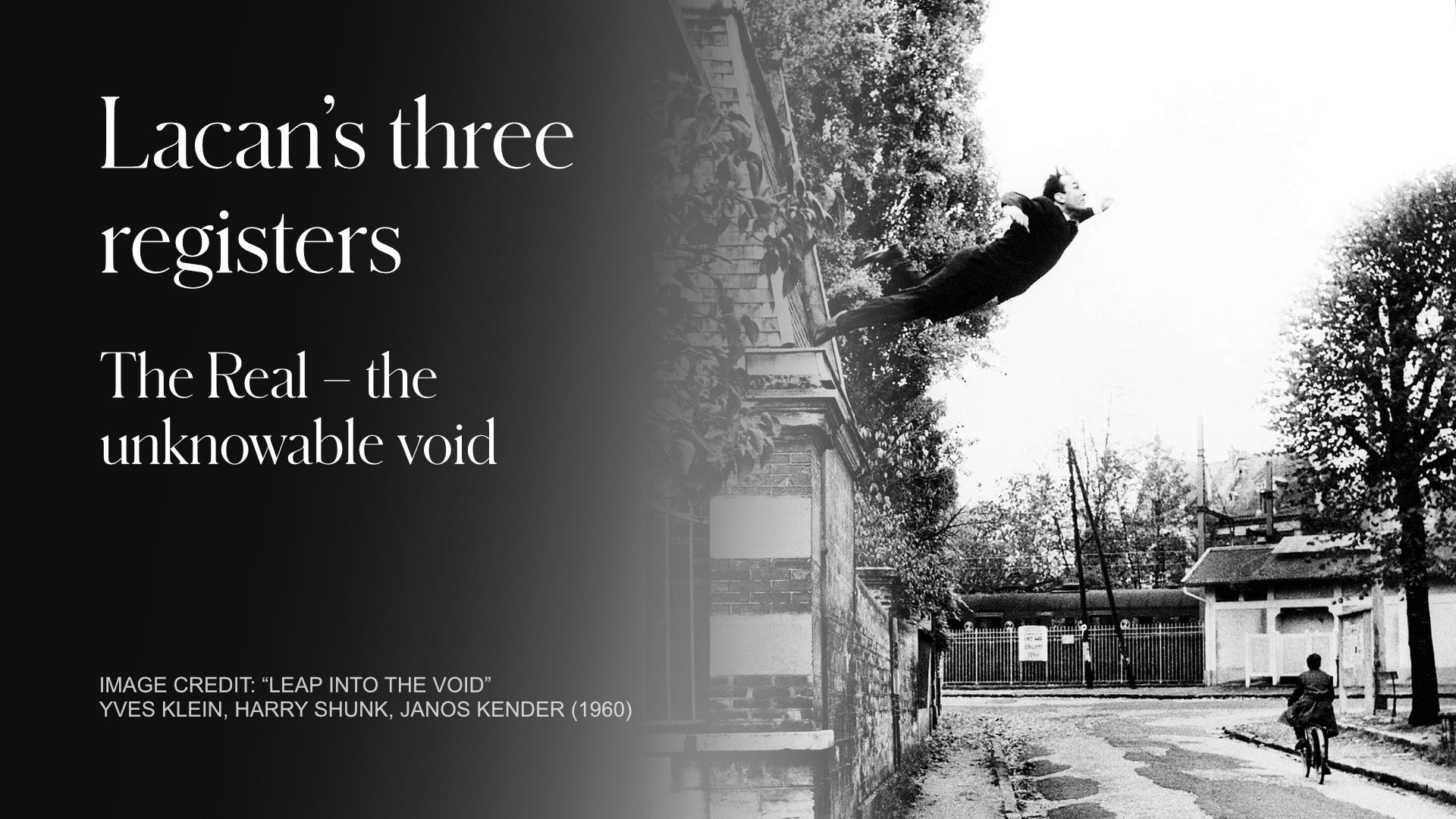
The Real is the hardest of these to talk about because, as we’ll see, it exists beyond – or perhaps beneath – language and image, and therefore resists definition. The Real is the realm of experiences that are confronting and impossible to rationalise. It’s met only through disruptive events like trauma, panic, pure drive or profound awe. We’re not focusing on the Real here, thank goodness, so you don’t need to worry too much about its slippery definition.
The Imaginary – ego, ideal self, the illusion of wholeness
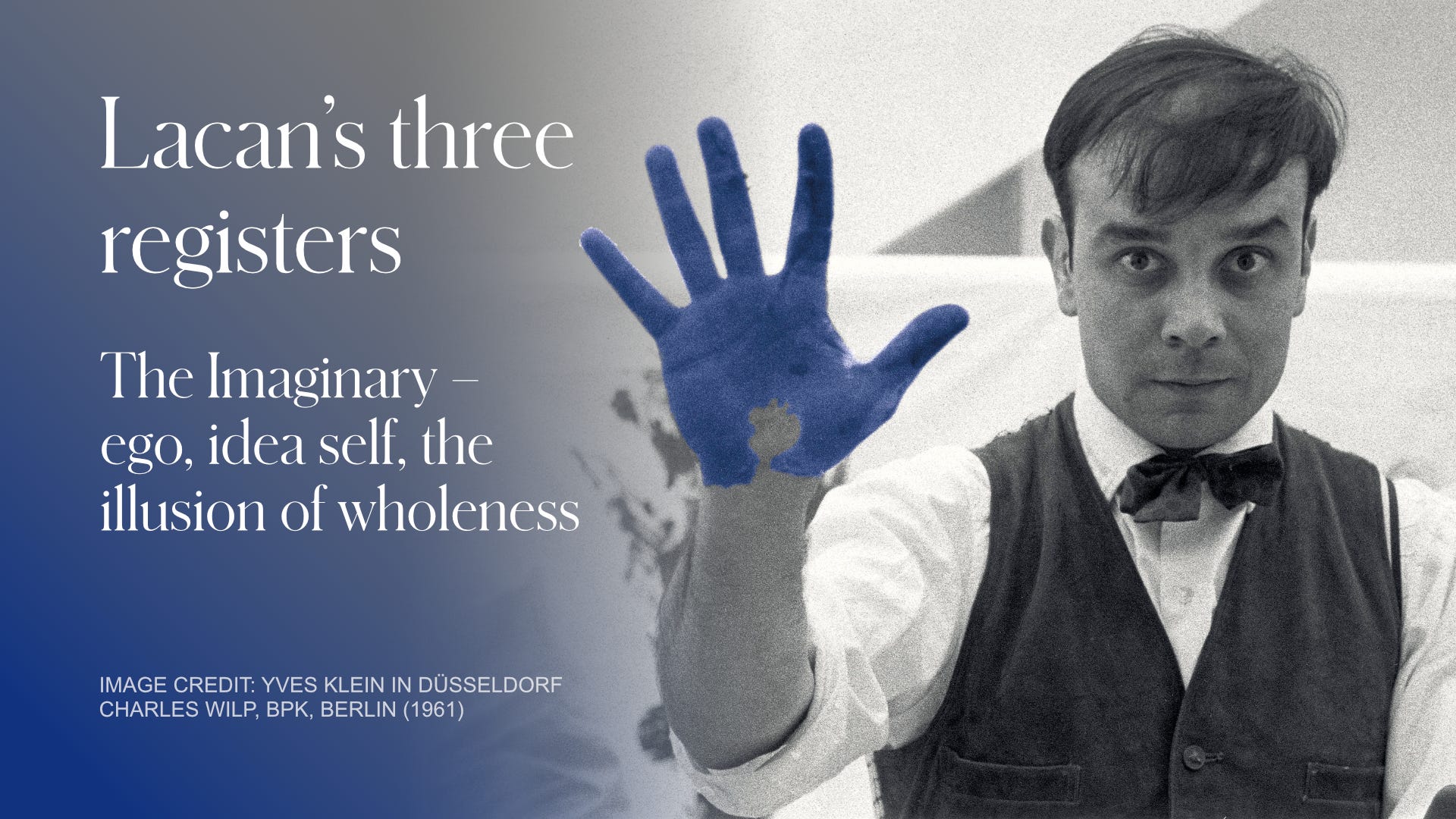
The Imaginary, conversely, is probably the easiest to understand. This is the realm of images, perception and the ego. It begins during what Lacan called the Mirror Stage of childhood development, when an infant first recognises their own reflection in the mirror. The baby sees a unified, organised and whole-seeming self, which contrasts with their somewhat clumsy physical experience of self. What emerges from this, according to Lacan’s framework, is the ego – an impressive but ultimately unrealistic self-image.
The Imaginary, then, is where our ideal selves reside, and it’s also the home of uncomfortable things like comparison, rivalry, and the nagging sense that who we truly are doesn’t quite match the version of self we aspire to or try to present to the world. This is, in other words, the social media profile problem – the gap between our carefully curated public persona and the reality of our lives is troublesome. We can feel like we don’t live up to our hype, and even as if we need to compete with our primped and edited selves.
The Symbolic – language, history, memory, rules and relationship
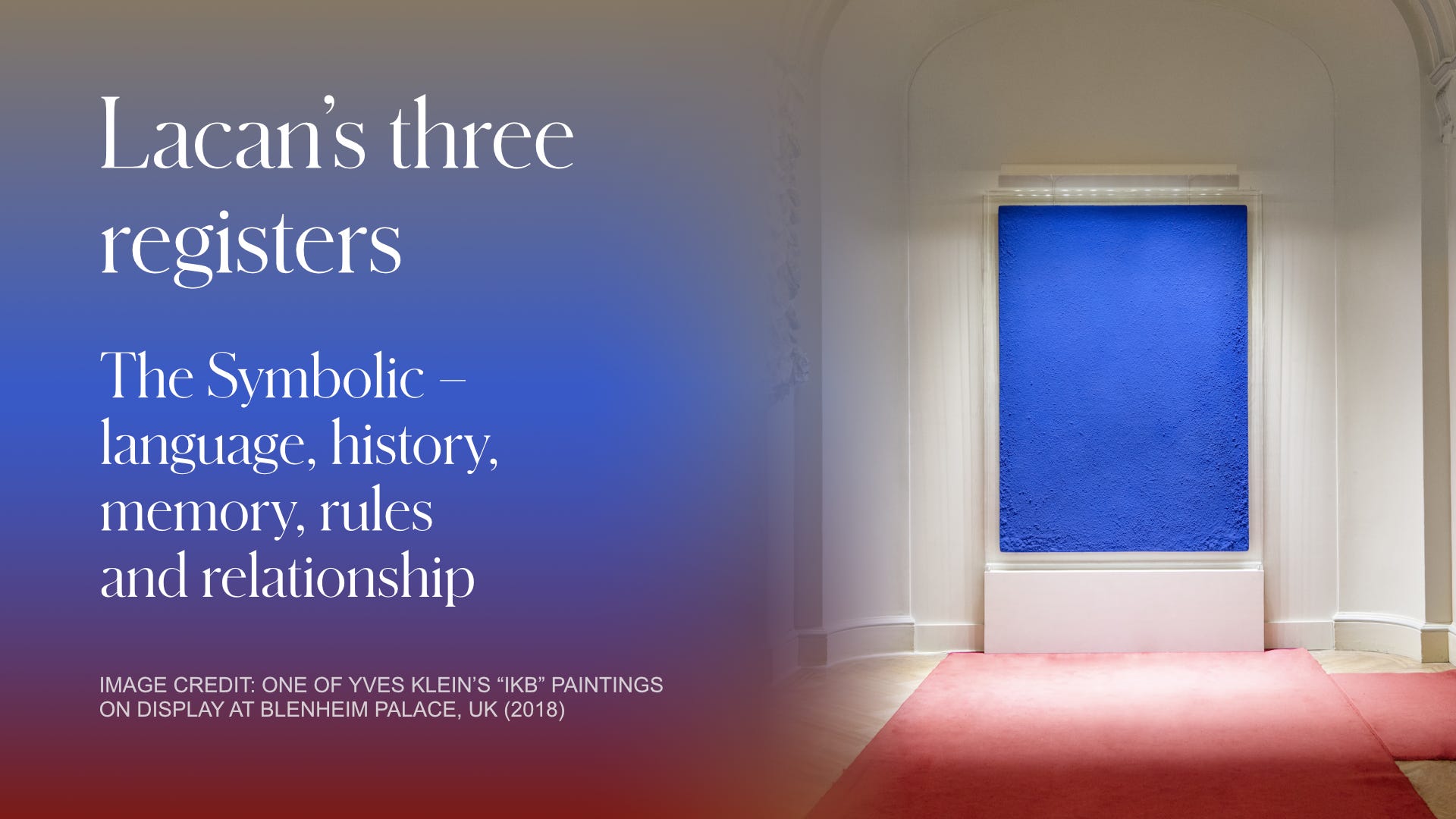
Finally, the Symbolic is the realm of language, culture, and social structures – it’s the vast web of signifiers (or units of meaning) that we inherit from those around us, and we need it in order to function in the social world. This register begins when a child learns to speak and is henceforth compelled to accept a shared set of rules, which Lacan called the “Law of the Father”.
In Lacanian theory, the Symbolic forms the foundation of human relationships. It dictates that all interactions are mediated through language, cultural rules, societal laws and social norms. Rather than connecting directly with another person, says Lacan, we relate to them through the filter of these shared patterns.
Additionally, the Symbolic is where meaning is made and attributed, and it’s how we make sense of ourselves. But it is, of course, flawed. No signifier – no word, no name – can ever fully capture the thing it points to. In language, we are incomplete beings represented by words that fall short of the felt truth. As a result, the Symbolic register brings with it an inherent and persistent sense of lack that we may find ourselves trying to overcome by reaching for the promise of wholeness offered by the register of the Imaginary.
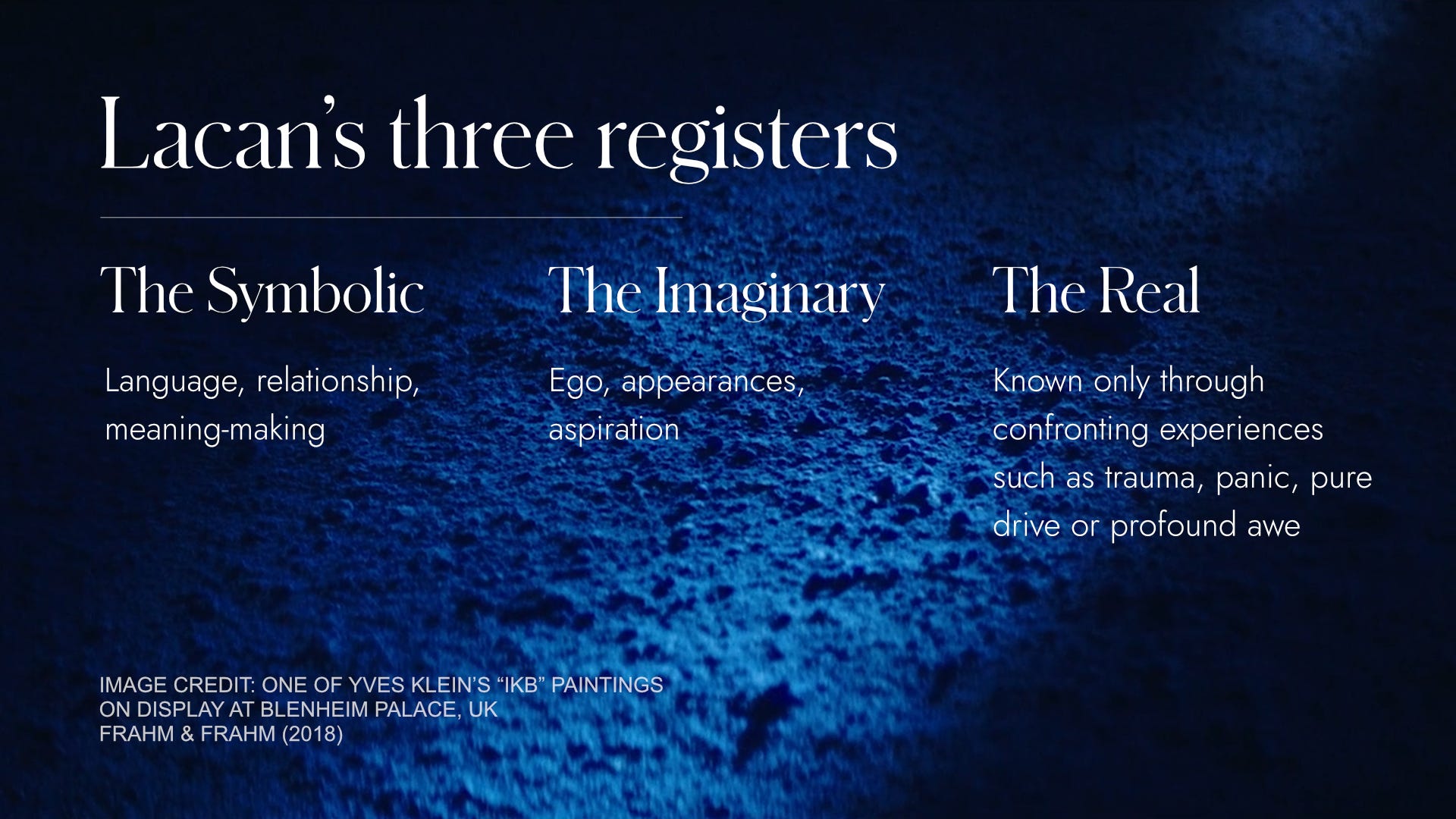
So, in short, the Symbolic is the realm of language, relationship and meaning-making; the Imaginary is the realm of the ego, appearances and aspiration; and the Real is essentially everything else. For Lacan, none of these registers is either superior or inferior. Rather, they are three unavoidable and entirely interdependent ways of experiencing the world and the self. As always, balance is the true goal.
The problem with achieving balance, though, is that the ego will always prefer the Imaginary, meaning that we’re at risk of loading that register with more weight and validity than the others. The image of ourselves as unified, powerful, and coherent is of course seductive, but the more completely we identify with that image, the more we lose our footing in the Symbolic, which means we’re at risk of the whole thing breaking apart. Like Haku, we risk getting lost in the Imaginary because, by fearfully holding onto our ideal selves, we forget how to make sense of who we actually are. We forget our names.
Haku and the Imaginary: the danger of the ideal image
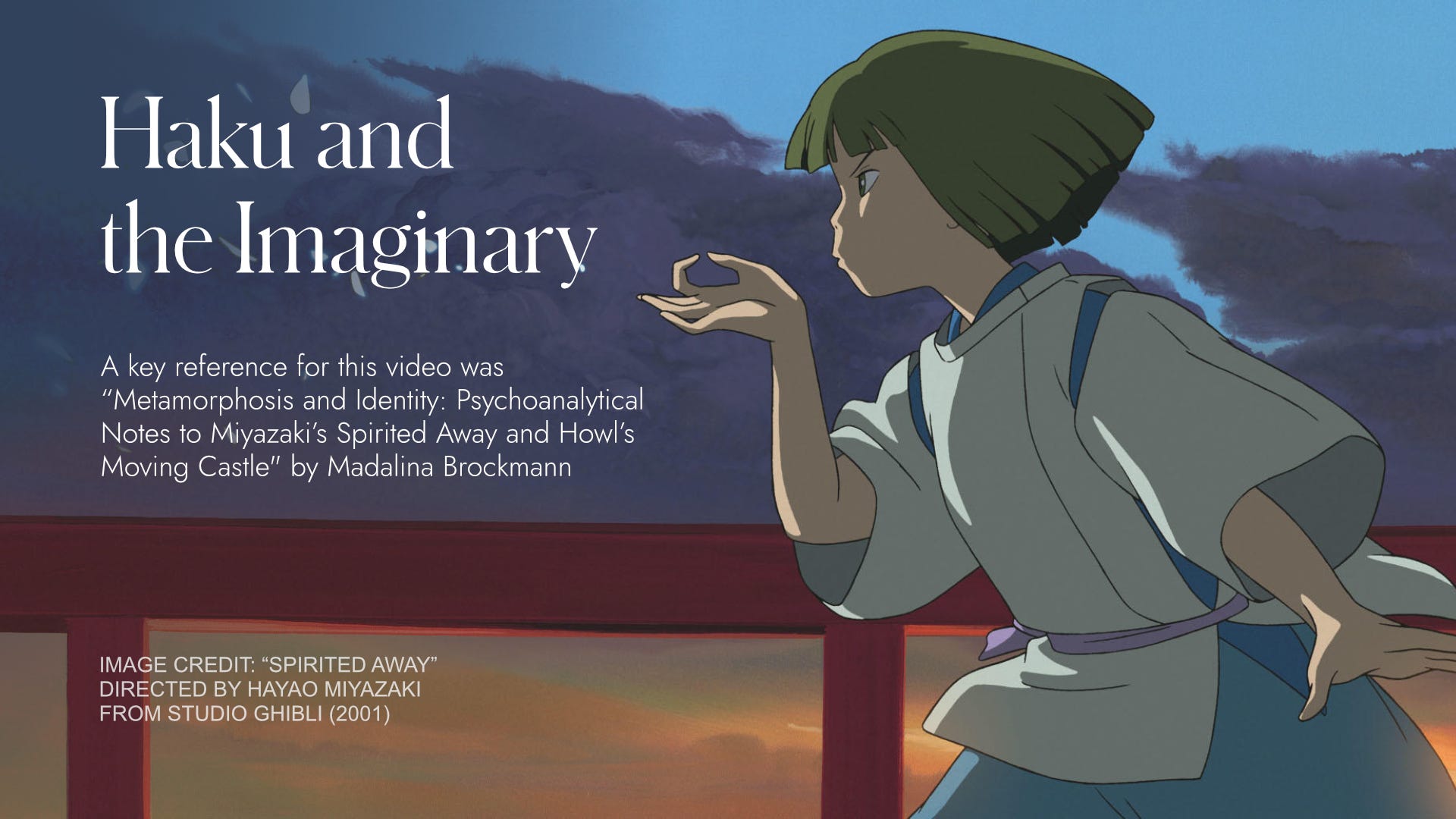
Over the course of the film, Haku shapeshifts back and forth between a beautiful, commanding human and a glorious white dragon. Neither of these is Haku’s true self. Rather, they are images constructed by the ego to replace what’s been lost.
Spectacular, powerful, and utterly convincing as an identity, the dragon is the most extreme version of Haku’s ideal self. It’s what he became when his true self – his name – was forgotten.
Lacan observed that the ego is built on a fundamental misrecognition – what he called méconnaissance – which is the mistake of taking the reflected image for the real thing. Haku has been living inside that mistake so long that he can’t remember anything else.
Chihiro and the Symbolic: the work of staying in the chain
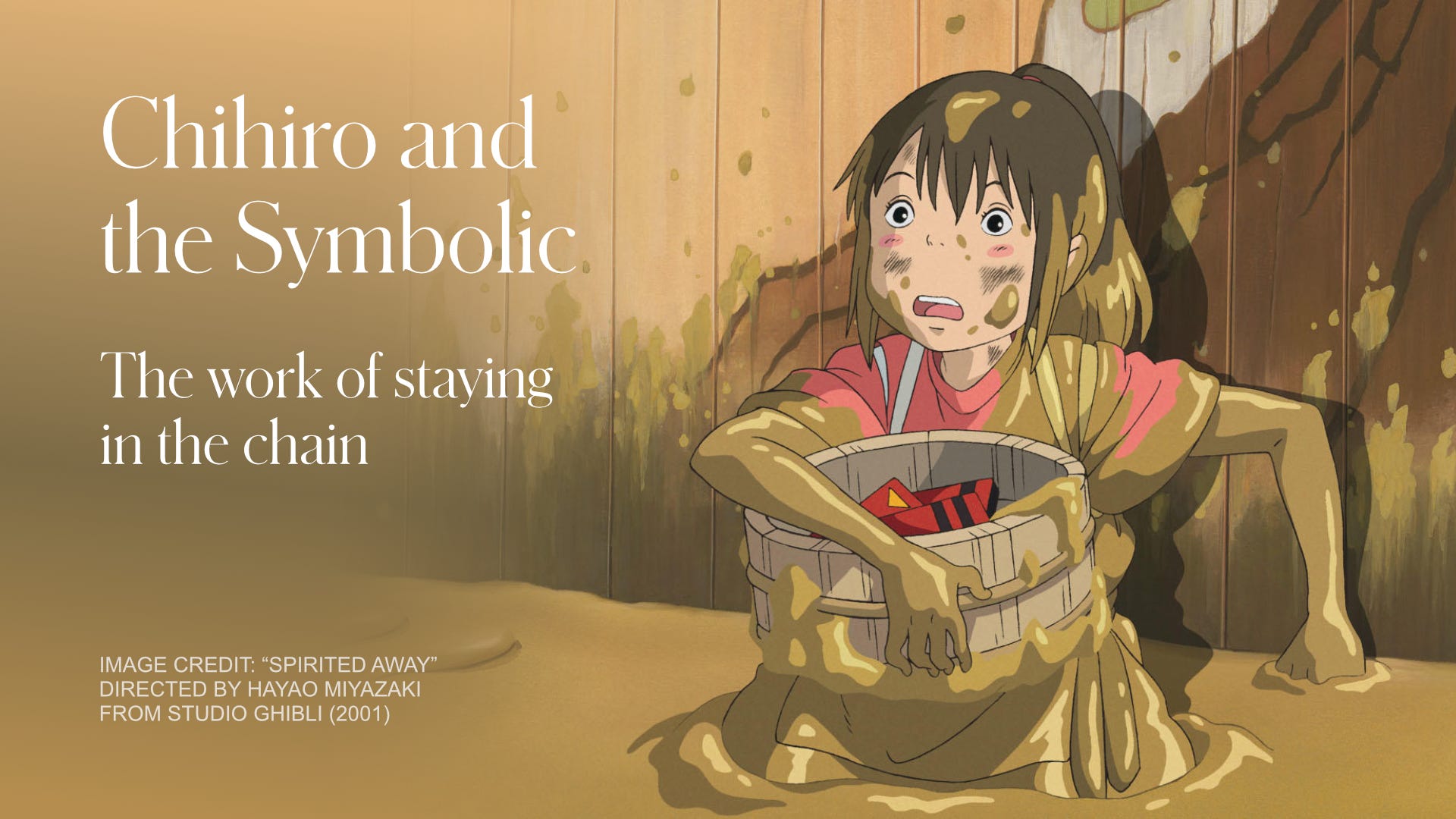
In contrast to Haku’s smooth, capable presence at the bathhouse, Chihiro fumbles her way through in a particularly unglamorous way. She’s right at the bottom of the hierarchy, scrubbing floors and tending to the stinkiest visitors. She makes humiliating mistakes in front of everyone, gets told off, cries… She does not, at any point, project competence or power, and yet she is the most powerful character in the story.
This is possible because what Chihiro does that Haku has failed to do is to stay connected to the Symbolic – to relationship, memory, and her authentic, albeit still-burgeoning, sense of self.
There are two interactions that demonstrate this particularly well.
The first is the Stink Spirit – a repugnant, filthy being who shows up at the bathhouse to be cleansed, causing everyone there to recoil in disgust. The Stink Spirit is seen as something beyond language, and with no place in either the Imaginary or Symbolic world. It is pure mess and contamination, and therefore to be dealt with and expelled as quickly as possible. Just as we’re all tempted to do when some unpalatable part of who we are raises its ugly head, the bathhouse wants to reject, ignore or deny the Stink Spirit. Jung would therefore call it shadow content. For Lacan, it is something to be treated as if from the register of the Real.
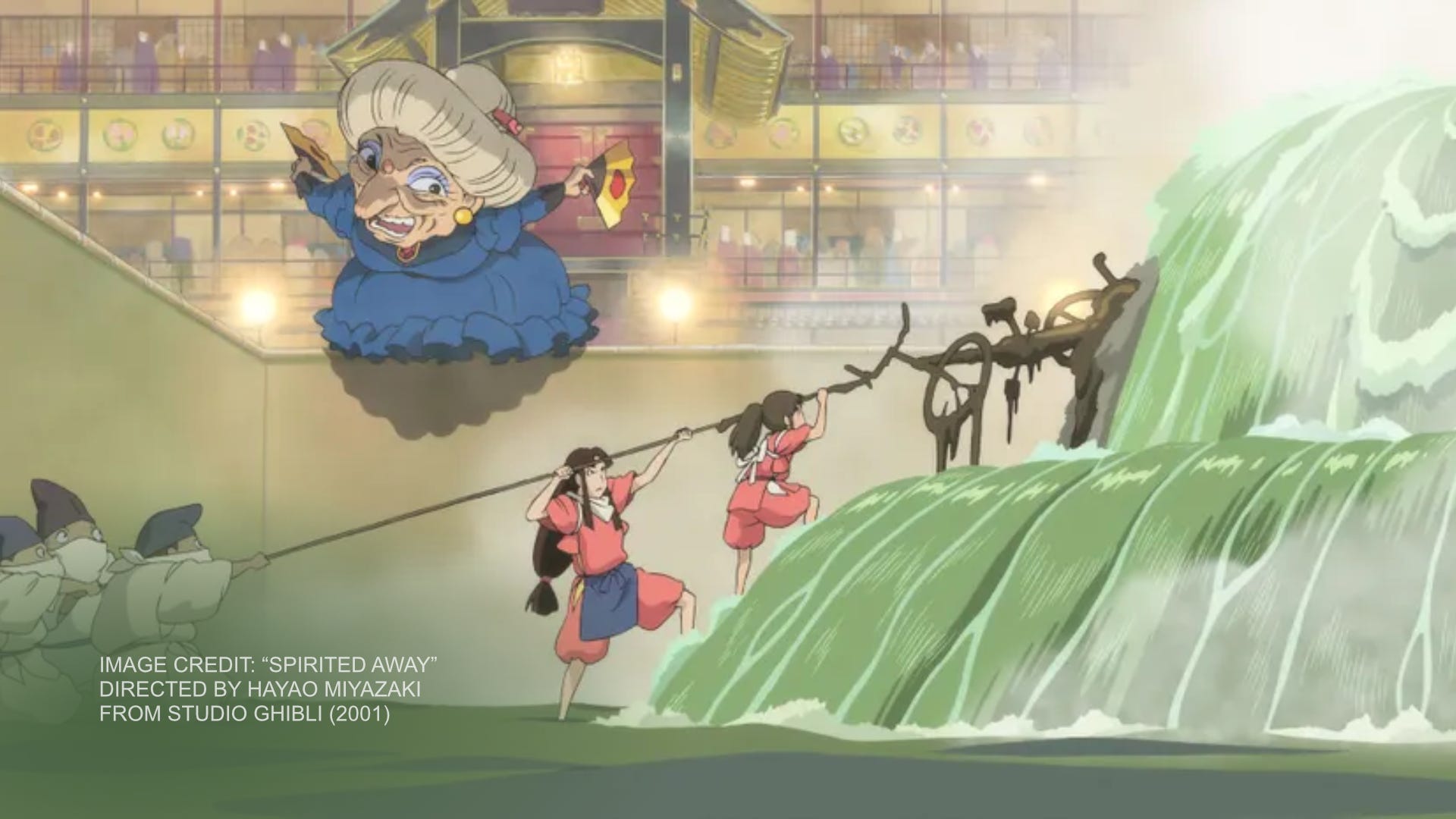
While tending to the Stink Spirit, Chihiro simply chooses to be present with it, rather than running as everybody else does. She gets close to it and gradually works out what’s wrong, ultimately discovering and extracting what appears to be a thorn in its side but turns out to be a bicycle, followed by a whole cascade of human trash. This is of course what happens to difficult experiences like trauma. The original pain is important and needs healing, but what gets piled on top of it over time – shame, self-judgment, years of avoidance – makes it almost impossible to reach.
Once free of this contamination, the Stink Spirit reveals itself as an ancient and beautiful River Spirit. So, as a result of Chihiro’s patient, analytical search for meaning, what had been untouchable and unwitnessable is given a form and a place, and what had been unspeakable becomes nameable, which is to say it has been both accepted and freed. Chihiro does for the Stink Spirit exactly what she needs to do for both Haku and herself.
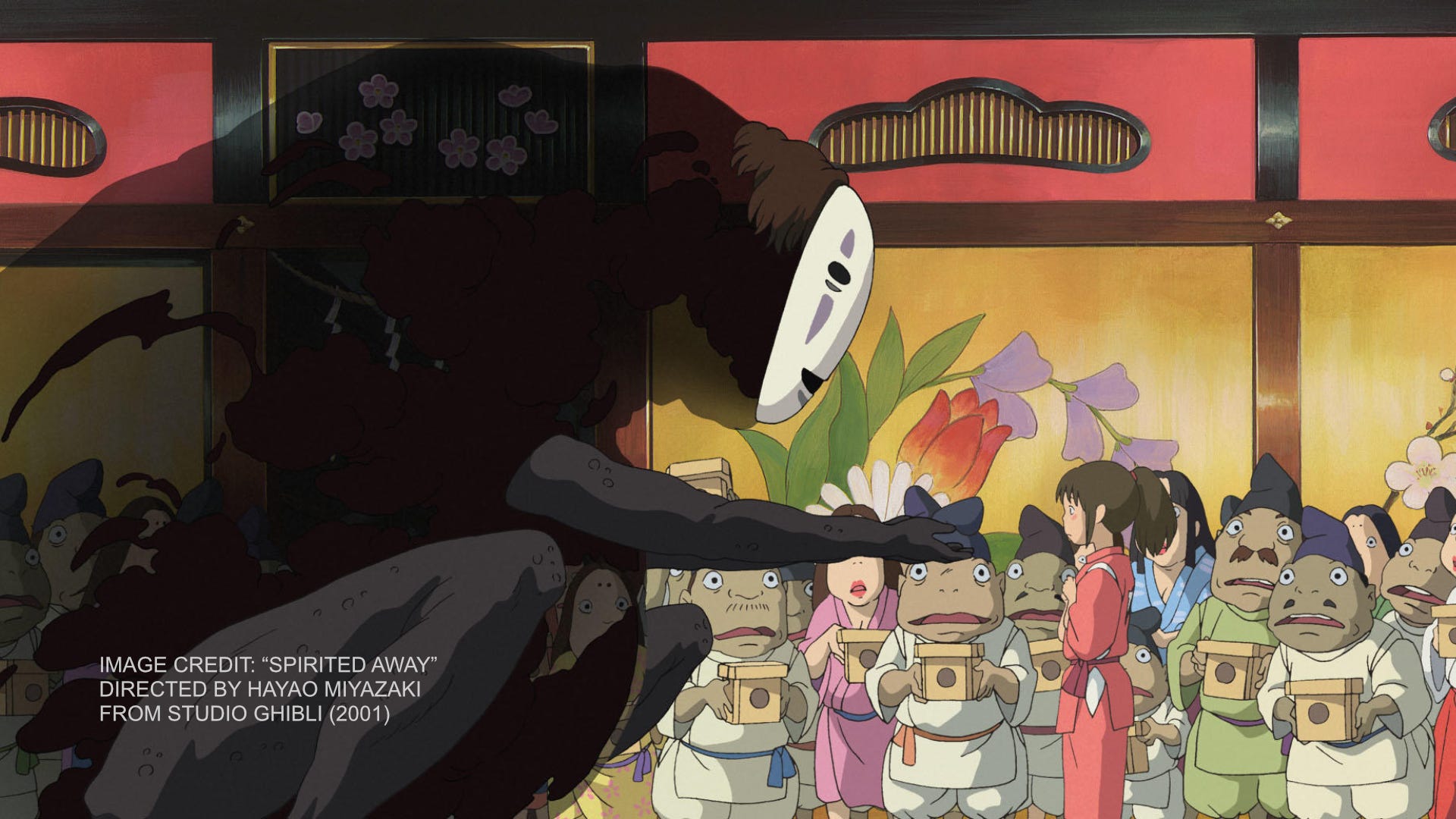
The second telling encounter is with No-Face, another dark, unknowable figure with no place in the bathhouse. He’s faceless, clearly; he has no image, and also barely any speech beyond fragments borrowed from others. What he does have, though, is appetite. No-Face learns to offer gold to those at the bathhouse to draw them in and consume them.
This character plays a relatively minor role in Spirited Away, and yet he’s one we all remember. I’d wager this is because he so perfectly represents something we’ve all tussled with – that is, what happens to pure drive, need or appetite when it encounters a system that has nothing to offer except transaction. No-Face arrives as something close to the rawness of the Real, and as the bathhouse pulls him into its hierarchical culture, it teaches him that gold equals worth and belonging, and that consumption and accumulation are rewarded.
To me, this reads as the way capitalist individualism converts human longing for connection into acquisitional drive. No-Face doesn’t actually want the gold – he wants to be seen – but the bathhouse only speaks one language. Gold is what he focuses on because it’s the only signifier available to him in that space.
And who hasn’t, at some stage in their development, made the same mistake? It’s not always money, of course – we latch onto all sorts of things because we’ve bought into the promise of wholeness they seem to offer: beauty, success, coolness, humour, the perfect relationship, the ideal family, accolades, knowledge, intelligence, wisdom, blah blah blah… These things aren’t fundamentally bad, of course, but they aren’t belonging either, and to make this mistake is to set out on an impossible mission where no matter how much we get, it’s never enough.
Most of the beings at the bathhouse fall prey to this trap. Seduced by No-Face’s apparent riches, they find themselves consumed – literally, eaten – by No-Face and the raw drive he represents. Chihiro, however, is the one person who doesn’t take his gold. Instead, she speaks plainly to him, neither fawning nor running away. In doing this, she refuses the bathhouse logic that has started to corrupt him without abandoning him. In other words, she makes it possible for him to separate himself from the gold, and to experience connection without it.
So, once again, Chihiro meets this challenging character in language – in the Symbolic – rather than the realm of image and ego, thus inviting him into the world of meaning and recognition without feeding his appetite. The result is that he is unable to consume her, and also that he feels safe with her. Eventually, No-Face begins to settle.
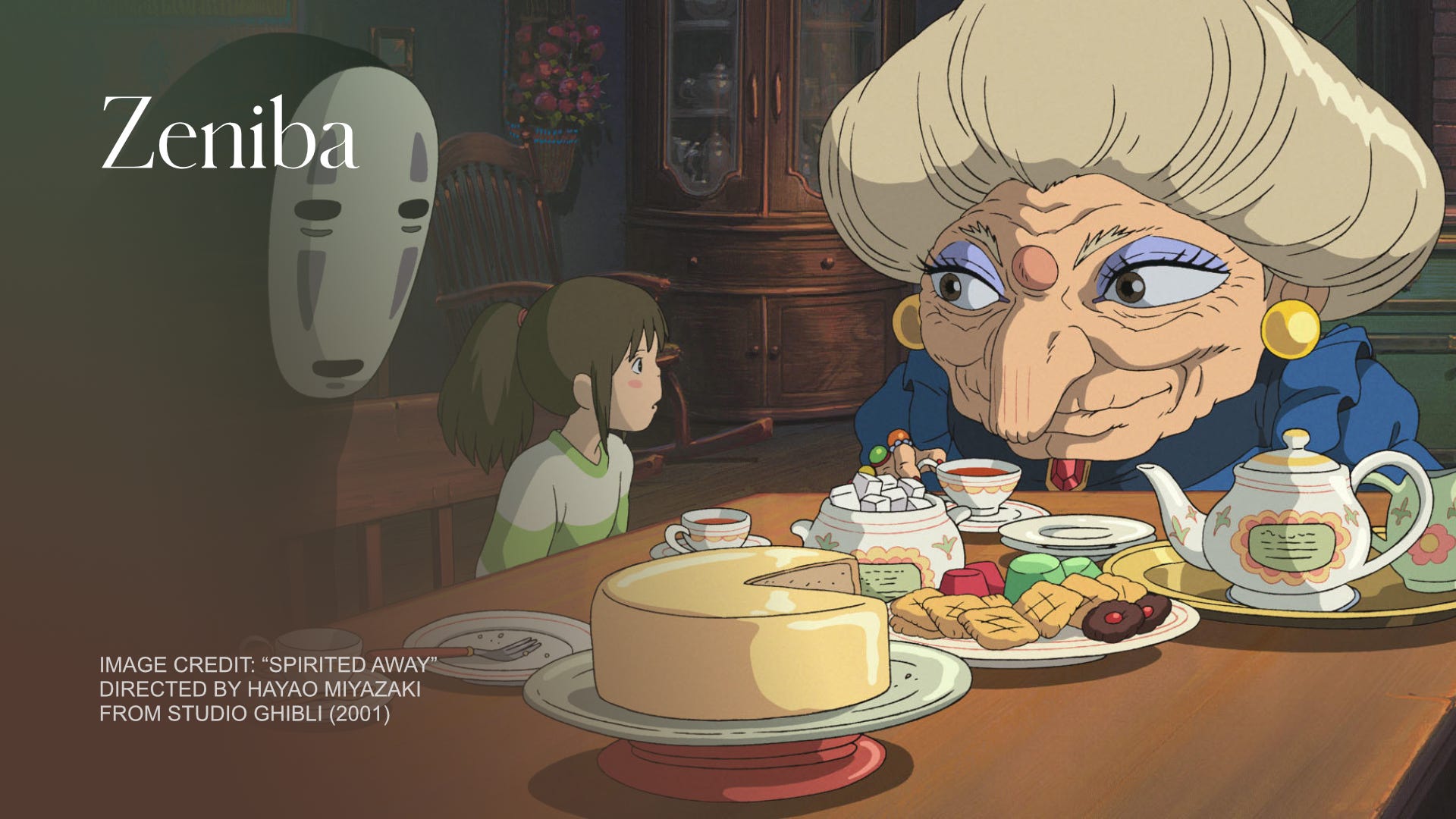
It’s when Zeniba enters the story that we truly get to witness the fruits of Chihiro’s labour. After taking a mysterious train journey across an inland sea, Chihiro arrives at the cottage where Yubaba’s warmer, kinder and more nurturing twin sister lives. Where Yubaba’s bathhouse runs on contract and fear, Zeniba’s cottage is humble and homely. The good witch offers tea and cake, speaks openly, spins thread by hand, and ultimately gives Chihiro a hair tie as a gift, which is woven from the collective effort of the small group she brought there with her. This can seem like a rather arbitrary little moment when you first watch the film, but the hair tie is a powerfully archetypal motif – a simple, useful gift that represents relationships and mutual care rather than glamour or transaction.
At the beginning, while Chihiro’s sense of self was undeveloped, she could never have found this place. She was only able to perceive the Spirit World as vast, alien and frightening. That she can now meet and interact with Zeniba, then, is the measure of her growth.
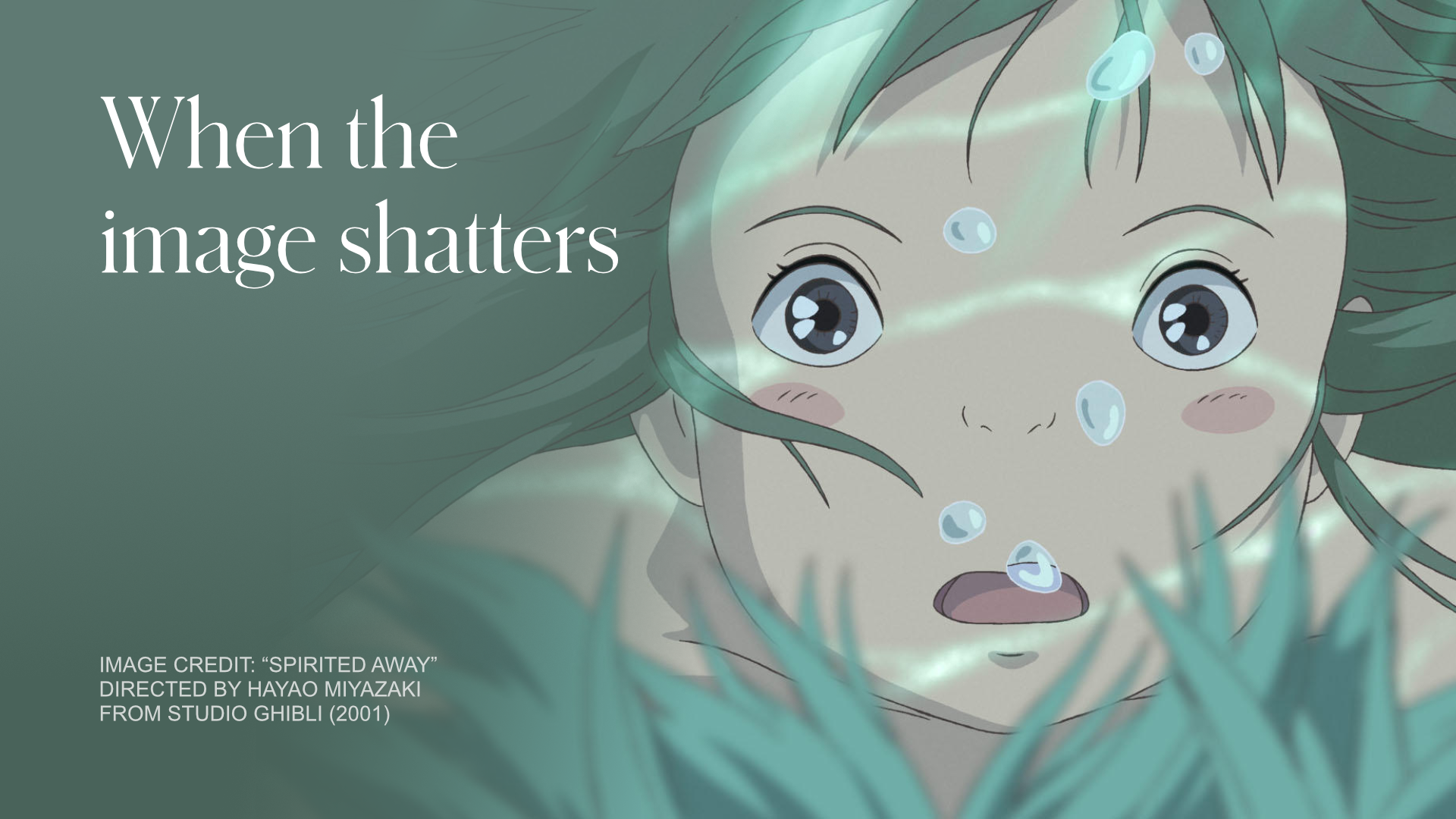
Everything truly comes together during the closing act of the film. Haku arrives at Zeniba’s cottage and carries Chihiro back to the bathhouse in his dragon form. Mid-flight, a crucial signifier surfaces for Chihiro – a distant memory of falling into a river as a small child, and of the water catching her and carrying her to safety, just as Haku’s dragon form is currently doing.
Recognition flaring, she looks at him and says: “The river was called… Its name was the Kohaku River. Your real name is Kohaku.”
It’s in this moment, thanks to her sustained connection to the web of memory and meaning that has kept her grounded throughout her journey, that Chihiro is able to save Haku as well as herself. Upon remembering his true name, Haku’s spectacular dragon form shatters and breaks apart, dissolving into a thousand shards of glass before resolving into drops of water. Haku’s ideal-ego, finally met by a true signifier, can no longer sustain itself. The méconnaissance shatters.
What’s interesting is that the river Chihiro remembers is long gone – paved over and built on by the industry of the human world. So, she is not giving him a way back to his original self, just as she will not be going back to her old home or the self she was before. Rather, they are each allowed to grow and move on while staying connected to the chain of meaning that trails behind them. And with that, they are free.
The world we live in is one built on bathhouse logic. It tells us to refine our ideal self-images and to work hard and buy things that will help us close the gap between who we are and who we want to be. “Look at this beautiful dragon,” it says. “This could be you, for a price.”
So we trade in our tethers to self for images of competence, success, beauty and wholeness. But no matter how shiny and impressive these things can seem, they don’t actually make life in the bathhouse easy or fulfilling, and the more signifiers we let slip away, the more we find ourselves bound to its rules, ways and punishments.
It’s important to remember that the Imaginary is not the enemy, just as the Symbolic is not paradise. What we need is to keep all three registers in healthy balance rather than pouring our resources and attention into one alone and hoping it will make us happy.
For Chihiro, staying anchored meant keeping hold of her name while daring to be present with the scary or repulsive parts of self and life. In the real world, our tethering signifiers can take a number of different forms: values, beliefs, memories, loving relationships, personal history, the effort of hard, repetitive work…
So my closing question for you today is this:
If there were just one thing that could keep you connected to yourself – one unit of meaning that stays true even when you feel furthest from who you want to become – what would that be?
Your thread back to self could be something or someone you love: a person who sees the real you rather than the mask. It could be a room, pet or a place in nature that helps you feel grounded. It could be a song or a sentence someone once said to you that you’ve never been able to forget; a value you’ve stuck to even when it was inconvenient; a moment from your personal history that simply feels true.
Whatever it is that can help you stay anchored, even when the bustle of the bathhouse is loud and overwhelming, keep it with you. Return to it when faced with aspects of self that make you want to recoil in disgust, or with the glimmering promise that things like achievement, beauty, wealth or knowledge will make you whole. Return to this thing of meaning – and others like it – when the world tries to convince you that you can be a glorious, infallible dragon. Because it’s things like this, not success or money or glamour, that will carry you home when you feel lost.
References
Spirited Away [Sen to Chihiro no Kamikakushi]; directed by Miyazaki, H. (2001); Studio Ghibli.
Madalina Brockmann, “Metamorphosis and Identity: Psychoanalytical Notes to Miyazaki’s Spirited Away and Howl’s Moving Castle.” Available at: https://www.medienobservationen.de/artikel/kino/brockmann_metamorphosis.html
Yury Li-Toroptsov, “Spirited Away and the Journey of the Soul: A Jungian Reading of Miyazaki’s Classic.” Available at: https://www.toroptsov.com/insights-blog-li-toroptsov/spirited-away-and-the-journey-of-the-soul-a-jungian-reading-of-miyazakis-classic
Lacan, J. “Écrits: The First Complete Edition in English” (B. Fink, Trans.). W. W. Norton & Company (2005).
Evans, D. “An Introductory Dictionary of Lacanian Psychoanalysis”. Routledge (1996).
Jung, C. G. The Archetypes and the Collective Unconscious, (1968)
What a wonderful question poses this journey. I'll let that sink in. Thank you, Hazel! (:
Thank you. Your application of story is so very helpful