


You can listen to this piece on our YouTube channel or read it below.
***
Once, there was a man who found a way to cheat death. To do it, though, he had to forfeit the right to truly live. My question for you is: Have you done the same?
This a story about the tension between staying safe and staying alive, and how we can walk that tightrope without losing ourselves in the process.
Koschei the Deathless
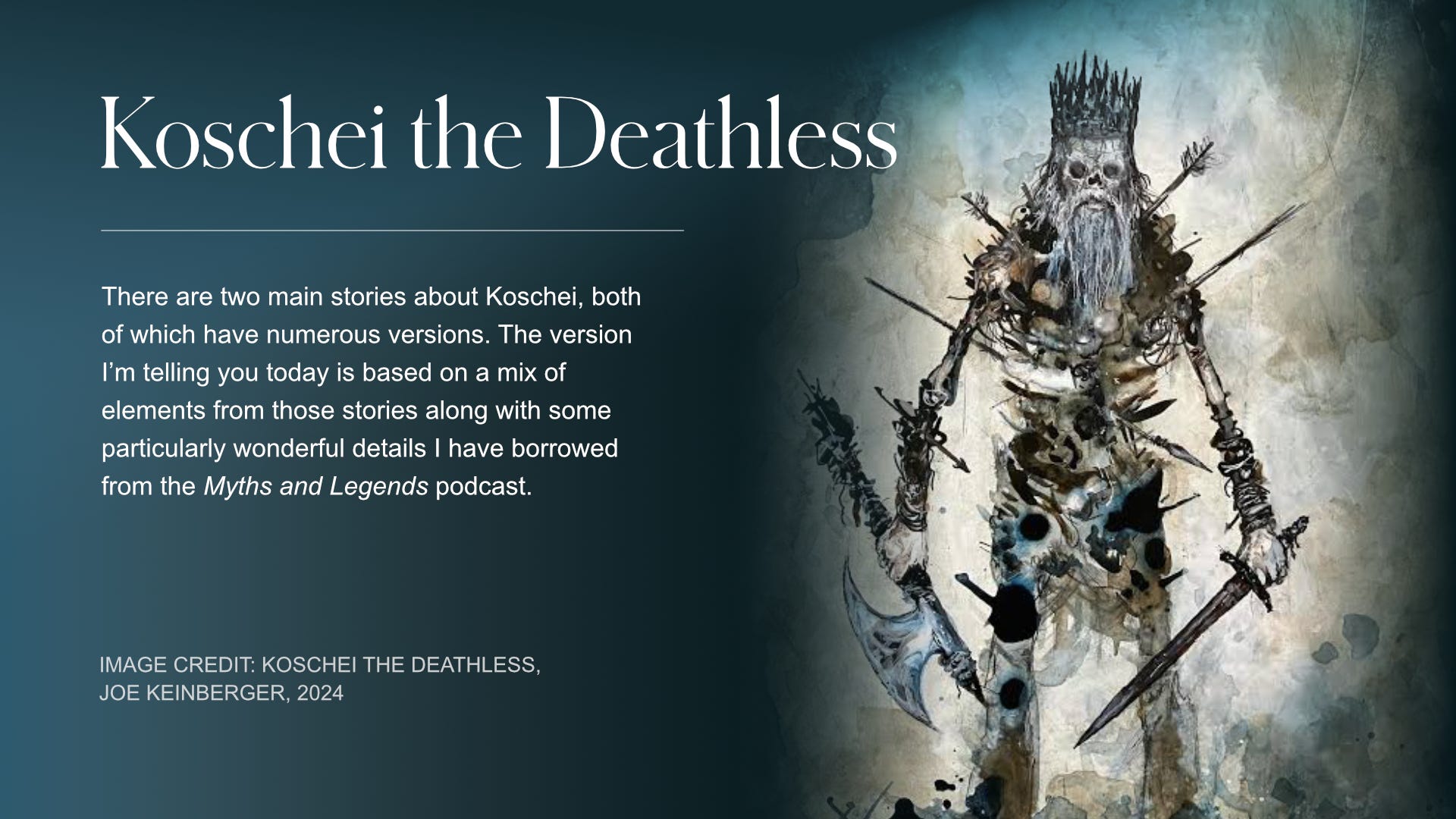
There are two main stories about Koschei, both of which have numerous versions. The version I’m telling you today is based on a mix of elements from those stories along with some particularly wonderful details I have borrowed from the Myths and Legends podcast.
Koschei the Deathless rides naked on horseback through the forest, shrieking as he hunts. A skeletal, emaciated, old, old man with skin like rotting leather, he is feared by all across thrice nine kingdoms. He is a sorcerer with immense power, the likes of which are rivalled only by the great Baba Yaga.
But there’s one thing, of course, that sheer power can never win: love. Koschei abducts fair maidens and princesses to live as his companions in the eerie castle he calls home. Some of them have grown old and died there. Some have tried to escape and died in the attempt. But only one of them will manage to achieve the impossible.
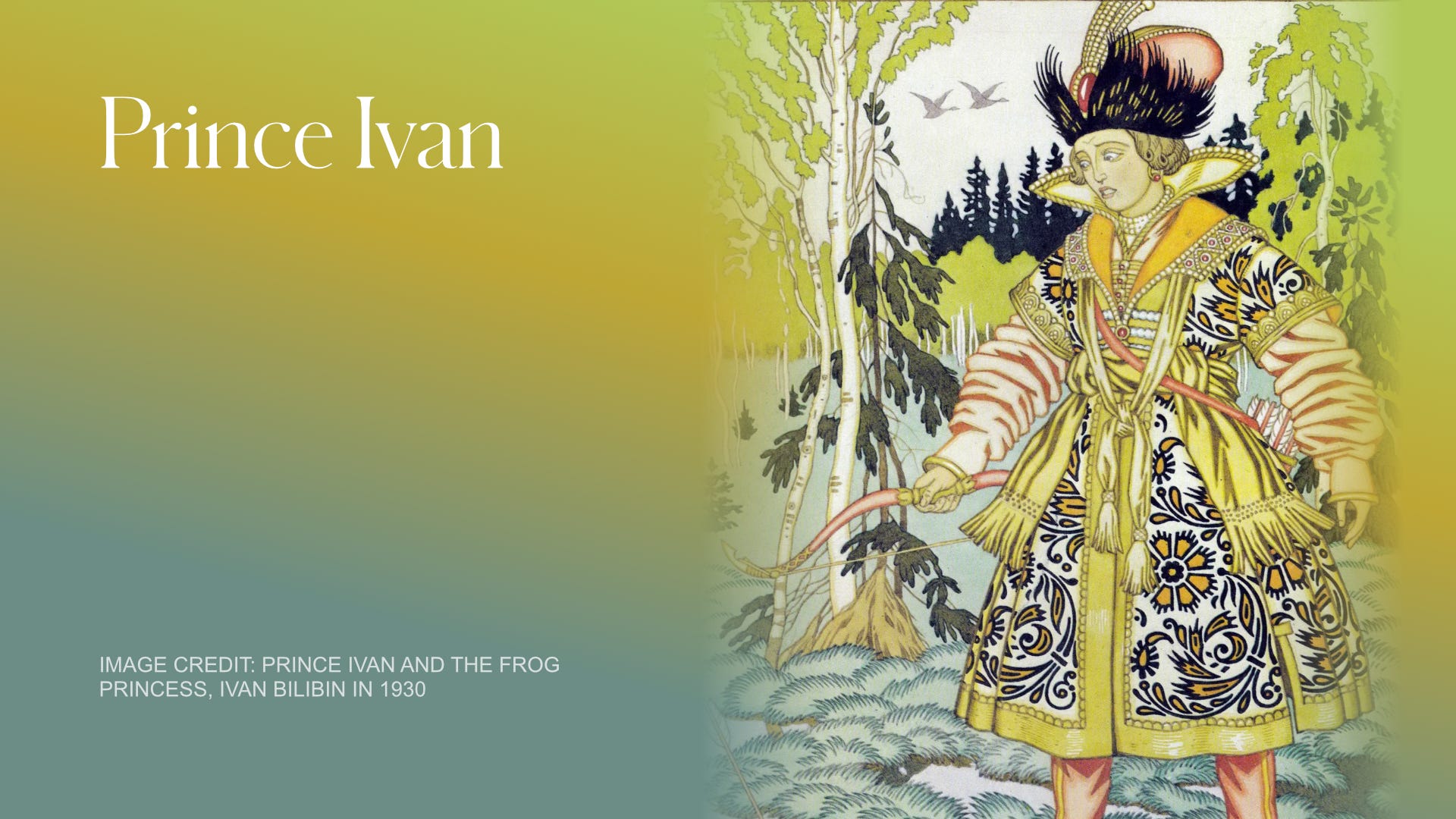
In a land far from Koschei’s clutches, the young prince Ivan learns that he is destined to marry a princess named Vasilisa the Beautiful, who you may know as the brave heroine who faced Baba Yaga, but that’s a different story. In Ivan’s story, Vasilisa is kept in a tower by her overprotective father. At just fifteen years of age, he sets off to find her, wondering how he’ll ever muster the courage to woo his future wife.
En route, Ivan comes across a man being flogged in a town square for failing to pay a debt. No one will help this man, because Koschei the Deathless has made it known that he’ll steal the wife of anyone who pays on the man’s behalf. But as Ivan is just a boy, and a single one, too, he chooses kindness anyway, freeing the man – Bulat the Brave – using his family’s largesse.
In return for Ivan’s compassion, Bulat promises to help him find Vasilisa and win her heart. He leads the young prince to the princess’ tower and tells Ivan to wait in the forest where he must roast the meat of a chicken, a duck and a goose. Using this food, cunning Bulat gains entry to the castle undetected and helps Vasilisa escape.
Ivan doesn’t ask questions of Bulat. He just does what he’s told, waiting for the braver man to free the princess so he can finally take her as his bride.
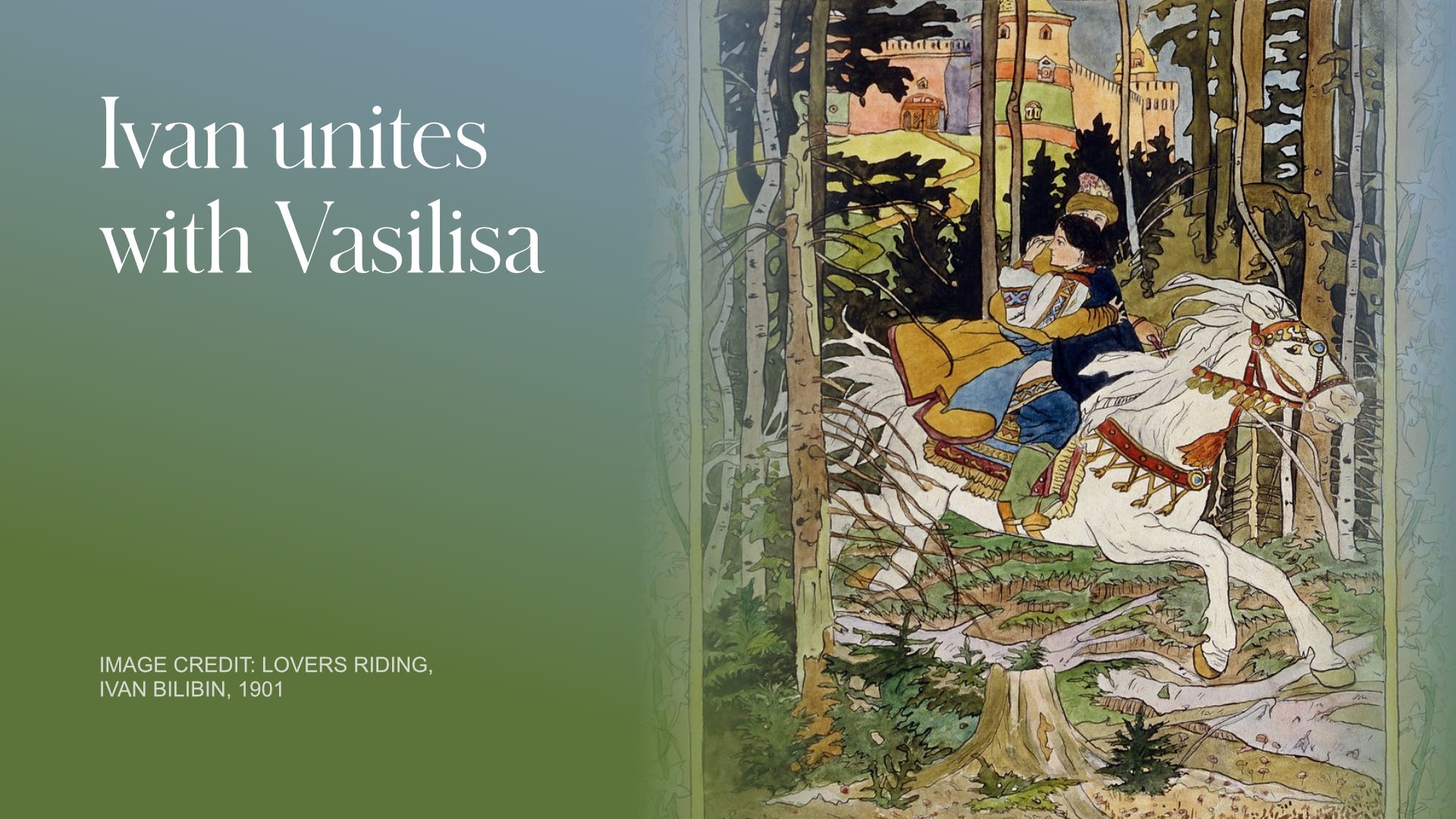
And when that happens, for a fleeting moment, all seems well. Together, the three ride on horseback towards Ivan’s castle, Bulat twice killing entire hordes of the king’s men who follow in pursuit. He does this in secret so neither Ivan nor the princess need bear witness.
As the sun sets, tired from all the slaying, Bulat tells Ivan to keep watch for just one night so he can sleep. Ivan agrees. But within minutes of his vigil, his eyelids grow heavy and his head begins to loll. And then his gentle snoring masks the sound of footsteps creeping through the shadow-cloaked forest.
The price of falling asleep
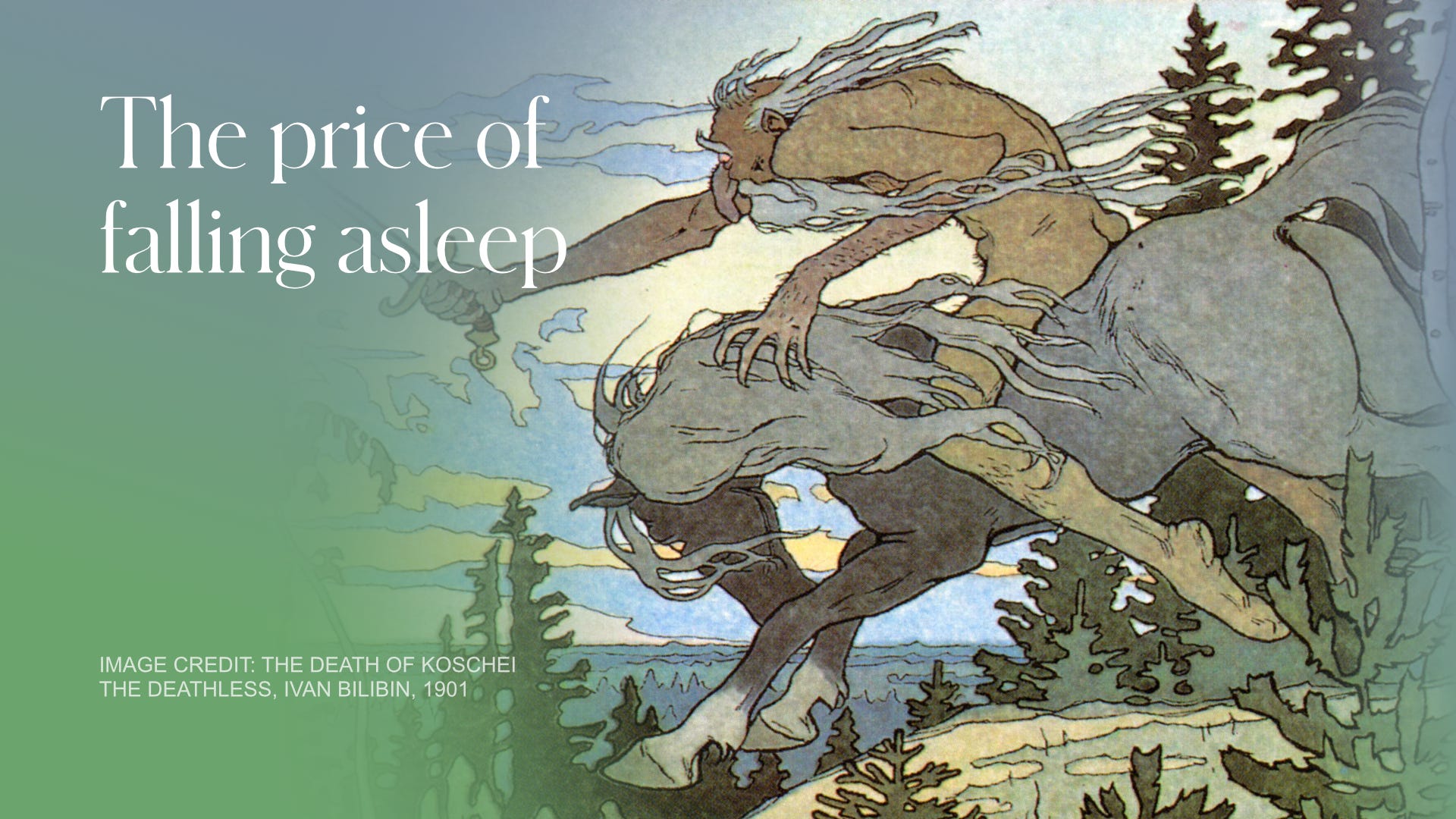
Koschei has come to claim what he’s owed. The deathless one gathers Vasilisa up into his reeking, naked arms, and shrieks with laughter as he carries her away.
The next morning, Ivan and Bulat gallop to Koschei’s kingdom: an unnervingly organised world where there are no wild animals roaming the pastures; where many of the trees have been felled and shrubbery hewn to make space for cultivation that will yield only what’s needed for the sorcerer to survive, and nothing more. There is no joy in this place, just the greyness of utility.
They meet two shepherds soon after crossing the border: gaunt, scared men with hollow eyes who are just as trapped as any of Koschei’s abducted brides. Though afraid of the consequences, these men arm our questing heroes with information about the workings of the ghostly castle, and the dreadful wizard within it.
On Bulat’s instruction, Ivan sets up camp in the surrounding forest, while he kills the shepherds – in secret once again – and steals their clothing.
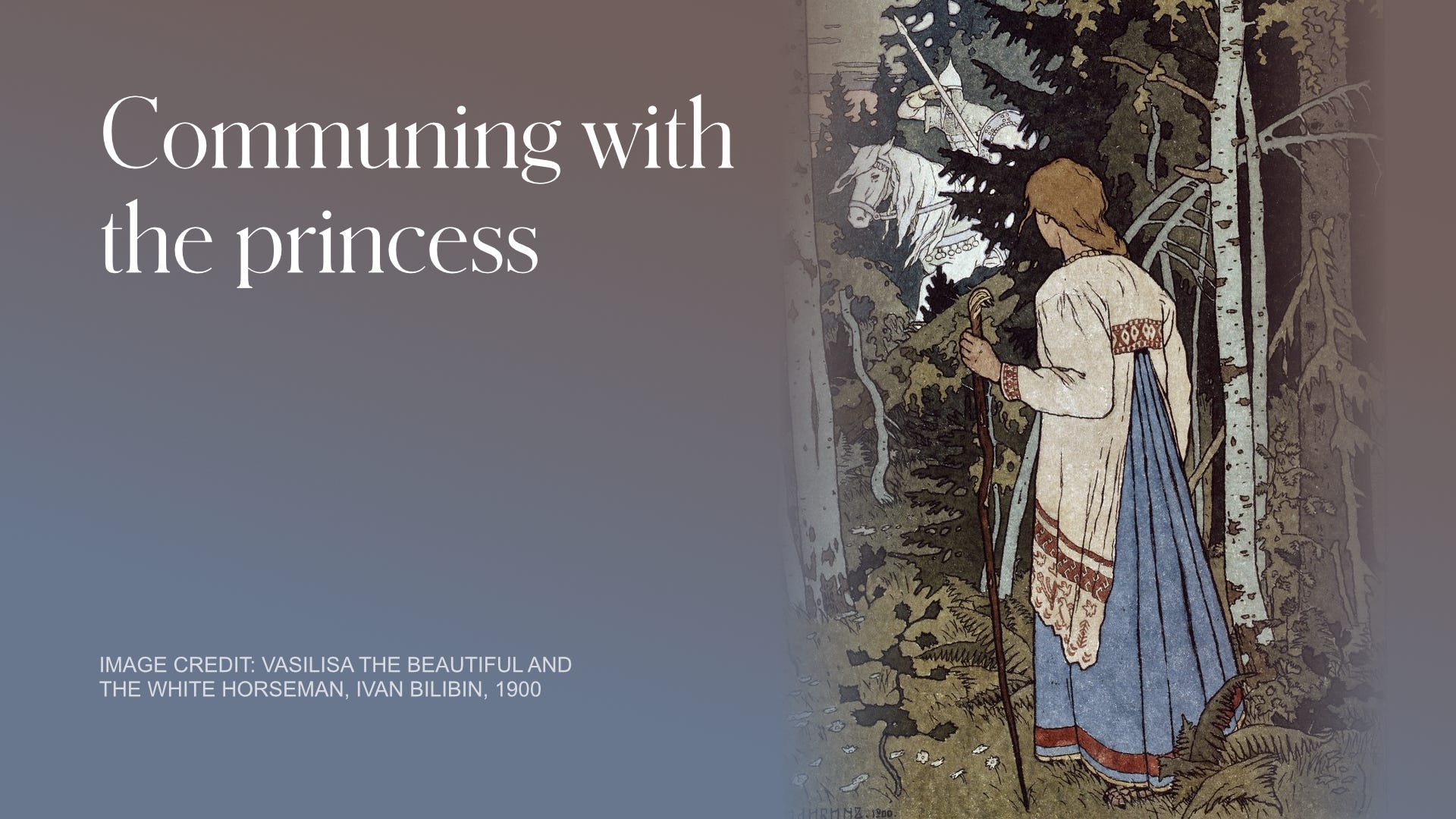
Then, while Koschei is out hunting, Bulat meets with Vasilisa in the garden at the edge of the forest – he wears the shepherd’s robes to keep from being noticed. Speaking in hushed tones, the princess assures him that she’s safe, but that the sorcerer is powerful beyond belief. Despite his fragile appearance, Koschei is in possession of superhuman strength, and he can shapeshift to take the form of a bird, storm clouds, or even a tornado.
They can’t break in and take her, and she can’t simply leave, because the monster will find them. No, they need to do something more final if Vasilisa is ever to escape.
The source of Koschei’s power, we learn, is his lack of soul – or rather, his separation from it. Many centuries ago, the sorcerer hid his own aliveness in a faraway place, and since then, death has not been able to find him. To rescue Vasilisa and end the immortal life of Koschei, Ivan and Bulat will need to unearth this hidden vulnerability and return it to him.
So Bulat says to Vasilisa, “You need to find out where it is. Use your charms and your wiles to coax the secret of Koschei’s hidden death out of him.”
And so she does.
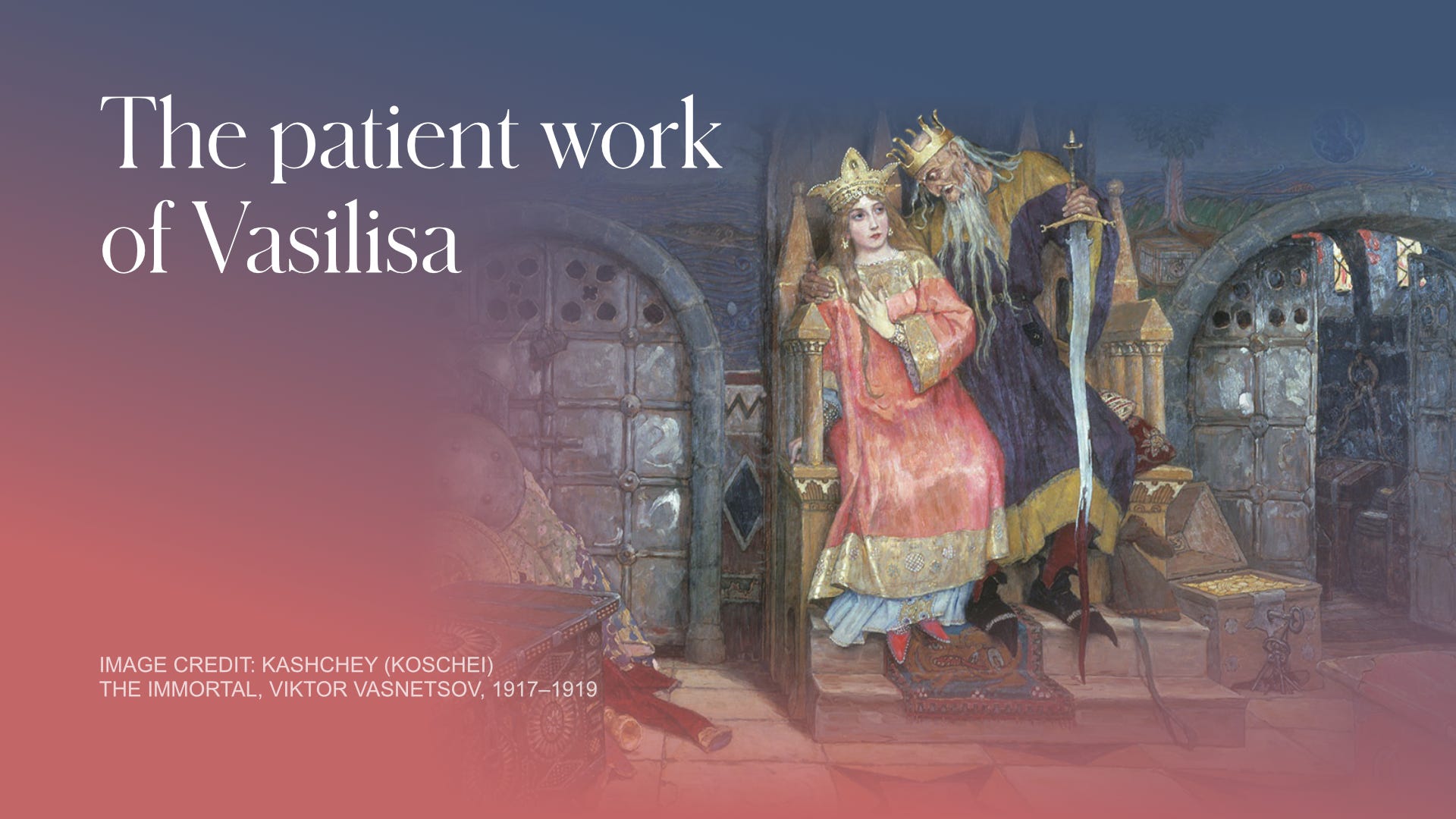
That night, Vasilisa sits opposite the sorcerer at the castle’s banquet table. He’s clad in thick, opulent robes, as if to hide his shriveled body. His long grey hair and beard lift every now and then, animated by a breeze that blows through the fortress from no obvious source.
Taking a breath, Vasilisa steels herself to slowly, patiently gain his trust. She reaches across the table and touches his haggard, cadaverous hand. She panders to his ego, saying she has no need to leave for she’s already with the most powerful man in the world.
And then she begins to weep. “But what if something terrible happens to you? What if you’re attacked and killed while out hunting? I’ll be left all alone!”
Koschei is the kind of man who doesn’t like to witness such emotion – not one bit. He eyes her suspiciously for a long moment, but then softens a little and lets slip a sliver of the truth. “Don’t worry, my love,” he says, “I cannot die, for my death remains separate from my body, hidden somewhere safe and secret.”
Vasilisa stops crying mid-sniffle and looks up. “Where?”
“Why, it’s just over there,” he trills. “In the wooden broom, right by the fireplace.”
The next morning, Vasilisa reports back to Bulat in the bushes. But Bulat smiles and shakes his head. “That’s a lie,” he says. “Koschei’s soul is in no humble broom, least of all one right next to the fire. He’s just testing your loyalty.”
So Vasilisa goes back inside, moves the broom away from the threat of the flames and begins to adorn it like a royal treasure. When Koschei returns from hunting and sees this, he asks her why she chose to do such a thing. “Because your precious life is inside it,” she simpers. “I must honour and protect this broom.”
As Koschei admires the decoration, Vasilisa could swear she notes a rare glimmer of happiness on his face. But no sooner than it arrives, it’s gone again – lost to the folds of tired old skin, the deep-etched lines of a centuries-old frown.
Koschei turns to her, straightening. “That’s not really where my soul is,” he says. “I was just testing that you wouldn’t destroy it – I have to be sure, after all. My death is actually in the goat outside, roaming the hills around the castle.”
When Vasilisa and Bulat meet in the garden, Bulat shakes his head again. “Koschei’s soul is in no goat. A clumsy animal like that would be a ridiculous hiding place – he’d be at risk of dying all the time. It’s another test.”
So Vasilisa takes the goat inside where it will be safe. She cleans it, grooms it, braids its long hair, and polishes its horns (which is a motif we won’t be reading too much into). And when Koschei returns to find the oh-so-well-cared-for goat, his heart begins to swell. Perhaps he can trust the princess after all. Maybe she is the one.
The soul’s true location
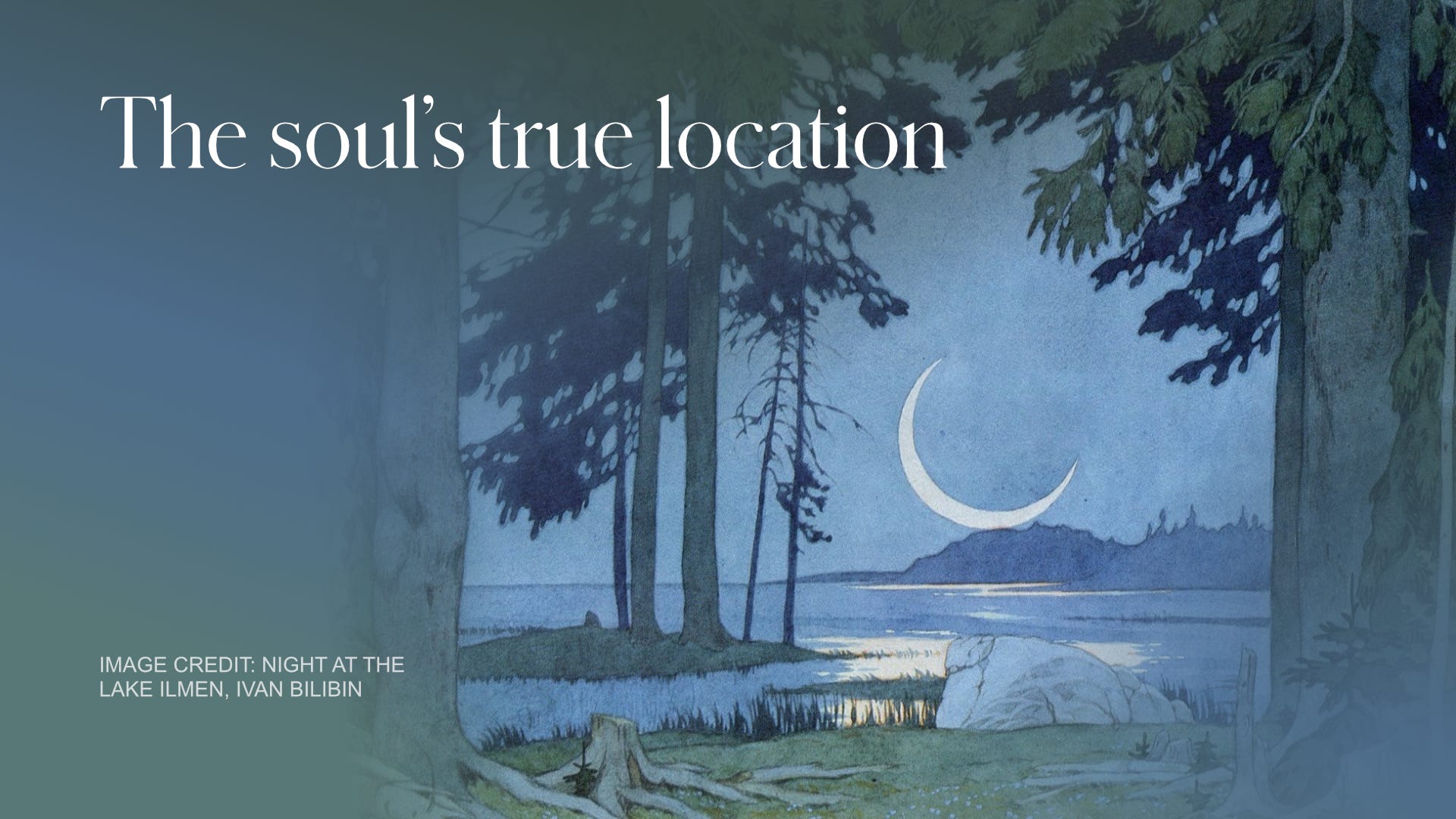
Only a little hesitantly now, the skeletal sorcerer leans in, skin creaking as he moves. He meets Vasilisa’s gaze with those deep, inky black eyes and, in a voice not much louder than a wheeze, he says: “The true location of my soul is on an island in the sea. On that island, there’s an oak tree; and buried within its roots, a strongbox; and in the strongbox, a hare; and in the hare, a duck; and in the duck, an egg; and in that egg, a needle. And the tip of that needle is my soul.”
It’s been decades, maybe centuries, since the old, old man has told anyone this secret, and we might imagine a great weight lifts as he does. Maybe, just maybe, in Vasilisa, he’s found the trusting love he’s yearned for his entire immortal existence.
But of course we know this not to be true, because Vasilisa does not love Koschei, and she’ll tell Bulat, and Bulat will tell Ivan, and they’ll collect the sorcerer’s mortality and return it here so he can finally be killed. Which is just what happens.
The quest
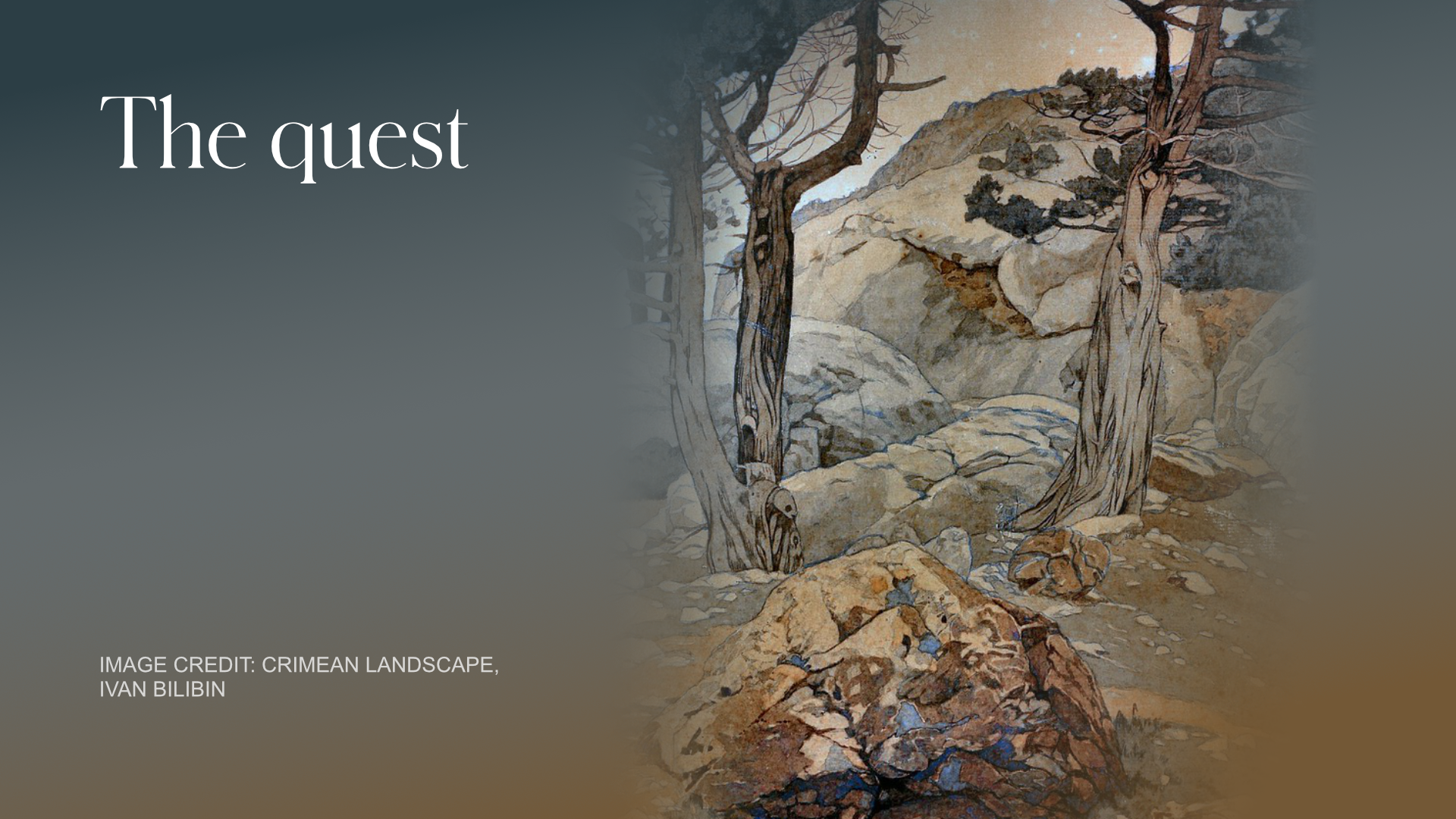
Ivan and Bulat set out for the island. On the way, as in so many of these old tales, they come across a series of animals. And even though they’re starving, and even though they happily cooked those three birds when they first rescued Vasilia, this time they show mercy: to the dog whose puppies look like a tasty snack; to the eagle with a nest of eggs; and to the lobster they meet when they reach the shore. Each animal begs to be spared, and when the heroes act with grace and humility rather than sating their hunger, each animal promises to repay their kindness, just as Bulat once did for Ivan.
Once on the island, they find the oak and they begin to dig until they find the chest and open it up. But the hare within flees immediately, dashing fast across the ground and out of sight. Ivan cries out in despair, while Bulat follows on foot in a desperate but ultimately futile attempt to catch it. The soul is gone. And just when they think all is lost, they hear the sound of distant barking. The mother dog returns the lifeless body of the hare and lays it at their feet, her debt paid.
When the duck inside the hare also tries to escape – this time to the sky – the men feel momentarily hopeless once again… until the mother eagle soars into view, clutching the duck in her talons. Again, she lays it at their feet. Another debt paid.
Once in possession of the egg, it’s packed carefully away in a satchel for safekeeping during the journey back to Koschei’s castle.
But Ivan, being Ivan, slips on the rocks as he tries to board the boat to cross the sea, and the satchel disappears into the depths. Bulat dives in after it, swimming down as far as he can, but he runs out of breath before he can retrieve the treasure. The two men slump down at the stern of the boat, defeated. Thankfully, there was one more animal to whom they’d shown mercy. The lobster retrieves their prize, placing the strap of the satchel into Bulat’s strong, reliable hand.
The return
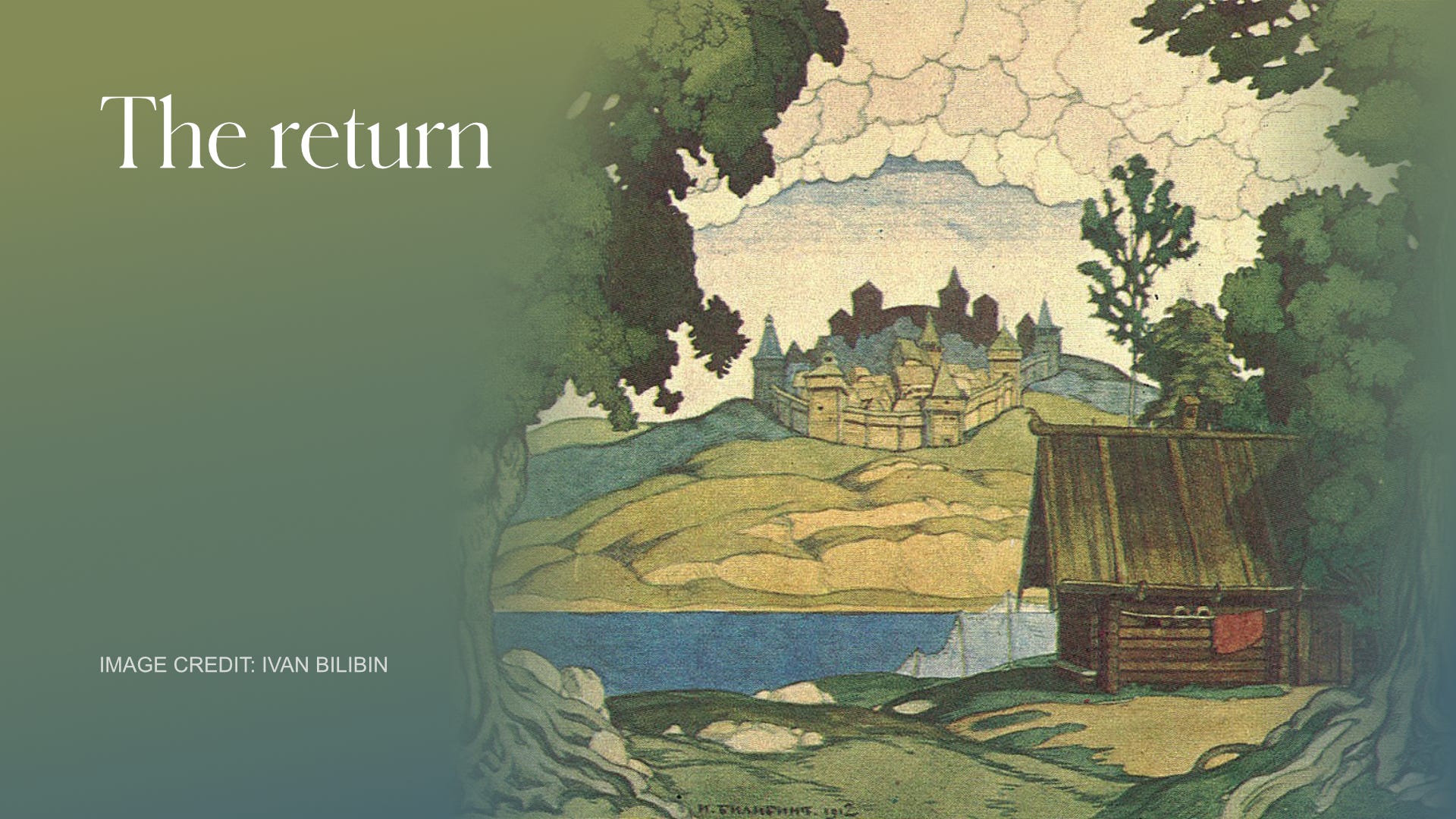
They return to the sorcerer’s castle to find Koschei and Vasilisa in front of the fire. Dark reflected flames dance in the princess’ eyes as she notices the heroes through the window. Vasilisa turns, then, to gaze lovingly at the skeletal old man beside her, just as she has done night after night. Once more, his decrepit heart swells a little to see this – his sweet, doting, affectionate Vasilisa…
But wait. Something isn’t right. Koschei’s eyes widen, his nostrils flare. Panicked, he looks around the dark room, saying, “I sense something wrong – there is a foulness in the air.”
As if offering him comfort, the princess lifts a lily-white hand to caress his face. And Koschei goes very, very still, staring into those fire-bright eyes of Vasilisa’s… as Ivan enters the chamber, egg in hand, and smashes it onto Koschei’s forehead.
And thus, in a darkened room, sat beside the one woman he believed he could trust, and at the hands of a young man who travelled to the ends of the earth and back, the deathless one finally, truly meets his end.
Vulnerability vs. control
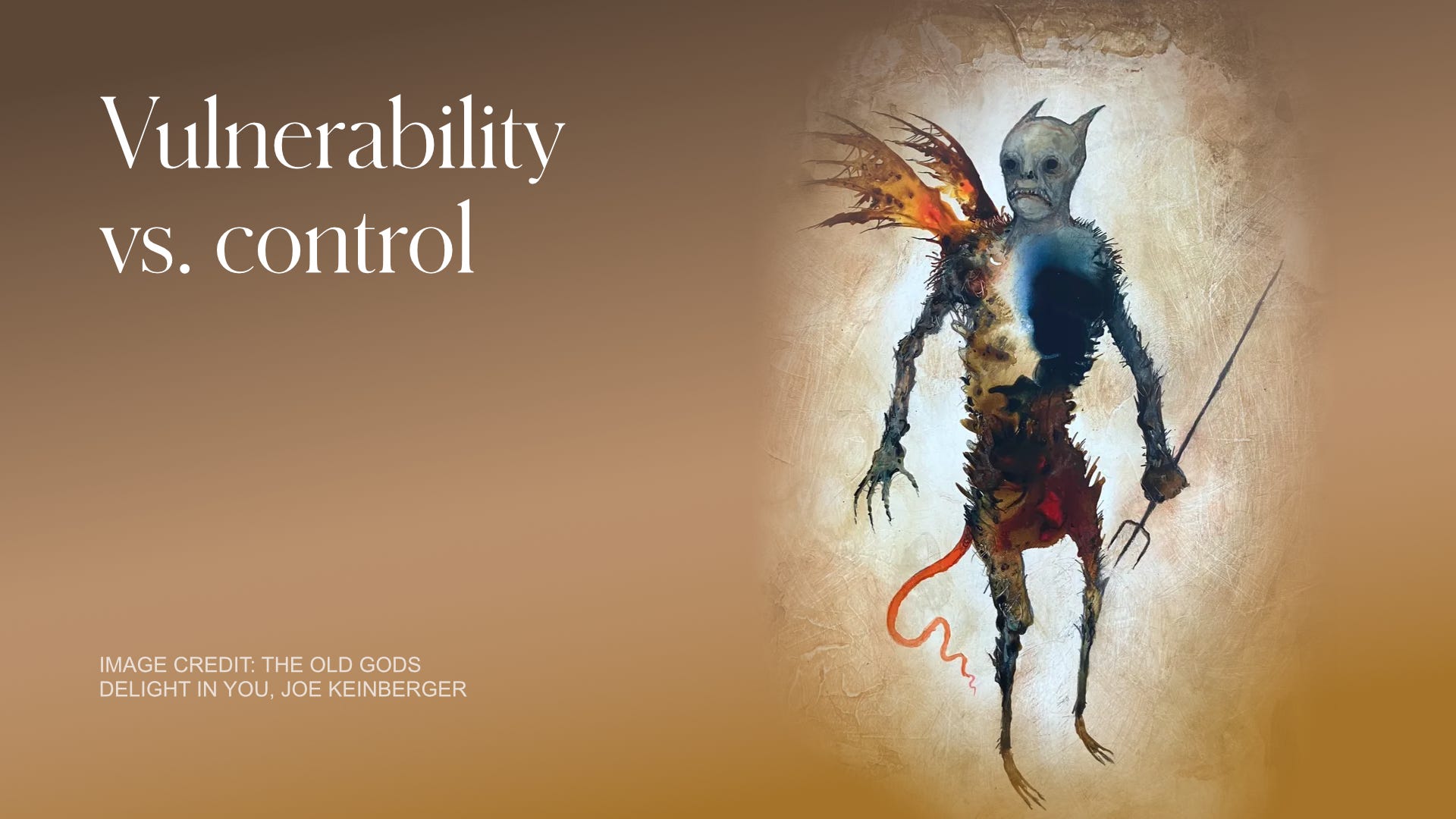
There are two stories of Koschei the Deathless from Slavic folklore, both of which have many different versions. This is my favourite, because it’s the one in which we get to spend the most time with him – get to know him a little bit.
Koschei is not a monster, but a man who becomes monstrous as a result of the choices he makes for self-preservation. And haven’t we all made regrettable choices for this exact reason?
Koschei, an expression of the Shadow Senex – the toxic, withered old man archetype – takes things to the extreme. By hiding his soul in an egg in a duck in a hare in a chest on a distant isle, he completely disconnects from his vulnerability and humanness, believing he can still live and, importantly, love without those things. But he can’t, because love requires vulnerability, and vice versa. Just as life needs death and death needs life. We can’t have the good stuff without the bad, and more to the point, we can’t enjoy a full-hearted life without accepting the reality of terrible risk.
Memento Mori
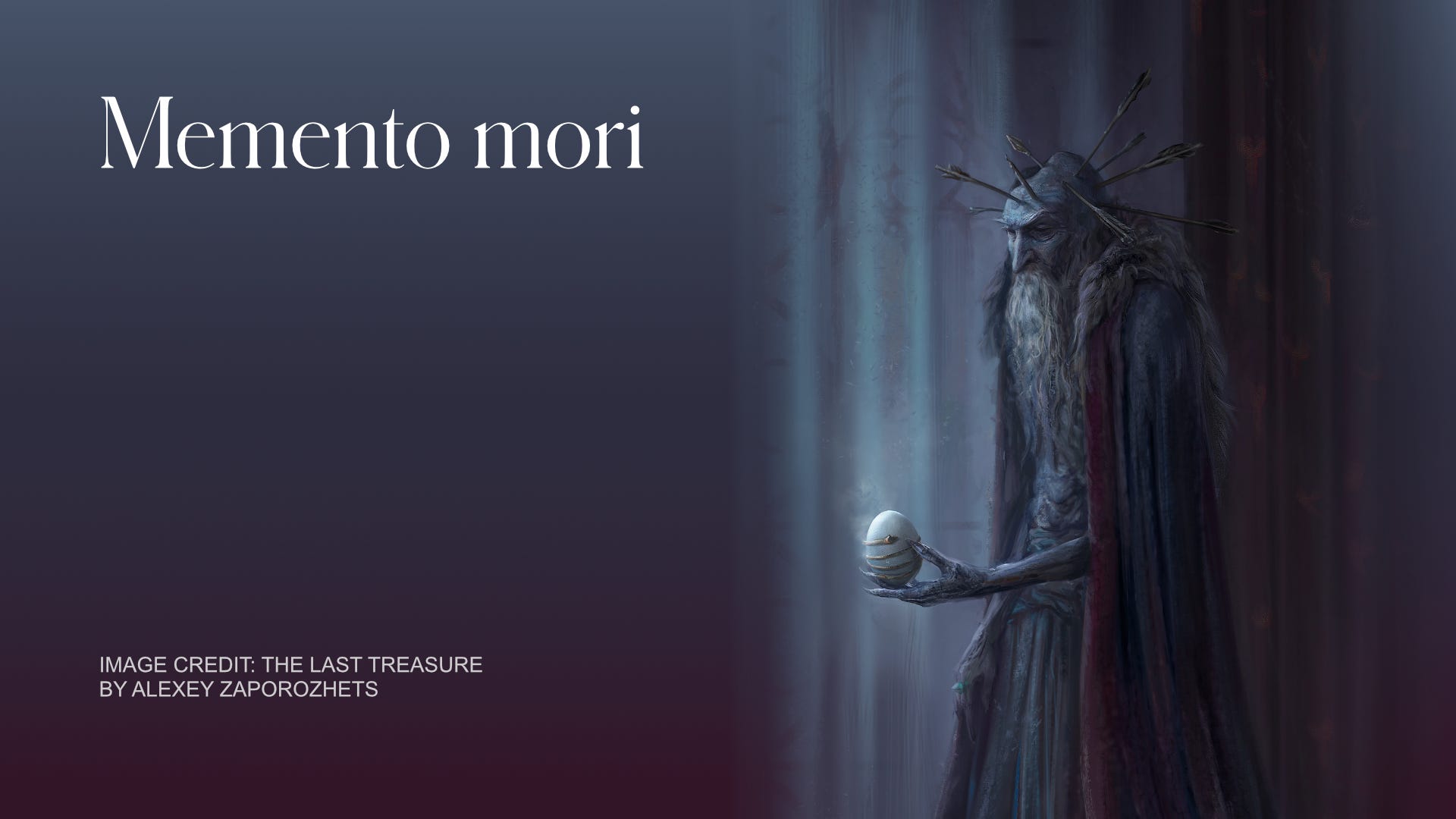
This is true both without and within. True psychic health requires flow, transformation, and eventual acceptance of ego-death to allow the Self to mature. Koschei’s deathlessness, then, depicts a pathological refusal to submit to the natural laws and cycles of the inner world. He represents an ego so rigid, calcified and terrified of change that it chooses a lonely, undead existence over the uncertainty of personal growth and connection.
No matter how many princesses he captured, Koschei would never have found joy, closeness or even the experience of being alive, because by hiding his soul from others, he hid those very things from himself.
Opening up
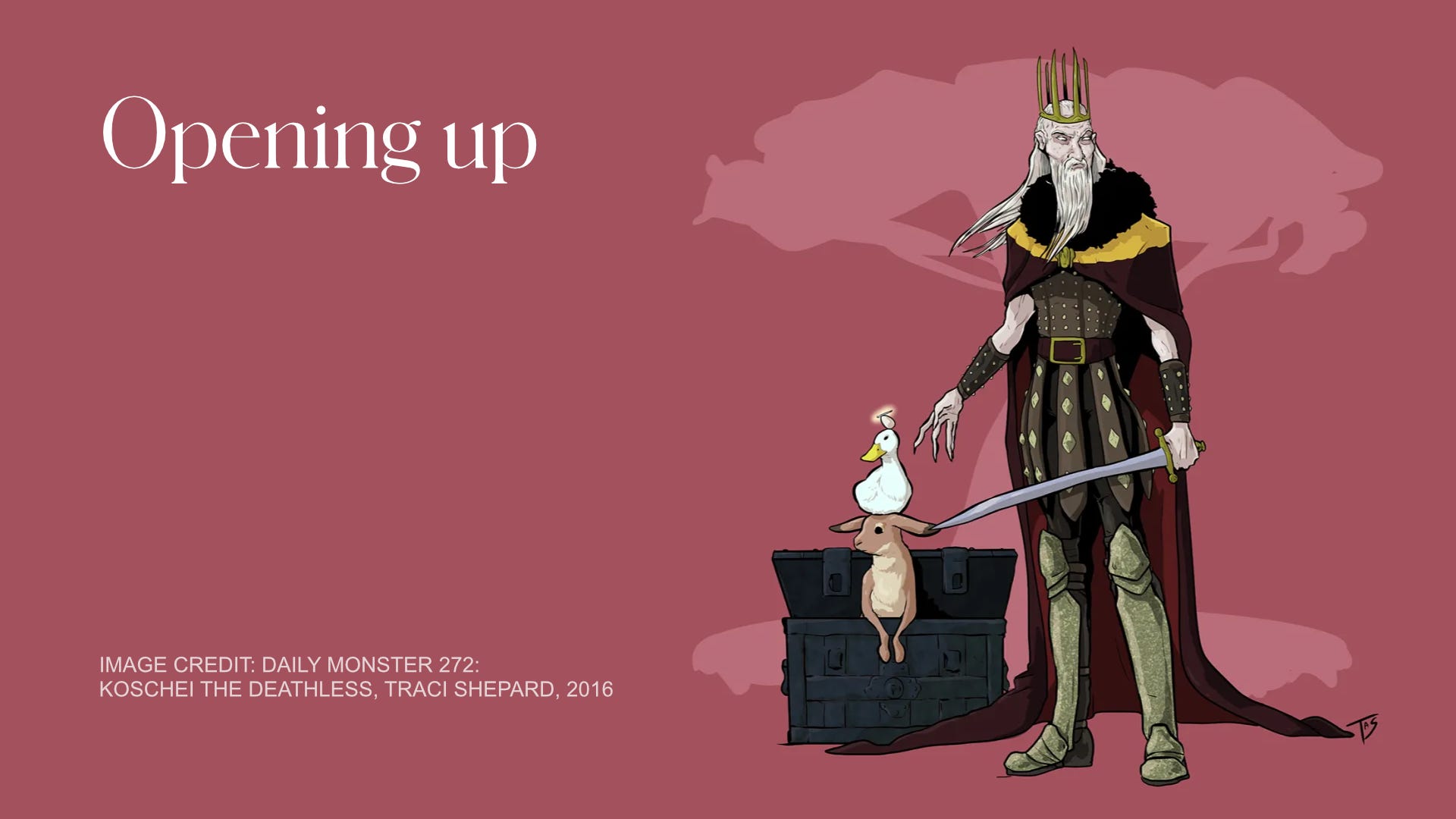
Something I really like about this story is the uncomfortable, almost hopeful part in the middle where it seems as if the sorcerer is actually opening himself up in telling Vasilisa the location of his soul. We have hope in that moment because we can see how Vasilisa will escape, but there’s also a glimmer of possibility that Koschei himself may be finally learning the lesson he so needs to learn – that connection requires vulnerability.
On closer inspection, though, even this admission was never true surrender. Vasilisa is his captive, and even if she weren’t, the soul is far from easy to find. Everything is still on Koschei’s terms, still controlled and safe. Importantly, he never gives Vasilisa the one thing that true love requires – the freedom to leave.
Relational vulnerability only means something when the other person is free to learn who we truly are and walk away if they don’t like it. This is precisely what’s so terrifying about love: we simply can’t be in a loving relationship unless rejection is also on the table.
Koschei IRL
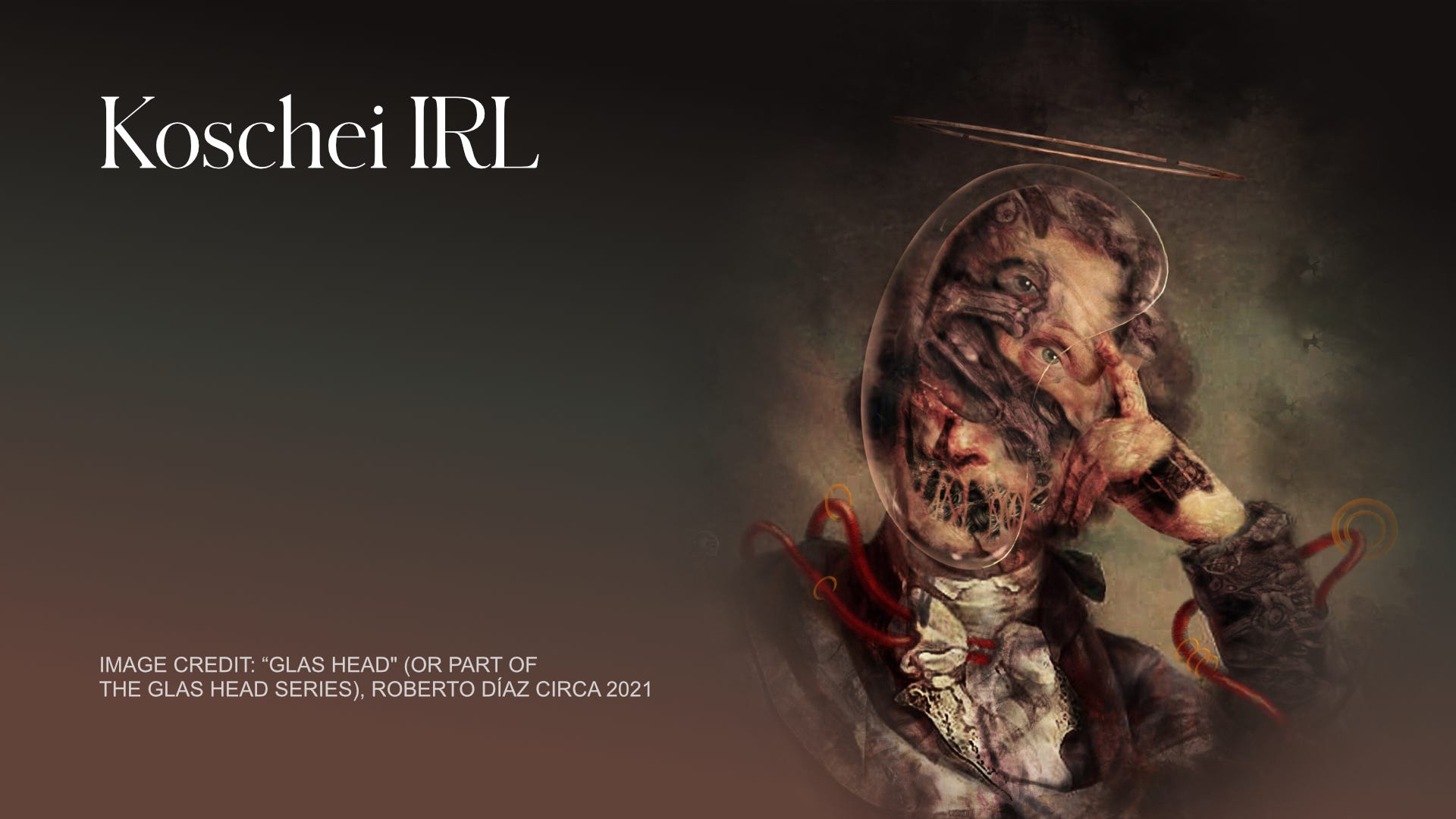
The real-world version of Koschei’s situation is, unfortunately, not all that unusual. People secure the closeness of others through guilt, dependency, control of resources, and control of self-confidence, and these things happen both consciously and unconsciously. Some people routinely criticise their partners due to an unspoken fear that if they felt too good about themselves, they’d leave. Those people, even if entirely unaware of their patterns, are playing Koschei’s unwinnable game.
And we slip into the very same trap on a smaller level when we keep secrets from our loved ones, too. When we feel shame, and we all feel shame, this dark emotion tells us to lock certain parts of ourselves away because if anyone sees them, it’ll all be over. So, we sweep that one detail under the carpet, telling ourselves that it’s for the best. But while that part remains hidden, no matter how seemingly insignificant it may be, we know that our whole self is not actually in the relationship – and how can we trust love that is based on an incomplete picture of who we are? “If they only knew the real me,” we lament, “they’d snatch that love right back.”
At a more general level, boys and men in particular are taught to love like Koschei. In many parts of the world, people socialised as male are taught that to be desirable is to be strong, stoic, guarded and in control. To make matters worse, movies, TV shows and books repeat the same lie to anyone who’s attracted to men, reminding us over and over that emotional men aren’t sexy; that male vulnerability is a turn-off. What they don’t tell us is that the men who do manage to fit the culturally decreed pattern for strong and sexy have had to sever and lock away the very part of themselves that makes them capable of connection.
Koschei could never have loved Vasilisa, and Vasilisa could never have loved Koschei – and some part of him understood this. He is a tragic figure who spent centuries chasing something he knew, deep down, he could never have.
Your inner Koschei
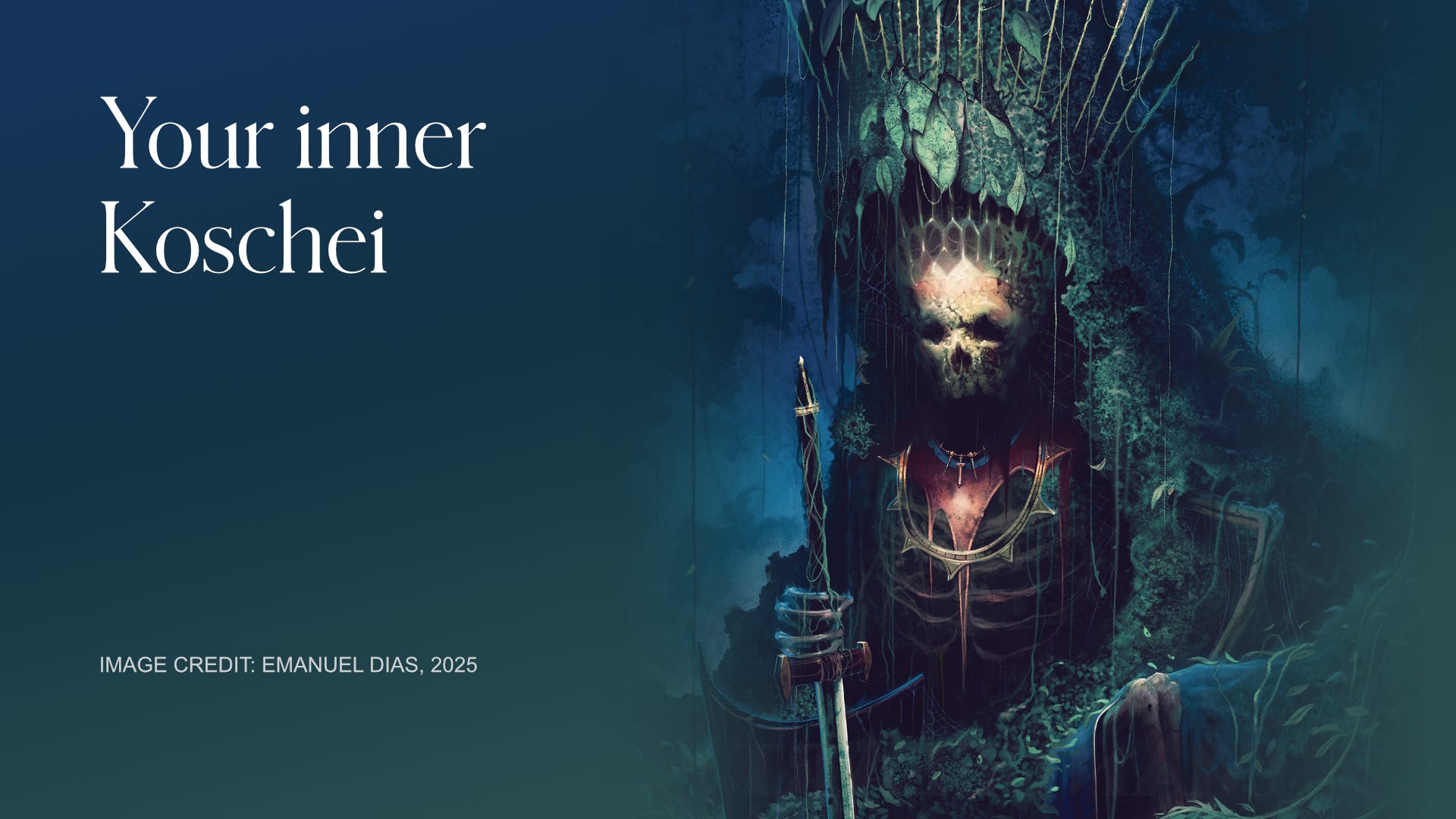
As bleak as all that can seem, the intrapersonal (as opposed to interpersonal) reading of this fairytale has a whole lot more to offer.
Jungian analysis of story casts the individual characters and other elements not as discrete external entities, but as interconnected parts of one psyche. Read this way, the story of Koschei the Deathless is about four archetypal parts of the personality that you, me, and everyone else harbour within.
So, let’s break the characters down to understand their various roles in our own inner worlds.
Koschei as Shadow Senex
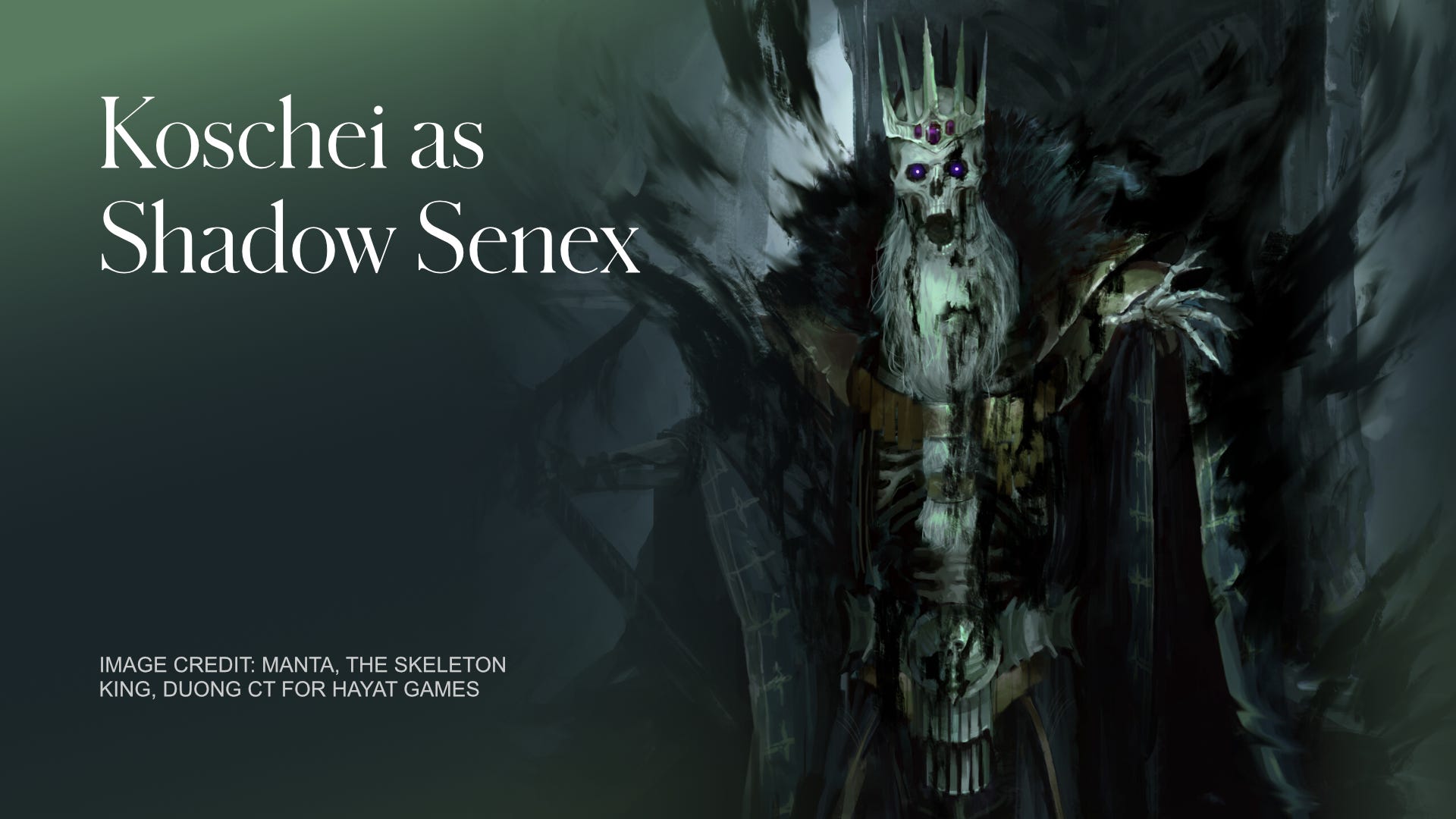
Koschei himself, as an expression of the Shadow Senex, is the potentially tyrannical inner force that chooses control and distance over vulnerability and uncertainty. This is a rigid, bitter, dogmatic and life-denying force that hates change as much as it fears weakness. We are not all consumed by this force entirely, clearly, but we do all have the potential to succumb to it.
The Shadow Senex doesn’t only show up within the context of love and relationships. You may recognise it as the instinct to double down rather than admit you’ve made a mistake or changed your mind. You may see it in the decision not to approach someone or something you’re interested in, because failure or rejection frightens you too much. Or in a stubborn tendency to stick to the tried-and-tested way of doing things rather than throwing caution to the wind and giving something entirely new a try. In short, it is the force that thinks it knows everything there is to know, that it can control everything in life, and whose withered old fingers will cling forever to that false sense of certainty.
The Senex itself doesn’t have to be a negative energy, though. In its healthy, integrated form, it is the “wise old man” archetype; a source of wisdom, guidance, and an adaptive capacity for order and discipline. This energy, when no longer at war with change and vulnerability, can offer its hard-won experience without needing to control the outcome, and can value order and structure without throwing its toys out of the pram whenever anything is out of place.
As with all archetypal forces, the version of the Senex we get depends on whether or not we’ve done the work to integrate it into conscious awareness. This means getting curious about it, observing our patterns of behaviour, and ultimately facing it. Which is exactly what Ivan is doing, in this fairytale, with the help of Bulat and Vasilisa.
Ivan as questing ego
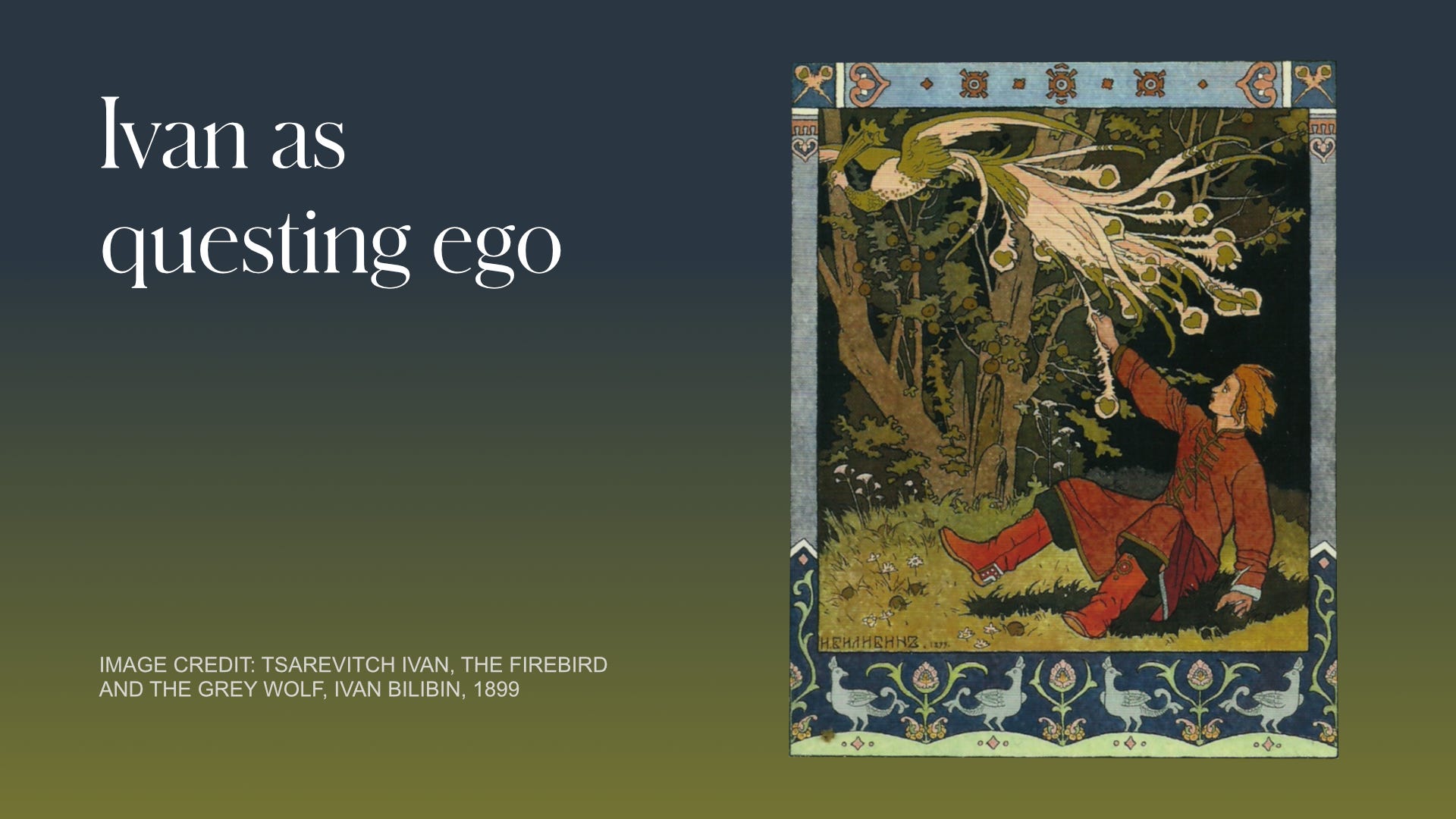
Because Ivan is the questing ego in this story. He’s young, a little naive, driven by a hope he can’t fully explain, and setting out to reclaim a part of himself that feels missing. That part (Vasilisa) is the very same part that Koschei has locked away, both on the island and in the castle – the anima, feminine principle or soul.
Where Koschei is old and set in his ways to the point of calcification, Ivan is only at the start of his journey. He’s therefore more flexible and better able to reflect and learn, which means he’s much more capable of winning Vasilisa. But that’s not to say that he has an easy time of it. He makes mistake after mistake on this journey, including falling asleep (that is, slipping out of consciousness) at the crucial moment. As a result, after being freed from one Shadow Senex (the king), Vasilisa is promptly whisked away by a second, even worse Shadow Senex in Koschei.
False integration
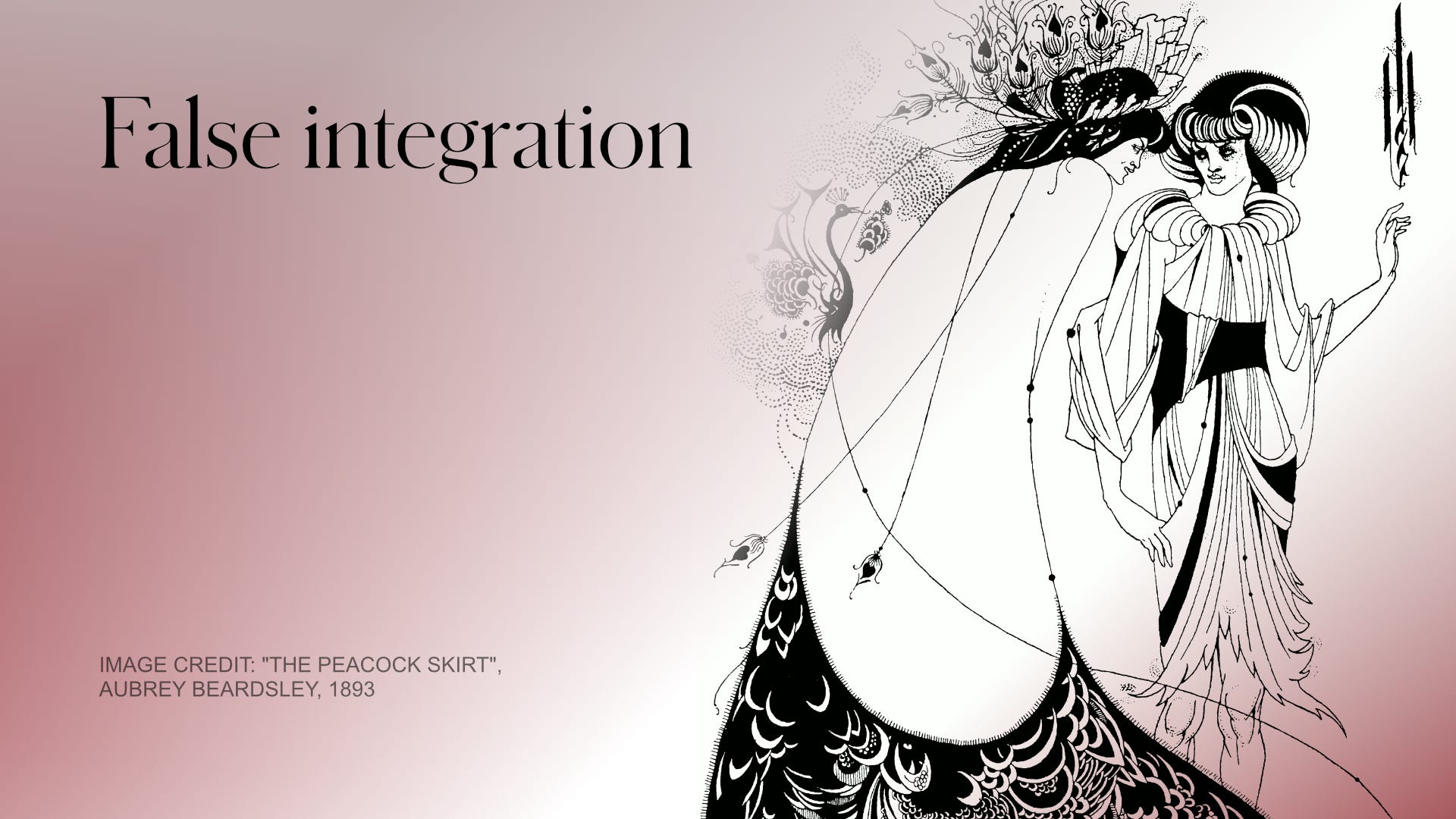
One way of looking at this motif of repeated abductions is to see Ivan and Bulat’s first rescue mission as a false integration: they didn’t truly free Vasilisa from the king, they just busted her out, which is like claiming to have overcome, say, a fear of heights by moving into a bungalow.
If we look at how Ivan and Bulat behave during that first mission, we’ll find that the story itself makes it clear that their first attempt to liberate the anima isn’t the real deal. Unlike on the second mission, where they show mercy to the kindly animals, on the first, they roast the three birds to get into the castle using trickery and deception.
Hurting defenceless animals in fairytales is a sure-fire way to come a cropper, because natural elements like these represent instinct and intuition – that is, the very ways of knowing that Ivan, at the start of his journey when the anima is lost, has not yet learned to listen to. So, instead, he sacrifices that knowing in favour of the more brash and slightly questionable heroics of Bulat the Brave.
We shouldn’t judge Ivan too harshly for fumbling his way through this first chapter, though. In our own lives, when we try to break out of old, rigid habits, we rarely do so gracefully from the off. Rather, we start by reaching for the blunt, clumsy force of pure willpower. The turning point only comes when we stop trying to ruthlessly conquer our internal world and instead learn to co-operate with it.
But none of that happens without a little blundering. The process of psychological integration is anything but a linear path – we all make mistakes, drop our satchels into the ocean, and take ill-timed naps when doing work like this. And while it would be lovely if it were easy, the self-connection we’d achieve in that case would be far from the deep, authentic awareness we truly crave.
The struggle, in other words, is an important part of the process. We just have to be courageous enough to face it.
Bulat as initiating courage
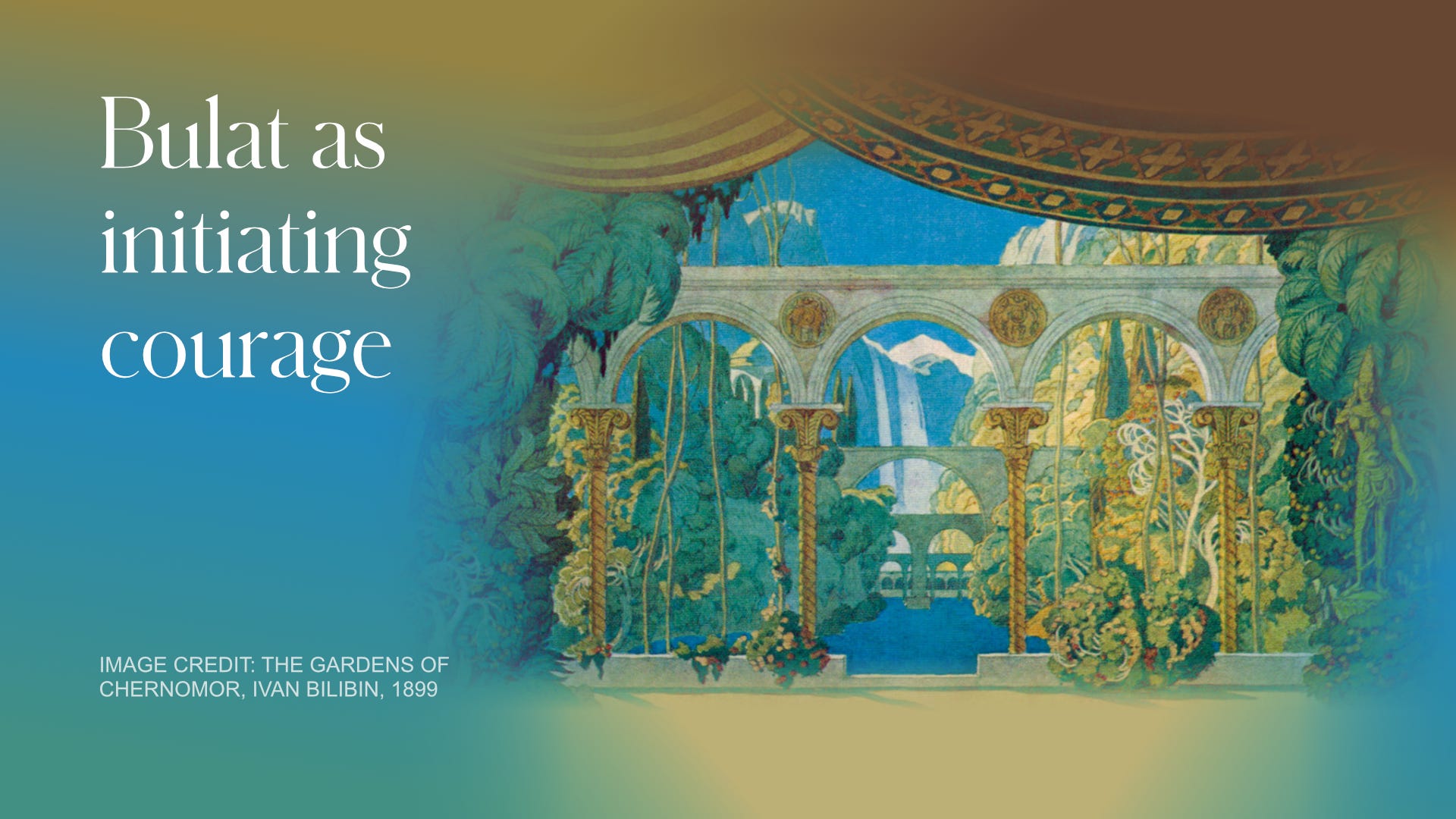
Which brings us to Bulat the Brave. This character can be read in a number of ways. In one sense, he represents the inner Hero – the part of the personality that offers courage, decisiveness, and the energy to take action. Bulat does all the thinking, talking, fighting, digging and carrying for Ivan, because he is Ivan’s go-getting self – the active masculine principle externalised.
But he’s not quite that simple. Bulat can also be read as a Psychopomp character or “soul guide” as well as a bit of a Trickster, and Ivan needs all of these things. The rigid, conscious mind can’t be dismantled by polite, conventional rules. Where Ivan, at the start, is rather passive, polite and naïve, Bulat is brave, raw, physical, cunning and prepared to colour outside the lines in order to get what he (well, what Ivan) wants.
Many of Bulat’s heroics – everything from killing the king’s men and Koschei’s shepherds to meeting Vasilisa in the garden – happen away from Ivan’s awareness. This is because he is not a fully realised, conscious force for the ego. Rather, he is Ivan’s very first understanding of his own interior world, and the bearer of the wild but necessary strength required for their quest to begin.
He is also, by the way, an aspect of self that we are socially pressured to keep under wraps – hence the flogging. Civilised society demands predictability, deference, and adherence to collective rules, and Bulat is opposed to these things. He is the part of you, me and everyone else that doesn’t respect arbitrary authority or social niceties – the part that simply won’t just lie down and be the good boy or girl the world wants us to be. As this is threatening to the governing forces that try to keep us in line, we’re encouraged to repress our inner Bulats and deny his disruptive, autonomous strength.
But if we do that, then our quests will never initiate. We’ll be forced to live the kind of superficial, sanitised existence that brings us Koschei rather than Vasilisa.
Vasilisa as the anima
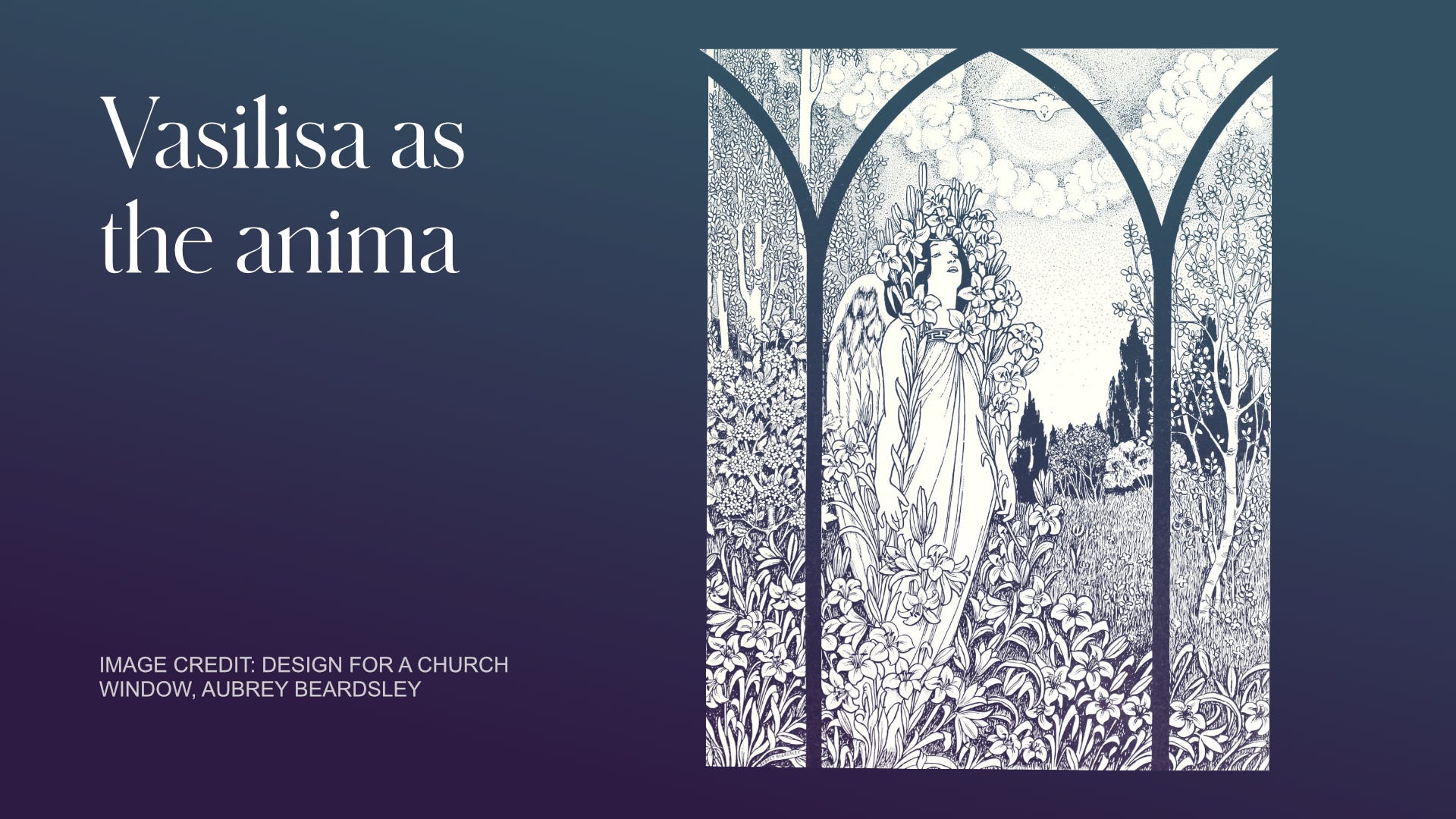
Lastly, Vasilisa, as already mentioned, represents the anima (or Eros, if you prefer) – the feminine principle of connectedness, relatedness, aliveness, emotion, depth and love. When this force is repressed – or imprisoned – and we find ourselves cut off from these things, what results is emotional rigidity, cold intellectualism, or sudden, explosive outbursts of irrational mood. We struggle to experience true intimacy, treating relationships like transactions instead. Creativity dries up, joy wanes, playfulness and laughter give way to a structured, results-oriented outlook on life.
As is virtually always the case in a fairytale, the anima is initially lost to the ego; trapped and immobilised by a world that has learned to prize control over nuance, and power over feeling.
But unlike in many damsel-in-distress storylines, where the anima figure is passive – just fretting away powerlessly in her tower or glass coffin while the hero does all the work – in Koschei’s story we get to see a more active, and in my opinion, far more realistic and helpful portrayal of this archetypal energy. Vasilisa is brave and clever herself, and she does the vital work of intuiting the truth of things. Without her input, Ivan would be screwed.
20th century folklorist, Vladimir Propp, noted that in East Slavic “wondertales,” female figures routinely fulfil the active role of the “Donor” or “Helper” who possesses the true operational magic of the narrative, without which the male protagonist would remain paralysed.
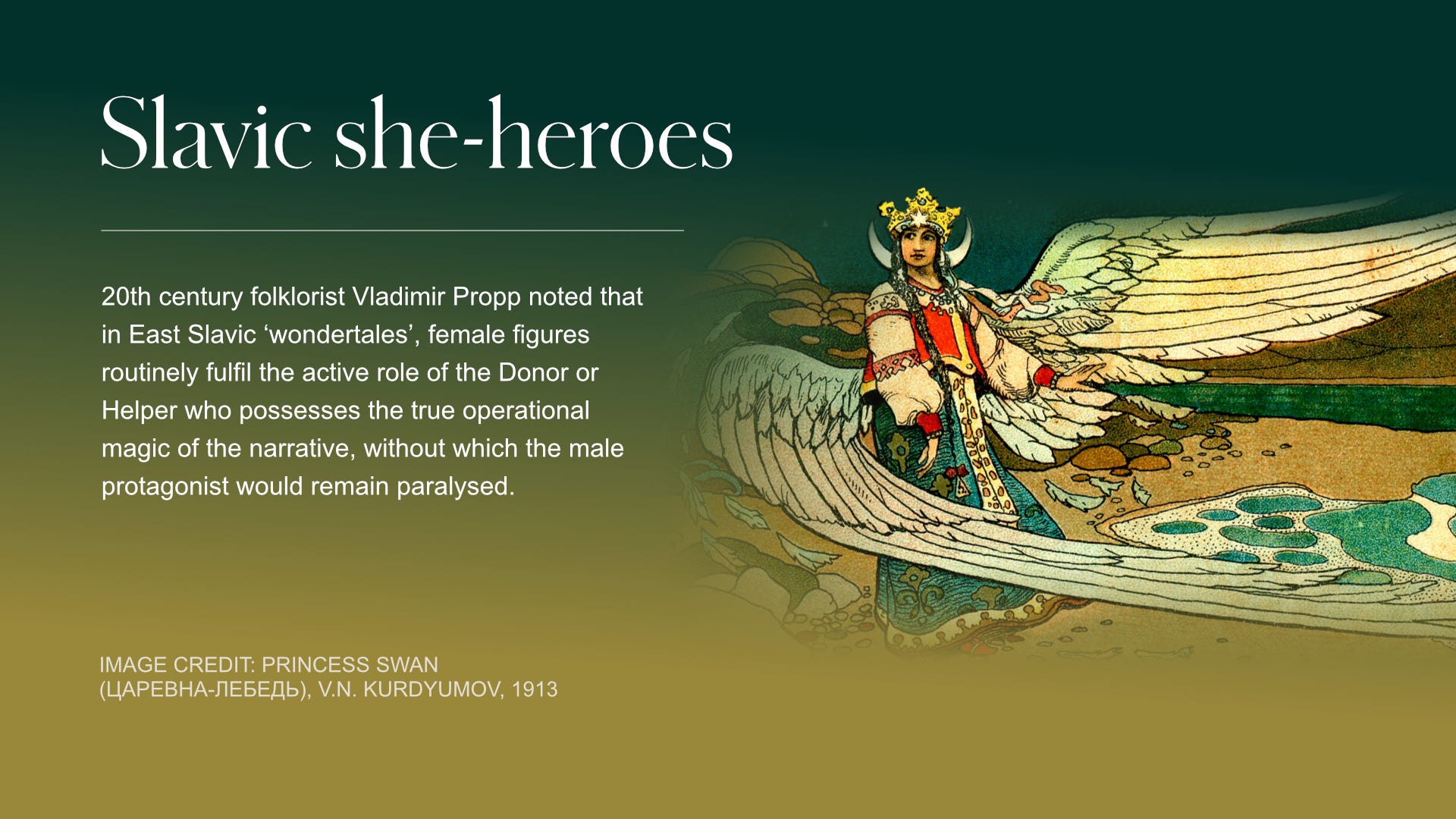
Fascinatingly, this is typical of Slavic fairytales, which are widely recognised to feature a significantly larger degree of feminine agency than their Western European counterparts. Across a number of stories, Slavic folklore elevates the feminine to a state of extreme autonomy, violent physical strength, or superior intellect – things we’d never see in a Brothers Grimm fairytale.
Why so different? Christianity, of course. Jungian scholars and folklorists attribute this dynamic to the relatively late Christianisation of Slavic regions, which meant that pre-existing pagan animist beliefs were never entirely subsumed. As a result, Slavic folklore shows us an anima that is freer of her patriarchal shackles – an active, dangerous, and utterly indispensable force for psychological wholeness.
Vasilisa as agent of revelation
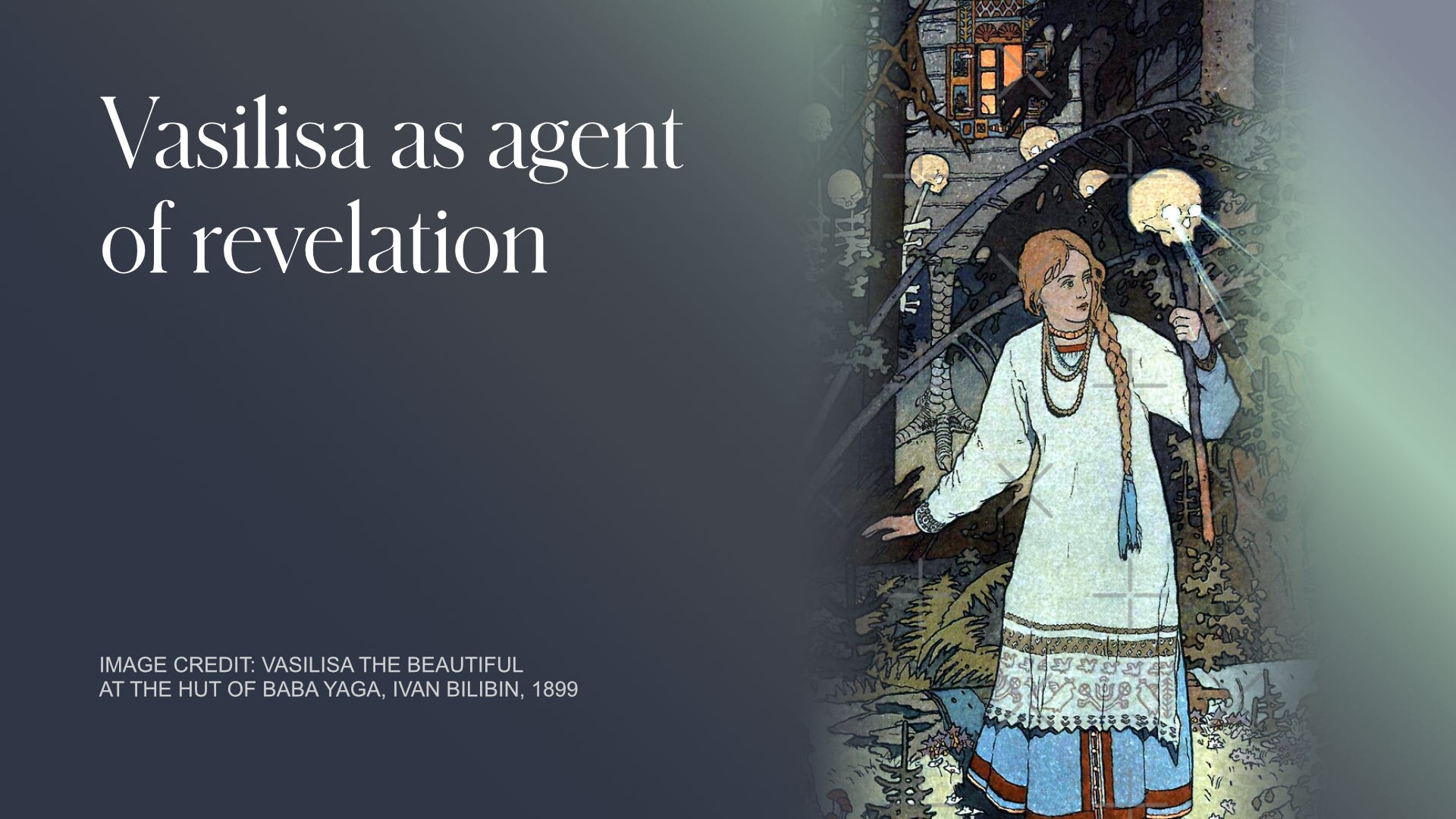
As such, Vasilisa shares with Bulat the responsibility for Ivan’s success, both characters serving as mediators between the conscious ego and unconscious forces like Koschei the Deathless.
And while it can seem as if poor old Koschei meets a particularly sad and sticky end as a result of Vasilisa’s betrayal, the interior reading of this story tells a different tale.
Vasilisa and the life/death/life cycle
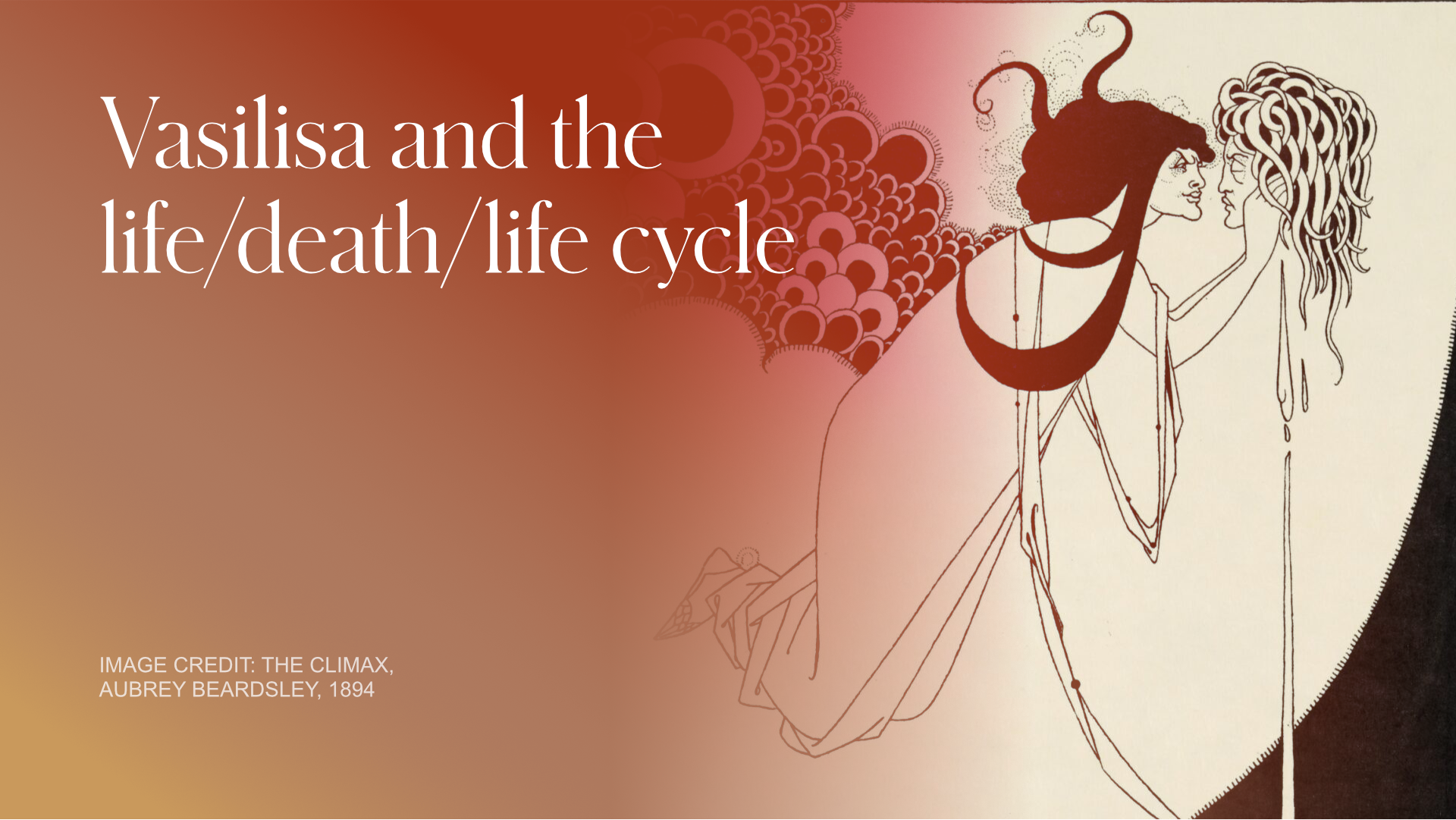
The anima presides over the whole cycle of life, death, and renewal – not just the giving of life, which is what she offers Ivan, but the releasing of what can no longer sustain itself, which is what she offers Koschei.
By the time Vasilisa encounters the sorcerer, he is literally a skeletal, rotting, exhausted thing, worn down by centuries of chasing what he could never have. He is lonely, but incapable of connection, and as such, just as trapped as any of the fair maidens he abducts.
When Vasilisa makes it possible for Ivan, the ego, to defeat Koschei, she is not merely winning her own freedom; she is granting Koschei his. Vasilisa releases him – finally and mercifully – from a suffering he had no way of ending for himself.
In a fairytale as in life, death is never a literal end, but a necessary transformation. Decomposing bodies fertilise the soil. Life becomes death, and death, in turn, becomes new life.
Koschei’s ending is no different. As the stifling reign of the Shadow Senex comes to an end, that archetypal force is not lost forever, but replaced, repurposed and reborn in Ivan, who goes on to become King Ivan – a more integrated and complete ruler, thanks to this quest that started and ended in compassion.
Ultimately, Koschei – just like Bulat and Vasilisa; and like the dog, and the eagle, and the lobster; and like the hare, and the duck, and the egg – is a piece of Ivan. He’s a troublesome, complex, and unconscious fragment of the self. This means that Ivan is not saving his soul from an external threat, but an inner one: from his own fear of vulnerability and change, love and life… His own fear of Vasilisa.
Koschei is Ivan, and Ivan is Koschei. Life is death, and death is life. To love is to risk endings, and the reality of an ending is the very thing that makes love true. In forced confrontation with the mortality he spent centuries fleeing, Koschei is finally given everything he’s ever sought.
Parting ways
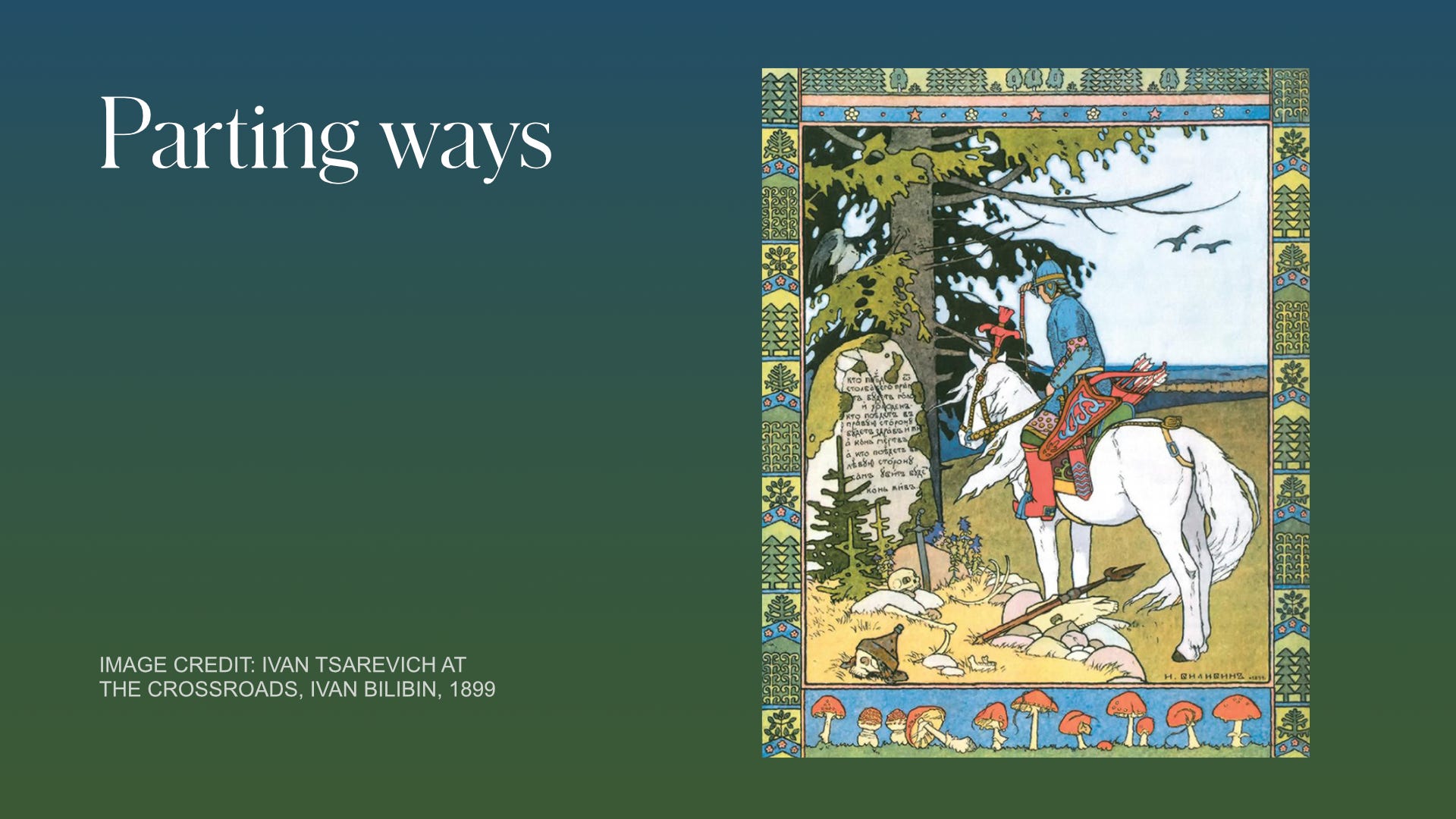
I’d like you to imagine, for just a little while, that you are approaching Koschei’s fortress. The path you follow is straight and flat and grey. But every now and then, you come across a little cluster of flowers – Vasilisa’s doing, surely.
Wood anemone: known as the windflower, its brief spring blooms are born out of grief and deep emotional processing in Greek myth – sprouting where tears hit the earth. It symbolises the highly sensitive, emotional, and intuitive landscape of the anima.
Wild iris: Named after Iris, the Greek goddess of the rainbow who acted as a messenger between the heavens and Earth, the iris embodies the anima’s function as a psychological bridge between the conscious ego and the depths of the spiritual, collective unconscious.
The delicate white petals of wood anemone flutter in the breeze. Wild irises in dusty mauve peel open as if made of liquid light.
You look up. The cold, unforgiving stone of the castle looms ahead, and every window is dark but one, within which you can see Vasilisa. Her skin glows faintly in the flickering light of the fire.
I wonder how it feels to lay eyes on this aspect of self: the part of you that carries your capacity to relate, connect, and form bonds; to dissolve the hard lines of the world by allowing for ambiguity, nuance and mystery. Your Vasilisa, who operates within the realm of feeling, where things cannot always be cleanly labeled as right or wrong, good or bad. Your Vasilisa, who is so much more than a passive mirror – a formidable force of transformational magic.
Your Vasilisa, who represents the vital life-affirming part of who you are that this world will try and try and try again to keep under lock and key.
How does she look to you, this force? Is she the slight, pale princess we’d imagine from Slavic folklore, or is she older, fuller, darker, realer? Your Vasilisa can be whatever you need her to be – active, strong and life-changing – for she has led you here, and now you are exactly where you need to be.
You enter the castle, quiet as a mouse, and stand at the door to the chamber, watching. Vasilisa turns away from the fire, leading your gaze to Koschei. He sits on a crumbling old throne, wearing robes that fail to conceal his emaciated form. Your eyes trail over the protruding bones, the stretched, desiccated skin – the undeniable evidence of lifelessness born of a refusal to face the uncertainty of change.
And as you look at him, you might wonder what it is, exactly, that he has buried. Whether he has, indeed, decided that his own heart is so dangerous a secret that he has locked it away in a strongbox, too terrified of betrayal ever to let it be seen.
Or whether the risk your Koschei most fears is insignificance – having fixated on the acquisition of success, not knowing its own value because it has hidden the needle of self-worth deep in the ground on an island of productivity.
Your Koschei could be a perfectionistic force that seeks safety in doing things better than anyone else – a part that has buried its right to make mistakes, and now finds failure around every corner.
You stand and look at the sorcerer for the longest time. His thin grey hair drifts in that curious breeze. The flames in the fireplace gutter. And it’s at this moment that Koschei senses your presence. He sits upright like a scared animal, searching the shadows for an unknown threat. His nostrils flare, his eyes dart about and you can feel his strength filling the room. Because that’s what happens when change is nigh – the part that wants to cling to the stifling discomfort of the familiar panics, tries to summon its power, to resist the transformation.
Vasilisa smiles the tiniest of smiles and reaches over to hold the old man’s hand. Everything stills into silence. She looks at him, and he looks at her – and can’t you now see, in the hollows of his eyes, the spark of longing that he’s so afraid to admit?
While there’s no way to know, for sure, what would happen if you were to do so, it’s always a good thing to wonder what it would mean to re-ensoul this old, old part of the psyche. To reunite Koschei the Deathless with his heart, his worth, his right to try and fail. With his humanness, his vulnerability. His love.
In your hand, as you look down, you find an egg. How long you’ve been holding onto it, you couldn’t say. Perhaps it’s always been there.
And you don’t need to break this egg if you’re not yet ready to do so just yet. You can hold onto it until such a time as you are. Or you could find that you have the courage right now – to crack it open, letting the soft potential on the inside flow into the world… into Koschei, who you realise now is looking rather longingly at it. Not Vasilisa, but the egg, though the two are one and the same.
Koschei looks at the egg because that’s what he truly desires. What he’s always wanted. Beneath the rigidity and control, beneath the rules and the striving, Koschei the Deathless just wants to be able to feel.
And he can, can he not?
Thank you so much for watching. This was brought to you by Betwixt: The Story of You, and if you enjoy the idea of narrative-based self-reflection, then you may like our app, too – a fantasy adventure into the magical landscape of your inner world.
–
References
Afanasyev, Alexander. Narodnye russkie skazki (Russian Fairy Tales), 1855–1863.
“The Death of Koschei the Deathless” (Marya Morevna), trans. Andrew Lang, The Red Fairy Book (1890): https://en.wikisource.org/wiki/The_Red_Fairy_Book/The_Death_of_Koschei_the_Deathless
“Koshchey the Deathless” (Vasilisa/Bulat the Brave variant), Afanasyev’s Russian Fairy Tales, summarised: https://www.goodreads.com/topic/show/2166006-the-death-of-koschei-the-deathless-maria-morevna
Weiser, Jason. “Koschei: The First Horcrux.” Myths and Legends Podcast, Episode 5B, 2015: https://www.mythpodcast.com/294/transcript-koschei-the-first-horcrux/
Wikipedia, “The Death of Koschei the Deathless” (ATU 552/302): https://en.wikipedia.org/wiki/The_Death_of_Koschei_the_Deathless
Reading the Ulster Cycle, “External Soul” (motifs E710, K975; ATU 302): https://ulstercycle.hcommons.org/tag/external-soul/
von Franz, Marie-Louise. Shadow and Evil in Fairy Tales. Shambhala Publications.
von Franz, Marie-Louise. The Interpretation of Fairy Tales. Shambhala Publications.
von Franz, Marie-Louise. The Feminine in Fairy Tales. Shambhala Publications.
Propp, Vladimir. Morphology of the Folktale.
Tatar, Maria. The Heroine with 1001 Faces (2021).
Haney, Jack V. The Complete Russian Folktale.
Ivanits, Linda J. Russian Folk Belief (1989).
Fedotov, George P. The Russian Religious Mind, Vol. 1: Kievan Christianity (1946).
Hubbs, Joanna. Mother Russia: The Feminine Myth in Russian Culture (1988).
Maas, Sarah J. A Court of Splintered Harmony (ACOTAR 6), Bloomsbury, forthcoming Oct. 27, 2026 – Koschei the Deathless as central antagonist.
Hazel, this moved me deeply. I have spent much of my life learning the difference between being safe and being so fiercely guarded that little of life can reach me.
There is a painful irony in how we sometimes preserve ourselves at the expense of living. I recognise something of that in my own history, and in the slow, often uncomfortable work of learning that safety and vulnerability need not be opposites.
I am coming to understand that courage is not measured solely by what we endure, but also by what we allow ourselves to feel.
I love how mythology carries the ancient contradictions of human nature across centuries, allowing us to recognise something of ourselves in its telling.
Thank you, Hazel, for the humanity and psychological insight you bring to these stories. I am genuinely grateful to have encountered your work. ✨🫶🏼🌙🤍