


You can listen to this piece on YouTube or read it below.
***
There are some things you know before you can explain them: instincts about people, a decision you’re making, or a need left wanting. And then there’s that other voice that comes just after that kind of knowing; the reasonable-sounding one that pooh-poohs the initial thought, or worse – demands proof. Today, we’re meeting the witch who can teach us how to honour the former, and who turns the latter into pigs.
My name is Hazel Gale. I’m a therapist, author, and co-creator of the fantasy mental health app Betwixt. And this is the first episode in a series on the witch as archetype, and the magic that lives inside of you.
Head’s up: there are spoilers coming, if you can say such a thing about the myth of Circe, but also for the wonderful Madeline Miller retelling of her story. And you should know that this piece contains a short but evocative description of violence against a woman.
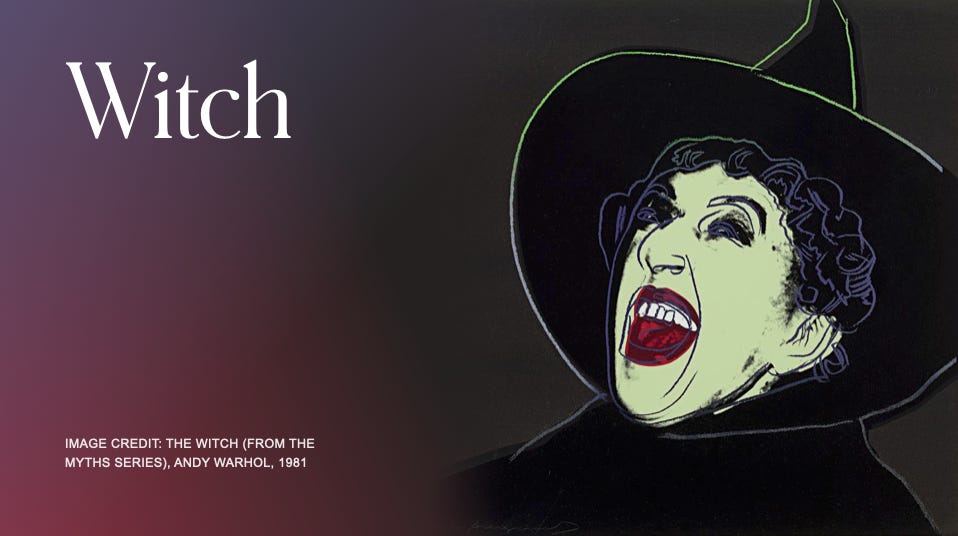
In terms of archetypal psychology, the Witch is the undomesticated feminine force within, or what Clarissa Pinkola Estés called the Wild Woman Archetype. She lives inside all of us, regardless of our gender, and she refuses to be tamed.
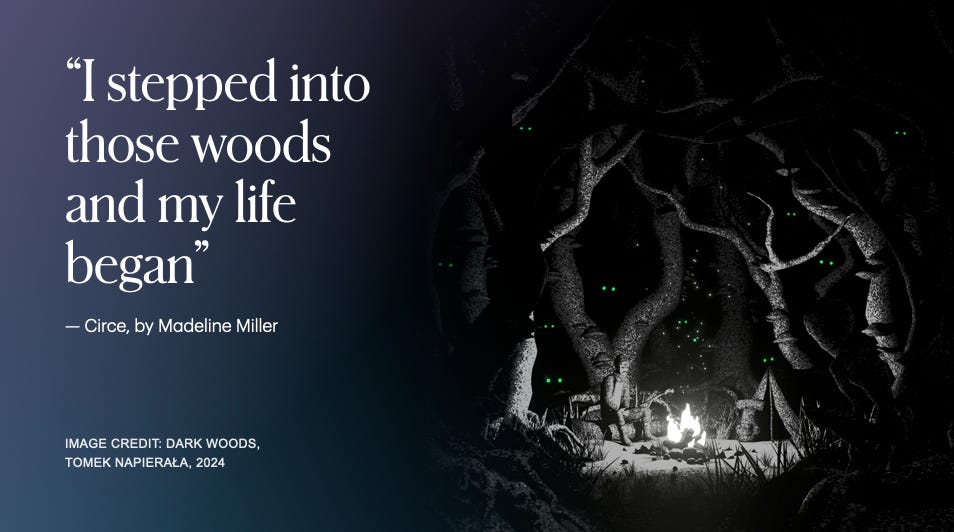
Witch wisdom exists beneath language and logic, and lives far, far away from our carefully constructed public-facing selves. This is why, in story, she resides in a cabin at the edge of woods, or in some similarly isolated threshold place where her particular power finds its roots. She cannot and will not integrate into the familiar, social, structured world, because the Witch is, in her essence, an archetype of liminality. She exists in the space between the seen and unseen, the living and the dead, the known and the unknowable, and also between what the world wants us to believe and what is actually true.
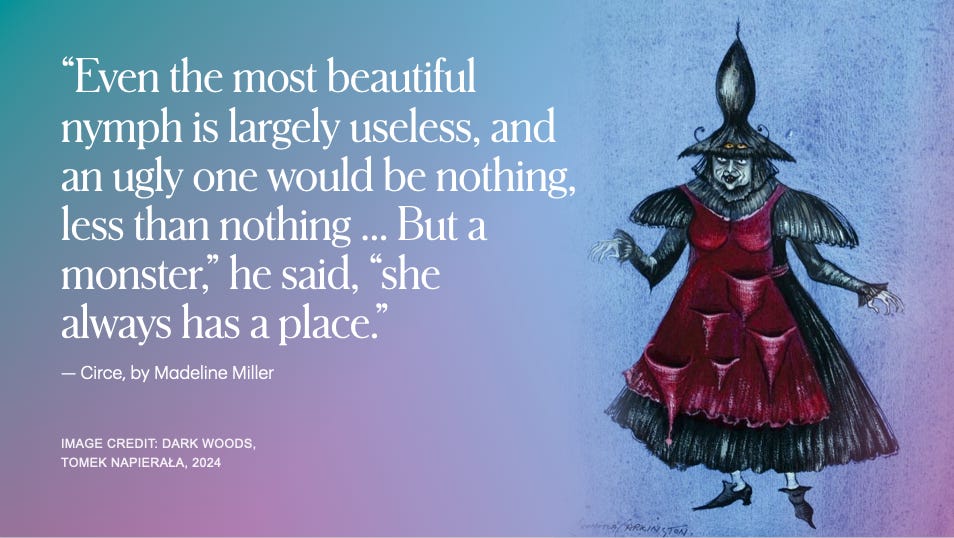
In spite of millennia of literal persecution, the Witch has survived. This series honours her many faces and varied powers. In each episode we’ll meet a different expression, starting with the story of a goddess who is sent away to live alone because her knowledge is considered too powerful and too dangerous. But what she knows, you also know. This is how to remember.
Circe – goddess, witch, exile
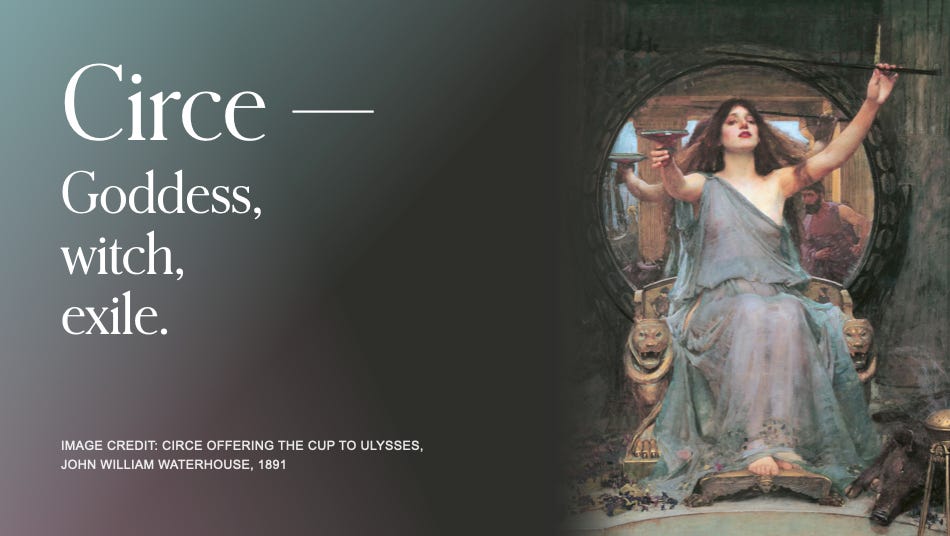
From her very first breath, Circe is between worlds. The daughter of Helios, the god of the sun, and Perse, an Oceanid water-nymph, she is neither fully a goddess (she has no obvious power, no seat on Mount Olympus) nor fully mortal (she doesn’t age or weaken, she doesn’t die).
Circe’s family is cold and unwelcoming. Her father is a Titan, and therefore of a different order to his nymph wife and children. Her brother Aeëtes is calculating and ambitious. Her sister Pasiphaë is renowned for her ruthlessness, and for becoming the mother of the monster that is the Minotaur.
Neither the most beautiful, most powerful, nor most valued, Circe watches her family from the sidelines. She observes. Until, one day, this is not enough.
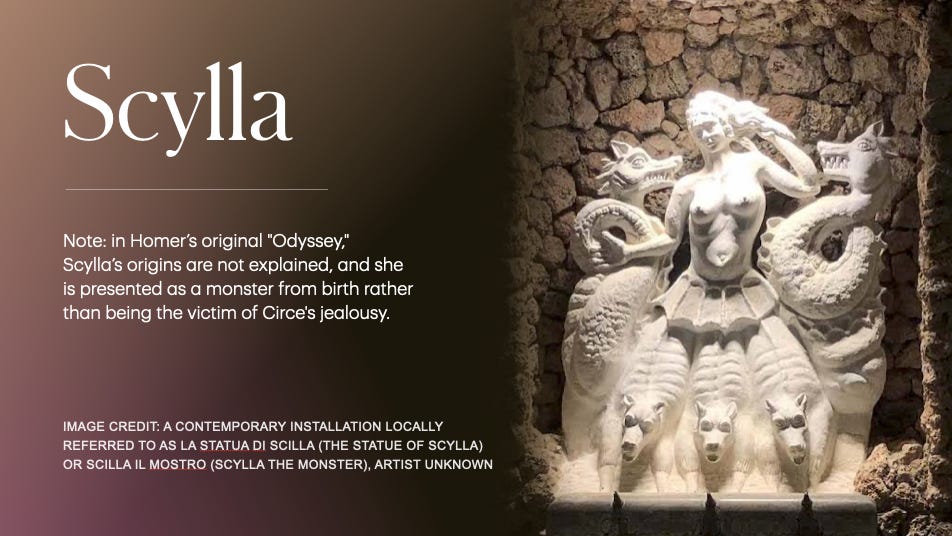
Consumed by jealousy and the pain of unrequited love, Circe transforms a fellow nymph named Scylla into a terrible six-headed sea monster, and the gods do not forgive her for this. As punishment, Helios carries her across the world in his chariot and drops her on an empty island named Aeaea, where she is to live out her immortal life alone. This is her exile. But this is also where both her story and her power truly begin.
What happens in the silence
In her essay “I Hate Strong Female Characters”, Sophia McDougall argues that the modern “strong female character” is often little more than a box-checking exercise where a woman is given a sword or a gun, but no real agency or depth. Rather, her arc is reactive to violence and trauma, with her strength defined almost entirely by her ability to withstand misery without complaining.
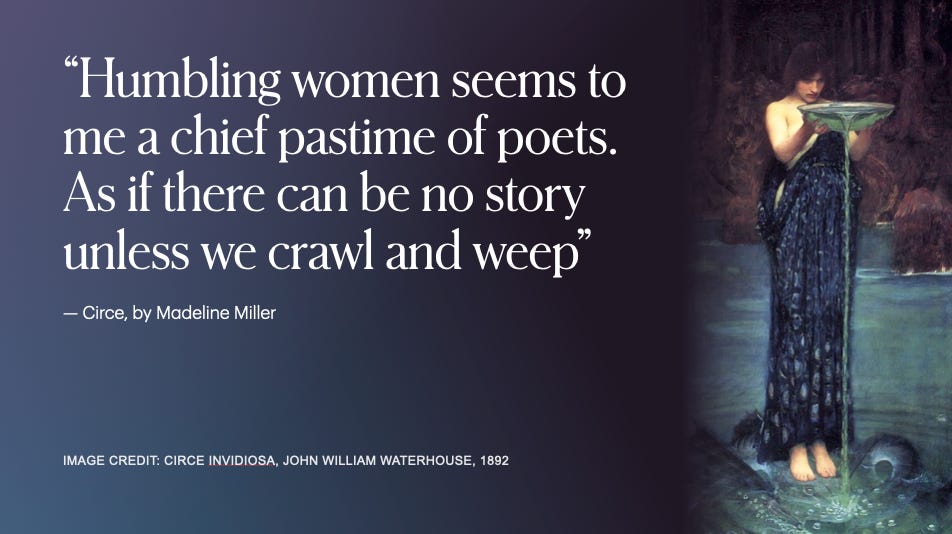
Many tales of powerful women are stories about what they lose more than anything else. Circe’s is one of these. She loses everything: family, connection, belonging, and the possibility of being accepted by others.
In real life, even now, the inner witch is still largely in exile. Pinkola Estés writes about how women (though I’d argue it’s women, men and everyone else) have been cut off from our wild, instinctual power as a result of the pressure we’re under to conform to what the world expects us to be.
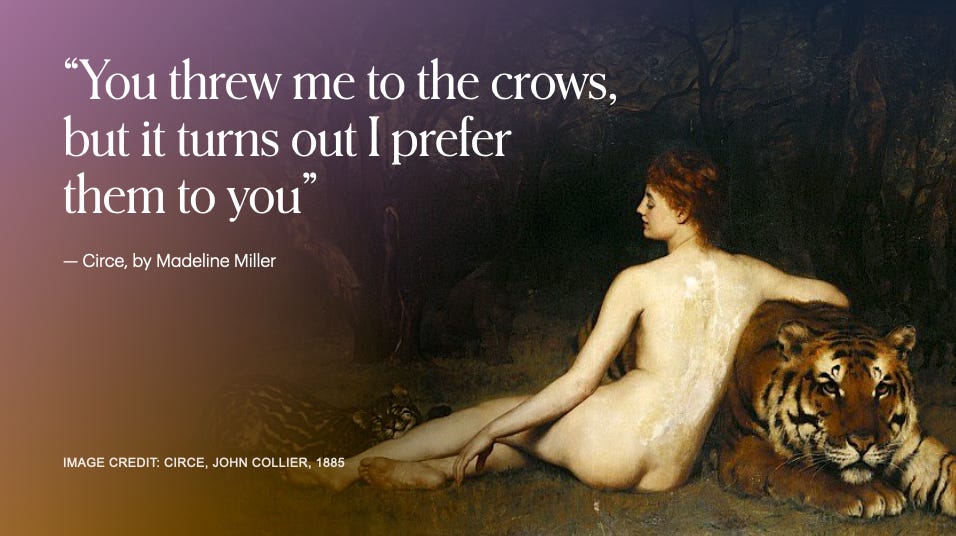
In Circe’s story, we see this exile as a real, external situation. But we also see the gift therein, because what she discovers in her solitude is the awakening of her natural, powerful self.
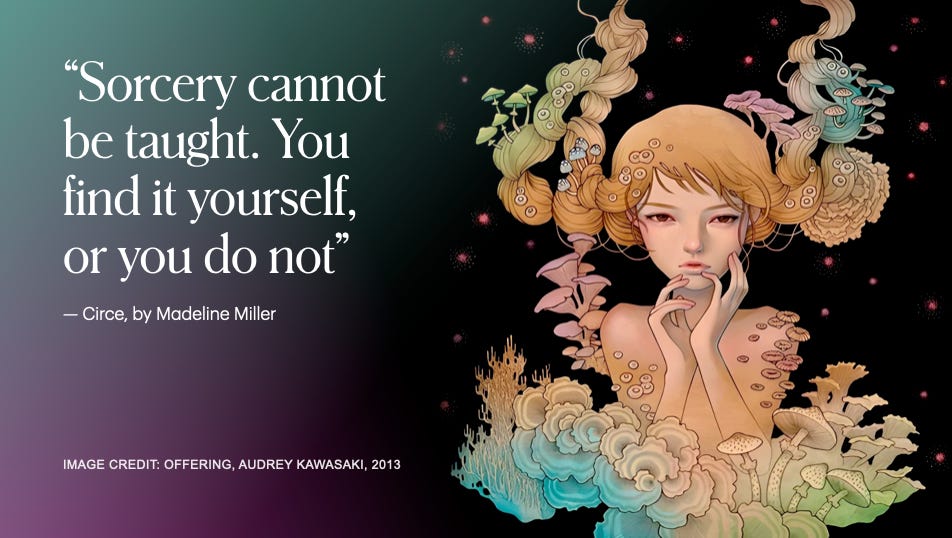
On Aeaea, Circe begins to learn. She learns how to trust herself in the woods. She learns the names of plants and what they’re capable of. She makes mistakes, of course, and she learns from those too.
Crucially, this learning is self-initiated and self-governed. With no teacher and no tradition to follow, she grows powerful by paying attention, and by trusting the part of herself that knows things before she knows she knows them. Intuition, instinct and her authentic felt-sense – these are the things that bring Circe alive in her exile before sailors begin to find her island, the most famous of these being Odysseus’s men.
The gift of transformation
The men arrive, lost and hungry, and Circe offers them a feast of food and wine. Then, she transforms them into pigs. Odysseus, having been intercepted by the god Hermes and given a magical plant named moly so that he’d be protected against Circe’s magic, escapes this fate. After some negotiations, Circe then restores the sailors to their human forms and she and Odysseus become lovers. She eventually bears his son, Telegonus.
In Homer’s Odyssey, Odysseus’s men are described as cautious, respectful and grateful to Circe for her initial hospitality. Later Greek and Roman philosophers, such as the Stoics, however, read The Odyssey allegorically and came to some different conclusions. They argued that Circe’s island represents the temptation of physical pleasure. In their view, the men “acted like beasts” by giving in to the appetites of gluttony and lust, and their physical transformation simply mirrored their lack of self-control.
Whichever reading you favour is of course up to you. I, fairly predictably, prefer the latter and therefore enjoy retellings like Madeline Miller’s novel. In Miller’s version, Circe welcomes the first sailors to her island, happy to offer her bounty freely in exchange for real company. But, unaware of her divinity, when they realise that she is a woman on her own, they choose to take more than just food and wine from Circe. The captain holds her against the wall by her neck, crushing her windpipe and silencing her voice as he assaults her.
Afterwards, when she drops to the floor, released and therefore able to speak again, she curses them all as an act of self-preservation as much as vengeance. If we ignore the fact that this throws some serious shade on the poor, innocent pig, this is also an act of revelation. When Circe turns the beastly, greedy men into swine, she is revealing the truth of things.
Which is exactly how intuition works. The conscious mind and ego are great at constructing stories and rationalisations. Excuses, in particular. But intuition simply sees what’s there, whether we like it or not. As such, it’s impervious to criticism, argument and gaslighting, which is precisely why it has been viewed as dangerous for as long as it has. You can’t control the truth; you can only try to hide or quiet it.
Circe needed to be free of the familiar world’s stifling rules to reawaken this knowing for herself and become tremendously powerful as a result.
Intuition
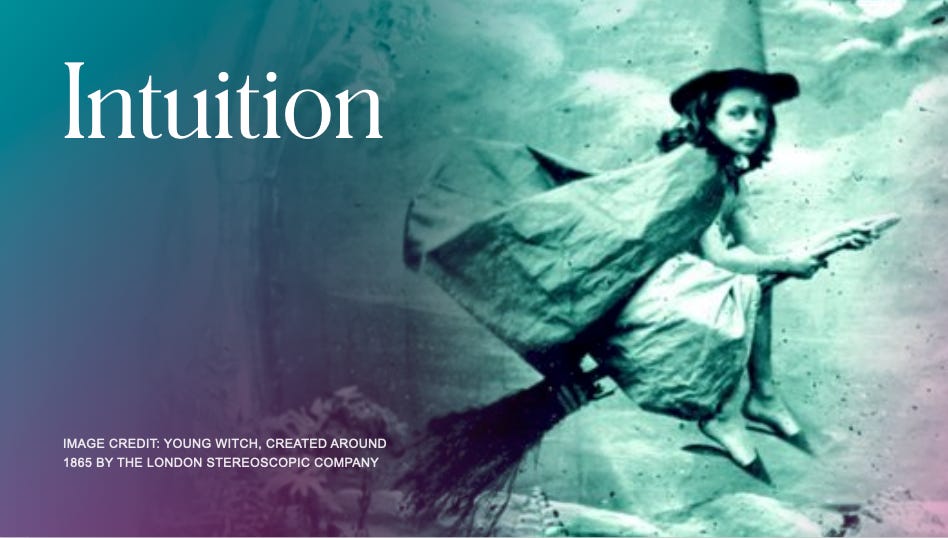
So what actually is intuition, and can we really trust it?
The research on this is interesting, and it says neither intuition is the stuff of unreliable whimsy nor that it is a faithful, all-purpose means of getting to the truth. Rather, it shows that intuition is reliable under certain, specifiable conditions.
To understand these, we need to look to two contrasting researchers. Daniel Kahneman spent decades cataloguing the failures of intuitive judgement, while Gary Klein spent his career documenting its successes. Eventually, they agreed to work together to see who was right, and found that they both were.
Their combined research showed that intuition is a skill that involves trained pattern recognition, and that for this skill to be reliable, two conditions need to be met. First, the situation at hand has to contain genuine patterns (that is, reliable cues that repeat). Second, you need to have had enough exposure to those patterns to have learned the cues well enough for your intuition to be on the money.
Situations in which intuition is next to useless include stock picking, long-range forecasting, and predicting how well a job candidate will perform two years after an interview.
The domains where instinct is genuinely trained, however, are the more present and/or human ones, such as: feeling the wrongness in a situation you know particularly well; reading the emotions or intentions of the person sitting opposite you; sensing a change of vibe in a group; or knowing that something is off in a relationship.
I think many of us at least sometimes trust our gut when it comes to specific circumstances that we know better than others, but feel less certain when it comes to people. Unless you’ve been living on a remote island, however, you’ve had a lifetime of exposure to people, with constant feedback, much of it painful and therefore memorable. This means that you are, whether you believe it or not, an expert at people – at least, the people you know, anyway.
Somewhat infuriatingly, the more human, everyday contexts in life tend to be where we’re told to be rational, objective and “less emotional” in our judgement-making. Meanwhile, gut-trusting is applauded in exactly the arenas where the evidence says it fails – markets, gambling, and hunches about the future. In other words, we have it perfectly upside down, and I’m sure this has absolutely nothing to do with the fact that reading people and tending relationships have long been considered women’s work (child-rearing, home-making, nursing and caring professions), while stock markets, casinos and the various professions that involve long-range forecasting are more male-dominated.
Be that as it may, I’d say these findings are encouraging overall, because the things most of us actually want to trust ourselves about are the things we probably can: who we can open up to; when to leave a relationship; whether our friends or partners are happy, scared, too tired, etc.; and whether something is right for us. When it comes to these things, we have spent our entire lives gathering data. And that means our gut *may* be more reliable than the obvious or expected answer to our questions. The problems arise when our intuition is at odds with either other people’s opinions or social norms and expectations. Because we haven’t been taught to trust it, when instinct and expectation pull in different directions, it’s far too easy to be swayed by the ways of the outside world.
Perchta, The Belly-Slitter
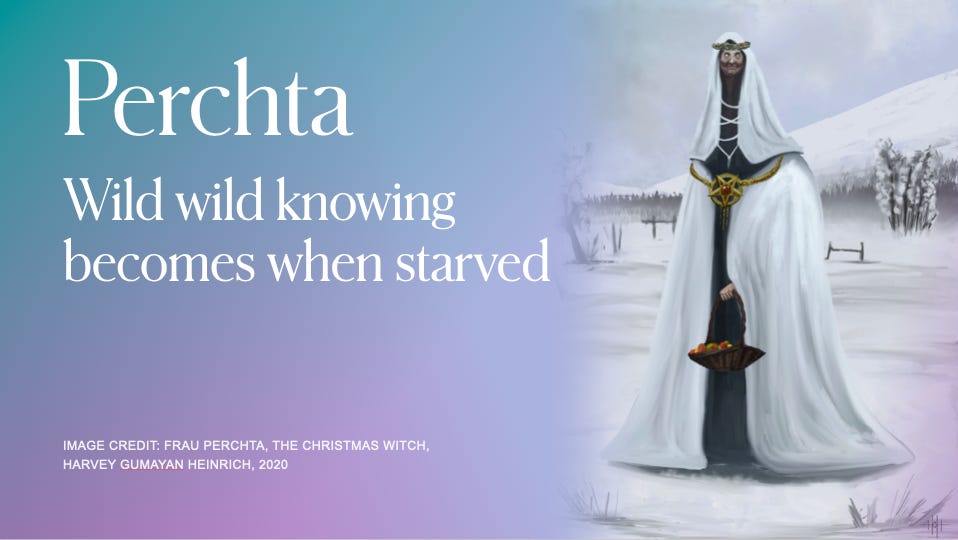
In each of these articles, we’re going to meet both a witch and her shadow – an often frightening example of what happens when Witch wisdom is repressed, ignored or, as in the case of today’s shadow, domesticated.
According to mythological historians like Jacob Grimm, Perchta was originally an ancient pagan goddess of winter, the home, and women’s crafts. When Christianity spread through the Alpine regions of Austria and southern Germany, however, church officials stripped away her divine status. Over centuries, she devolved from a powerful, dual-natured deity into a terrifying, witch-like bogeyman used to frighten lazy children.
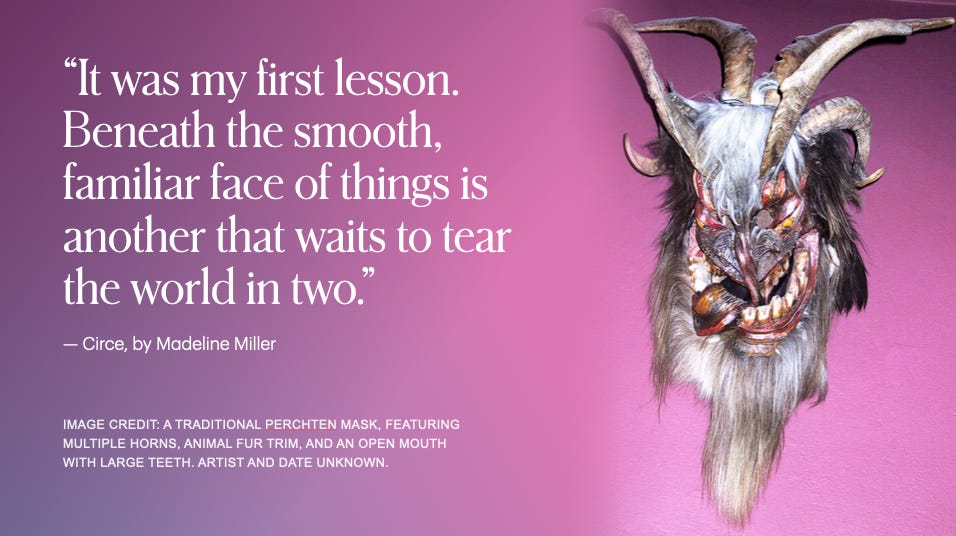
Frau Perchta – aka the Christmas Witch or, horribly, the Belly-Slitter – comes in the twelve nights between Christmas and Epiphany. She has two faces: one is bright and beautiful, associated with spinning, the hearth, and the giving of rewards to children who do their chores; the other is a truly terrible monster who seeks out the shirkers, and opens them up to remove their organs before filling them with straw.
So, in one way at least, Circe and Perchta are similar – if you step out of line, they’ll show you what exactly you’re made of – but in other regards, not so much. Perchta is Circe’s shadow because, while they’re both fearsome feminine forces, they meet very different fates – largely because one is confined to the home while the other is allowed to roam free on the island of Aeaea.
Circe, exiled, discovers her wild knowing and uses it to become something extraordinary. Perchta, caged in domesticity, presides over a world that sustains life but is rarely celebrated, and becomes a near-invisible cautionary tale.
I think Perchta is a cautionary tale, but not for children who haven’t tidied their bedrooms. Rather, she shows us what happens when wild knowing is belittled, tamed and systematically suppressed: it waits for the cold of winter, in which it sours into vicious judgement, pain, and the hollowing out of our humanity.
Perchta’s silence in the modern world
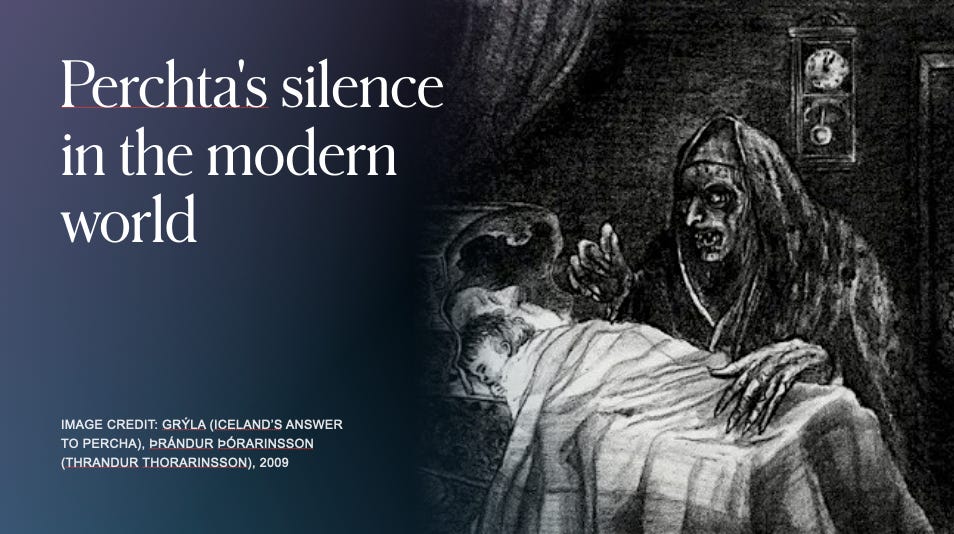
In the modern world, we see the real-life effect of the wild knowing’s domestication in the silencing of our intuitive instincts, which happens day in, day out in a culture that values logic and, in particular, reason over other ways of being sure.
In 1991, researchers Wilson and Schooler asked people to make choices, having first required half of them to write down their reasons. The reason-givers made worse choices, and in a later version of the study were still less satisfied weeks afterwards. In short, thinking about why they wanted something made them pick things they liked less.
Why? Because when we introspect on our reasons, we gravitate towards whatever’s easiest to put into words. And what’s easiest to put into words is whatever the world has already described to us – that is, long-accepted ideas or opinions, and the sensible or respectable choices that won’t rub people up the wrong way. Intuition, though, is by definition something that exists away from language. When forced into the world of reason, it will lose the argument every time.
But why would you want to leave such a cushty job?
Why end the relationship when they’re so lovely most of the time?
Why give that person such a wide berth when they haven’t done anything wrong (yet)?
What is your REASON?
Each of these questions is an invitation – nay, a demand – for us to present something explicable, and the moment we do that, we are forced to edit our wilder knowing into something the world can accept. We are forced to tame it. Or, to domesticate it.
If we wish to preserve our intuition, and keep hold of it as something we can hear, understand, honour and trust, then we need to be willing to do one very particular and very uncomfortable thing: stop explaining ourselves. We need to be able to say, “I don’t have words for it yet, and I’m not going to invent some just to make you feel comfortable.”
There is always a gap between knowing something and being able to defend it, and it is in that gap that we get rerouted.
What Circe’s time in exile truly shows us, then, is that the permission to stay unexplained in front of others is the very soil in which our personal magic can take root.
The invitation
Circe and Perchta demonstrate two possible experiences of the wild knowing: as a banished but powerful force that gains our trust when given space and silence; or as lowly, less-than-credible women’s stuff that’s forced to sit around and wait for someone to pay attention. Which is never.
The world we live in serves us Perchta’s version, not Circe’s. With intuition relegated to the shadows, our go-getter, success-forward culture prioritises accumulable knowledge and defensible reasons. But the Witch couldn’t give a rat’s tail about any of that. She’s only interested in the knowing that she knows all of us have already, and whether or not our ears are open to it.
So, are yours?
Thankfully, we don’t have to be literally exiled to escape the shackles of conformity – Circe did that so we don’t have to, and now she lives inside of each and every one of us, in a quiet, beautiful land full of wild and wonderful things.
I think it’s time to meet her, don’t you?
To the island
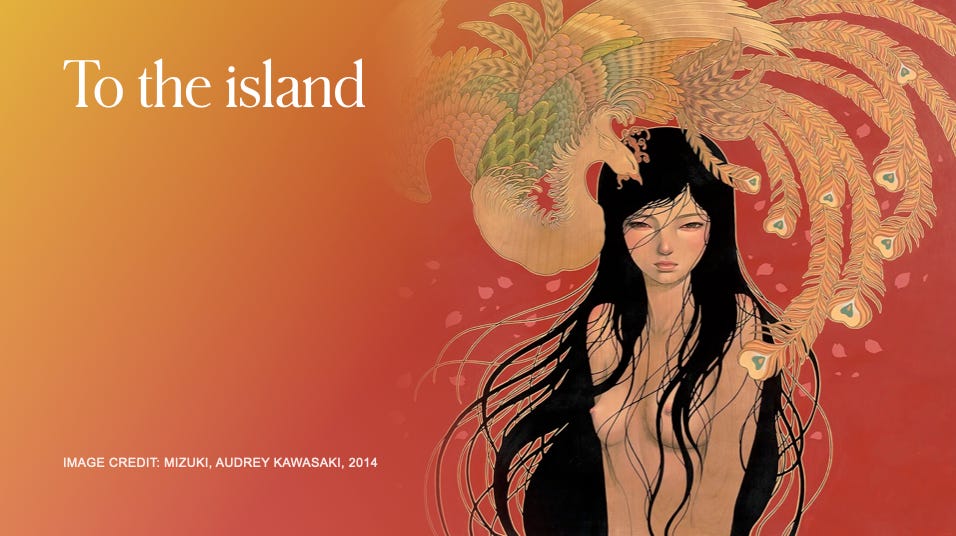
Imagine that you’re standing at the prow of a boat, approaching the island of Aeaea. At first, the shore looks like nothing but perilous rock and crashing waves. But then the glamour lifts and a paradise makes itself known. Circe knows you’re coming. She has opened her home to you.
You follow a narrow track through the grass towards the cottage – the kind of path made by a single pair of feet that have walked the same route ten thousand times and more. The witch is in the garden when you arrive, bending over a dense plot of herbs; some you recognise, some you don’t. She doesn’t look up from her work as you approach but she knows you’ve arrived. Once you’re close enough for your mortal ears to hear her, she simply says, “Come.”
When you tell this story later in life, you’ll find you have no idea how long you spent on Aeaea. Your time with Circe seems fluid, almost circuitous. Days and nights merge, seasons roll into one. You learn the island as if it is a part of you – where to find food and water, where the moss grows thickest in the woods, and how to read the shore before the weather turns.
Circe teaches you nothing directly; she asks no questions. Instead, she walks, and you follow, and the island speaks to you both: about the sanctity of space and time; about the importance of waiting for a plant to mature before you clip it for propagation; about the courage required to simply trust the earth to yield what you need.
One morning, Circe crouches beside a plant with purple flowers and broad flat leaves. Mandrake. The witch says nothing, just places her hand flat on the earth above the root, and waits. After a moment, you understand that you’re meant to do the same, and as you do, you find the soil itself feels alive with warmth and vibration. Circe nods as if this is enough.
Up on the western side of the island, a craggy hill rises. It’s visible from almost everywhere on Aeaea, and one day you realise that in all your wanderings, the witch has never once turned towards it. You know better than to ask about the hill, of course. But it plays on your mind nonetheless.
In the evenings, Circe works at her loom. The repetition soothes you: the smooth, skilful movement of the shuttle back and forth; the gradual coming together of the cloth, fine yet simple. She speaks more after the sun has set, too, telling long stories over wine or tea. You feel as if the tales she tells are picked with just as much discernment and intention as the plants she forages during the day – stories about the gods and people she has known, about the things they wanted from her that she wasn’t prepared to give.
She tells you that she can see, now that she’s connected to the living and dying world, that immortality – to be above and away from the true cycles of life – is nothing but a cage. That it’s a beautiful and tempting cage, yes, but that “a golden cage is still a cage”.
Little by little, you begin to listen better during the day, too: to the sap moving in the plants, to the blood in your veins. You learn to understand your own intention, to prune and to add, to feel where the power gathers. Shrewd-eyed and watchful, Circe recognises this change in you, as if it’s the very thing she’s been waiting for.
She turns, then, and walks away, towards the craggy hill at last. It’s moly you find growing at the summit. Black root and white flowers; shadow and light in one. Circe kneels beside it, bare toes digging into the soil behind her. She plucks a single stem of moly, one pristine flower at its head, and hands it to you.
“Curse-breaker,” she says. “Take it with you. For it’s time to leave”.
You keep the plant close as you set sail for home. Something inside you knows that it will never wither or break – not when the ocean rages, not when storms tear at the sails of the ship, and that when you alight on familiar shores once again, this curse-breaking plant will offer immunity to those domesticating spells cast by the world. It will offer you permission, full and ripe, to remain unexplained in front of others. This is Circe’s gift to you, and the fruit of your labour on Aeaea. But how will you use it?
What would it mean to have this world’s spells of disconnection lifted? What would it mean to live life as if you trust what you know, what you love, what you want?
What would it mean to shed this world’s spells of belittlement? To grow into the full size you were meant to be? To take up all the space you have?
What would it mean to break free of this world’s spells of confinement? To transcend the categories set for you – how you’re supposed to behave, what you’re supposed to strive for, the voice you’re supposed to speak with?
What would it mean to pause when asked to explain your instincts, and to stay silent even as people wait, because you honour your intuition more than you want to appease them?
You look back towards Aeaea just once before the island fades from view. Circe stands on the rocks, hair blowing in the breeze, eyes fixed on you and your journey. And you feel, in your bones, that she’s asking a question now, one that you can answer only through your actions.
“Will you use what I taught you, or will you merely return to your own golden cage?”
References:
Caliban and the Witch by Silvia Federici
Witches, Witch Hunting and Women by Silvia Federici
Women Who Run With the Wolves, Clarissa Pinkola Estés
Witch: BBC podcast series by India Rakusen
Ovid’s Metamorphoses (Book XIV)
“A Plague of Strong Female Characters” by Carina Chocano (The New York Times)
Sophia McDougall, “I Hate Strong Female Characters”
New Statesman, August 2013
Deutsche Mythologie (German Mythology), Jacob Grimm (1835)
Ref: Homeric Problems (Quaestiones Homericae), Heraclitus the Allegorist (1st Century CE)
Writing Archetypal Character Arcs, As K. M. Weiland
Kahneman, D., & Klein, G. (2009). “Conditions for intuitive expertise: A failure to disagree.” American Psychologist, 64(6), 515–526.
Simon, H. A. (1992). “What is an explanation of behavior?” Psychological Science, 3(3), 150–161.
Klein, G. (1998). Sources of Power: How People Make Decisions. MIT Press.
Wilson, T. D., & Schooler, J. W. (1991). “Thinking too much: Introspecting about reasons can reduce the quality of preferences and decisions.” Journal of Personality and Social Psychology, 60(2), 181–192.
Wilson, T. D., Lisle, D. J., Schooler, J. W., Hodges, S. D., Klaaren, K. J., & LaFleur, S. J. (1993). “Introspecting about reasons can reduce post-choice satisfaction.” Personality and Social Psychology Bulletin, 19(3), 331–339.
Wilson, T. D. (2002). Strangers to Ourselves: Discovering the Adaptive Unconscious. Harvard University Press.
Garfinkel, S. N., Seth, A. K., Barrett, A. B., Suzuki, K., & Critchley, H. D. (2015). “Knowing your own heart: Distinguishing interoceptive accuracy from interoceptive awareness.” Biological Psychology, 104, 65–74.
Dunn, B. D., Galton, H. C., Morgan, R., Evans, D., Oliver, C., Meyer, M., Cusack, R., Lawrence, A. D., & Dalgleish, T. (2010). “Listening to your heart: How interoception shapes emotion experience and intuitive decision making.” Psychological Science, 21(12), 1835–1844.
I love this one! Trust your intuition