You can also listen to this post on YouTube.
***
Slowly but ceaselessly, they drag themselves forward. Arms, outstretched. Skin, rotten. Milky and unseeing, their eyes search for the living, hungry. There is no thought, no decision, no pain, only the unrelenting drive to consume.
This post is for anyone who ever wonders why they feel dull inside, as if something is missing. As if something has perished.
Zombie as archetype
“The monsters that rose from the dead, they are nothing compared to the ones we carry in our hearts”
— Max Brooks (World War Z: An Oral History of the Zombie War)

Zombies are as undying in our culture as they are in stories. From Night of the Living Dead (1963) to World War Z, Shaun of the Dead (brilliant), Zombieland (also brilliant), The Walking Dead and The Last of Us, we just can’t get rid of these creatures.
Perhaps the reason for the Zombie’s resilience in modern stories is the deeper warning this monster conveys – a message that makes immediate, visceral sense: that it is not death that we should fear most, but living without life, advancing without thought or autonomy, consuming without connection.
The origin of the zombie
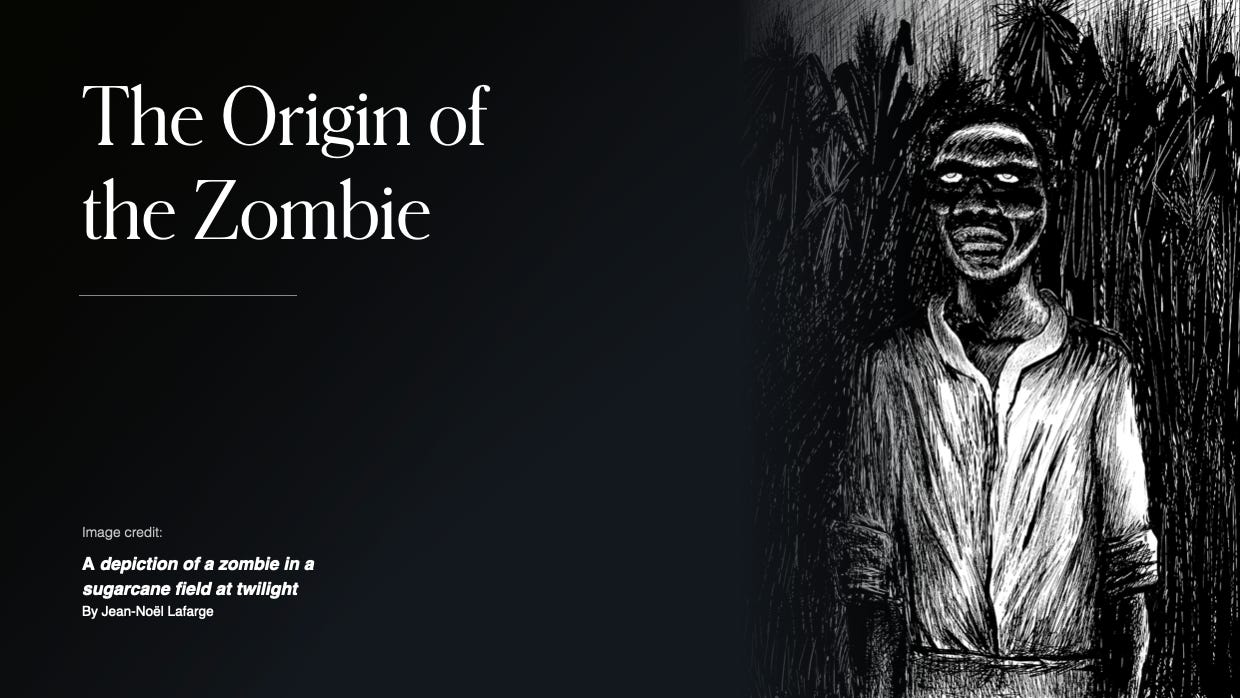
The Zombie legend has ancient roots. In medieval folklore, a ‘revenant’ was a spirit or soulless animated corpse revived from death to haunt the living.
A little more recently, the Haitian religion of Vodou – often misrepresented in pop culture – gives us the word zombi. In Vodou, a zombi is a person revived after burial, compelled to work, and stripped of autonomy. Scholars now suggest that some zombi cases may have been induced by toxins like scopolamine, from deadly nightshade, and pufferfish poison.
Frankenstein’s monster
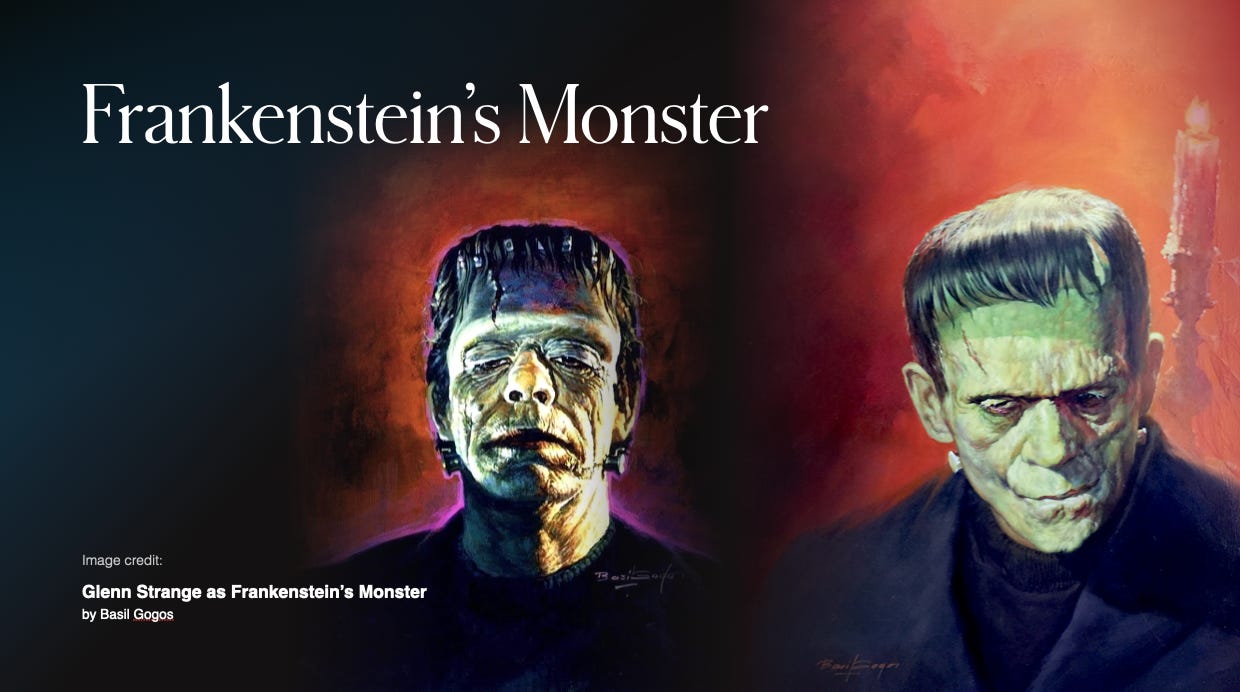
By the 19th century and the Industrial Revolution, the monster of Mary Shelley’s Frankenstein – not a Zombie technically, but with strong Zombie vibes – added a new twist: stitched from dead flesh, this story asked what happens when humans manufacture life, something human-shaped but not human.
Philosophers have been discussing this for some time. The “philosophical Zombie” is a popular thought experiment in discussions of human consciousness. It goes like this: imagine a world full of people who look, talk, and behave exactly like you and me, but with no inner life at all. They smile, they nod, they say “I love you” but there’s no one in there.
A note: the philosophical Zombie was once confined to the classroom. Right now, though, in the age of artificial intelligence, it doesn’t feel so abstract.
Zombie stories tap right into the same basic theme: a fear that the people around us are unreachable; that they’re shells; that no matter how close you get physically, you’ll never really be able to connect, because they’re void of self or soul — and worse, that the same could happen to us.
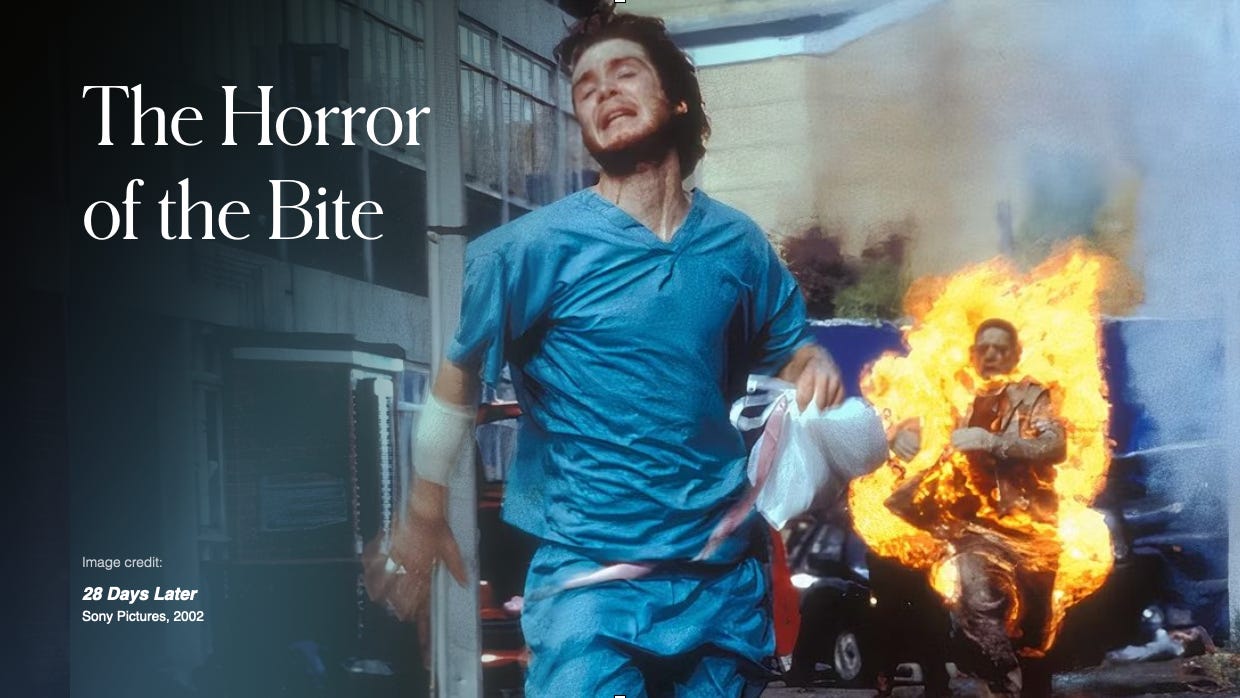
That’s the true horror of the Zombie’s bite. With Vampires and Werewolves, a bite is a curse and a gift. You gain powers, awareness, even beauty. But when a Zombie bites you, it doesn’t give anything back. The thing characters always beg for in those films — don’t let me turn, kill me first — isn’t about the fear of dying, it’s about the bigger fear of continuing to exist without the spark of consciousness. It’s about becoming whatever it is that we will be when our sense of self, soul or mind is removed.
Ultimately, we have always been obsessed with these questions. What makes a person? What happens when that light goes out? And what responsibility do we have if one day, whether by science or accident, we create a whole new kind of being — one that walks and talks like us, but may or may not be awake?
Hungry for braaaaaaains
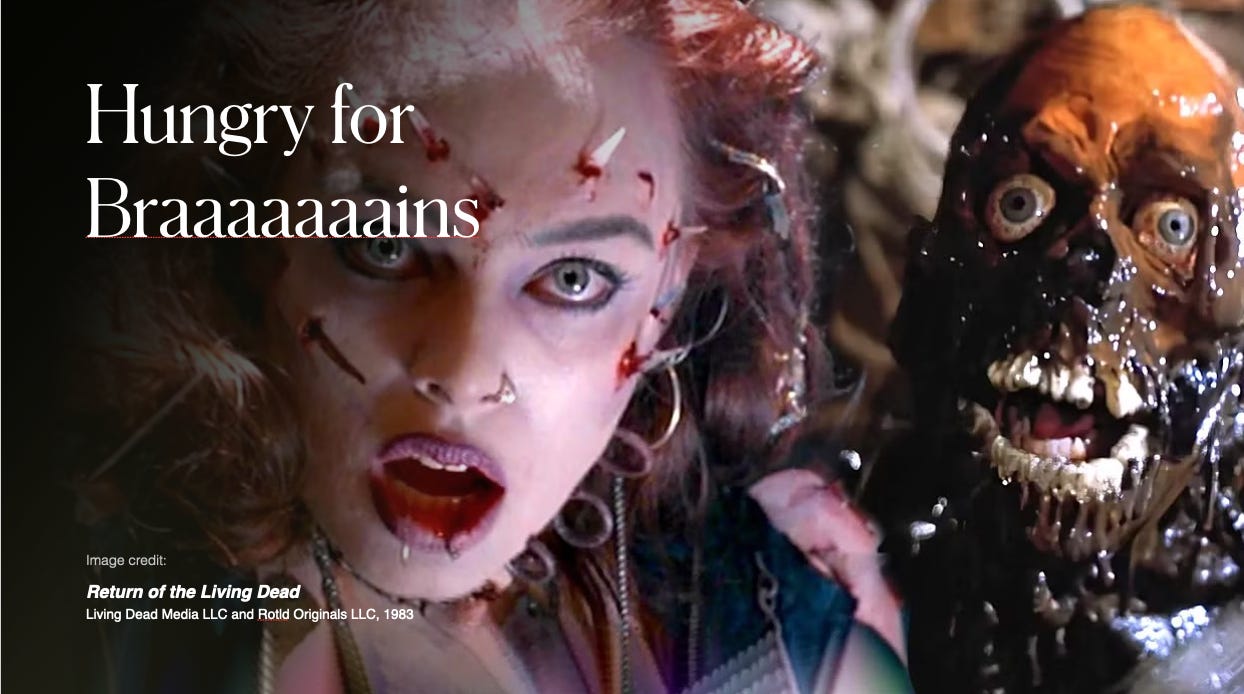
Let’s fast-forward again. It was only in much more modern times that flesh-eating (or brain-eating) Zombies became a thing – an augmentation of the zombi/revenant concept with that of the flesh-eating ghoul from Arabian mythology.
In 1963, George A. Romero’s Night of the Living Dead was the first Zombie story to show the undead monsters feasting on human remains, thus launching into the collective consciousness the pervasive image of society devouring itself.
It’s surely no coincidence that Zombies as mindless consumers entered the world just as the “Golden Age” of capitalism was gaining speed in the west, and in the U.S. in particular. Once again, the stories we tell hold up a mirror for the world to look into.
The zombie as disconnection
“It is not the end of the physical body that should worry us. Rather, our concern must be to live while we’re alive - to release our inner selves from the spiritual death that comes with living behind a facade designed to conform to external definitions of who and what we are.”
– Elisabeth Kubler-Ross, Family Limited Partnership

So, whether ancient revenants or Vodou zombis, whether brain-eating or mechanically resurrected, across cultures and eras, the core theme of the Zombie’s archetypal story remains the same: this monster is a body without soul, a life without essence.
Psychologically, the Zombie is the perfect metaphor for what happens when we dissociate – when we become disconnected from ourselves, from each other, from life itself. It personifies soul-death before physical death: the death of spirit.
At this point, I need to state very clearly that I’m not calling people with dissociative disorders Zombies. I’m also not suggesting a little self-reflection can “cure” a disorder of this type.
This post is also not meant to shame or discourage our non-pathological moments of numbness either. Because numbness is needed sometimes. Dissociation is a natural and adaptive function of the brain. It helps us to cope when our emotions would otherwise overwhelm us.
What this archetypal monster warns of is extended, chronic disconnection – disconnection as a way of life – not the occasional, healthy ins and outs of consciousness and presence.

In essence, the Zombie carries a timeless warning about straying too far from our authentic selves, something many of us do on a near-daily basis: whenever we disconnect from our instincts, our dreams, our passion, our values; whenever we start doomscrolling, overworking, binge-watching, or chasing compulsive achievement; whenever we allow ourselves to be productive but not present.
The Zombie shuffles ever closer each time we let a day pass without difference, feeling, meaning, or authentic decision (modern Zombies crave brains, after all – they want their consciousness back). We can see this monster in patterns of people-pleasing, consumption as a coping mechanism, living for the weekend or working our way into burnout, and striving for goals that don’t matter to us but we think that’s what we ought to be doing.
The way back
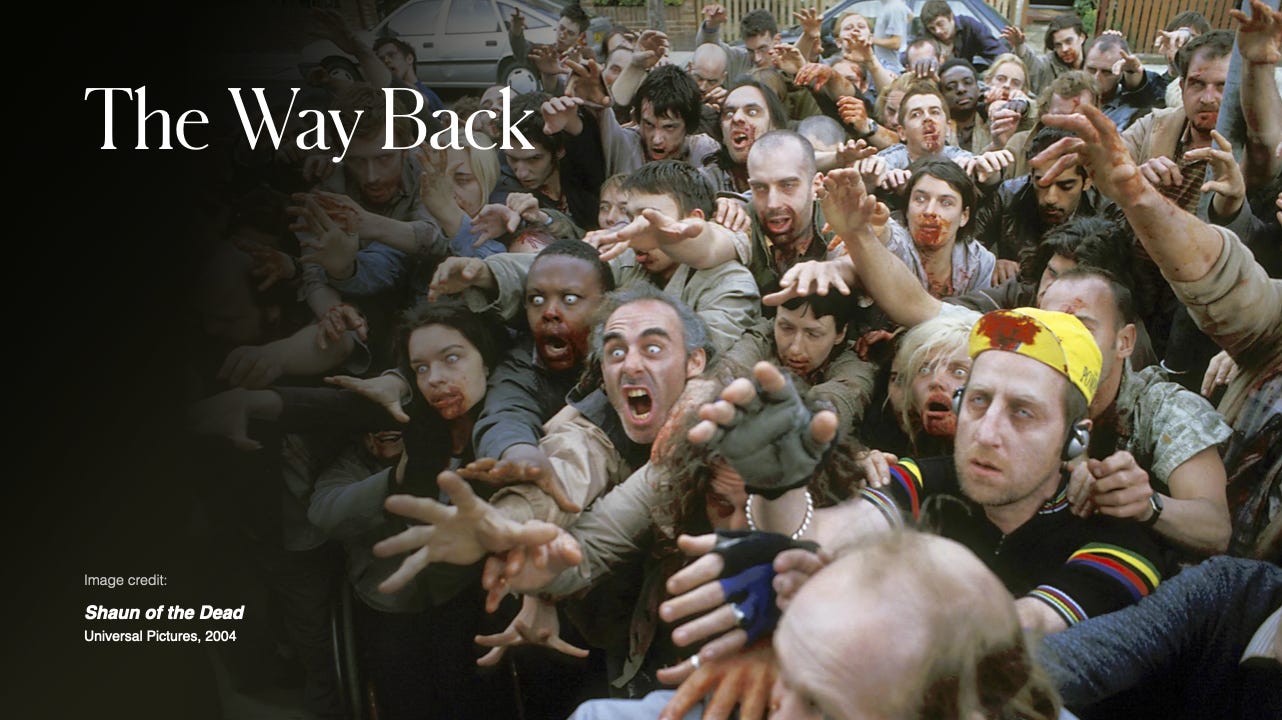
The good news is that the Zombie isn’t just a warning – it’s also a call to action. Beneath its hollow groaning, there’s a quieter, clearer message: that a life without meaning, connection and feeling is a kind of slow death. That consumption can never replace creation. And that mere survival is not enough.
Perhaps more than any other monster in this series, the Zombie is asking us for something. What if it isn’t stumbling towards us to consume, but reaching out, desperate to get back in – into the body, into feeling, into a present, living experience of life?
If the Zombie is the archetype of soul-death, then its antidote isn’t escape or battle. It’s to live. To return to embodiment, to desire, to meaning – to whatever it is that makes you feel alive.
So, let’s turn this monster into a tool for self-reflection. I invite you to ask yourself gently, and with curiosity:
Where in my life have I gone numb?
The question posed by the philosophical Zombie is, by nature, unanswerable. We can study the brain, and we may some day know more about what consciousness really is and where it comes from, but we will never experience for ourselves what goes on in the minds of others. What we do know, though, is that when we allow our own spark to dim, or our authentic self to fade away, we diminish the possibility of connection. If we drift too far from ourselves, then we might as well be living in a world of Zombies.
In addition, the Zombie motif taps into our fear of becoming indistinguishable from everyone else. Just another groaning horde member following the crowd.
So, whenever the Zombie moans its lifeless warning, there is a vital opportunity available to each of us: to find our way back, slowly, bit by bit, feeling by feeling. To reanimate our true selves and our lives.
The answer:
1. Reanimate — move your body.
You could start by simply moving your body as if trying to wake it up from sleep. A stretch, a short walk without headphones, or dancing alone in your kitchen — these things are simple acts of rebellion against inertia.
2. Experience — pause to taste, feel, enjoy, savour
Seek out small pleasures and actually taste them, feel them — a sip of tea, the smell of the air, the comfort of your favourite jumper. Presence begins with noticing. It’s as simple as that.
3. Create (instead of consume) — make something, anything, that’s yours
Choose to create, sometimes, instead of consume. It doesn’t have to be art in the grand sense – cook a meal, write a sentence, grow something. Make a tiny mark on the world that wasn’t there before.
4. Connect — with others and with yourself
Importantly, take your chances to connect, even if only briefly – look up and meet someone’s eyes across a shop counter or in the street, or send a message that lets a friend know you’re thinking of them. And do the same for yourself, whether through self-talk, journaling, breathing or just placing a hand over your heart. Zombies are lonely because they’re cut off. So is the part of you and me that feels numb.
5. Feel — without judgement
Lastly, let yourself feel one thing without judging it. Sometimes what melts numbness is not joy, but allowing the grief or frustration that’s frozen underneath to be heard.
You don’t have to do all of these things, of course. Choose one, or invent your own. The point is not to fix the numbness, but to turn towards life again, a fraction at a time.
This, I think, is the invisible gift the Zombie clasps in those reaching fingers: an invitation to return to ourselves, and to the wild, messy aliveness that makes being human worth the trouble.
Have you heard about our new game Echoes?
Our new game Echoes is available for pre-orders on Kickstarter. It’s a futuristic tale of time travel, magic, myth and tarot, and it’s perhaps our favourite and most awaited project.
There’s a special card deck and other exclusive rewards available only on Kickstarter. Ready to meet the Selves, gather ancient wisdom, and save the future?