


You can listen to this post on YouTube, or read it below.
***
You’re mid-sentence and you just... stop. You were about to say the thing you always say – the polite deflection, the self-deprecating joke, the answer you think they want to hear. But something shifts – your mouth closes, you take a breath, and instead of performing, you tell the truth.
“Actually, no – I’m not sorry.”
“I’m proud of what I did.”
“Wait. I’ve changed my mind. I want this.”
“I think I love you.”
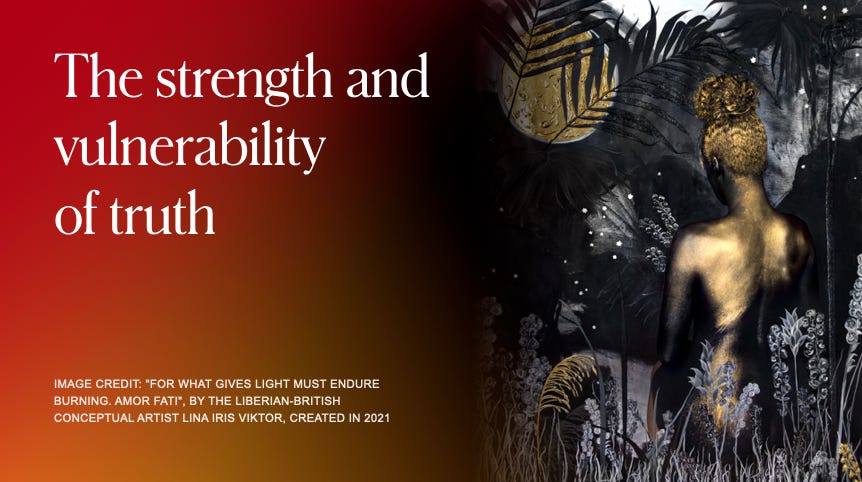
Have you ever noticed how, the moment we say the true thing rather than the safe, expected or otherwise easy thing, something within us relaxes and strengthens simultaneously? Our spines straighten, we breathe more easily, and we feel grounded, as if our feet have ancient roots. But we also, probably, feel exposed, vulnerable, and a little afraid. To stop performing and start being feels terrifying and right in equal measure.
This is the Rubedo experience, and today we’re talking about how to make it work. This is the final post in a three-part series on alchemy and psychological transformation.
If you’re just joining, here’s what you need to know in a nutshell:
First, psychological alchemy is about transforming consciousness – moving from confusion to clarity, authenticity, and embodiment.
It happens over three main stages:
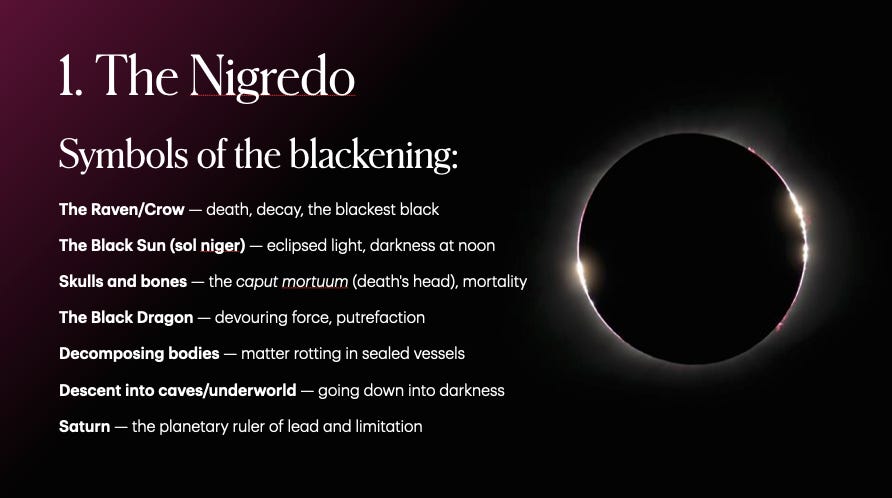
First, the Nigredo, which is the death – everything false burns away in the fire.
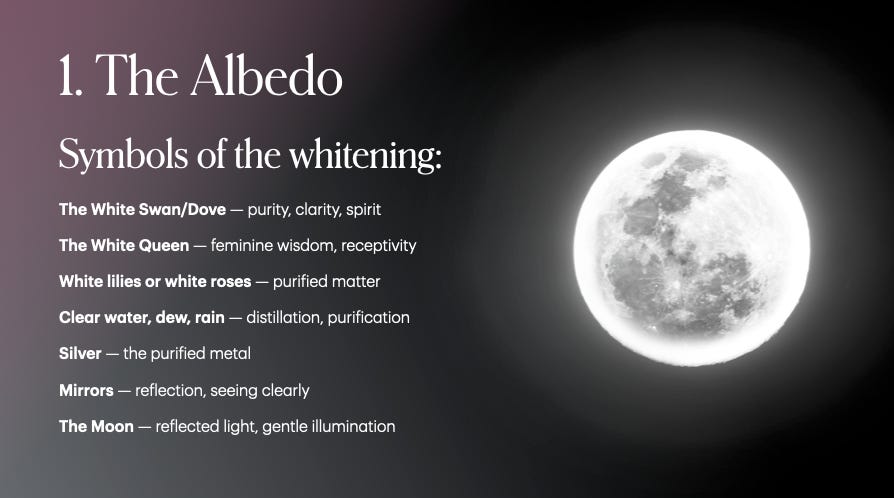
Next, the Albedo, which is the purification – a moonlit process of sorting truth from learned values, conditioned rules, absorbed fears, etc.
And finally, the Rubedo, which is the embodiment – the journey of actually living as a transformed person.
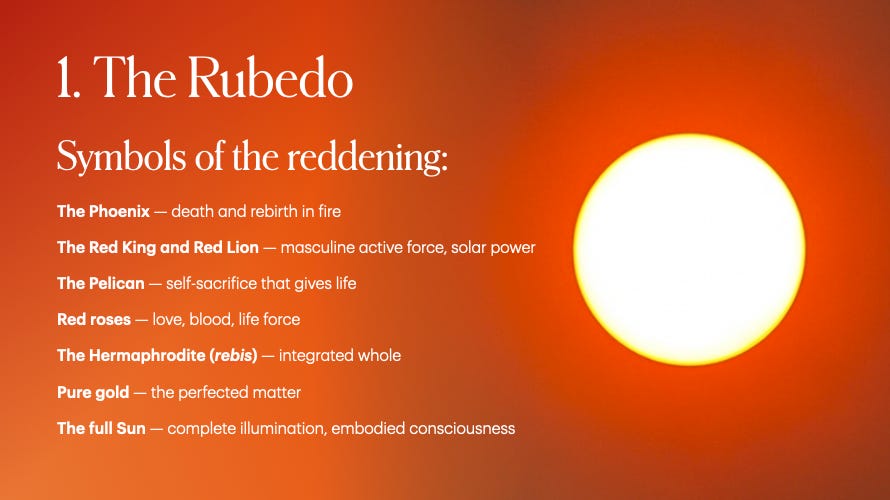
In many ways, the Rubedo is where the real work begins.
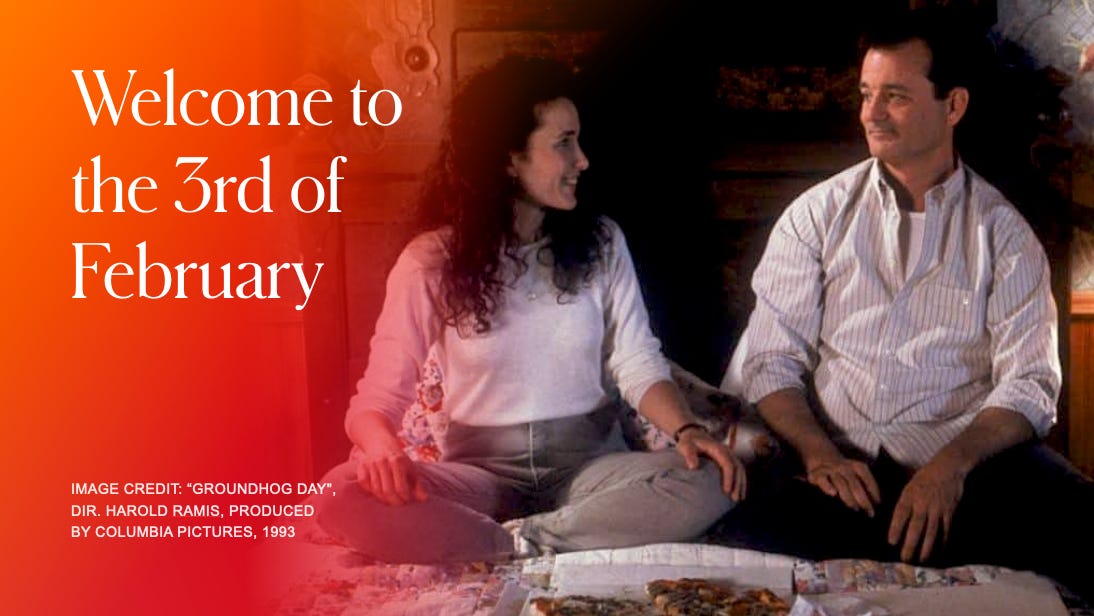
Connors’ Rubedo moment in Groundhog Day
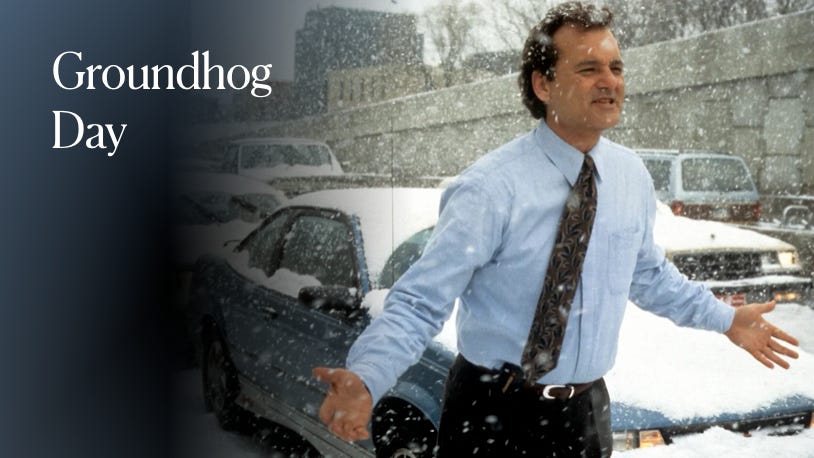
In Groundhog Day – the movie I’ve been using to illustrate the three stages of alchemy over the course of this series – Bill Murray’s character’s Rubedo awakening goes something like this (spoiler alert):
Phil Connors has been trapped in the same day for decades. He’s been through it all: the manipulation, the suicide attempts, the breakdown, the learning, the self-improvement.
He’s become skilled, knowledgeable, helpful; he knows exactly what everyone in this small Punxsutawney town needs and when they need it.
But on this particular day – this particular February the 2nd – something is different.
Phil Connors has stopped performing. Now, he plays piano because he loves it, helps people because he’s genuinely connected to them, and talks to Rita not to seduce her, but because he actually cares what she thinks.
Phil is a new man, now living from the truth he discovered in the darkness and clarified over the decades of learning and sorting. And that night, when he goes to sleep next to Rita – for the first time not trying to control the outcome – he finally wakes up to February the 3rd, and there’s a brand new song playing on the radio.
The gold you earned
So, what exactly is the gold we seek through psychological alchemy? What is all of this for?
You’ve braved the darkness and worked patiently through the sorting and the learning, and now you’re standing in the world with something precious: wisdom, truth, self-knowledge, and authenticity. You have earned a clearer sense of who you are beneath the old assumptions, but now what?
This is something we talk about less than the rest of it, and certainly less than we should: What are we supposed to do with our shiny, golden truth?
The Rubedo stage of alchemy is about making your discovered gold into something you can actually carry out into the sun-lit world of a new day and use.
The embodied marriage of opposites
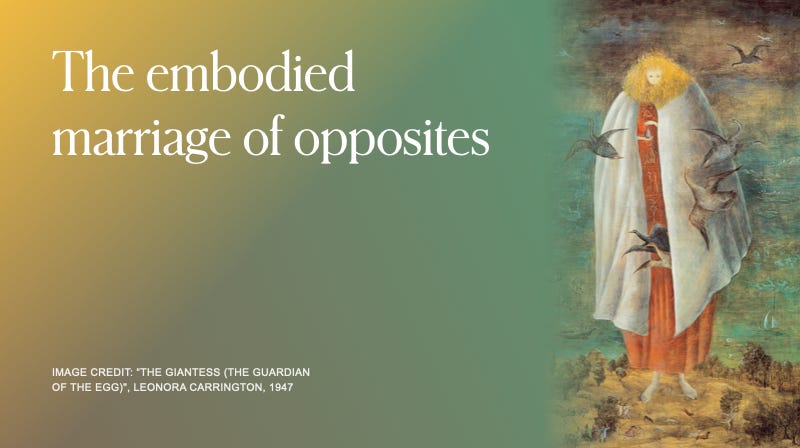
In practical alchemy, the Rubedo is the final stage of the Great Work, when the purified material is heated one last time to create the Philosopher’s Stone. The red stage is about stabilisation, completion, and embodiment.
Picture the Alchemist in their laboratory at the crack of dawn. Golden light streams in through the windows. The Alchemist stands before a vessel they’ve been tending for months, maybe years. The matter inside was once black (burned, putrefied, dead), then it was white (washed and clarified). Now, it’s turning red.
The alchemist watches as the separated elements begin to recombine. They don’t revert, though. This isn’t a return. Rather, they integrate into something new, the opposites coming together consciously.
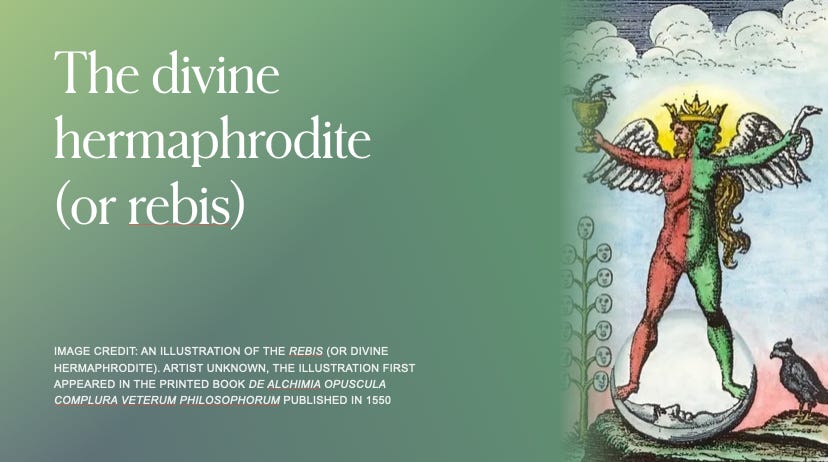
Symbolically represented by the divine hermaphrodite (or Rebis), Carl Jung described the Rubedo as the coniunctio – the sacred marriage of opposites: conscious and unconscious; light and shadow; masculine and feminine; spirit and matter.
Jung’s writings about the Rubedo describe it not in terms of transcendence, or leaving the body to rise above the material world. Rather, the Ribedo is about bringing wisdom into the body and into the world. It’s about embodiment – becoming the truth rather than just knowing it.
Soul-making in the world – anima mundi
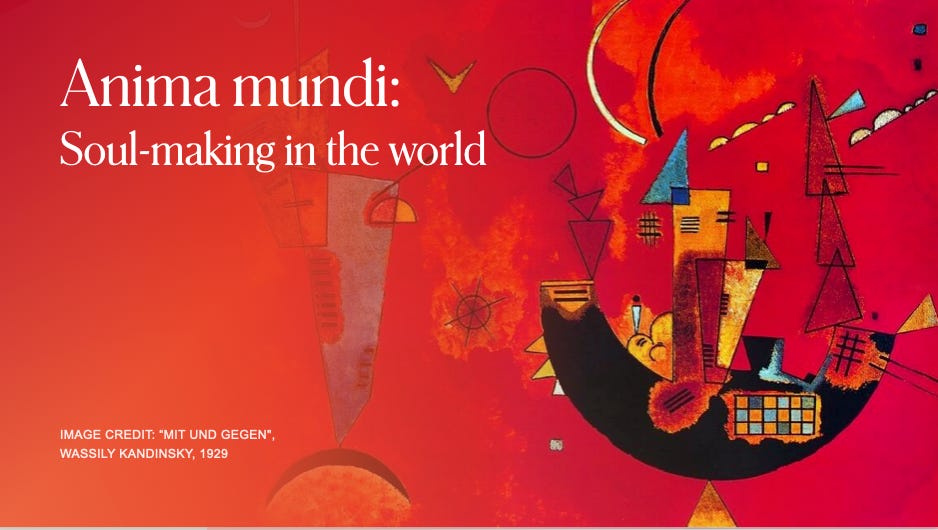
Jungian psychologist James Hillman argued that psychology itself has become too focused on internal work – gaining insight without enough emphasis on living from that understanding.
Hillman called this “soul-making” – the ongoing work of bringing consciousness into relationship with life, with others, with the world, and of fostering a richer, image-based consciousness rather than focusing purely on ego development. In his alchemy lectures, Hillman critiqued traditional Jungian analysis for stopping too soon. He attributed this to Jung’s own introversion. Hillman, an extrovert, needed more than this. “I like it out there in the world,” he claimed, with passion.
Hillman wanted psychology to move beyond just understanding the soul and into living the soul in actual relationships, work and creativity – the red, embodied, messy reality of being human. Because without that part, it’s all for nought.
The Fisher King healed
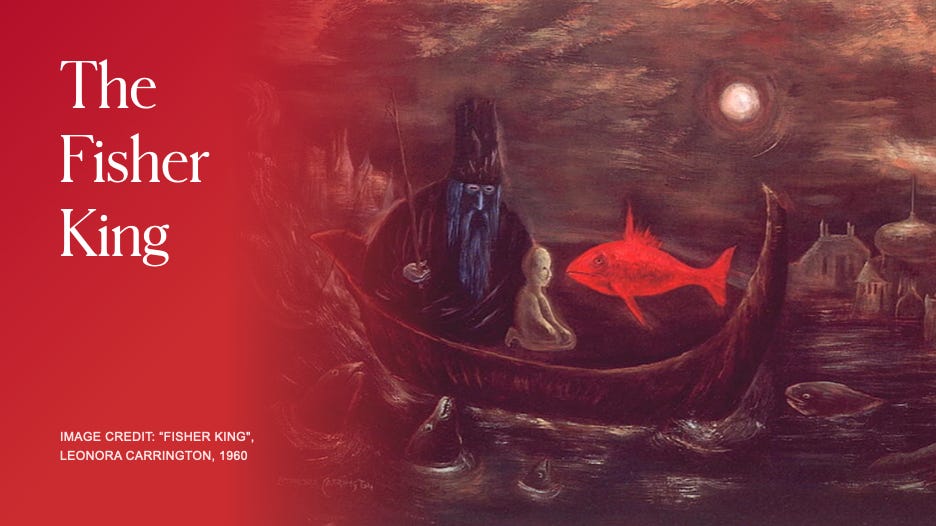
The Arthurian legend of the Fisher King captures this idea.
The Fisher King rules over a wasteland. His kingdom is barren, his people are struggling, and he himself suffers from a wound that will not heal. Even though he has, in his castle, the literal Holy Grail (along with other sacred objects like a bleeding lance), the Fisher King cannot restore himself, or by extension, his Kingdom.
Mirroring the King, various knights visit the castle seeking the Grail. But because they don’t ask the right question – “Whom does the Grail serve?” – they fail to discover it.
Eventually, it’s Percival (or Parsifal) who asks the magic question and therefore breaks the spell. In that moment, everything changes – the King is healed, the wasteland blooms, life returns.
The Grail represents spiritual nourishment, healing, and salvation. All this time, the King is within touching distance of salvation but cannot access it because of the sterility of his worldview, and his lack of agency and responsibility. The Grail will remain dormant until the correct protocol is observed.
Or, to put it differently, neither the King’s wound nor the wasteland will be healed by merely possessing this sacred object. The hero needs to ask the magic question before its power can mean anything. To ask whom the Grail serves is to ask these things: How can this wisdom be of service in life? Whom does it heal and how? How does it manifest in the actual world?
These are the questions the Rubedo asks us to answer. We have gold now – real gold! – but locking it in a vault somewhere serves no one. Gold must be worked, shaped, and used before it means anything. It must be lived.
Living the gold
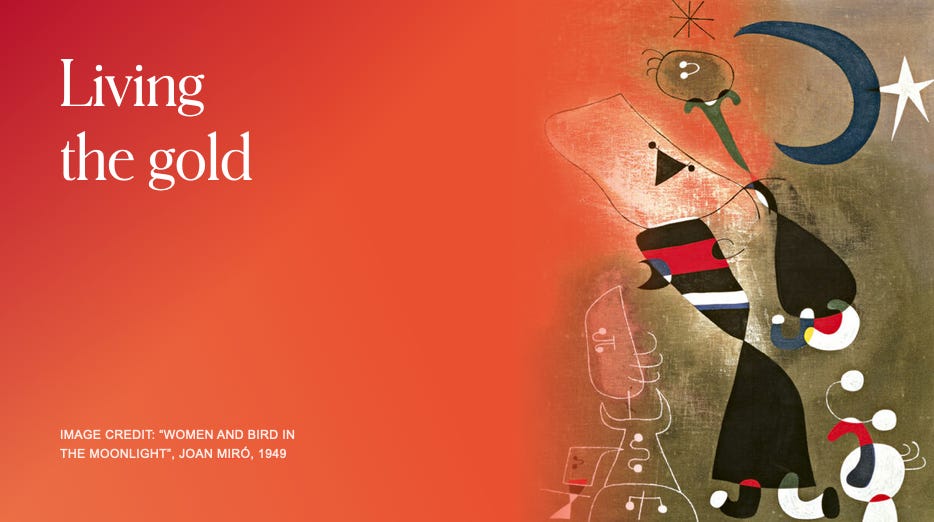
Over the course of this series, I’ve been comparing my experience of burnout and recovery while competing as a fighter to the story arc of the alchemical process. During the Nigredo, I fell apart completely, stripped of my health, fitness and identity as an athlete. For me, the Albedo stage involved therapy and patient recovery from the crash, which culminated in a moment of clarity after winning a boxing title I’d always coveted – all of a sudden, I knew I no longer wanted or needed to fight.
Shortly after that realisation, I stopped fighting, both literally and metaphorically. I let go of the old need to prove myself as an indomitable warrior, I hung up my gloves, and committed fully to the work that had really been calling me all along. As a therapist, I adored the deep listening, the witnessing of transformation, and the humanness of it all. It felt like coming home to something I’d been running from my whole life.
But this Rubedo shift was about more than just changing careers. For the longest time, I’d been at war with my own femininity. I’d rejected softness, creativity, connection – anything I saw as “girly” – because I thought masculine strength was the only strength worth having. The fighter identity was my way of proving I wasn’t weak, wasn’t vulnerable. Wasn’t feminine.
In the Rubedo, I had to bring the separated masculine and feminine energies within me back together – I realised I was both/and, not either/or. So, while the rigid Warrior identity had to go, its essence stayed, just in a new form. The discipline I’d learned from fighting became part of my therapeutic practice, my writing, and my commitment to finding meaning in things.
The strength, resilience and willingness to face my fear all stayed, too, they just transformed in combination with what I’d previously rejected, such as softness, creativity, whimsy, relational warmth, and intuitive knowing. The feminine energy I’d spent decades loathing became the very thing that brought my masculine side into focus.
The difference looked like this: I became less competitive, less defensive, less resistant to others. I grew closer to my family, especially my mother, which felt like healing something ancient and foundational. As time went on, my work got more and more creative. I started singing again, I wrote a book, I created Betwixt… I fell in love with someone loving and gentle, and I got the silliest, fluffiest little dog of all time and now proudly identify as her mummy.

In the end, all of this was my gold – the self-understanding and self-acceptance I built in therapy got me here, but the Philosopher’s Stone was the real-world manifestation of that internal shift.
To be very clear, I am not claiming I did something exceptional. Quite the opposite. I share my example simply because I know it, but everyone makes their own gold time and time again over the course of their lives. Whether they see it as their Philosopher’s Stone really only depends on whether they’ve gone down the same alchemy rabbit hole as I have.
The gold of service
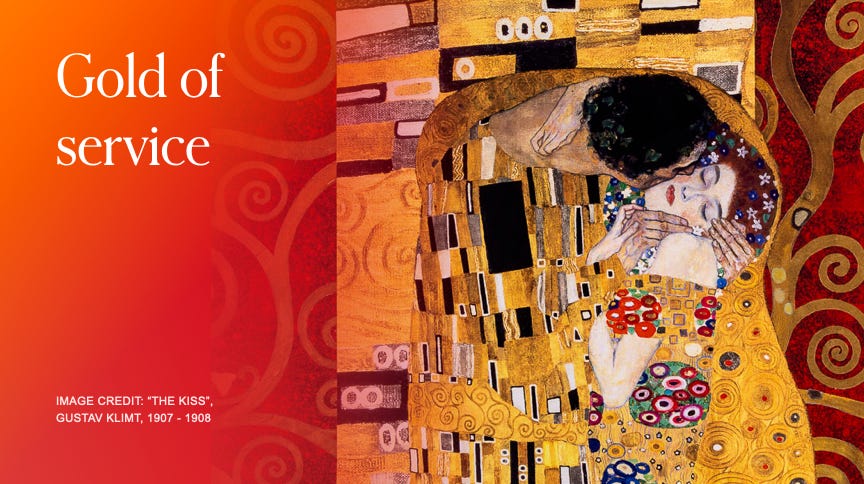
The point here is this. Just like the Holy Grail locked away in the Fisher King’s castle until the right question was asked, the gold of the Rubedo has to serve in some way. My example is obvious because I’m in the world of mental health – my professional gold serves the people who play Betwixt, read my writing, or watch these videos. But the service we’re talking about isn’t always that literal.
We can see the Stone in the teacher who went through burnout and now shows up with both boundaries and genuine care, or the parent who breaks cycles by modelling authenticity. It might be the friend who holds space for grief without trying to fix it, or the leader who organises with love instead of micromanagement.
Your gold might be starting a nonprofit or simply having one deeply honest conversation that changes a relationship. It might show up in how you rest without guilt, giving others permission to do the same.
Alchemical gold doesn’t have to be public, grand, or monetised. It might touch thousands or it might only affect three people. The scale, flavour and direction mean less than the embodiment and intent, because when you embody your actual transformed self rather than performing transformation, people can sense it – we can smell authenticity, and it gives us permission to be real, too. And that is invaluable, even if only one person ever experiences it.
The final descent
So, it’s time for us to conclude the stranger’s little story.
The stranger has returned to the Alchemist’s staircase, and by now, they know the steps by heart. The first time, they descended into fire, darkness and the burning away of falseness. The second time, they descended into moonlight, cleansing, and the patient sorting of truth. This time, they hear something new drifting up from the laboratory – a rhythmic striking sound, metal on metal. It’s the sound of making.
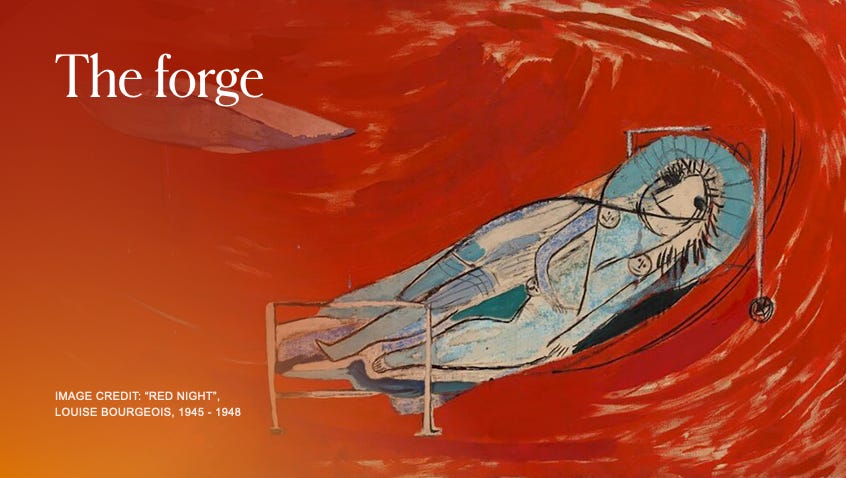
As they enter, they find the space entirely different. Golden sunlight streams through the windows, bright and warm. In the centre of the room stands a forge, and beside it, an anvil. There are tools hanging on the walls.
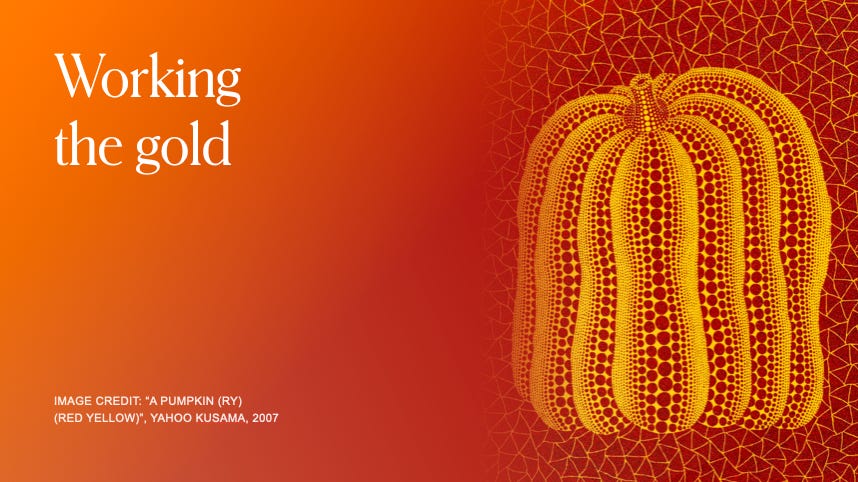
Sleeves rolled up, the Alchemist beckons the stranger in. Their face is streaked with soot and sweat. Wiping their forehead with a sleeve, they gesture to a shelf lined with small pieces of pure gold. “Those are yours,” they say simply, before lifting one little nugget and placing it in the forge. “Now we work it.”
When the gold begins to glow red, the Alchemist places it on the anvil and hands the stranger a hammer. “You must shape it into something that can be used in the world.”
The stranger hesitates. “But I don’t know how.”
A shrug. “No one does at first,” the Alchemist replies, “That’s the point. Its final shape will come from working, not planning.”
So, with a small frown, the stranger lifts the hammer. Clang. The gold barely budges. “Again,” the Alchemist says.
Clang.
With repetition, the gold begins to shift – slowly reforming itself with every strike.
Clang. Clang. Clang.
Until, eventually the matter begins to take shape. But the stranger still has no idea what they’re making: maybe it’s a tool, maybe it’s art, maybe something they don’t have words for yet. They keep working.
Some time later, when the sun is at its highest in the sky, the stranger stops. Sweat drips from their brow, and their muscles ache, but this is not why they have paused. “I know what it is,” they say, gazing into the flames. And when they look up, they can see the light of recognition in the Alchemist’s eyes, too. “I do as well,” the Alchemist says.
And then, “Go, friend. Take it into the world where its transformation will conclude.”
The Alchemist’s friend nods their assent, feeling both relieved and a little wary. And as they climb the stairs, the gold feels almost alive in their hand – energised, like a stone warmed by the sun.
Welcome to February 3rd
It takes courage to return as yourself after transformation – to take your gold out of the laboratory and into the messy, imperfect, relational chaos that is reality.
It takes courage to set boundaries rather than build walls; to speak honestly, rather than saying what you know other people want to hear; and to choose authenticity when performance feels safer. It takes courage to make the thing you’re meant to make, to do the work you’re meant to do, and to love the way you’re meant to love.
The Dragon always stands at the threshold – there is no change without fear – but if you’re at this stage, then you’ve done the hardest part already. You don’t have to walk back into the flames – not yet, anyway – you just have to remember what they taught you.
You are the agent of change in yourself, because the Alchemist is a part of you, and they tend the fire day and night. This inner facilitator will always be ready to invite you back into the laboratory, because you are no longer a stranger to the work.
So, open your eyes, my friend, because there’s a new song playing on the radio, and as you listen to it, you may find yourself asking the specific questions that can make change a reality:
What are the polarised opposites that you must now bring back together?
What truth are you going to practice living this week?
What gold are you going to work at the forge?
What transformation are you ready to embody – imperfectly and vulnerably, but genuinely – in your actual life?
Whatever your time loop is, it can break; whatever your wasteland looks like, it can bloom; and however you came by your wound, it will start to heal the moment you decide to become. I, for one, can’t wait to see what that means.
REFERENCES:
Carl Jung, Mysterium Coniunctionis (1955-56)
Carl Jung, Psychology and Alchemy (1944)
James Hillman, Re-Visioning Psychology (1975)
James Hillman, Alchemical Psychology lectures (Uniform Edition, Vol. 5)
Dennis William Hauck, Complete Idiot’s Guide To Alchemy: The Magic and Mystery of the Ancient Craft Revealed For Today (2008)
Medieval legend, The Fisher King (various versions)
Groundhog Day, directed by Harold Ramis (1993)
Hazel Gale, The Mind Monster Solution (2018)
"It takes courage to set boundaries rather than build walls; to speak honestly, rather than saying what you know other people want to hear; and to choose authenticity when performance feels safer. It takes courage to make the thing you’re meant to make, to do the work you’re meant to do, and to love the way you’re meant to love." Yes - and thank you.
I needed this, it's a beautiful balm for the mind, the soul and the heart. Thank you especially for sharing your own personal journey, it is really inspiring.