


You can listen to this post on YouTube or read it below.
***
Psychology calls it the Drama Triangle – a toxic game where everyone loses. Disney calls it… true love.
You already know the story. A young woman, trapped by a monstrous creature. She’s his captive, but she’s so pure, so patient, and so selflessly loving that eventually, through her devotion, she transforms him – the Beast becomes a prince, the castle blooms. Love conquers all.
We’ve been sold this as one of the greatest love stories ever. But, if we read it literally, which we honestly can’t help but do, this fairy tale serves better as a near-perfect illustration of a toxic relationship, with a “happy ending” built on deeply dysfunctional foundations.
The Drama Triangle
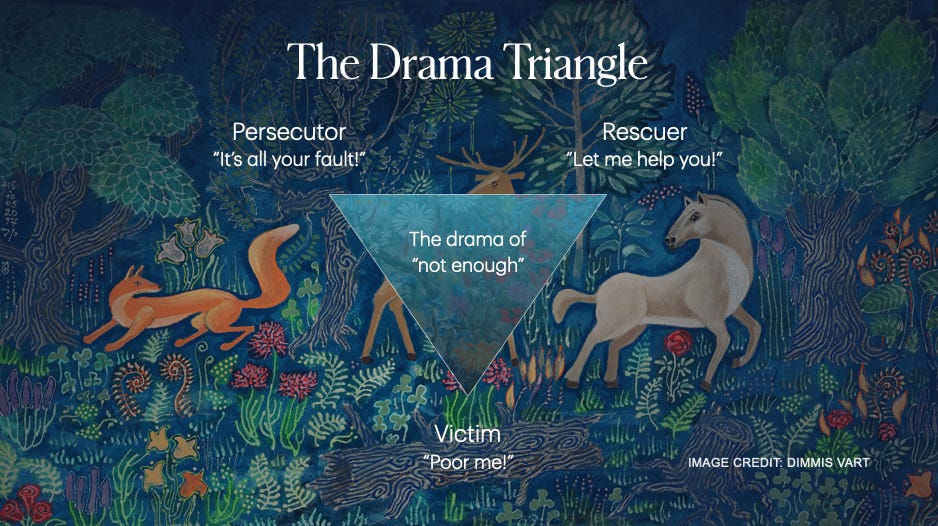
The Drama Triangle is a model developed by psychiatrist Stephen Karpman for understanding the power games people play in conflicted relationships.
There are three roles to inhabit on the triangle: the Persecutor (or bully), the Rescuer (or saviour), and the Victim (the helpless one). At least, that’s how it appears at first glance.
These three roles represent archetypal patterns of behaviour or interactions, and at the root of them all is the same basic design: these are the three main ways that we attempt to get our needs met without having to do the difficult, vulnerable thing that is to ask.
Before we go further, some crucial clarifications: these roles are used to describe psychological dynamics, not assessments of anyone’s objective position of power in the world. When I talk about the Victim with a capital V – or the concept of “playing the Victim” – I am not necessarily (or at least not exclusively) referring to actual victims, such as those affected by abuse, oppression, or structural disempowerment. If you’re experiencing abuse in any form, you are not responsible, and your safety matters most.
Okay. Caveats done.
Let the games begin
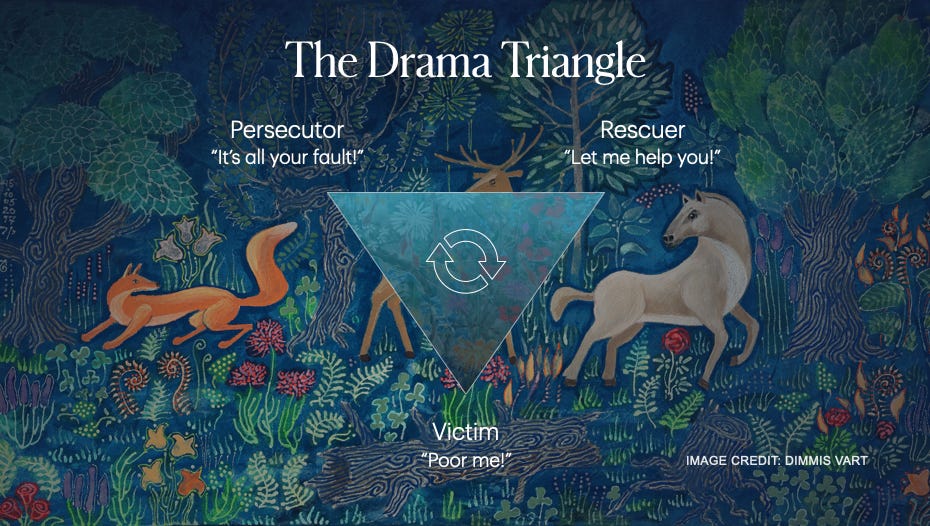
When we first learn about the Drama Triangle, we tend to identify with one of the roles fairly quickly – usually the Rescuer or the Victim, rarely the Persecutor. Go figure.
But here’s the thing: everyone cycles through all three roles. Once we’re on the Triangle, we switch positions and even play multiple roles at once, in order to gain a sense of control.That said, many of us have a tendency towards one role. This is called our “starting gate” because it’s how we most often get drawn into drama.
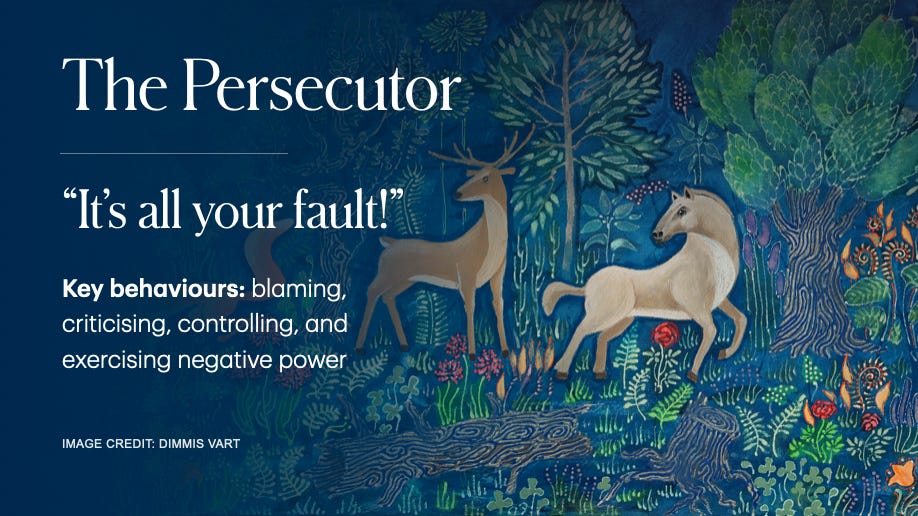
Starting-gate Persecutors get pulled in when they see an opportunity to pin the blame on someone else. Their opening position is: “It’s all your fault!”
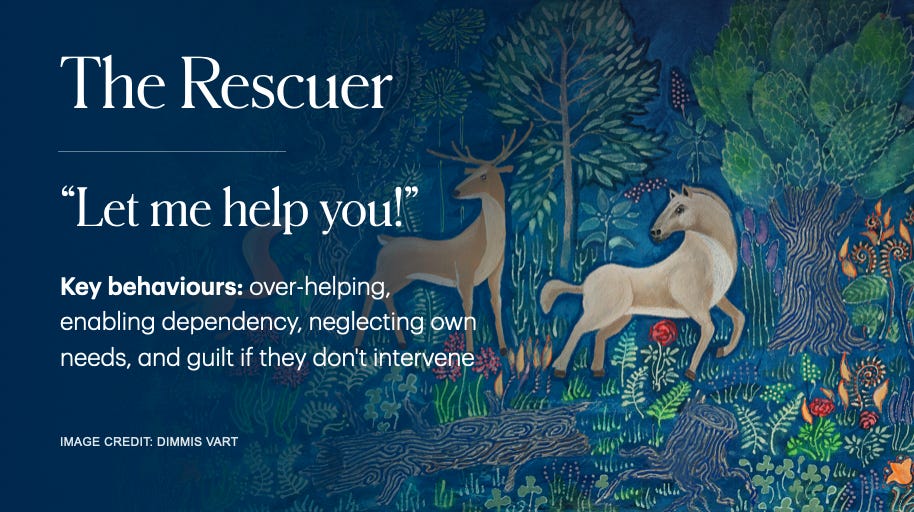
Starting-gate Rescuers get hooked by perceived helplessness – someone struggling, someone who needs fixing, someone to save. This position is “Let me help you!”
And starting-gate Victims are induced to play the game when they feel overwhelmed or powerless, and therefore in need of saving. The Victim’s position is “Poor me!”
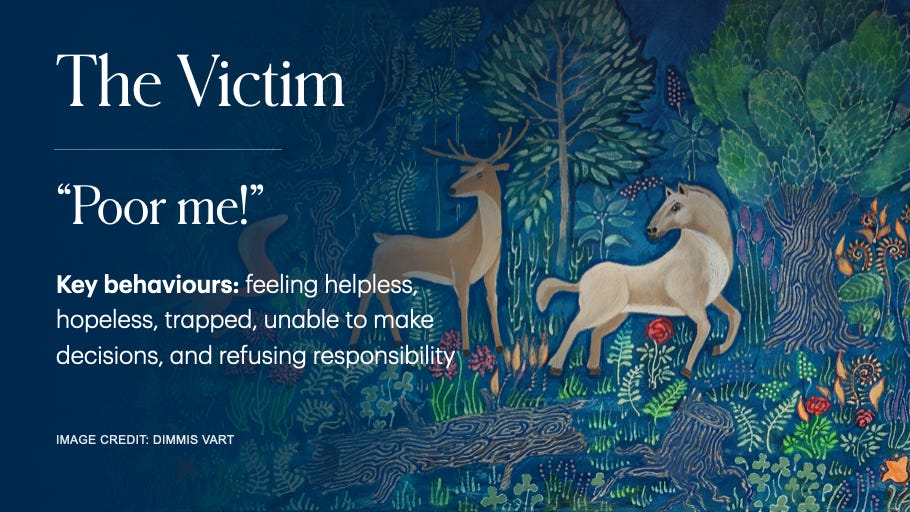
These roles and the games they represent are everywhere. No one is immune to the Drama Triangle – we learn it from our parents, our friends, TV, the movies and, of course, fairy tales like Beauty and the Beast, which, when read as a literal depiction, is essentially Drama Triangle: The Musical.
Fairy tales as literal depictions
There are basically two ways of reading a fairy tale. At first glance, we might see them as commentaries on relationships and conflicts between individuals, social groups, or even whole nations, usually with a moral message about good versus evil. That is, we read them as if they are stories about separate (albeit often weird and wonderful) individuals. Alternatively, we can read them as dramatisations of the inner world and how it changes and evolves along with us as different aspects of self interplay and relate to one another.
In my articles, I usually focus pretty much exclusively on the internal reading of stories, and I have released a full series devoted to the psychological dynamics on show in the myth of Psyche and Eros, of which Beauty and the Beast is a version.
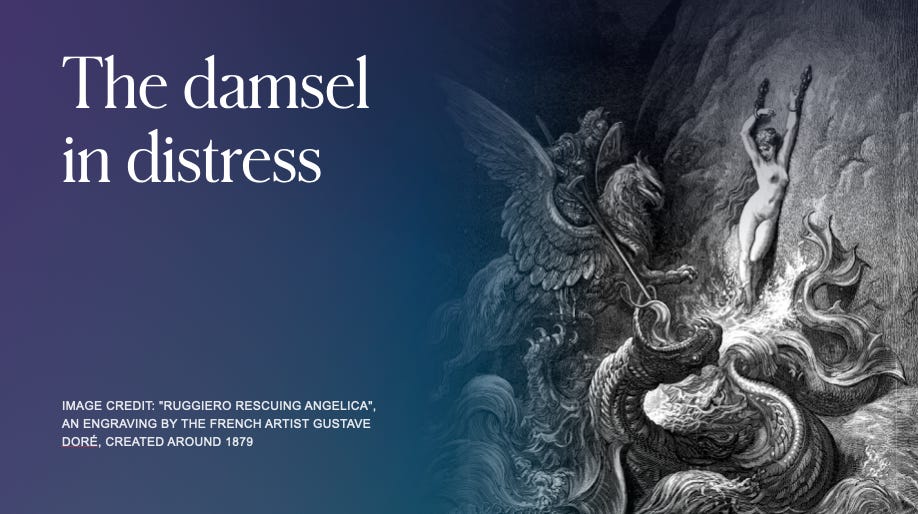
I do this because to take them at face value is downright dangerous. Internally, the “damsel in distress” is a universal aspect of self – the lost anima or feminine principle. If seen as an individual, however, she, along with many other archetypal characters, is a feminist nightmare – a poor, pathetic, helpless woman who needs saving by the love of a charming man.
So, while there’s potentially freeing and empowering insight available in the psychoanalytic reading of Beauty and the Beast, there’s some seriously toxic shizzle to be gleaned from a literal reading, and that’s what we’re looking at here today. For this reason, I’ll be using the 1991 animated Disney version of the story for this analysis.
The Beast: Persecutor and Victim in one cursed package
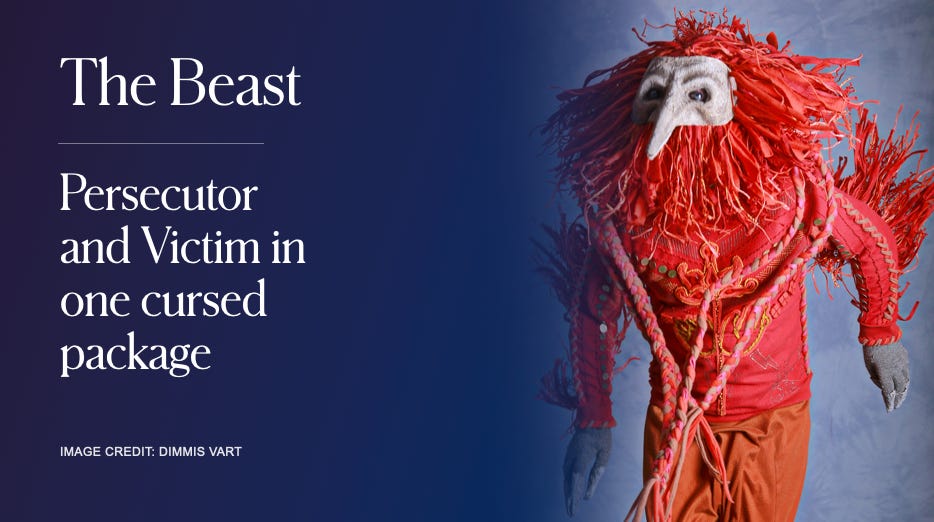
So, let’s break the Disney telling down, starting with the Beast. On the surface, he’s obviously a Persecutor. He literally imprisons Belle’s father for picking a rose, then forces Belle to take his place. He rages, threatens, controls her movements, and isolates her from everyone she loves. This is classic Persecutor behaviour – using dominance and fear to maintain power.
But here’s where it gets interesting: the Beast also plays the role of Victim. “I’m cursed,” he moans. “I’m unlovable. No one will ever break this spell. Poor me!” His entire existence is built on the belief that he’s doomed, that his monstrousness is inevitable, and that he needs someone else to save him.
This is textbook Drama Triangle. The Persecutor doesn’t see themselves as the bad guy but as the wronged party – so their acts of persecution are therefore reasonable. The Beast genuinely believes his imprisonment of Belle is justified because he’s the one who’s suffering. He is the angry or abusive partner who says, “But you don’t understand how hard this is for me.”
Belle: The Rescuer who needs you broken
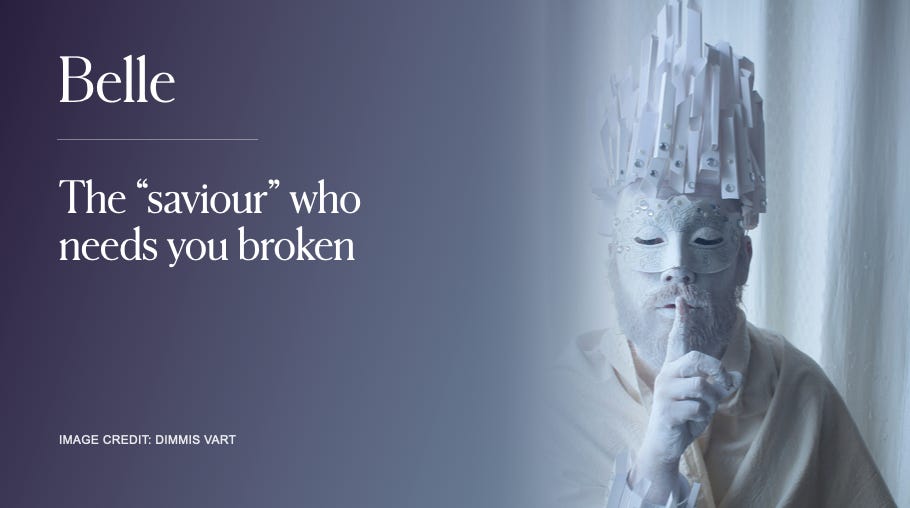
Now let’s talk about Belle – sweet, bookish, self-sacrificing Belle. She’s the Rescuer. She gives up her freedom to save her father; she stays with the Beast to transform him; she sees past his terrifying exterior to the “good man” underneath. She’s the hero. Except... she’s not.
The uncomfortable truth about Rescuers is that they need someone to save. If their Victim is actually liberated from whatever bind they’re in – if they are actually empowered – then the Rescuer loses their purpose, their identity, and their sense of power.
So, whether consciously aware of this or not, someone playing the Rescuer will keep their Victim in the one-down position so they can safely stay in their one-up role of saviour.
In the story, Belle stays with her captor, she makes excuses for his violence, and then she takes responsibility for his transformation, as if her love and patience are what he really needs rather than, I don’t know, accountability for imprisoning people.
Beauty’s toxic message
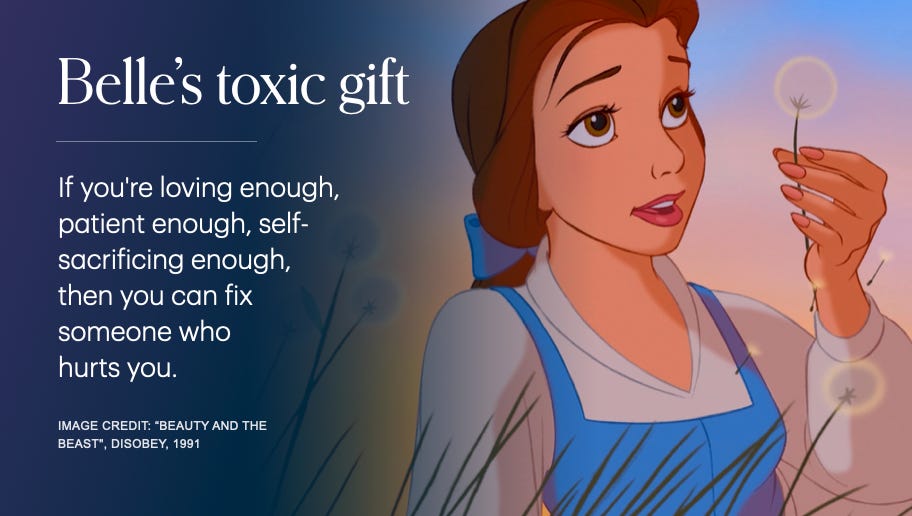
In the end, Belle teaches us – and this is the really insidious bit – that if you’re just loving enough, patient enough, and self-sacrificing enough, you can fix someone who hurts you.
This is, of course, not real love. It’s codependency, and surely one of the most damaging messages we’ve ever dressed up as romance and beamed into the growing minds of millions upon millions of children.
Gaston: The Persecutor who thinks he’s the Rescuer
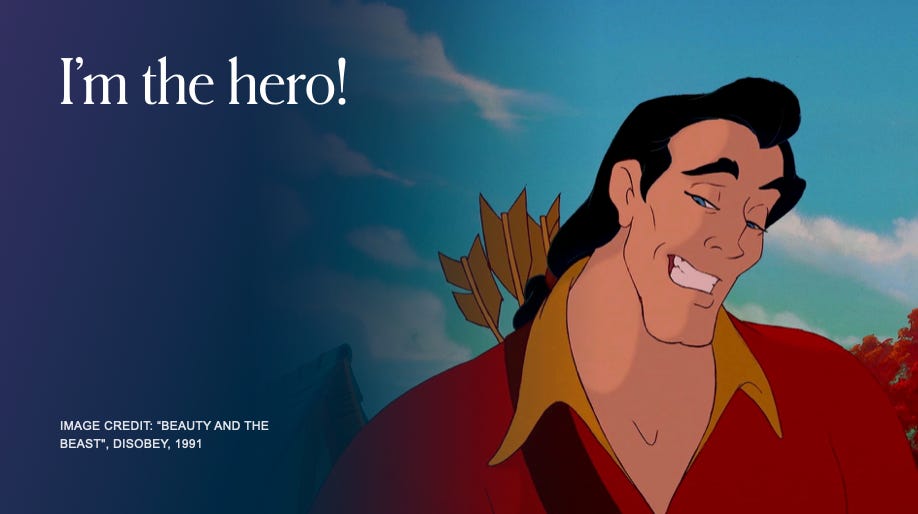
The third player in this story is Gaston. Now, Gaston was created for the Disney version of this tale, and he’s perhaps the most revealing character in this whole mess, because he illustrates how Drama Triangle roles overlap, and how people rationalise their behaviour.
Gaston is obviously a Persecutor – he’s violent, manipulative, narcissistic, and he leads a mob to kill the Beast. But just as the Beast sees himself as the Victim, Gaston genuinely believes he’s the Rescuer.
“I’m here to save Belle from that monster!” he says. “I’m the hero!”
This is what Persecutors do – they reframe their violence as righteousness, their control as protection, and their abuse as salvation.
At the dark heart of the Drama Triangle, the reality is that everyone thinks they’re in the right. Everyone has a story to justify their behaviour, and every power play only ever fuels the next one in line. Around and around we go, cycling through the three roles in a vain attempt to find a play that will make us feel okay, but that only ever leaves us feeling like we’re at war with someone else in our lives.
The Victim feels hard done by and bullied by the Persecutor, but also lorded over and controlled by the Rescuer.
The Persecutor feels like the Victim is wielding helplessness against them, making them feel like the villain.
The Rescuer feels like all their hard work goes unrewarded, because they have no idea they’re actively enabling their Victim’s victimhood.
When our current play fails – and it always fails – we switch roles, lashing out, performing virtue, or just claiming that we’re the real Victim.
The Inner Drama Triangle
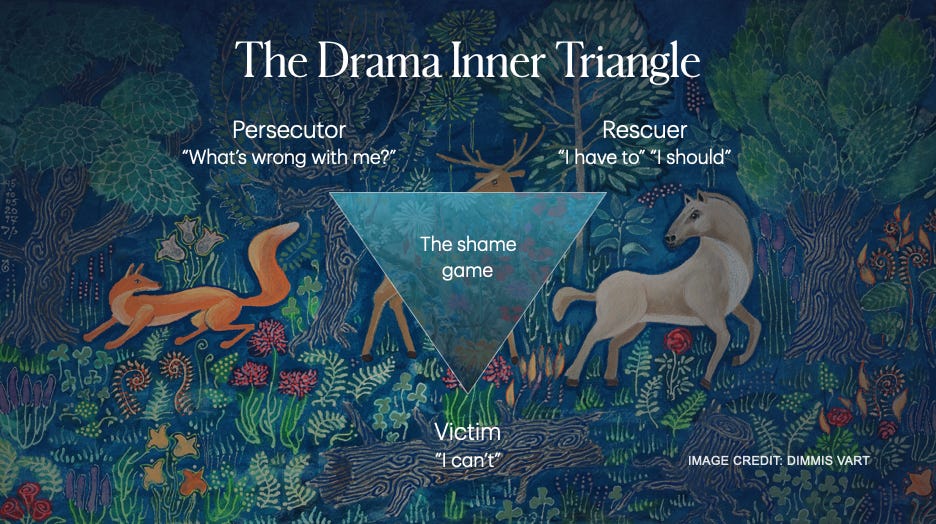
There’s no sugarcoating it – the Drama Triangle is a bit of a nightmare. And it is not, unfortunately, limited to interpersonal relationships. We play the damn game with ourselves, too.
Ultimately, the inner world mirrors the world outside, and vice versa. If we want to change the way we relate to other people and escape the disempowering trap that is the Drama Triangle, then we will need to recognise the parts of our own personality that inhabit each of the different roles.
Our inner Beasts, Belles and Gastons are archetypal patterns, or parts of the personality, that interact with each other in exactly the same toxic ways, creating an internal Drama Triangle where we simultaneously persecute, rescue, and victimise ourselves.
To the castle

Imagine, if you will, that you’re walking through a castle. Not a bright, enchanted Disney castle, but a dark one, with stone walls, flickering torches, and shadows that move when you’re not looking. You can hear your footsteps echoing.
Climbing the staircase, you find a heavy wooden door and push it open. There, in a chamber full of broken mirrors and tattered curtains, is the Beast. Your Beast, perhaps.
In this castle, the Beast is the Inner Victim: the part that feels monstrous or cursed or fundamentally wrong; the part that says “I can’t” when we want to do something hard, like quit a habit, or initiate a difficult conversation.
This is the part that clings to victimhood as a shield – it fearfully seeks and provides endless evidence for that nagging feeling that we’re beyond help. “I’m doomed,” it says, “too damaged. Other people can change, but not me.” Why does it act this way? Because it thinks it has to – the Beast is convinced that powerlessness is protection.
Who has never opted out of a difficult conversation, thinking, “They won’t listen to me anyway. They never do”, or stopped themselves pursuing a dream because they “always mess stuff like that up”? Who has never picked a fight to avoid intimacy?
If we never try, the Beast reasons, we can never fail. If we never hope, we can never be disappointed. And most of all, if we never show our true face, we can never truly be rejected.
The creature turns as you enter, eyes filled with emotion. It can’t hurt you, so don’t turn away. Instead, look at it. Choose now to see this archetype for what it really is – fear, helplessness, and an attempt to protect by staying small.
Belle’s library
You turn to walk away from the chamber to Belle’s library. Here, soft light filters through tall windows. There are books everywhere, and there, at a desk covered in lists and plans and schedules, is Belle – your Belle, perhaps – frantically working, exhausted but unable to stop.
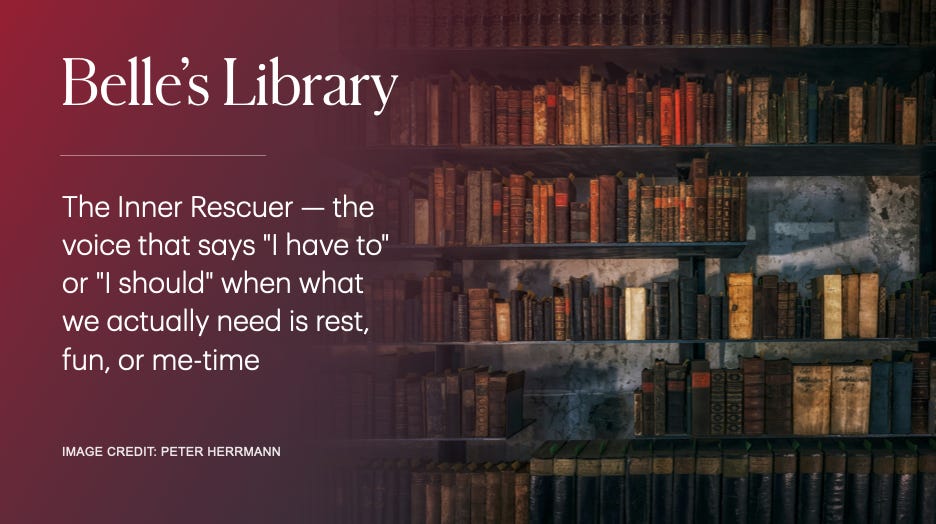
As the Inner Rescuer in this scenario, Belle is the voice that says “I have to” or “I should” when what we actually need is rest, fun, or me-time. It’s the part that overrides the body’s signals, pushes us beyond our limits, and creates guilt whenever we consider putting ourselves first. “I can’t possibly tend to my own needs,” it says, “when there are so many things to be done and people much more helpless than me who need my infallible help”.
Oblivious to the game of “I’m better than you” that Belle’s really playing, she uses the Beast’s plight as a shield – proof that she’s not the weakest around here, and that she doesn’t need help.
Rather than empower the Inner Victim, the Inner Rescuer compensates for it, overrides it, and tries to fix it through sheer force of productivity and self-sacrifice.
For a Rescuer, internal or external, to be seen as a Victim is the ultimate failure, so Belle refuses to validate or even acknowledge her own Beast’s pain. Instead, she doubles down on her toxic positivity and naïve can-do attitude.
Belle doesn’t look up as you enter – too busy. You can hear her muttering to herself. “I can do this,” she murmurs, “I have to. If I stop, if I’m not useful, or productive… and then I’m nothing.”
Belle is doing, so she doesn’t have to feel, convincing herself that she can empower the Beast with care and love, so she never has to accept the weakness she perceives in the pain it feels.
Beneath this performance, though, Belle is just as scared as the Beast.
Gaston’s hall
Quietly, you close the door of the library and walk to the great hall to be met by grand, antique furniture, dark wood, and hunting trophies on the walls. Standing by the fireplace is Gaston, with his arms crossed, ready to fight his corner and to mete out his judgments.
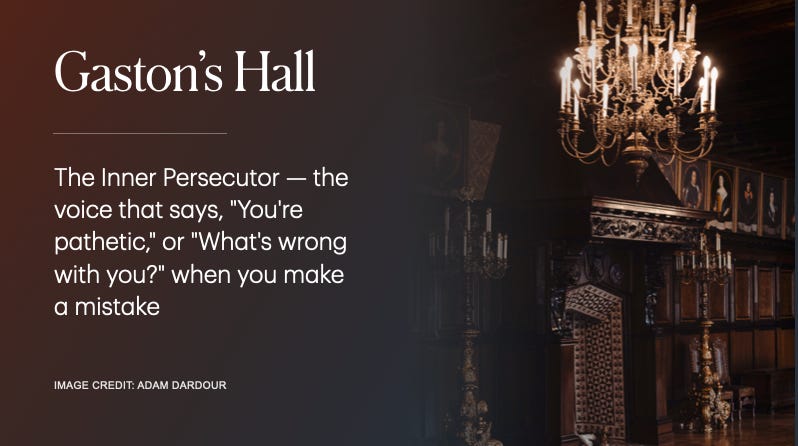
Gaston is the Inner Persecutor: the Inner Critic or the voice that says, “You’re pathetic,” or “What’s wrong with you?” when you make a mistake. This part storms in at the faintest whiff of failure to use shame as motivation, because it believes that punishment will lead to growth – “If I’m harsh enough to myself, I’ll have to improve.”
Just like Belle, Gaston is oblivious to his own struggle and wholly unwilling to admit weakness. He’d rather shout, scream and criticise than show his softness of self to the world.
As Gaston notices you, his eyes narrow, one finger rises, and his mouth opens. But before he can say anything, the scene freezes. There’s just no need to listen to his vitriol when you can see this part for what it truly is – just as scared as the other two. Gaston is terrified that if he’s not cruel enough, if he’s not punishing enough, he’ll – you’ll – be vulnerable. And vulnerability, to Gaston, is death.
The garden
All of a sudden, you’re in the castle’s garden. It’s night, and the flickering light inside shows you all three characters at once – the Beast in his chamber, Belle at the desk, Gaston with his hunting trophies – and from here you can see that, beneath their various attempts to control and protect, is the same simple belief – “I’m not okay.”
Persecutor: “I’m not okay… unless I’m on top”
Rescuer: “I’m not okay… unless I’m of use”
Victim: “I’m not okay… fundamentally”
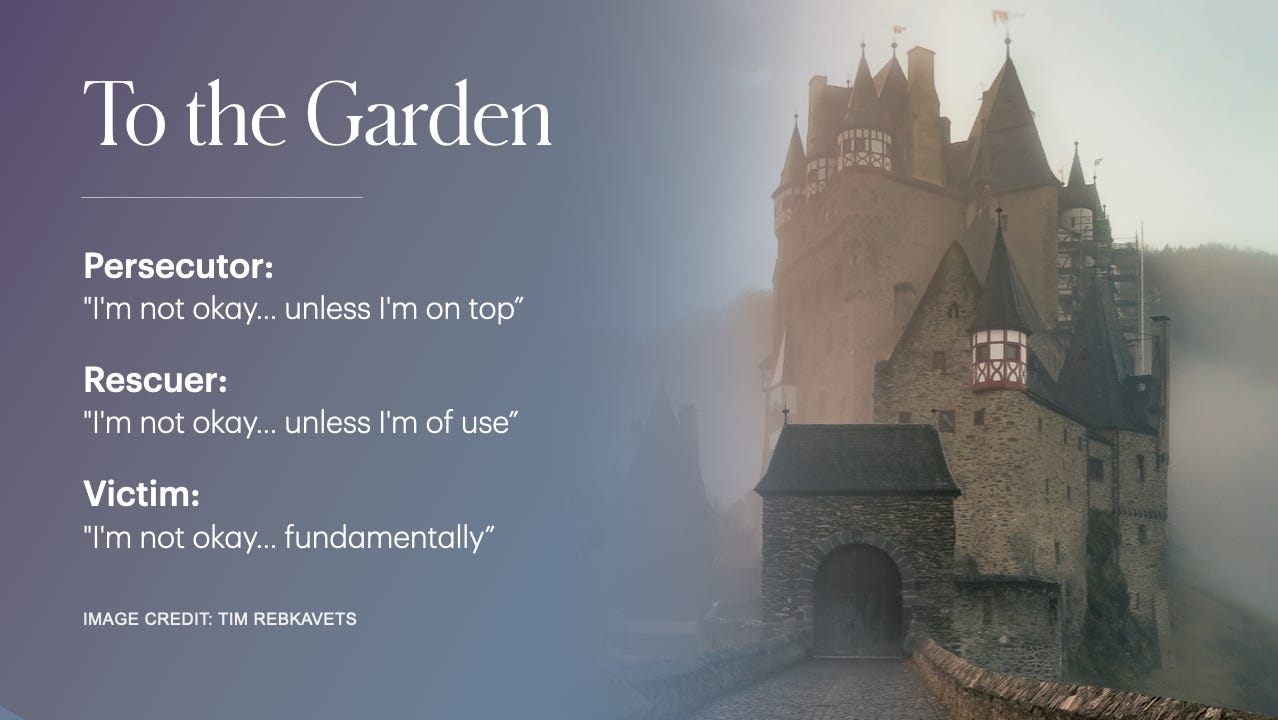
What this means is that you’ve discovered the Drama Triangle’s dirty little secret. These seemingly different roles are just three flavours of Victim – aggressive, self-sacrificing and vanilla.
When we get sucked into drama, we cycle through these variations ad nauseam, searching for the play that will finally make us feel better about ourselves – finally make us feel okay – but because none of them actually work, we just keep on spiralling. No matter how strong a habitual Rescuer might appear, or how intimidating a bully might seem, if someone is playing this game, it means that in some way and for some reason, they do not feel okay – not safe, not good enough, not loveable, likable, respectable. Valid.
Walking away from Drama
To opt out of drama then – to stand up and leave the castle – is to decide to feel okay, not by being better than other people, not by saving other people, and not by allowing others to try and fix us, either, but by listening to our needs and meeting them for ourselves.
What are the needs you must meet before you can step into this garden? What’s one boundary you need to set, one awkward truth you need to give voice to, one trap you need to walk away from? When we’ve been wrapped up in drama dynamics for a long time, it can feel like a huge task to opt out, but it isn’t. Not always, anyway. Every time we choose to meet a need with clarity and independence, the drama pauses, and we pop out of the castle into the fresh air of the garden, and it is good.
Rewriting the fairytale ending
The story we’ve been told is that love transforms the beast. And it does, but only the one inside, and only when that love comes from a strong, responsible, self-empowered place. The love that will liberate our inner Beasts, Belles and Gastons from their endless torment is honesty. Honesty with ourselves and with others about what we truly need, and what we’ll no longer put up with.
To walk away from an external Drama Triangle usually means being seen as the Persecutor for denying others the game they want to play, but that’s a hit worth taking when the pay-off is freedom. And it all starts with awareness of your own patterns – noticing the moments you slip into “It’s all your fault!”, “Let me help you!”, “Poor me!” or all of the above at once, and simply choosing not to play the game.
We can’t force other people to change, and we can’t expect them to change us either. Liberation from the Drama Triangle is an inside job. But it’s one worth doing, because when we stop playing the game, other players have nothing to hook into, and the triangle collapses.
So go ahead and walk away from the castle. I’m not saying you won’t be back, because you will – we all will – but now you know how to leave.
And look! The sun is rising. A new day awaits. I wonder what you’ll make of it.
REFERENCES
Karpman, S; “Fairy tales and script drama analysis.” Transactional Analysis Bulletin, 7(26), 39-43; 1968
Karpman, S; “Options.” Transactional Analysis Journal, 1(1), 79-87; 1971
Eric Berne; “Games People Play: The Psychology of Human Relationships”, 1964
Beauty and the Beast (1991). Directed by Gary Trousdale and Kirk Wise. Walt Disney Pictures.
Hazel Gale, The Mind Monster Solution, 2018
I never saw it presented this clearly... And I love the traversing of the different imaginaries, thank you
What a powerful way to get to the heart of the matter! I was thinking lately how negative emotions play a huge role in manipulation games and how important it is to get in touch with those emotions and understand them, so that no one can hook us and use them against ourselves, not even our own self! Your explanations are wonderful as always!