


You can listen to this post on our YouTube channel or read it below.
***
Most people sleepwalk through life. We scroll without seeing, eat without tasting, talk without meaning. We can find ourselves living like ghosts or zombies – reactive, automatic, only half-present.
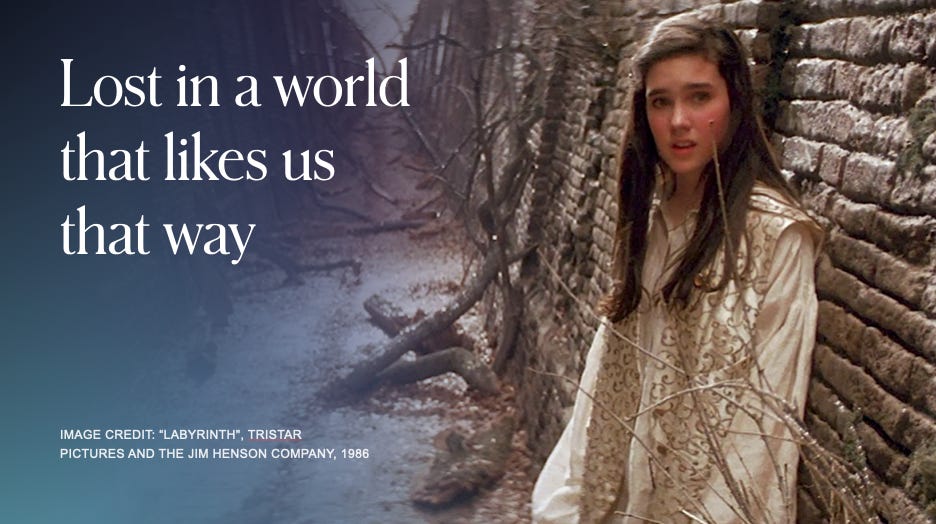
It’s not all our fault, of course. We live in a world that’s designed to keep us distracted – where attention is a currency and full consciousness is rare. But there are a few people who escape this trap. The true magicians, the mages, the sorcerers of the modern day; the ones who somehow manage to live with intention and presence. The ones who can perform true magic.
Today we’re going to talk about the Mage archetype – not the stage performer with tricks up their sleeve, but the wielder of will, the master of consciousness, the one who shapes reality through focused intention. The Mage lives within, and its power is available to all of us if we’re only willing to wake up.
“Everything I’ve done, I’ve done for you”
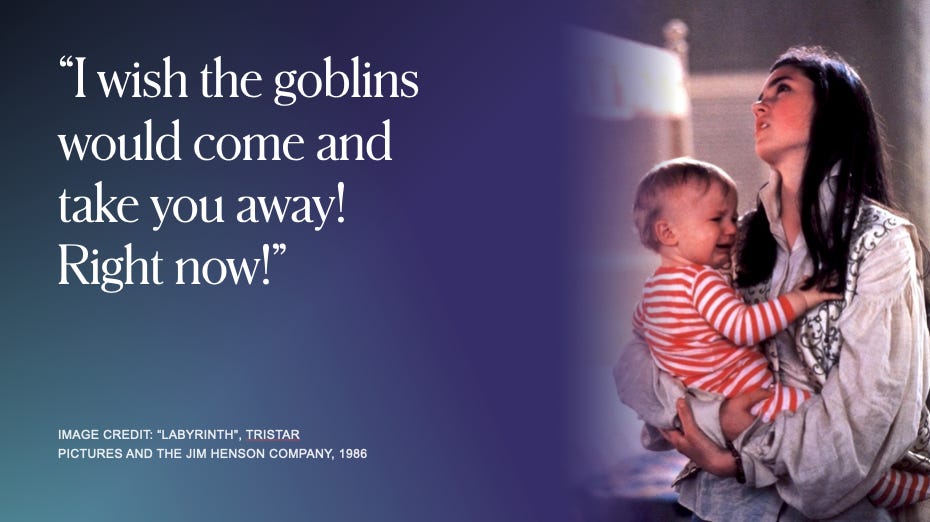
The 1986 fantasy film Labyrinth (spoilers incoming) sets the perfect scene for exploring the powerful, fundamental archetype that is the Mage. Sarah, played by Jennifer Connelly, a teenage girl angry about having to babysit her little brother, wishes him stolen away by the goblins. And the Goblin King – Jareth, played by David Bowie in all his otherworldly glory – arrives to take her at her word. He whisks the baby to his castle at the centre of a vast labyrinth. Now, Sarah has thirteen hours to navigate the puzzle, or her brother will become a goblin forever.
Jareth’s labyrinth is a maze of illusions, manipulations and enticements. As Sarah tries to navigate it, the Goblin King bamboozles her with both threats and seductions. He plays with time, creates mirages, and offers her everything she wants – if she’ll only surrender.
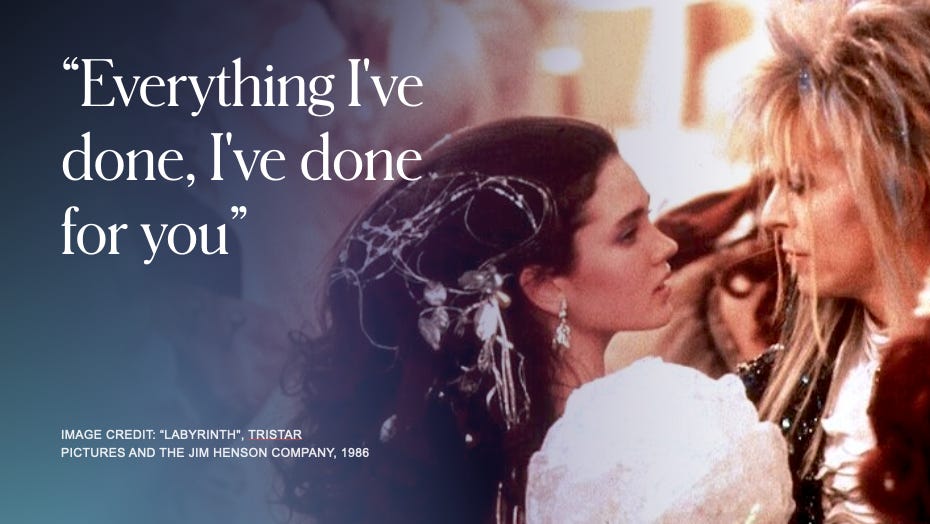
Sarah is tempted, of course. Who wouldn’t think twice about the offer of eternal bliss with a Lycra-clad David Bowie? But at the very last minute, she finds herself. Standing in an impossible castle surrounded by glamour and temptation, Sarah utters the six simple words that break the spell: “You have no power over me.”
With that, the illusion shatters. The castle crumbles, Jareth disappears, and Sarah finds herself back in her bedroom, holding her baby brother, her power reclaimed because she was able to see past the smoke and mirrors.
So, who’s the real magician in this story – Jareth or Sarah?
The Mage archetype – “As above, so below”
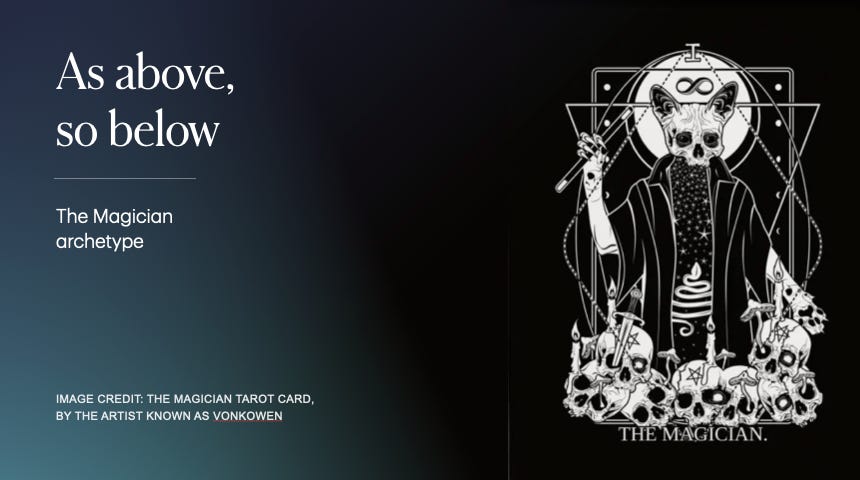
In Tarot, the Magician is the first numbered card – number one, marking the beginning of the journey. He stands with one hand pointing to the heavens and one pointing to the earth to symbolise the principle of correspondence, or the idea that the microcosm reflects the macrocosm, and vice versa: as above, so below.
These words come from the Emerald Tablet, or Tabula Smaragdina – a foundational text attributed to Hermes Trismegistus. What the phrase means is that what happens in the spiritual, celestial realm is reflected in the material, earthly realm, or that the pattern of the universe is replicated at every scale.
Psychologically, this principle of correspondence translates to “As without, so within” – the external world is reflected in the inner, and vice versa. Projection in a nutshell. Or, as Anaïs Nin is often quoted: “We don’t see things as they are, we see them as we are.”
The Mage archetype – master of all four elements
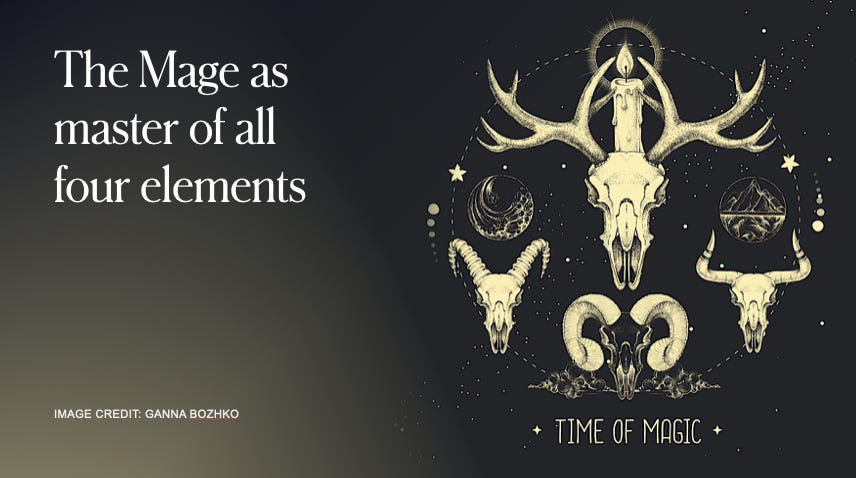
In Tarot, the Magician has all four suits laid out before him – wands, cups, swords, and pentacles – representing the elements as the tools of manifestation. He is the archetype of focused will, conscious intention, and deliberate action. He represents the moment when you stop being acted upon by life and start acting with life instead, just as Sarah experienced when she finally shattered Jareth’s illusions of control.
Carl Jung, who used Tarot as a tool for understanding archetypes, described the Magician as representing the ego’s capacity for conscious control and transformation (as distinct from the Hero’s journey of conquest). The Magician’s power isn’t about supernatural abilities or mystical forces so much as pure, simple consciousness. To be awake in a world that’s designed to keep you asleep is a fundamental act of magic. Real-world sorcery is…
to pay attention when attention is being harvested by a thousand apps
to act with intention when everyone around you is reacting automatically
or to speak, deliberately, with thought and meaning rather than spewing platitudes or just saying what you’re expected to say.
These things sound simple, but judging by how rarely we do them, they obviously are not.
“There Is No Spoon”
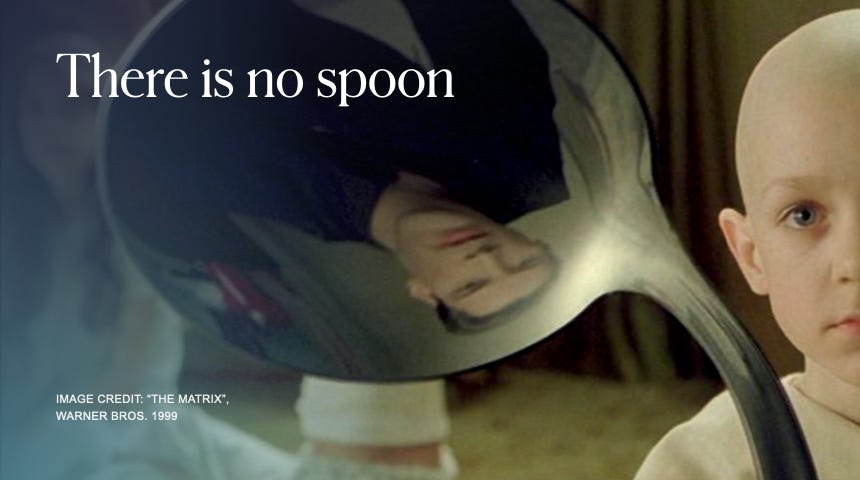
When Neo visits the Oracle in The Matrix and sees a child bending a spoon with his mind, the child tells him, “Do not try and bend the spoon. That’s impossible. Instead, only try to realise the truth: there is no spoon. Then you’ll see that it is not the spoon that bends, it is only yourself.”
This is the essence of Mage consciousness. It’s not about forcing reality to bend through sheer will so much as recognising that your experience of reality is shaped by your consciousness. Perception is a creative act, not a faithful replication of the real world, which means that where you place your focus literally determines what you see, and what you see, you experience as real. Not only that, but you experience it as all that is real, too, as if nothing else exists. But there’s always more.
When Neo takes the red pill and therefore comprehends the Matrix for the first time, he is accessing the power of the Mage.
Language as spell-casting
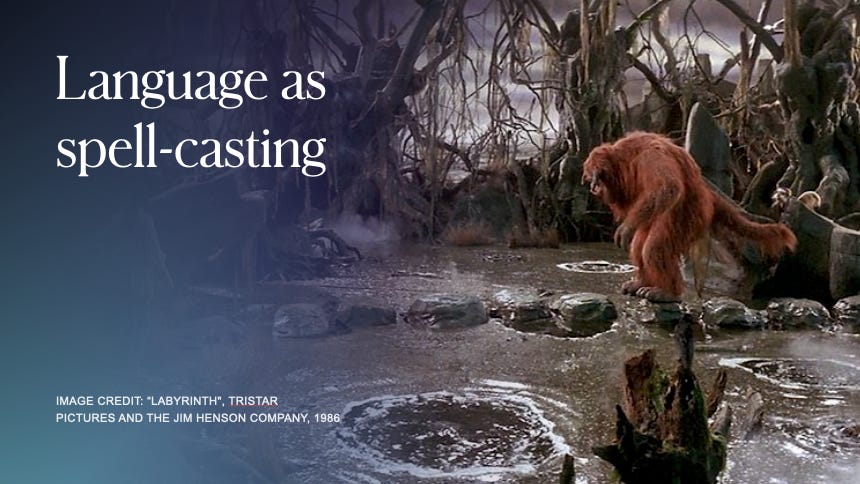
In the Labyrinth, Sarah’s awakening – in fact, the entire film – is all about the power of words.
Sarah wishes her brother away by reciting lines from a play she’s been rehearsing, unaware that she’s summoning the Goblin King. Then, as her journey continues, the weird and wonderful creatures she meets ask her to say things that determine her fate: she must state whether she wants to go up or down in that weird, hand-filled hole thing; figure out the right question to ask the door guards; Sir Didymus won’t let her pass unless she asks permission. And, of course, in the end, it’s those six words spoken to Jareth that set her free.
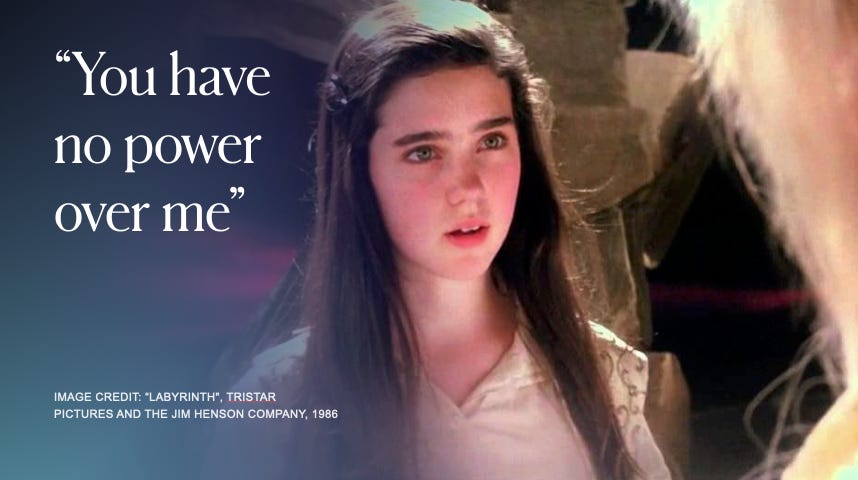
Over the course of the movie, Sarah learns that words are magic – that they bind and create. She goes from a tantruming girl who flippantly wishes death on her baby brother to a conscious, empowered woman who can see the world for what it is, and will not be controlled by the evil wishes of others.
Although none of us is all that likely to summon the Goblin King any time soon, language is magic for us too. We create reality for ourselves when we make agreements, state boundaries, ask questions, make requests, gossip, moan, curse. Every word we speak has the power to influence others or shape their perception, and also to program our own consciousness.
Every time we say (or think) things like, “I can’t do this,” “Nobody listens to me,” or “I always mess this up,” we cast spells on ourselves – spells of limitation, invisibility, inevitability. And I don’t mean this in a kind of woo-woo, manifestation, the universe provides way; I mean it quite literally. When we say things like this to ourselves or others – especially repeatedly – they crystallise into expectations and beliefs, and beliefs filter consciousness, changing the world we perceive, which is to say they change the world we live in.
As Sarah learns this during her ordeal in the labyrinth, she gradually brings the power of words into her conscious control. She becomes the Magician.
The Shadow Magician: Jareth’s seduction
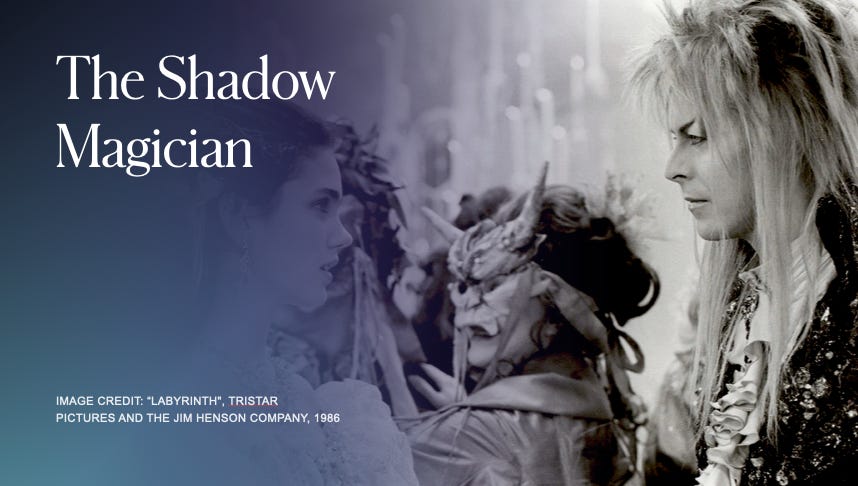
But, of course, this archetype’s power isn’t only used for wholesome things like saving babies from evil 70s rock stars. As every archetype does, the Mage has a shadow side, and it can be a very, very toxic thing.
In Labyrinth, Jareth is a Shadow Mage. Where the light of this archetype creates conscious freedom and strength, its shadow intends to trap, and it does so through manipulation and seduction.
Shadow archetypes are not just the mean and nasty ways that mean and nasty people do things. For an archetype to be in the shadow, it must be repressed and rejected – whether through fear, shame, or cultural conditioning, this particular power or experience has been deemed off-limits for us.
So, while bringing the Mage into the light of consciousness is about realising and owning the extent of our power, the Shadow Mage manifests in those of us who don’t understand or accept our own power. This doesn’t mean the power isn’t there, mind you. It is – everyone has the ability to influence the world around them. But, rather than use it deliberately, when the Mage has been relegated to the shadow, its archetypal force seeps out in unconscious manipulations – power games we don’t even know we’re playing.
Living in a Mageless world
Now this is a problem, because we live in a world that is disempowering by design. Our malleability and presumed impotence are required for governing powers to keep us in check, for advertising to work, for economic systems to extract our labour without resistance, and for algorithms to keep us scrolling.
We’re taught that real power belongs to someone else – the experts, the authorities, the people at the top, and then, to boot, we’re sold pseudo-empowerment in the form of a sports car, the latest iPhone, a productivity app or dubious supplements. Nice. The Shadow Mage is everywhere we look.
The difference between magic and manipulation
So what’s the difference between real magic and shadow magic?
Real magic requires:
Consciousness – you’re awake, aware, present
Intention – you know what you’re doing and why
Action – you’re willing to do the work
Integrity – your words match your actions
And respect for others’ will – you’re not trying to control or manipulate anyone in the process of getting your own will done.
Shadow magic, on the other hand, is unconscious, performative, manipulative, and violating.
Sarah’s magic at the end of Labyrinth is real because she’s conscious and intentional as she performs it. She’s not trying to control Jareth or defeat him with bigger tricks. She’s simply reclaiming her own will, power, and reality.
Jareth’s magic is shadow magic because it’s all about the control of others – keeping Sarah distracted and unconscious so she’ll surrender to him.
“Just let me rule you”
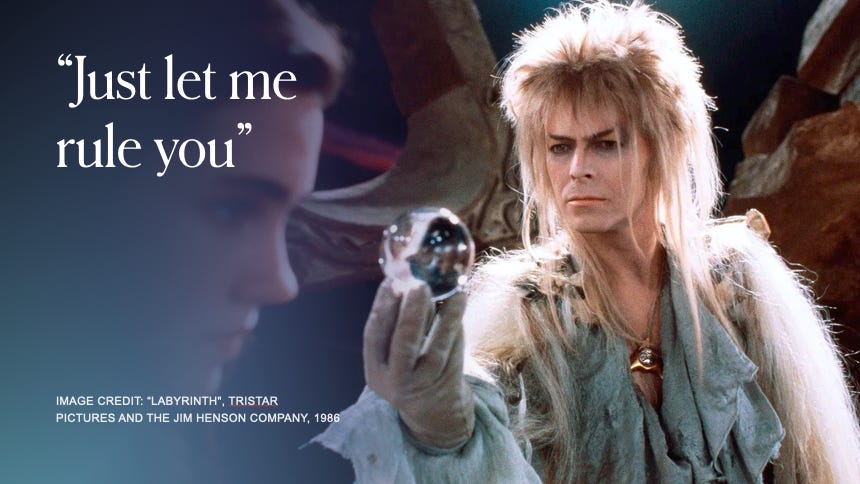
But shadow magic doesn’t need a Shadow Magician in order to be cast. There’s a scene in Labyrinth where Jareth offers Sarah a crystal ball. “This crystal,” he says, “if you turn it this way and look into it, it will show you your dreams.” Of course it’s a trap – if Sarah looks into the glittering ball, she’ll forget everything: her brother, her mission, even herself.
This motif goes to the very heart of shadow magic, and it is everywhere. Whether it’s unrealistic promises made by scam products or charlatan gurus, or the lure of escaping a difficult task or conversation by binging Netflix, shadow magic offers us a quick-fix illusion of what we want in exchange for our will, autonomy and agency. The offer is always tempting, and the price is always the same: our power.
Waking up
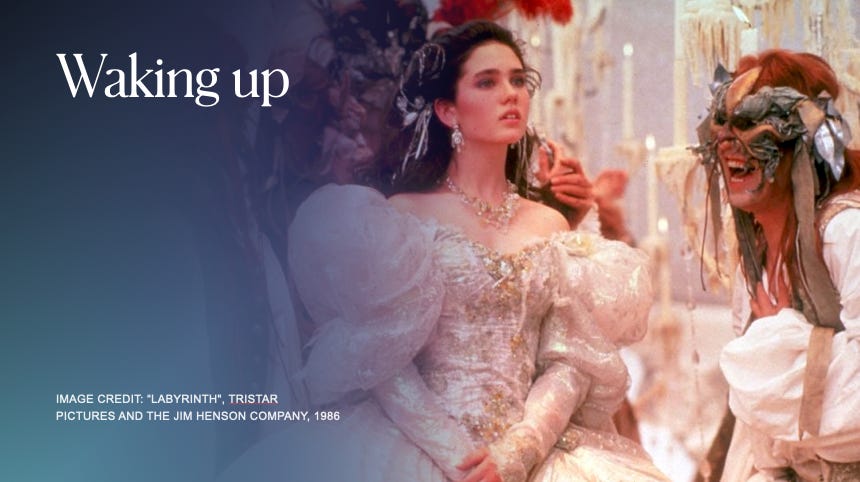
But that’s not to say that watching Netflix is inherently disempowering, of course. The difference is consciousness.
Choosing to relax for an evening in front of the TV because you need rest is fine. Mindlessly disappearing into a binge because some invisible part of your mind is trying to avoid a difficult conversation? That’s shadow magic at work, and it’s a wake-up call.
The very first and most important act of real magic is choosing to wake up. We need to wake up to the particular disempowering patterns we fall into, and to the promises we’re most susceptible to. This is how we claim back the power that this world’s shadow magic has been leeching away. And it isn’t a big thing – in the moments where we’re about to hand over our autonomy, we need only the tiniest spark of consciousness to ignite in order to break the spell. We may not even act on this awareness the first few times, but if it’s there, then the bigger magic is on its way.
The spark of change
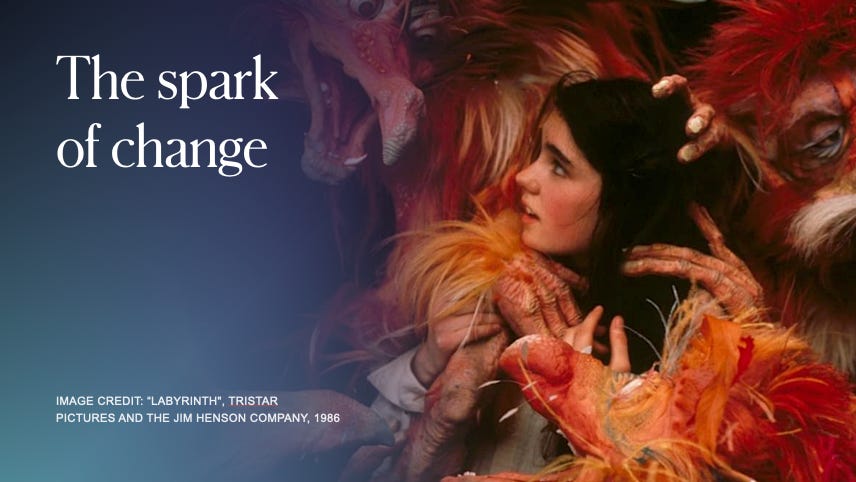
Waking up isn’t only about self-preservation, however. When we become conscious of our own patterns, we’re much less likely to cast shadow magic on others as well.
When manipulation is unconscious, it’s invisible to us. We genuinely don’t know we’re playing power games or guilt-tripping people. We think we’re being helpful, protective, or just doing what needs to be done. Consciousness makes these patterns visible.
And once they’re visible, we have a choice we didn’t have before: keep doing it knowingly, or stop. Most people, forced to truly see and own their manipulations, at least want to stop – not because they’re inherently virtuous, but because the cost becomes unbearable. When we can no longer pretend innocence or hide behind “I was only trying to help,” we have to face the reality of what we’re doing and why. This means we have to own the damage we’re doing to our relationships, our integrity and our sense of self.
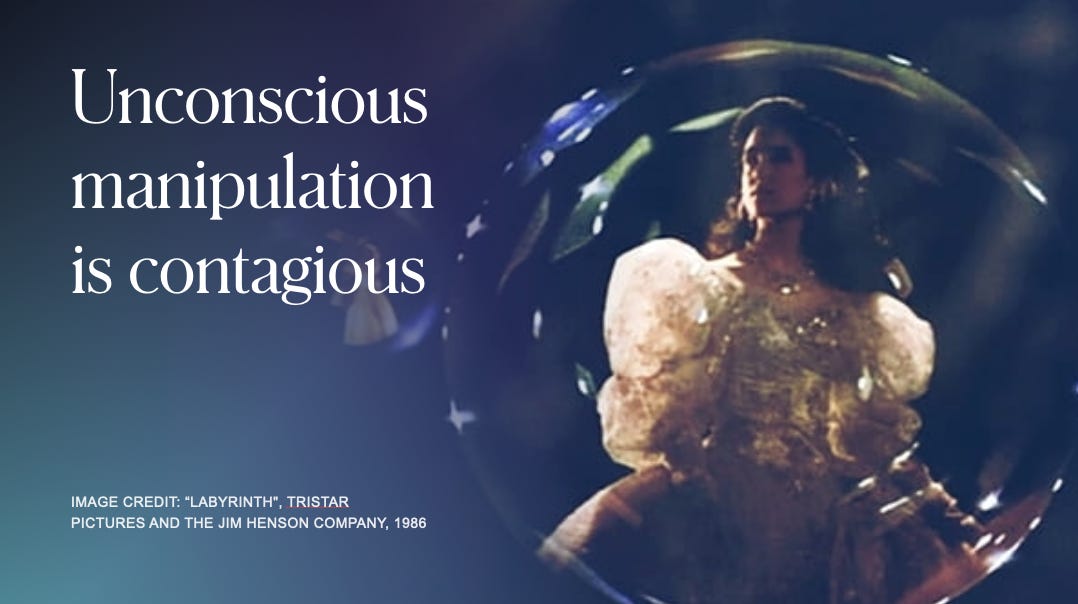
Unconscious manipulation is contagious – we manipulate because we were manipulated. Conscious manipulation requires active choice and self-justification. It’s harder to sustain.
There are, of course, some people who deliberately manipulate and control. I’d wager that there are fewer of these than it might sometimes seem, and I’m *sure* this kind of maliciousness is born of trauma and fear, but that doesn’t excuse it. Regardless of whether we can see where abusive behaviour comes from, and no matter how much we just want someone to heal and therefore change, it is never our responsibility to stick around and make that happen. If our eyes are open to patterns like this, then our only responsibility is to find a way to protect ourselves.
Ultimately, consciousness doesn’t guarantee goodness, but it does force choice, and choice comes with responsibility and consequences. It also, however, brings power, freedom, autonomy and growth, but only once we’ve woken up. We need to reconnect with the Inner Mage for that spark to ignite.
The magical labyrinth
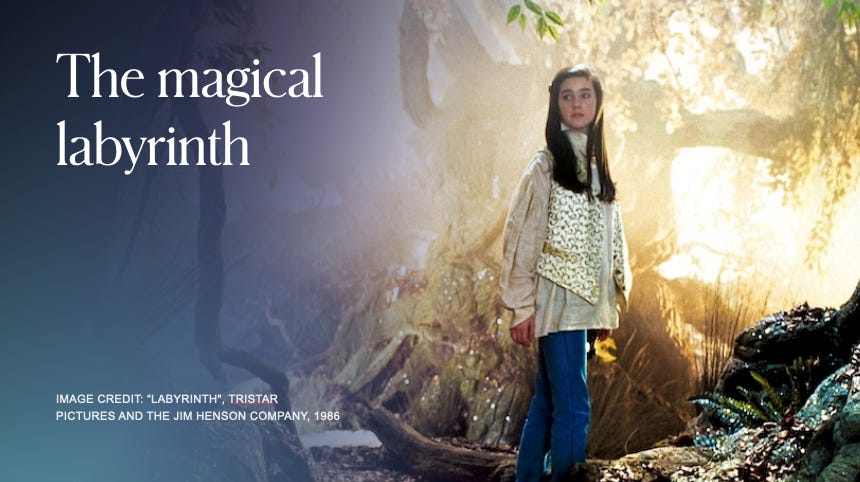
Imagine you’re standing at the entrance to a labyrinth. At first, you hesitate, but it soon becomes clear that this is not Jareth’s nightmarish kingdom. It’s a place of warm power that exists within you – your magical home.
The walls shift and breathe, impossible staircases twist up and down like Escher drawings. Water flows towards the sky in spiralling streams, ignoring gravity. Flames flicker downwards from floating braziers, golden and alive.
You step through the entrance just as a soft breeze lifts a stream of fallen leaves from the floor and swirls them around you as if in welcome. They settle once again as you pass into a long corridor filled with plants. Vines creep and climb through stone, blooming before your eyes.
You make your way, calmly, through the maze of rooms, drawn forward by a quiet sense of knowing. When you reach the centre of the labyrinth, you find a circular chamber. It has no ceiling, and you can see a clear star-strewn sky above. Standing in the centre of the space is your Mage – tall, ageless, powerful.
As you step towards the entrance to this chamber, you find that you can’t yet pass. There’s something blocking the way. How do you imagine this barrier? Perhaps it’s made of thorns, wire, or glass. Perhaps it’s made of chains or woven fabric. You can see through it, but you can’t enter.
And I don’t know whether, for you, this barrier is thick and old and strong, or whether it’s relatively sparse. I don’t know whether it’s made primarily of personal experiences, limiting beliefs, memories of failure or powerlessness… or whether, for you, the barrier is made solely of conditioned limitations – powerlessness inherited from a world that wants you to be small. But no matter how you imagine this barrier, it needs to come down for you to meet your Mage.
You peer through into the chamber. The figure in the centre holds all four elements in their hands. A flame hovers above one palm, golden and alive. A perfect sphere of water floats above the other, swirling and moving within itself. Between the Mage’s fingers, a tiny whirlwind spins – visible, dancing air. And wrapped around one wrist, a living vine with a vibrant purple flower at the end.
Words. You realise, as you gaze at this powerful figure, that only words can dissolve the barrier between you – words imbued with will, intention and determination. Speak those words, and you’ll gain access to the chamber. But which words? You might find yourself speaking about your own power – affirming your right and ability to make things happen. You might find yourself voicing a single intention – a statement of resolve or desire to do one small thing, utter one little truth, act in one tiny way that will signal complete ownership of your own strength to the world and to yourself. So, what’s it going to be?
When you open your mouth to speak, your voice sounds different. Maybe it’s the chamber, or maybe it’s just your true voice, but it resonates in a way you’ve never heard before. It’s not certainty that you sense in these words, because that’s rarely the goal… It’s purpose. You can feel it in the sound of your voice.
As the final syllable echoes around the circular space, the barrier melts. It unmakes itself before your eyes – cracking and warping first, then turning to liquid like molten wax. It seeps into the floor of the labyrinth and disappears.
Suddenly, you’re standing in the centre of the chamber, looking the Mage in the eye, and you can sense the power between you.
Then, the elements start to animate:
The flame streams towards you, warm but not burning, and you can feel the fire in your core – courage, passion, boldness.
The sphere of water bursts and flows in your direction. You feel it in your heart – wisdom, knowing, the ability to adapt and to feel deeply.
The whirlwind spins and swirls around you, cool against your skin. You feel this in your mind – clarity, independence, the power to see through illusions.
And finally, the vine wraps around your wrist, moving soft and slow, like a loving touch. You feel it throughout your body, right down to the tips of your toes – presence, stability, the power to stay rooted and to trust in yourself.
The Mage nods once, satisfied. They make a sweeping gesture to the magical palace around you – the impossible staircases, the upward-flowing water, the living walls – and you know, in that moment, that this all belongs to you. It always has. And with that realisation, the entire space begins to glow – brighter and brighter, until it’s gone, and you’re back in the present moment, the feeling of raw, elemental power still thrumming through your bones, along with the simple sense that you can. Can you not?
REFERENCES:
Carl Jung, Archetypes and the Collective Unconscious (1959)
Labyrinth, directed by Jim Henson (1986)
The Matrix, directed by the Wachowskis (1999)
Robert A. Johnson, Owning Your Own Shadow (1991)
Clarissa Pinkola Estés, Women Who Run with the Wolves (1992)
Jessica Dore, Tarot for Change (2021)
I love how you're calling out the difference between chosen and passive consumption, I feel like that is core to this issue today
I absolutely love that movie. And I get what you are explaining. I never thought about Labyrinth in that way and it makes a lot of sense to me.
I actually thought the movie was about a Girl dealing with Addiction and the journey was her finding herself