


You can listen to this post on YouTube or read it below.
***
You know that voice in your head that tells you to work harder, or improve yourself by fixing that one little problematic thing? This voice might sound like motivation when you hear it, or like self-care – encouragement towards a perfectly reasonable goal. We all need to grow, of course, and the impetus has to come from somewhere. But how much do you know about that voice, really? Is it on your side, empowering healthy change? Or is it motivating you towards something much darker?
Today we’re diving into the world of K-Pop Demon Hunters – the smash-hit animated movie that hundreds of millions of people, young and old, have devoured, dissected, and sung along to in their living rooms over the last year.

This is the story of a demon hunter battling dark forces in a bid to save the world from destruction, and reckoning with her own demon nature in the process. For me, the most fascinating and useful thing about the psychodrama presented by K-Pop Demon Hunters is what this film reveals about how we use other people’s adoration to fuel self-elimination, and how shame doesn’t always look like darkness, but rather productivity and the pursuit of success. K-Pop Demon Hunters is about the walls we build to protect ourselves, but that often turn out to be the very things that will destroy us.
Fair warning: this article contains significant spoilers. If you haven’t watched K-Pop Demon Hunters and want to go in fresh, bookmark this and come back.
Still here? Then let’s talk about what this film says about you.
K-Pop Demon Hunters in a nutshell

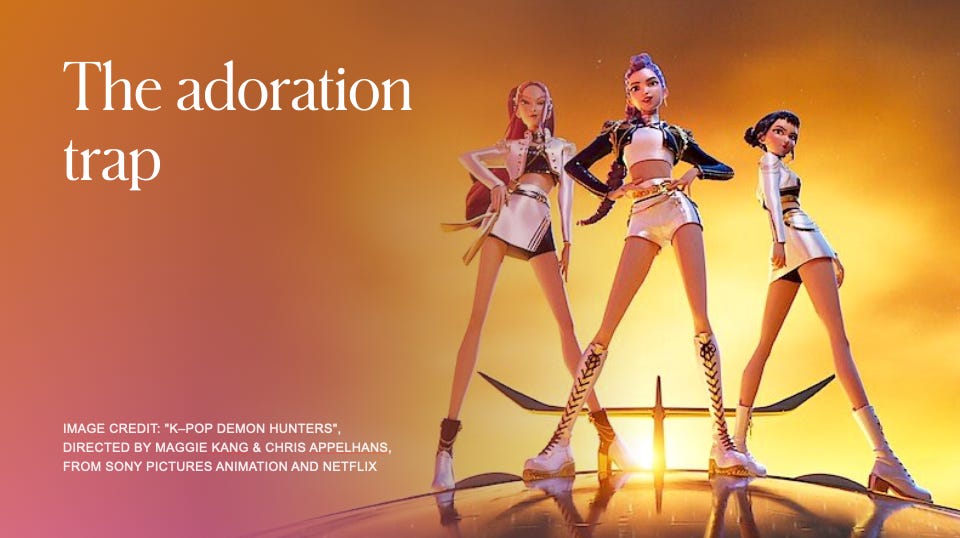
Meet the K-pop girl group, Huntrix: Rumi, Mira, and Zoey. On the surface, they’re pop stars loved all over the world, but their true mission is bigger than releasing yet another No.1 hit – they are also secret demon hunters under oath to protect humanity from the evil that seeps in through tears in the Honmoon.
The Honmoon is a magical barrier woven from collective human soul energy that keeps the demon realm separate from the human world.
The word Honmoon is a combination of two Sino-Korean words: hon (혼), meaning “soul” or “spirit”; and mun (문), meaning “door” or “gate”. This soul gate, then, divides what’s acceptable from what must be kept out.
Huntrix’s goal is to turn the Honmoon gold, symbolising perfection and purity. By perfecting the barrier through a combination of the power of song and the collective soul energy/love from their fans, the demon hunters will seal the human world permanently, making the separation between good and evil absolute. Music, worship, and collective energy: that’s the defence system.
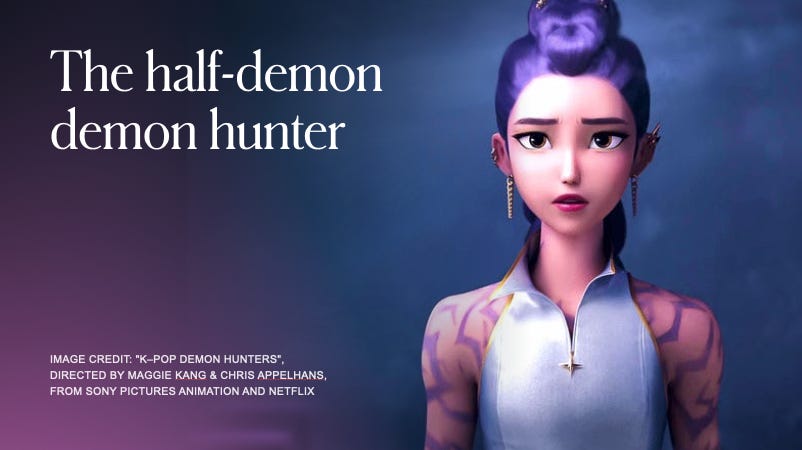
But here’s where it gets complicated: Rumi, whose name means “flowing beauty” or, as fans have noticed, “to come true” if used in combination with the common Korean surname Lee, is half-demon. Her father was a demon, and she has dark marks on the skin of her arms that she desperately hides. Rumi has been told that when the Honmoon is sealed, her marks will disappear, making her extra invested in the endeavour.
The fight against shame
K-pop Demon Hunters makes no attempt to veil the psychological meaning behind their story of good versus evil – which, by the way, I think is a fantastic sign of where we’re headed in terms of what we teach growing minds about fear, shame and human struggle. Because that side of things is evident, I’d like to focus on some of the less explicit messages conveyed by this movie.
The film opens with Rumi’s bandmates making a beeline for the couch and some hard-earned rest after all the success they’ve been having.
Rumi, however, has other ideas – she secretly releases their next single and propels them into yet another sprint of work.
Fast forward twenty minutes or so, and Rumi’s demon patterns have spread to her neck, where they affect her voice. That is, the very thing she needs to perform, and to maintain the barrier and complete her mission. She’s losing the capacity to do the work that’s supposed to save her.
Taking the advice of her bandmates Zoey and Mira, she goes to a doctor, sits down, opens her mouth like a child, and goes, “Ahhhhhh.” The doctor wags a finger. No. “In order to heal a part, we must understand the whole,” he says.
Staring at her in a slightly menacing way, he diagnoses the real problem. “You have lots of walls up,” he notes. “Focusing on one part leads you to ignore other parts, leaving you separated.”
So, the Honmoon isn’t just external. Rumi has an internal wall, too, designed to keep her demon heritage separate from her human identity. And this defence system, it would seem, is the real problem.
At this point, Mira and Zoey chime in to agree – “she’s emotionally closed off,” they nod, “a workaholic! She doesn’t know how to relax!” But the doctor doesn’t stop with Rumi’s analysis.
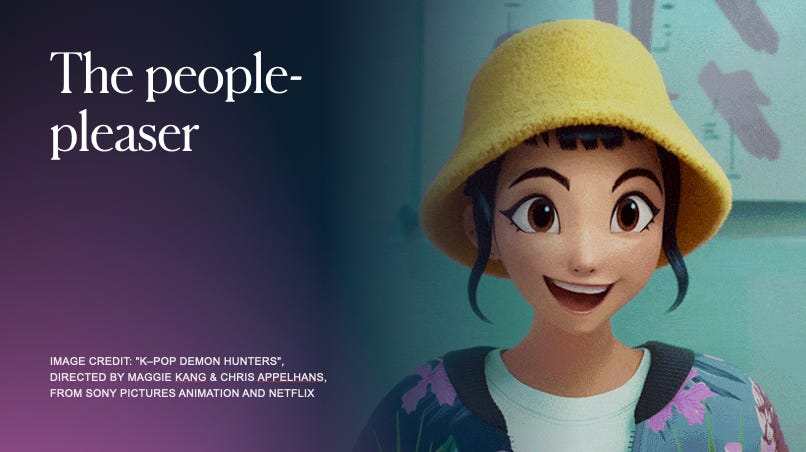
Rounding on Zoey, he diagnoses an “eagerness to please,” constantly accommodating others.
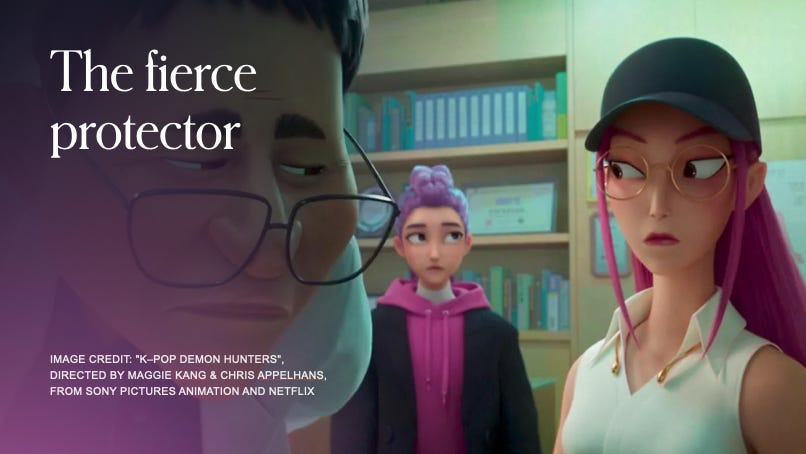
And in Mira, he finds a fierce protector whose vicious anger won’t let anyone close.
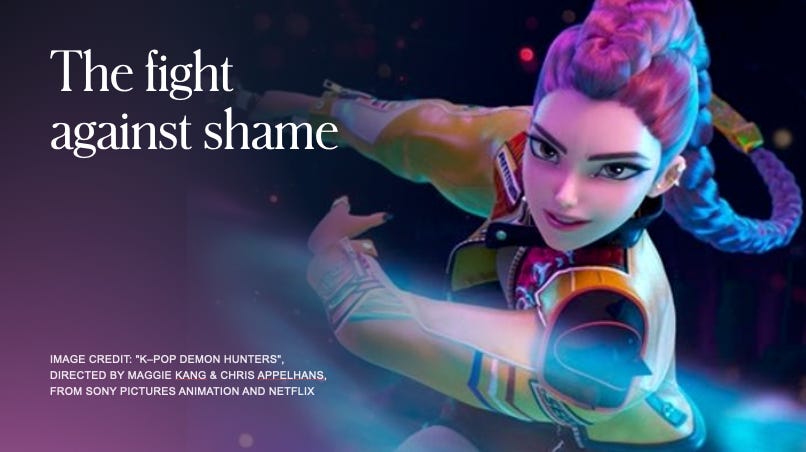
This is where we start to see the psychological interplay between characters. Just as every story that touches on the archetypal, K-pop Demon Hunters tells the inner tale of a single psyche as well as one of external conflict. Read internally, this doctor isn’t diagnosing three separate people, so much as three trauma responses: freeze, fawn, and fight. Rumi is freeze – the shut-down workaholic. Zoey is fawn – the accommodator and people-pleaser. Mira is fight – the warrior part that does battle in order to protect. In Huntrix, these three responses work in concert (pun intended) to maintain the barrier.
The lure of the quick fix

So, it would seem like this doctor really knows his stuff. But, much to Rumi’s disgust, he’s revealed as yet another simpering fan when they leave the surgery and see their poster on the wall, his effigy superimposed on top to look like they’re the best of friends. To make matters worse, the tonic he gives Rumi for her voice is fake. They don’t know it yet, but they’re leaving with a presumably expensive box of grape juice.
What takes place next all happens pretty quickly. They leave the doctor and encounter the Saja Boys: a demon boy band sent to defeat them, but also totally swoon-worthy and annoyingly talented.
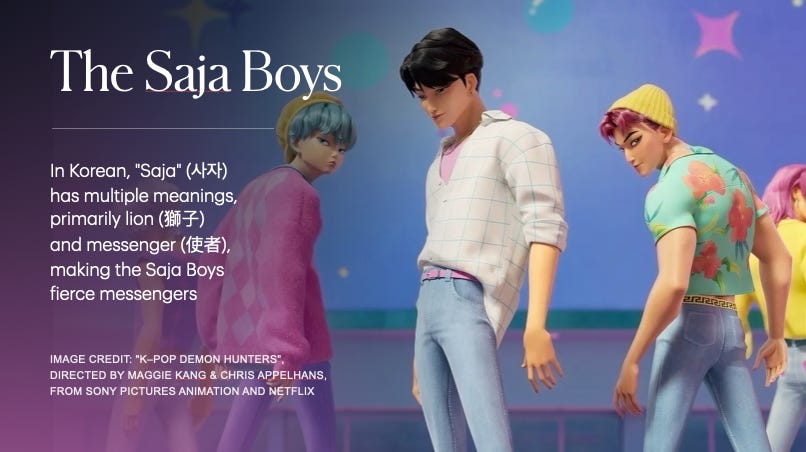
Rumi literally falls in front of Jinu, their leader – whose name means “genuine friend” – and, for a moment, there’s attraction and the hint of recognition. But then he brushes lint from his shoulder, tells her to watch herself, and walks away without helping her up. Disgusted by this rejection, Huntrix follows the boys to an impromptu gig they stage in the street, realise they’re demons, and have a big fight in the men’s bathhouse with a horde of water demons the Saja Boys had up their perfectly tailored sleeves.
Huntrix walks away from this encounter, but not unscathed. Rumi’s patterns have been glimpsed by Jinu, who therefore now knows her secret, and there was at least one civilian casualty – an old man in the bathhouse is singing the Saja Boys’ catchy new song as a water demon rises up behind him and sucks away his soul.
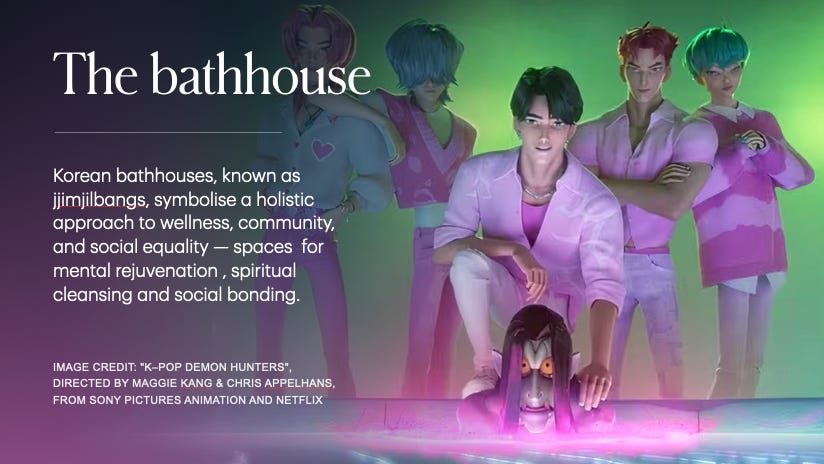
The bathhouse is deeply symbolic. It’s where transformation takes place through ritual and nakedness, but this man, isolated and singing alone, shows that even a place meant for cleansing can become the site of consumption.
The fragmented system
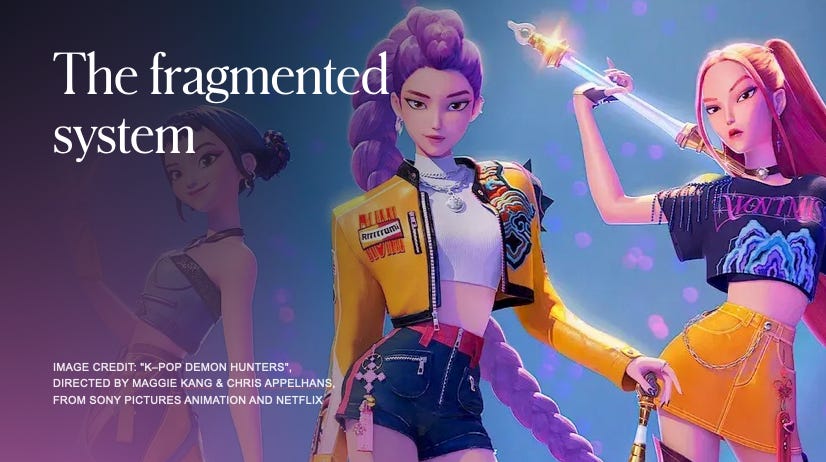
Here’s what we can take from an internalised reading of K-pop Demon Hunters. Rumi, Mira, and Zoey represent three parts of one fragmented psyche that have learned to perform as a coordinated unit. Each member is a different wall and a different defence mechanism. Together, they’re convinced that if they just strengthen the barrier enough – turn it gold, make it perfect, eliminate all the demons – they’ll finally be safe.
But this isn’t working. What a surprise.
The demon patterns that spread across Rumi’s body represent the shadow refusing compartmentalisation. The more she tries to perfect the barrier, the more her demon nature asserts itself, until it tries to claim the most important thing: her voice.
The doctor gave her the answer right away – tear down the walls, understand the whole, stop separating – but she wasn’t ready for this truth yet, and instead left with the quick-fix grape juice, devaluing the doctor on the way out by seeing him as just another fan. We all do this when we catch a glimpse of something that’s both true and difficult to accept – if we aren’t ready to transform, we warp the advice or the advisor in our minds with rationalisations and bent truths until we can write it all off as nonsense.
Ultimately, even the doctor – with his picture superimposed on their poster – is captured in the same performance system. He can diagnose the problem, but he won’t be heard, because he’s also a fan. In a way, he’s complicit.
The fans – projection and paradox
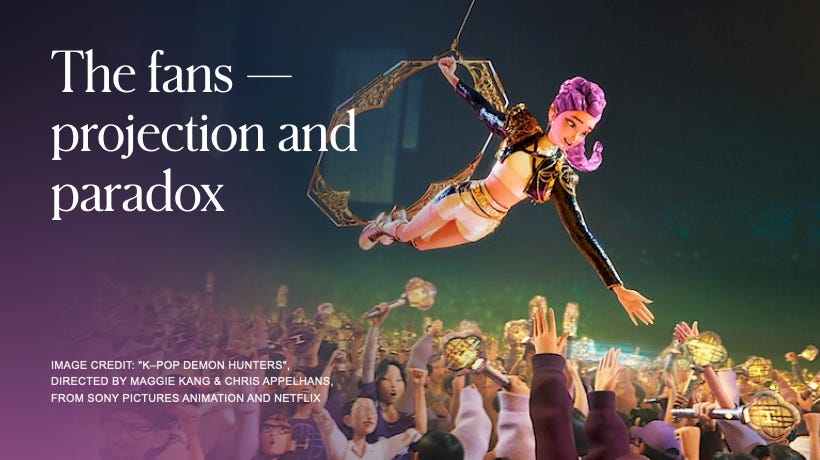
Now, in our internalised reading, the fans aren’t external to the psyche, either. They’re Rumi’s projected self-love and her terror of rejection made visible, representing how she perceives the adoration she’s destroying herself to earn.
When the Saja Boys perform, the fans worship them with the exact same fervour they do Huntrix, and as the film goes on, the adoration splits down the middle – 50% for Huntrix, 50% for the demon band. What this shows us is that the acceptance Rumi is fragmenting herself to earn flows to her authentic demon nature just as easily as her perfected persona, because self-love doesn’t require perfection or elimination. Quite the opposite, actually; self-love needs imperfection in order to be real.
Rumi can’t see this, of course, because she’s externalising her self-connection, throwing it out onto the audience and convincing herself that ratings and adoring fans will finally make her whole. She’s weaponising her own capacity for self-acceptance and using it as fuel to destroy herself through shame.
Shame’s whispered promise
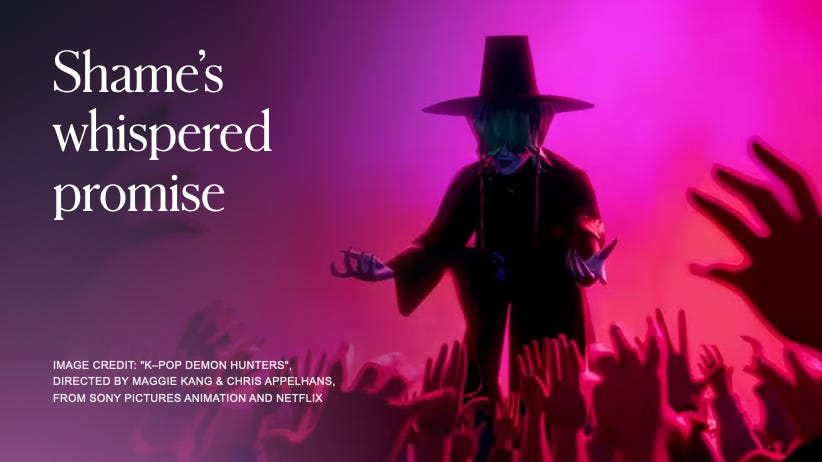
Shame is the dark heart of this movie, and it conveys a message that I find powerful.
When we think of shame, we tend to imagine isolation and darkness – perhaps someone curled up in a cold, lonely room, drowning in self-hatred. But while shame certainly can manifest that way, that’s not what it looks like for most of us. More often, the shameful person looks like Rumi – busy, driven, productive, and constantly “improving”.
Shame can look and feel like a mission or path; a pseudo-goal of barrier-strengthening that we call self-improvement. And while we’re on that path, shame is the voice that whispers, “Just fix this one problematic part. Just build that wall a bit higher. Just work a little harder, win the competition, get the promotion or the partner or the family or the damn car, and you’ll finally be acceptable.”
Shame promises us gold. And in doing so, it keeps us moving through the world like zombies, mindlessly following the lie that salvation is just one achievement away.
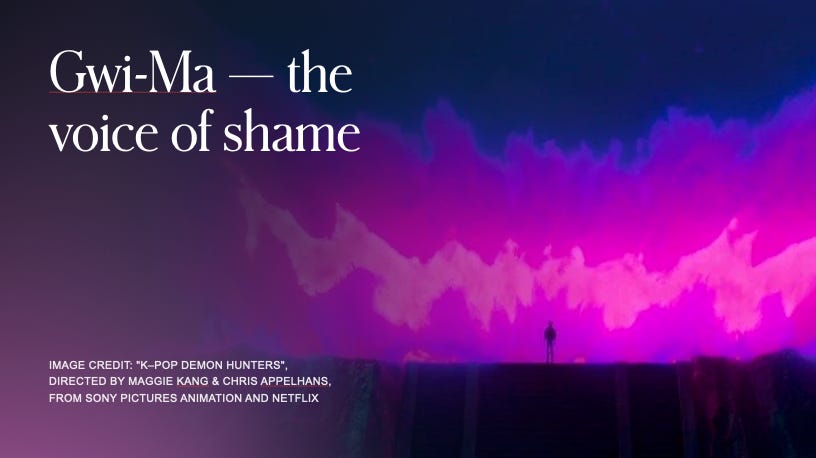
This is what the film’s villain Gwi-Ma understands. K-pop’s Big Bad isn’t a demon – it doesn’t have a body or form beyond a plume of pink smoke. But it has a voice, and it uses that voice to control and imprison its demons in the murky underworld of shame. “Feel is all demons do,” Jinu tells Rumi when she claims that his kind are pure, unfeeling evilness. “Feel our shame, our misery. That’s how Gwi-Ma controls us.”
Later, when it looks as though all is lost, Gwi-Ma’s cruel voice can be heard by everyone in the city. “You’re a failure,” it whispers to Huntrix’s manager; Mira hears that she never deserved a family; Zoey’s told she’ll never belong. Each person gets their specific fear and self-doubt amplified, and then turned into a promise: “And I can take that pain away,” says Gwi-Ma… all for the little price of their soul.
Seeing this, Rumi goes to the woman who raised her – her birth mother died when she was young – and presents a sword: “Do what you should have done a long time ago, before I destroy what I swore to protect.” The jig is up. Rumi can finally see that what she was trying to do was never going to work. She’s initially ready to admit defeat, but something clicks when her mother figure can’t kill her, and instead suggests she just keep going with the lies to mask her demon nature.
With the fans all moving like zombies towards the demon band’s sinister midnight concert, Rumi finally gets in touch with the self-love she’s been separated from the whole time. “Why couldn’t you love me?” she screams. “Why couldn’t you love all of me?”
What actually heals

So, how does she manage this just as everything looks so hopeless? Since the moment Huntrix meets the Saja Boys outside the doctor’s office, Rumi’s voice has been healing. It wasn’t the sham tonic that did this, obviously, though she was happy to let her bandmates believe this to be the case. In reality, her voice returned when she started to connect with her shadow – with Jinu.
The process of reunion began with conversations fraught with conflict, and progressed through secret trysts and the gift of a loveable demon cat. The closer she and Jinu got, the more whole she felt, until the two of them – light and shadow – sing a duet about how they can be free if they face things together.
When Jinu reveals that he was once human – a poor boy who traded his soul to Gwi-Ma to save his starving family – Rumi sees his humanity and learns that anger and fighting can never win this battle, just as self-censoring and masking won’t make her marks go away. She learns that you can’t hate your way from shame to freedom, and you can’t eliminate your way to wholeness. The Honmoon – the barrier – was the problem, not the solution.
Crucially, the superstar Rumi’s journey of growth takes place in private, not on stage. Integration happens at the margins, away from the performance. It happens when Rumi gives up striving to perfect her public persona and succeed in her public mission – when she stops trying to turn the Honmoon gold and starts connecting with the parts of herself she’s been taught to wall off.
“If this was the Honmoon I was supposed to protect, I’ll be glad to see it destroyed,” Rumi says, finally, to her mother figure.
Boss fight
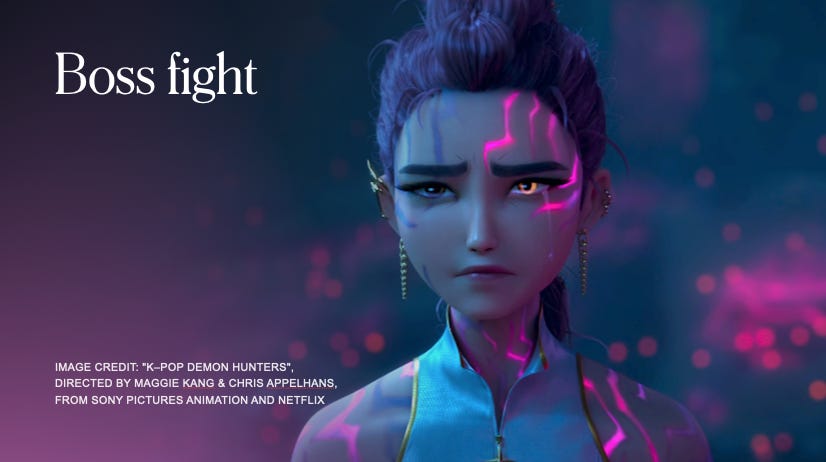
And with that, Rumi descends into the demon realm to face the embodiment of shame that is Gwi-Ma. She looks worn and battered, but not broken. “Everyone finally sees who you are, and the Honmoon is gone,” the demonic voice says. “It is,” she agrees, with a glint in her eye, “So we can make a new one.”
Time for a change. Rumi sings now about how she used to think she had to fix her patterns, and how she fragmented in the process, but now she sees beauty in the broken glass. Mira and Zoey join her – the three fragmented parts reunifying. “I’ll be right here by your side,” they all chorus.
And with this last song – a song of integration rather than performed strength and hate – Gwi-Ma is defeated. Jinu, freed by being genuinely seen, offers his soul to empower Rumi’s final blow. “You gave me my soul back, and now I give it to you.”
The demon world vanishes, along with Jinu and the rest of his band (though I’m sure we’ll learn more about what happened to them in the second movie). The sun comes up as the people of the world are re-imbued with their stolen souls, and the Honmoon turns not gold, but a full spectrum of rainbow colours.
Perfection and permanence were never the solution. Gold was too narrow, too restricting and too impossible to achieve. But acceptance, diversity, fluidity and everything else about the sheer complexity that is being human are finally allowed in the world. The Honmoon is transformed rather than strengthened – it’s turned into a vessel that can hold multiple truths at once.
What about the ending tho?

Now, if this had been an old-school Disney movie, that would have been the end. In K-pop, though, things aren’t sewn up in quite such a tidy fashion.
Huntrix goes to the bathhouse – the space for spiritual cleansing and vulnerability – where they relax for a brief moment. When they leave, promising themselves they’ll head to the couch and chill, they see a pair of young fans and get right back to work instead. “The couch can wait,” they giggle before heading off to take some selfies with the girls. The camera pans right to show the cuddly demon cat watching from a nearby rooftop, its huge grin plastered all over its Cheshire Cat-like face.
So here’s the question: have these parts actually integrated, or did they just survive one crisis before reverting to the same pattern? They defeated Gwi-Ma’s voice and transformed the barrier, but they’re still trapped by the same performance imperative, no? The fans are still there, their projection is still externalised, and the moment adoration calls, they choose it over the rest they’ve been wishing for throughout the movie.
Defeating one voice of shame doesn’t end the work
Maybe this is the most honest thing the film could show us – defeating one voice of shame doesn’t end the work, it just reveals the next layer.
Huntrix is reunited, but the world is still built from the same machinery – striving, hero-worship, consumption. The shadow has been integrated enough to be kept as a beloved pet, but not enough to be public. It still has to watch from the sidelines.
The question for us (and maybe for the sequel, who knows?) is how integration can survive when everyone around us still demands the same performance they got from our fragmented selves.
Will we ever truly rest, or will the couch always have to wait?
The answer isn’t in the film; it’s in your next choice. Right now, are you going to push through to “just one more thing,” or are you going to close this post, take a breath, and give yourself permission to simply be? The rainbow Honmoon isn’t something you achieve once. It’s something you choose, again and again, every time the performance imperative calls, and you find the strength to turn down its shiny offer.
So, let me leave you with some questions to chew over instead:
Does slowing down feel like failure to you? If taking a break feels wrong, dangerous or like “giving up”, then you’re probably listening to the voice of Gwi-Ma.
In what ways do you perform perfection? Where are you hiding parts of yourself to be acceptable? What gets locked behind your personal Honmoon because you’ve decided it’s too messy, too ugly, too much? Your gold barrier might look like productivity, politeness, or never showing weakness. It’ll be different for each of us, but its effect is the same: it fragments rather than protects.
Finally, perhaps the most important question of all: What’s the worst that could happen if you just… stopped? What fear arises when you imagine dropping the mask? That fear is where your work begins.
–
References:
K-pop Demon Hunters, directed by Maggie Kang & Chris Appelhans, from Sony Pictures Animation and Netflix (2025)
Carl Jung, Archetypes and the Collective Unconscious (1959)
Carl Jung, Psychology and the Unconscious (1912/1943)
Bessel van der Kolk, The Body Keeps the Score (2014)
Carol S. Pearson, Awakening the Heroes Within (1991)
Have you heard about our new game Echoes?
Our new game Echoes is available for pre-orders on Kickstarter. It’s a futuristic tale of time travel, magic, myth and tarot, and it’s perhaps our favourite and most awaited project.
There’s a special card deck and other exclusive rewards available only on Kickstarter. Ready to meet the Selves, gather ancient wisdom, and save the future?
Loved this!!