


You can listen to this post on our YouTube channel or read it below.
***
Frodo watches Gollum sleep. The creature looks almost peaceful – curled up, vulnerable, the lines of corruption softened. (Spoiler alert: Tolkien’s Lord of the Rings)
He’s like me, Frodo thinks. He’s what I’ll become if I keep the Ring.
As we are all supposed to do when reading or watching the epic story of The Lord of the Rings, Frodo sees his own potential fate laid bare before him in Gollum sleeping peacefully, just three feet away. There’s a Gollum inside all of us, threatening to break through, and we know it. But having glimpsed a future we’re most certain we don’t want, what can we do to avert it?
Today we’re talking about Gollum as the externalised shadow – a particular part of self that most of us would rather destroy than understand, but that can give us untold strength if we just dare to do the latter.
The shadow made visible
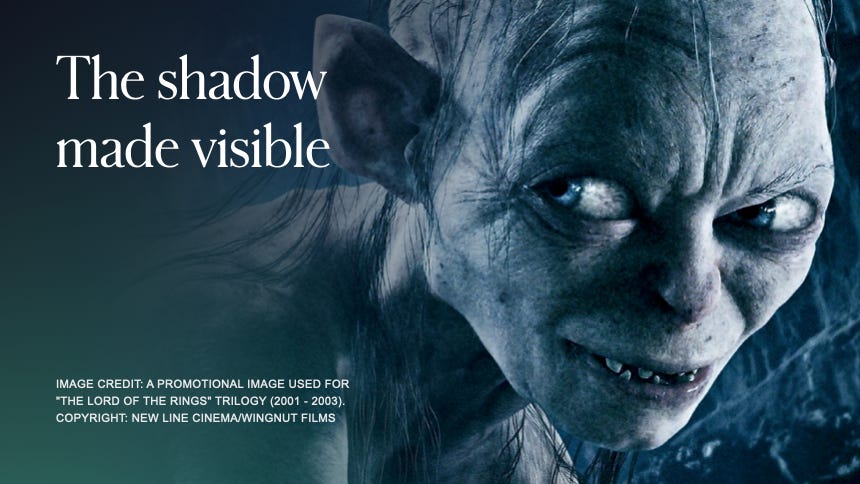
Anyone who’s dipped a toe into the dark world of shadow work knows that the parts of our personality we reject, repress, or feel unable to acknowledge – the parts that make up our shadow self – never disappear entirely. Instead, our denial forces them to operate unconsciously, influencing our behaviour in ways we struggle to accept or even notice.
We learn about our shadow selves in tiny moments of insight when we reflect on our relationships or how we speak about things. Some do this in therapy, some through meditation or journaling, and some just by living. If we’re lucky, and if our minds are open, the nature of our shadow comes to light bit by bit.
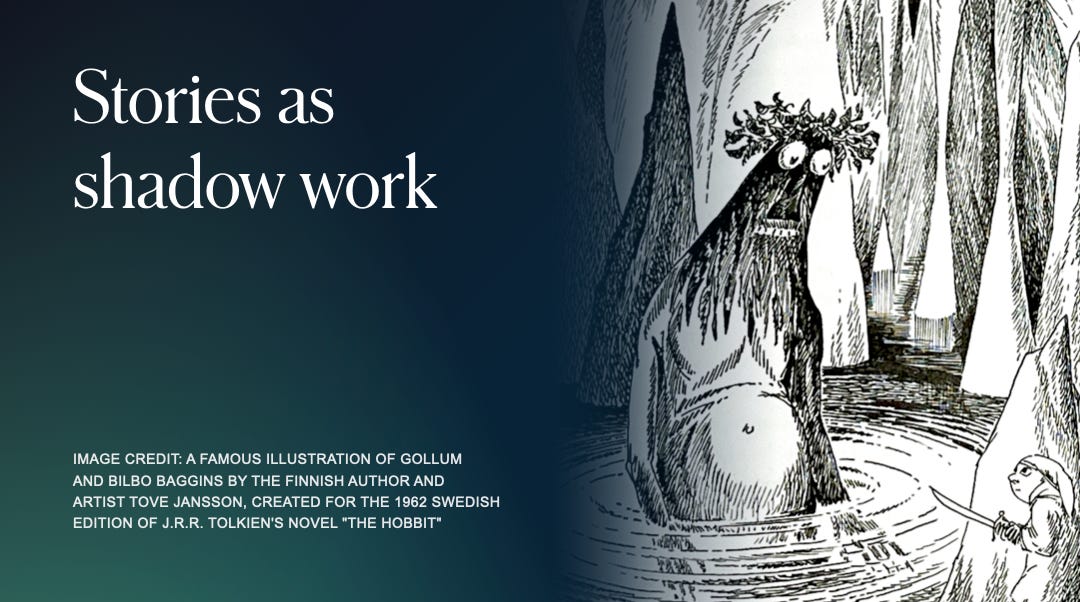
But there are other ways to catch a glimpse. From myths to movies, fictional characters – even the most monstrous or despicable – show us what it means to be human. We relate to the struggling protagonist and the desperate villain, because they walk archetypal paths as they try to overcome the same challenges we all battle with – the temptation to take what isn’t ours, to dominate when we feel powerless, to lie, cheat, or hoard what we’re afraid of losing. To become the bully when we’re tired of being the coward.
Stories make the shadow visible – they give it a body, a voice, a face, and a place in the world.
Gollum as Frodo, Frodo as Gollum
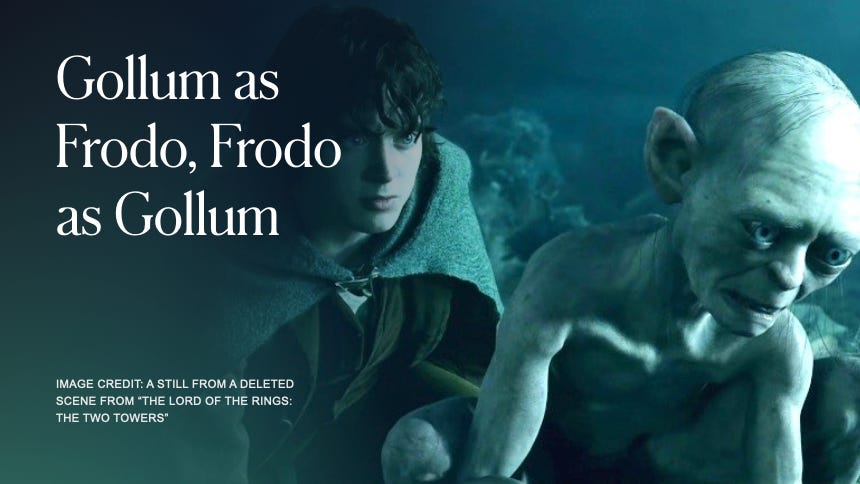
In The Lord of the Rings, Gollum is Frodo’s shadow in the flesh – a visual manifestation of what Frodo will become if he loses his internal battle… and what we’ll become if we lose ours. Specifically, Gollum warns us of the danger of being corrupted by something shiny – something we’ve convinced ourselves we need, even if it will hurt others, the world around us or, of course, ourselves.
In Carol Pearson’s work on archetypes, she identifies twelve core patterns that drive human behaviour and story. The Warrior is one of them (AKA the Hero) – it’s the archetype of courage, ego-strength and personal boundaries, and the willingness to fight for what matters. In The Lord of the Rings, Frodo is a Warrior.
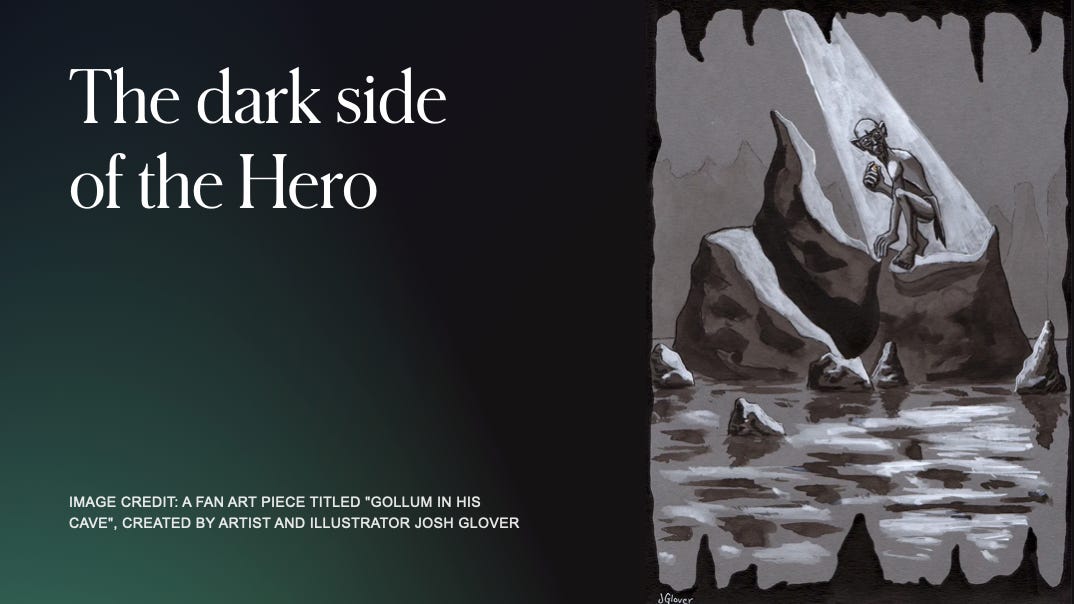
But every archetype has a shadow side. In Writing Archetypal Character Arcs, K. M. Weiland divides the shadow side of archetypal characters into two parts: the passive and the aggressive. For the Warrior archetype, the passive shadow is the Coward – too afraid or self-doubting to fight for what matters. The aggressive shadow is the Bully – too bitter and angry to fight for what matters, preferring to use the ego strength it’s developing for personal gain.
Of course, none of these archetypes is limited to a single form. The Coward can become the Bully when they discover their power, or they can become the Warrior by making peace with their fear. Just as the Warrior can slip and descend into either of their shadow forms if they’re not careful.
Gollum moves fluidly and continually between the polarities of the Warrior’s shadow, in one moment grovelling pathetically at Frodo’s feet, sneering and plotting betrayal in the next.
We even get glimpses of his light form – his potential Warrior self – when he becomes Sméagol, kind and good for just a flash, willing to serve and even to be brave.
His shifts are usually made in relation to his environment: he is servile to those with power over him, then vicious to those he perceives as weaker. In this pattern, we get to see how the Bully and the Coward are always one. Bullies tyrannise others in an attempt to master their inner cowardliness, believing they can overcome their fear by being the aggressor.
And, of course, we see this same pattern in Frodo, too. The Ring’s corruption affects him just as it did Sméagol – it tempts him with the promise of domination and the power to make others bow to him.
In a nutshell, Frodo is the Warrior struggling to stay true. Gollum is what happens when the Warrior falls.
The split psyche
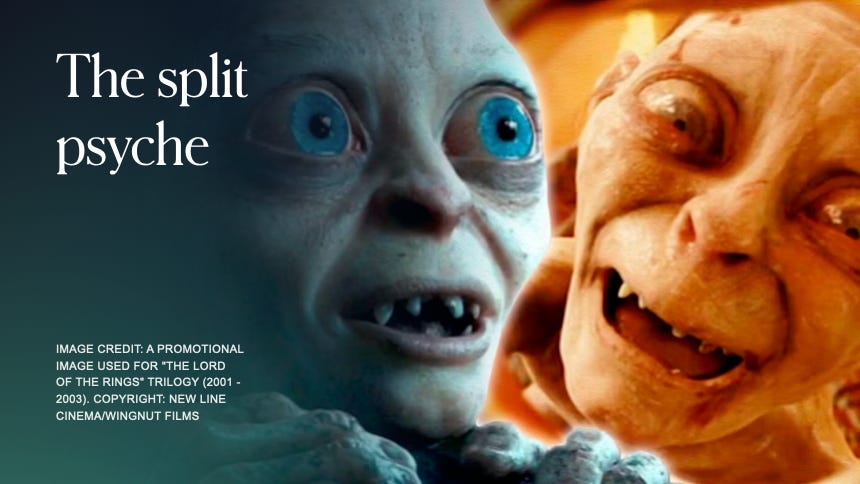
In his corruption, Gollum becomes fractured. As if his psyche couldn’t contain the reality of his deterioration – couldn’t fully bear it – it splits into two.
Marie-Louise von Franz writes about this pattern as it appears in fairy tales. When the protagonist encounters figures who’ve been split by trauma or dark magic, the schism represents what happens when integration becomes impossible – when the shadow has consumed so much that the ego can no longer hold both light and dark in one coherent self.
This sounds dramatic and final, but this fracturing of self is something we all do naturally, albeit to varying degrees. Jung called the split-off parts of the self complexes or splinter psyches. We develop them to cope with the challenges of life, especially when a particular experience or trait is being repressed.
Before I go on, I need to make a crucial distinction: I’m not discussing Dissociative Identity Disorder or OSDD-1 here, which are specific trauma-based conditions where the development of distinct identities (alters or parts) serves as a survival mechanism. The alters in DID/OSDD systems are full, valid identities – not shadow material or “inferior” aspects, and not something to be eliminated or integrated against the system’s will. That’s a completely different conversation requiring its own respect and understanding.
What I am exploring here is the everyday psychological splitting we all experience – the way we compartmentalise, develop personas, or exile parts of ourselves that feel unacceptable. A splinter psyche allows shadow content to exist, as it must do, but in a place that feels safely separate from the rest of the ego.
Of course, this doesn’t mean we actually keep it under lock and key. Our complexes push to the surface when they need to, and we won’t always enjoy the results. Healing a fracture of this kind means reintegrating the rejected splinter – welcoming it home, rather than trying to force it away. Gollum seems to be largely beyond the point of redemption, but not quite. He walks this line throughout the story of The Lord of the Rings, tantalising us with the possibility of a return to goodness every time Sméagol finds his way out.
The negative arc – corruption as choice
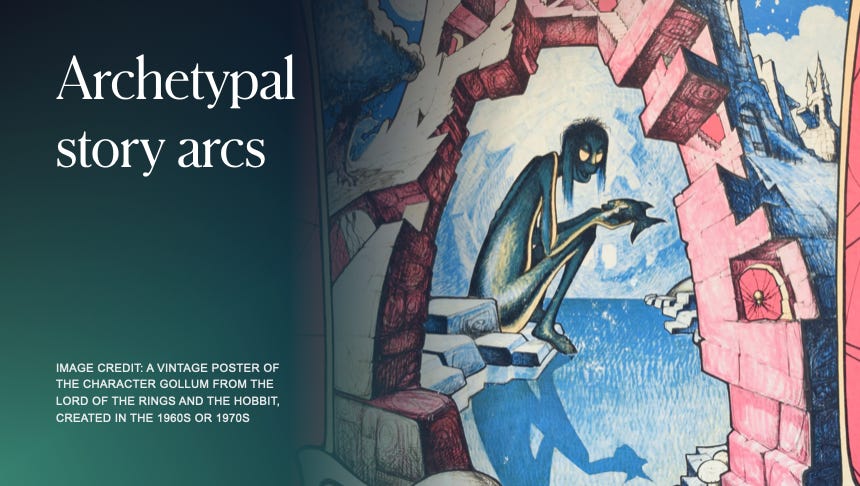
K.M. Weiland identifies three types of character arcs that show up in archetypal stories: positive (change for the better), flat (the character doesn’t change, though the world around them may do), and negative (a story of corruption or disillusionment).
The archetypal Warrior arc that Frodo travels is a positive-change arc – the character grows from someone who doesn’t believe in their own strength, influence or importance, to someone who discovers and integrates their personal power in order to use it in the service of good.
To walk this path, the Warrior must reject the archetypal lie they start out believing – “My actions are insignificant” – in favour of the archetypal truth: “All my actions affect the world around me” (or, in Weiland’s words, “those I love”).
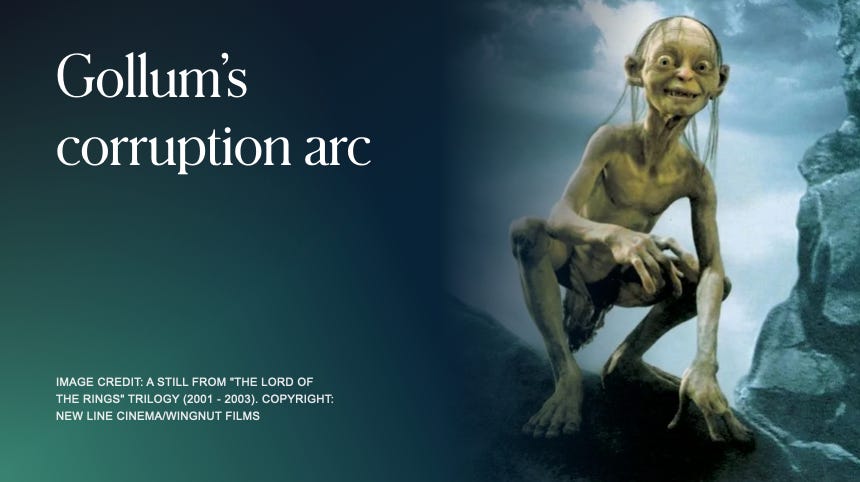
Gollum’s arc is a corruption arc – a slow, centuries-long descent into total possession by the archetypal lie of powerlessness. The story-specific lie that Gollum believes goes something like this: “The Ring is my salvation. It completes me. Without it, I am powerless. Without it, I am nothing.” Unable to integrate the Warrior’s truth, Gollum rejects the true power of autonomy, connection and service for the illusion of power offered by the Ring.
And now, the Ring whispers the same lie to Frodo, and we can feel the tension in every step of the journey. One wrong move, and Frodo will suffer the same fate. “Stay strong, Frodo”, we think as we read. “Resist the temptation. You can do it!”
We relate to Frodo’s struggle because we know it ourselves, and we long for him to succeed, because we need to know that we can, too.
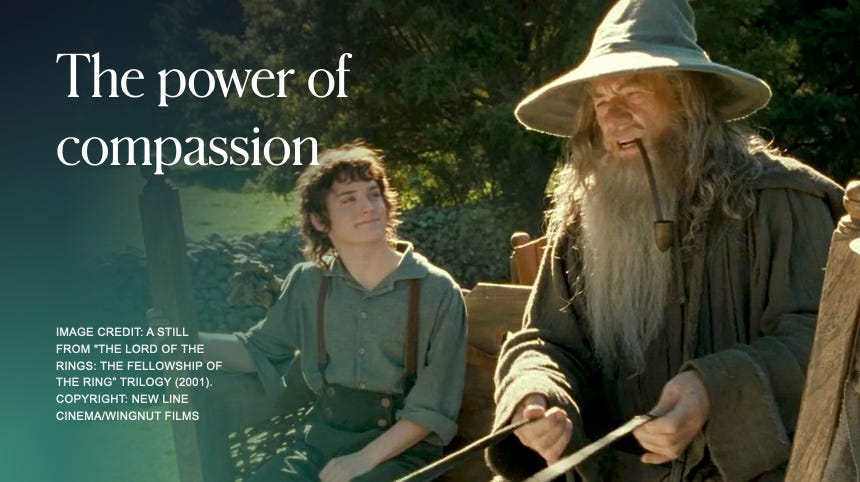
This kind of success, we learn in the story, is dependent on compassion. As told by Gandalf – the wise Mage archetype to Frodo’s Warrior – “Bilbo’s pity may rule the fate of many.” If Frodo’s uncle Bilbo had done the easy thing and simply killed Sméagol back when he took the Ring, the quest would have failed before it even began. Gollum is the only creature alive who can lead Frodo and Sam to Mount Doom, making him essential to the success of their quest.
Remembering Gandalf’s wisdom, Frodo takes pity on Gollum. Unlike Sam, who wants him dead, Frodo consistently shows compassion to his externalised shadow, seeing him and acknowledging his importance and right to exist. Frodo shows Gollum mercy because he recognises that Gollum is what he could become. And in showing mercy to the shadow, he’s showing mercy to himself – an essential part of the process of psychological shadow integration
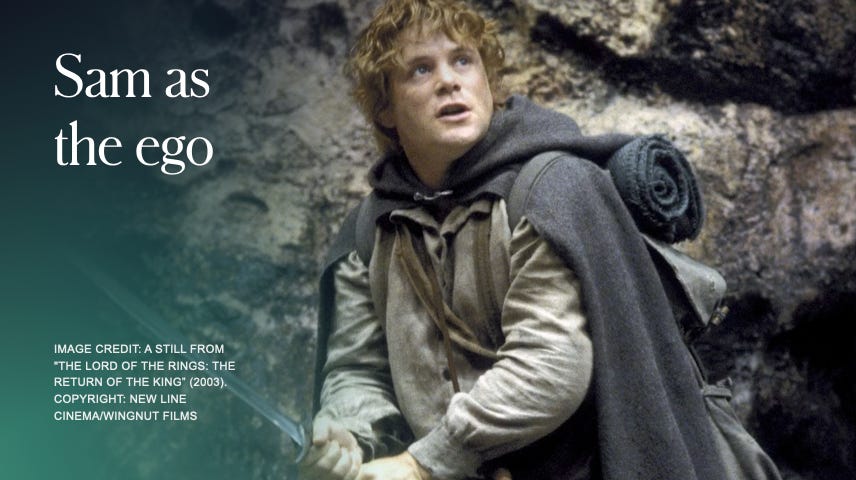
Sam functions as another part of Frodo’s psyche, aligning with the ego’s natural response to the shadow: destroy the threatening parts; they’re dangerous and better off eliminated. “He’s no good, Mr Frodo. Never was, never will be.”
But you can’t eliminate your cowardice or selfishness, or your hunger for power. You can only bring them into consciousness and choose differently, aided by the light of awareness.
The moment on the stairs
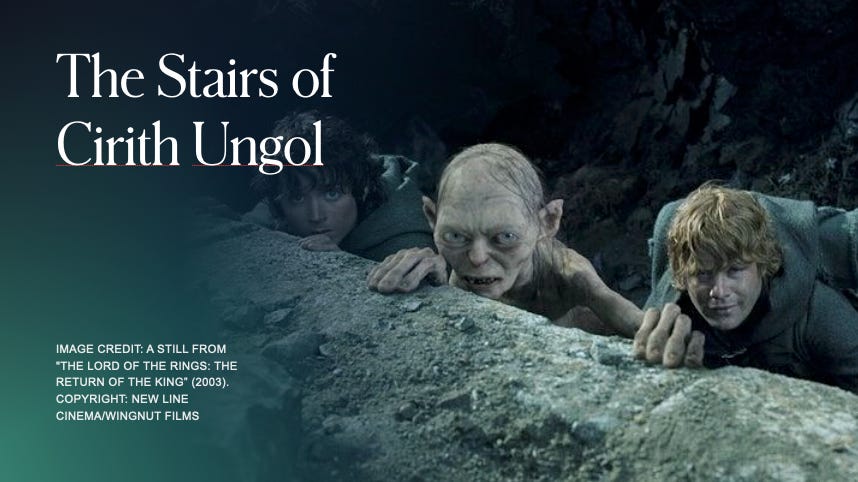
There’s a scene in The Return of the King that breaks my heart every time I watch the movie. Gollum is leading Frodo and Sam up the Stairs of Cirith Ungol. It’s night, Frodo is asleep, and Gollum reaches out and touches Frodo’s shoulder gently, almost tenderly. For just a moment, Sméagol surfaces, and we see the part that could still choose differently. Hope.
Then Sam wakes and snaps at him, causing Gollum to return, face contorted with hatred. This moment demonstrates the fragility of the shadow’s redemption and how easily it retreats when met with shame. The lost parts of the self need to be witnessed without judgement if we’re going to coax them back into the light.
Mount Doom – the athenor’s fire
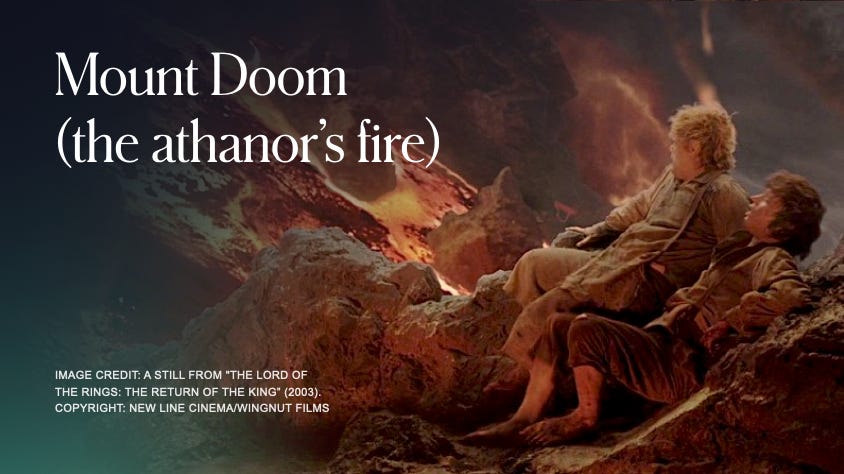
At Mount Doom – the story’s climax – everything converges. Frodo finally succumbs to the call of false power, claiming, “The Ring is mine.” Gollum attacks him, bites off the finger on which the Ring has been placed, and falls into the fire clutching his “precious”.
Here, we see Frodo embody the corrupted part of himself that has always been there – that we have known existed all the way through, regardless of whether we’ve admitted it to ourselves. For Frodo to complete his positive-change arc and succeed in saving Middle-earth, this part has to be realised so the control it has over Frodo can perish once and for all. It is Gollum’s desperate rage that tips things over the edge, literally. As Gollum (this part externalised) and the Ring (this part’s desire) both plummet into the fire, the levelled-up version of Frodo is able to be born.
The key thing here is that Frodo had to succumb for this to happen – he had to wake up to the reality of his inner struggle and take ownership of the corrupted part. Only then could the threat of it burn away.
Embracing your inner Gollum
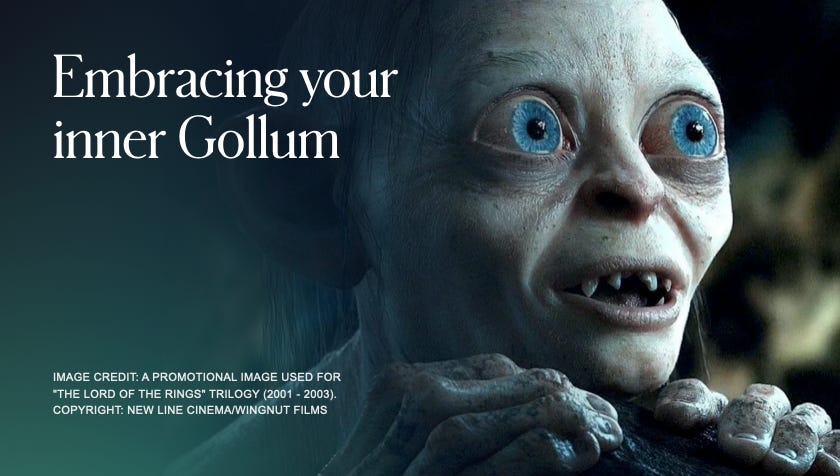
The lesson we learn from Gollum, then, is that, in order to change, we must witness ourselves as fully as possible.
We all have an inner Gollum – a part that’s both cowardly and callous, and that grasps desperately for power – just as we all have Gollum-esque instincts to hoard, to lie, and to protect ourselves even at the expense of others.
As unpalatable as these things may seem, the aim is not to destroy or even restrict this aspect of self, but to learn to see it without becoming it. That is, to integrate and hold it in our awareness, so when those urges arise, we can make a conscious decision about how we respond rather than unconsciously embodying our Gollum self and allowing it to run the show.
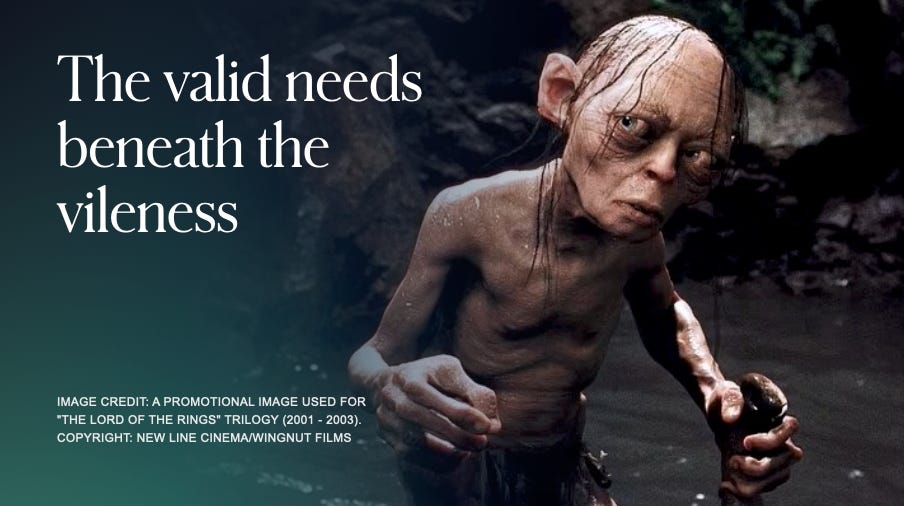
The key to achieving this is to remember that even the most monstrous of urges or inclinations is born of genuine need. Every need we feel is valid and important, even if our initial interpretation of it – that is, how we first think we have to meet it – is completely out of the question. If we take Samwise Gamgee’s approach and simply try to cut off the needing part, it will find a “tricksy” way to have its will done. If we take Frodo’s self-compassionate approach, on the other hand, then we can pause, understand the true need beneath the urge, and consciously choose a better way to meet it.
For example, the urge to control others may stem from a genuine need for a sense of security, predictability, or protection from rejection. Where Gollum would plot and scheme, a better way to allay this discomfort might be to communicate our needs directly instead of testing people; to build trust gradually and to work on internalising our locus of control – that is, to integrate the truth that while we can rarely command the outside world, we can always have a choice in how we respond to it.
Similarly, the urge to hoard or steal may stem from a need to feel protected against future scarcity. Where Gollum would clutch the Ring so tightly that he can think of nothing else, a better way to respond might be to build a genuine sense of safety through community, savings, or support networks, learning to share resources while maintaining healthy boundaries, and addressing the root fear rather than trying to mend it with quick fixes and magical thinking.
There is always a real need beneath the horror. The urge to manipulate can come from a need for love, the urge to lie can grow from a need for acceptance, the urge to isolate can come from a need to rest, the urge to take what isn’t ours can come from a need for wholeness… the list goes on and on. The need is the genuinely “precious” thing. The urge is just a fearful knee-jerk reaction to it. It’s only when you can discern the difference that you can be truly in control.
Meeting your Gollum
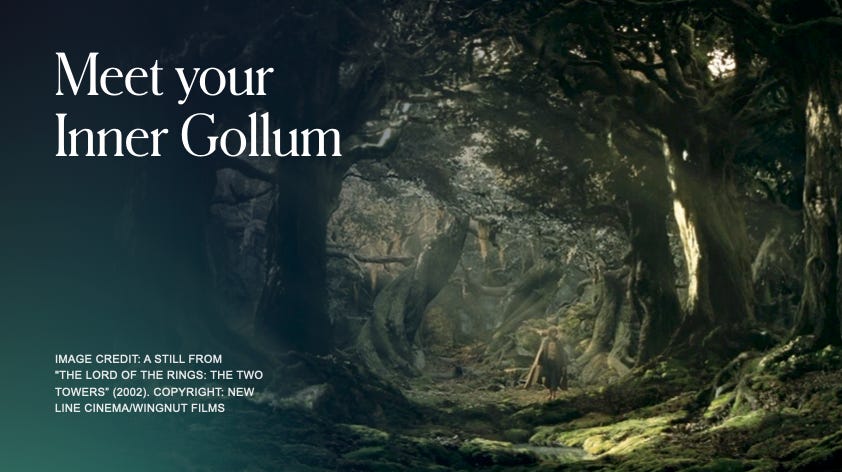
Imagine, if you will, that you’re on a dark path. Ahead of you, crouched by the side of the road, is a small figure. It’s your Gollum – the part of you that’s afraid, and that wants to find a way to feel safe, even if it hurts others in the process.
As you see this part of yourself, you have a choice: you could walk straight past; you could try to destroy it before moving on; you could kick it or spit on it as if it’s vermin… Or, you could stop, crouch down a little distance away so as not to scare it, and you could meet its eyes.
And if you were to do that, you might wonder what this part of your personality calls “its precious” – what it is, exactly, that you find yourself reaching for when you feel insecure, or fiercely clutching to your chest when you think someone or something might take your personal power away.
Maybe your Gollum’s “precious” is a relationship or success in work. Maybe it’s validation, money, independence, or being right. Maybe it’s your pain or your backstory, your beauty or youth. Maybe it’s simply control.
Looking down, you can see that your Gollum is holding something so tightly that its little hands have gone white. And as you look into the creature’s eyes, you find that you can see beyond that surface-level want. As if you can sink down to a deeper level of self, you get a sense of the true need from which it stems. Maybe it’s love, trust or closeness. Maybe it’s security, certainty, protection. Maybe it’s just the need to feel okay.
No matter what it might be that your Gollum has clasped in its hands, I’d like you to imagine that just a little distance down this path you’re walking, you will be able to find healthier, better ways to meet the fundamental need it represents. You don’t need to know these methods yet, because they aren’t always going to be visible right away, and that’s okay.
All you need to do, in this first meeting, is let your Gollum know that there’s hope just up ahead. So, you point down the track, and as the creature’s scared eyes follow, you notice that the sun is rising in the distance – the sky is glowing with a hazy pink-blue lightness that makes this path easier to follow, even if you’re not quite sure yet where it leads.
And maybe that’s enough for your Gollum to trust what you’re telling it. Even if it doesn’t yet let go of what it holds, and no matter whether it takes your hand when you offer it, or whether it stands by itself and walks a little distance away from you at first. All that matters is that you’re moving, together, in a different direction.
So, how does your Sméagol respond? Please let me know in the comments.
–
REFERENCES:
J.R.R. Tolkien, The Lord of the Rings (1954-1955)
The Lord of the Rings film trilogy, dir. Peter Jackson (2001-2003)
Carl Jung, Aion: Researches into the Phenomenology of the Self (1951)
Marie-Louise von Franz, Shadow and Evil in Fairy Tales (1974)
Carol S. Pearson, Awakening the Heroes Within (1991)
K.M. Weiland, Writing Archetypal Character Arcs (2023)
The wonderful book 'Why we meditate' gives the 'beautiful monsters' as the analogy. If we can contact those parts of our selves, we may find a lot of wisdom in what they have to tell us. Our various Gollums, if you like.
Also, whilst the film made a decent attempt, the book's description is one of my two favourite scenes:
'For a fleeting moment, could one of the sleepers have seen him, they would have thought that they beheld an old weary hobbit, shrunken by the years that had carried him far beyond his time, beyond friends and kin, and the fields and streams of youth, an old starved pitiable thing.'
In the book, Sam wakes up grumpy, but not outright aggressive as in the film. But it shows so much better how little it takes for Gollum to jump back into his shadow self.
The other scene is at the mirror of Galadriel, where she shows/tells Frodo what she would be like as an absolute ruler:
'And now at last it comes. You will give me the Ring freely! In place of the Dark Lord you will set up a Queen. And I shall not be dark, but beautiful and terrible as the Morning and the Night! Fair as the Sea and the Sun and the Snow upon the Mountain! Dreadful as the Storm and the Lightning! Stronger than the foundations of the earth. All shall love me and despair!'
The ease with which a good person can fall down into darkness, even (especially?) with good intentions.
I think Tolkien knew a lot about human nature.
"The lost parts of the self need to be witnessed without judgement if we’re going to coax them back into the light."
Oomph!
Difficult to do within oneself, and an entirely different challenge when relationshiping with others.
Thanks Hazel