


You can listen to this post on YouTube, or read it below.
***
As the full moon rises, the body changes: the heart beats faster, teeth lengthen, claws extend, and one self shatters as something wilder takes its place.
The Werewolf as an archetype, is an inevitable part of the human psyche. It’s not a comfortable proposition, is it? But what if we were to let go of the temptation to see this monster as a curse to fear, and frame it instead as a natural cycle to embrace? If integrated, what could the wolf have to offer you?
This piece is for anyone who fears what might happen if they allow their untamed instincts to overflow, along with those of you who secretly, desperately want to know what that would feel like.
The history of the Werewolf
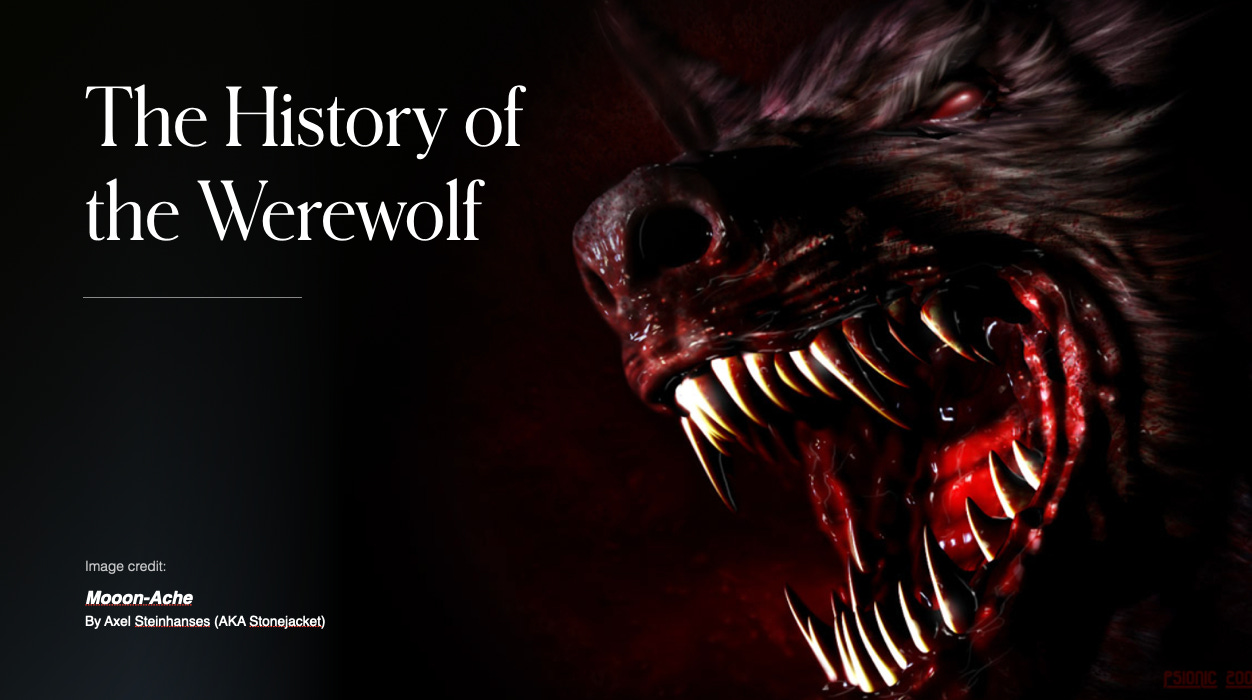
The Werewolf is a creature caught between worlds: human and animal; conscious and unconscious; civilised and primal.
Although we’re most familiar with the wolf, tales of other were-creatures are told around the globe. According to David D. Gilmore, author of Monsters, “in Africa, people believe in were-lions, and in the South Seas there are man-eating were-sharks, not to mention (...) the bellowing ape-men of the Far East!”
There are also, of course, tales of shapeshifters from indigenous mythology from the Americas, such as Skinwalkers from the Navajo tribe. I should be clear that these traditions belong to the Navajo people and are distinct from European werewolf stories – but they do show how widespread and ancient the fear of shapeshifting wildness is.
Werewolf as archetype
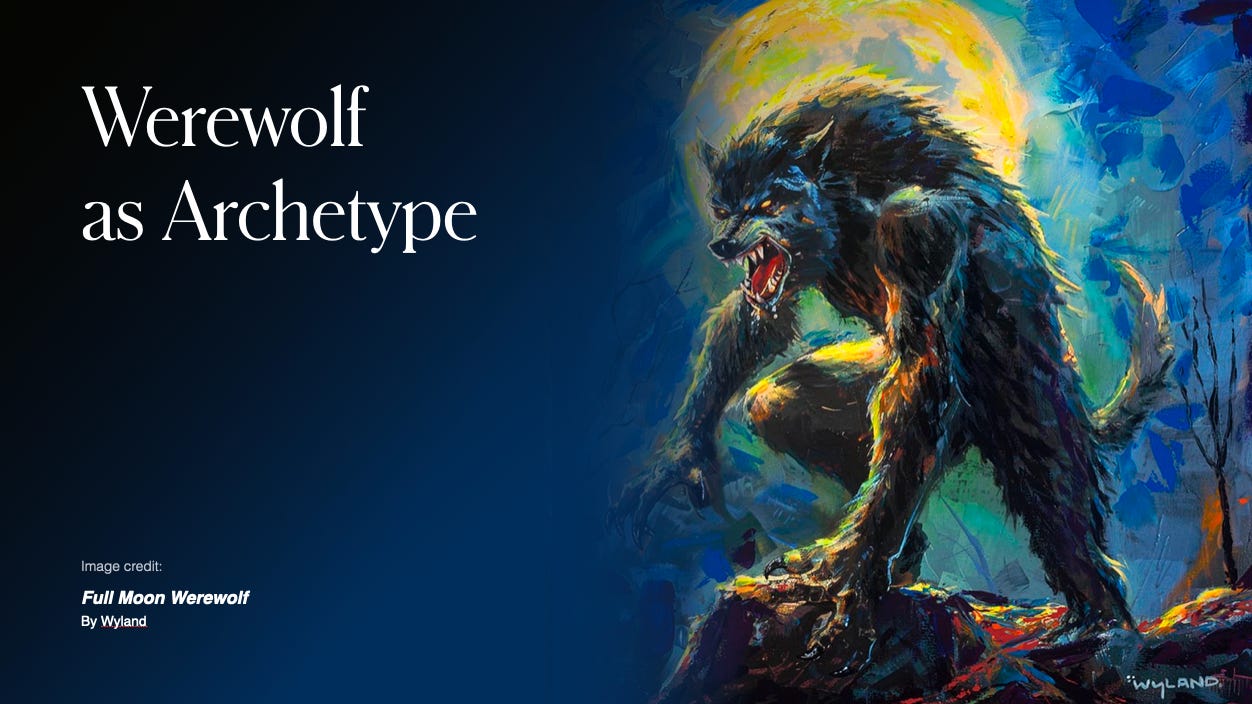
No matter which version of the story we refer to, at its heart, the were-myth is about the transformation from tame and domesticated to violent and terrifying.
Most of us know what it feels like for something feral or primal to rise up from within, whether it’s anger we tried to hold back, repressed trauma, or even excitement, lust or a gleeful burst of laughter. We live in a world that, by and large, expects and celebrates self-control, containment, dispassion and stoicism – we revere thought over feeling, order over chaos. But we are not robots, and our emotions inevitably break through the hardened outer shells that we’ve been conditioned to assume.
The Werewolf is that breakthrough. We fear it and feel ashamed of it, and therefore try to keep it locked away, but as we all know, what we resist persists. The moon will become full again. It’s only a matter of time.
The question, then, is not how to hide, control or weaken the wolf within, but how to accept and integrate it. What happens when we choose to see this archetype as a call to honour our instinctive, wilder selves?
Or, more specifically, the primal masculine energy within.
Werewolf as Animus
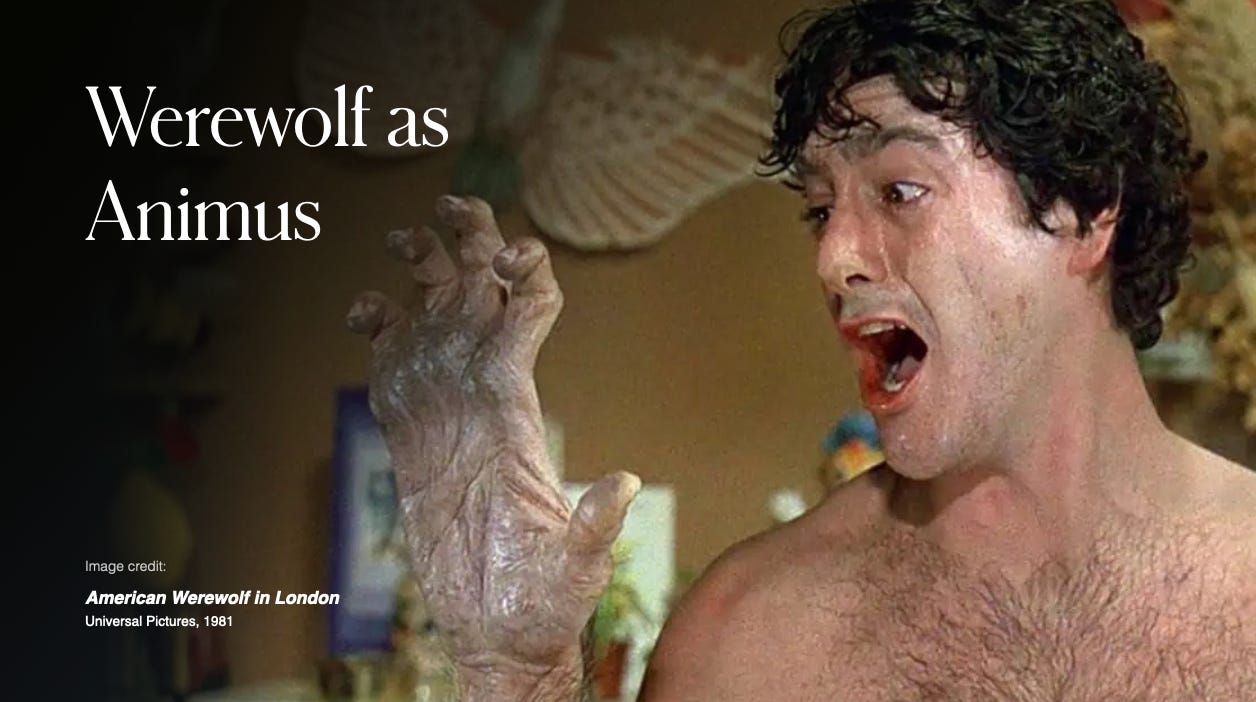
When we think of werewolves, we usually imagine men first – David in American Werewolf in London, Scott in Teen Wolf, Oz in Buffy, Jacob in Twilight. Overwhelmingly, werewolves are male because the untamed, aggressive, animalistic energy they embody is traditionally coded as masculine.
However, masculine is not the same, of course, as male, which leads us straight into one of Carl Jung’s most provocative ideas: Animus v. Anima. In Jungian theory, the Animus is the inner masculine aspect of the psyche, supposedly found in the unconscious of women. It’s the counterpart to the Anima – the inner feminine – supposedly found in the unconscious of men.
People will undoubtedly fight me on this but, in my opinion, this part of Jung’s thesis just doesn’t stand the test of time. Jung’s framework reflected the binary views of his world. Back then, basically everyone (including doctors and scientists, which is no longer true today) believed that sex was binary – you were either male or female. Jung believed that women could only consciously associate with the feminine and therefore the masculine would live in the shadow of the unconscious. And vice versa. Thus, the Animus lived in women, the Anima lived in men.
A more modern and, I’d say, more helpful reading sees these energies as available to everyone. Some of us repress the feminine, others the masculine. Crucially, it’s that repression, not the energy, that does the damage.
When the Animus is buried, it turns volatile. Instead of confidence, it becomes criticism; instead of assertion, aggression; instead of clarity, icy detachment. If you’ve ever found yourself snapping, lashing out, or collapsing into harsh self-judgement, you may have felt the shadow Animus at work.
Animus as Ally
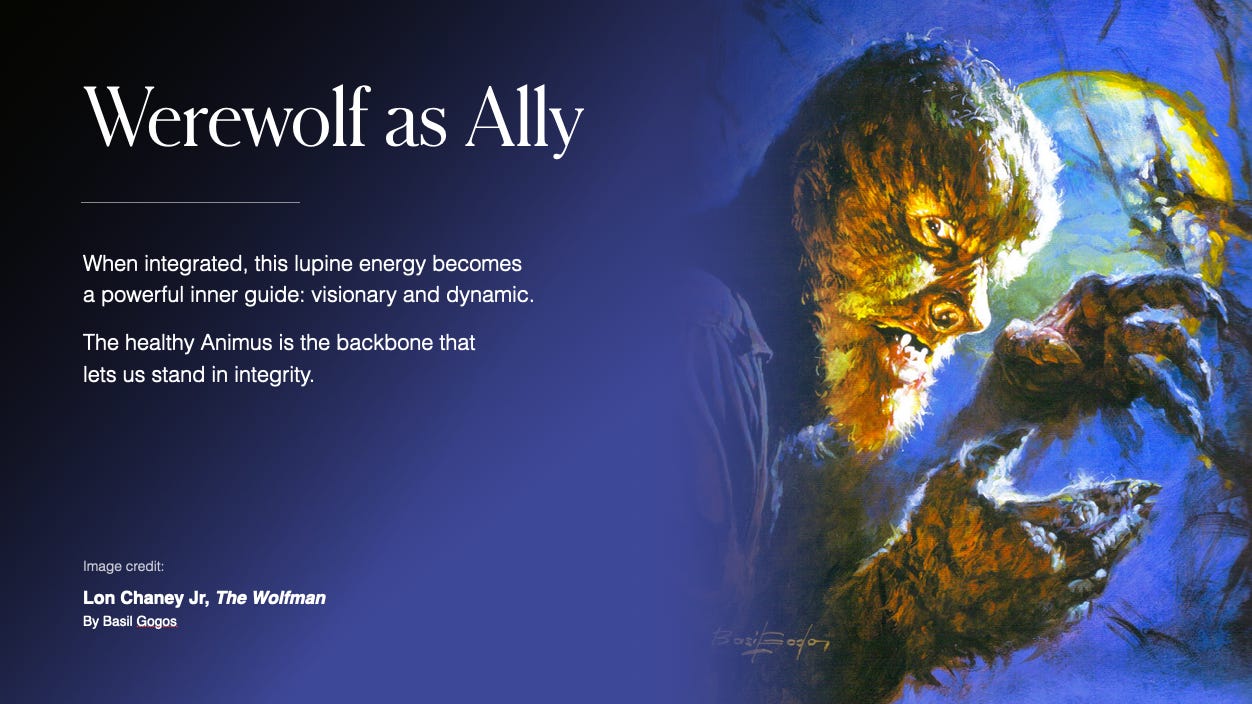
When integrated, this energy becomes a powerful inner guide: visionary, dynamic, a doer. The healthy Animus is the backbone that lets us stand in integrity. It’s the voice that says, “This is who I am,” without flinching – even when the world demands we be someone else.
So, no matter our gender, when we deny this confident, go‑getting force, we diminish ourselves. We cage a vital part of who we are.
It’s easy to see why. Few of us feel safe being unapologetically ourselves in the face of cultural expectation, so we push the Animus away. But that only makes it roar louder.
And roar it does: in road rage, drunken arguments, emotional outbursts with partners or colleagues, in slammed doors, snide online comments, or sudden, sharp words. These micro‑transformations are all moments when the untamed breaks through the shell.
So, enter the Werewolf: the angry, lustful, emotional, wild masculine self that erupts through the rational persona, not with the express intention to cause harm, but because it has been silenced too long and needs to be seen.
Where masculine meets feminine?
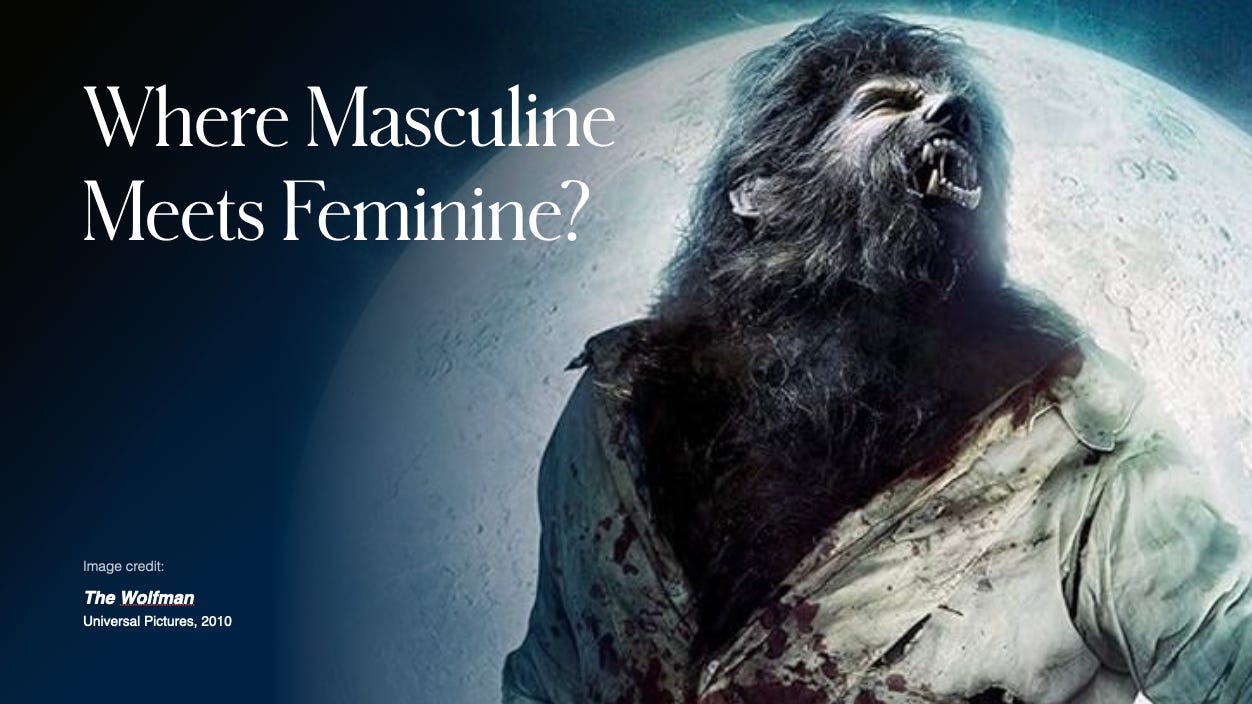
There’s something very intriguing about the Werewolf when viewed through the lens of archetypal gender. The wolf breaks through when the moon is full, and the moon, across centuries and cultures, stands as a symbol of the feminine: cyclical, reflective, intuitive.
So why is it that feminine light calls the masculine beast out?
One way of reading this symbolic motif is that the moon draws out what the sun — the conscious ego — cannot bear to look at. Moonlight is sunlight reflected, after all; it’s sunlight transformed, and consciousness in reverse. So, like an archetypal midwife, that soft silver glow births all the things we’ve suppressed, insisting that they come forward, no matter how feral or frightening they have become in the dark. In other words, the full moon doesn’t make the human into a wolf. It just makes visible the wolf that was always there.
Why? Because the moon needs the wolf as much as the wolf needs the moon. They are two halves of one whole; you can’t have feminine without masculine, nor masculine without feminine. They each need the other in order to make sense, in order to be healthy and integrated.
We know from the stories, of course, that this meeting is not harmonious. The Werewolf does not come out to talk; it erupts. The energy we’ve spent a lifetime repressing has no skills in dialogue; it knows only how to burst through in violence. The moon becomes the trigger because it is the opposite pole, and when these polarities meet after too much separation, they collide rather than integrate.
This is as much a representation of the outer masculine and feminine as it is the inner – we see a similarly explosive dynamic in today’s polarised, us-versus-them debates about gender roles. Is there a social call to action underpinning the steady flow of Werewolf stories we create, then? In this time of incel culture, trad wives, Andrew Tate and all the rest of it, is the Werewolf motif a mirror we need to look in?
Cycles of transformation
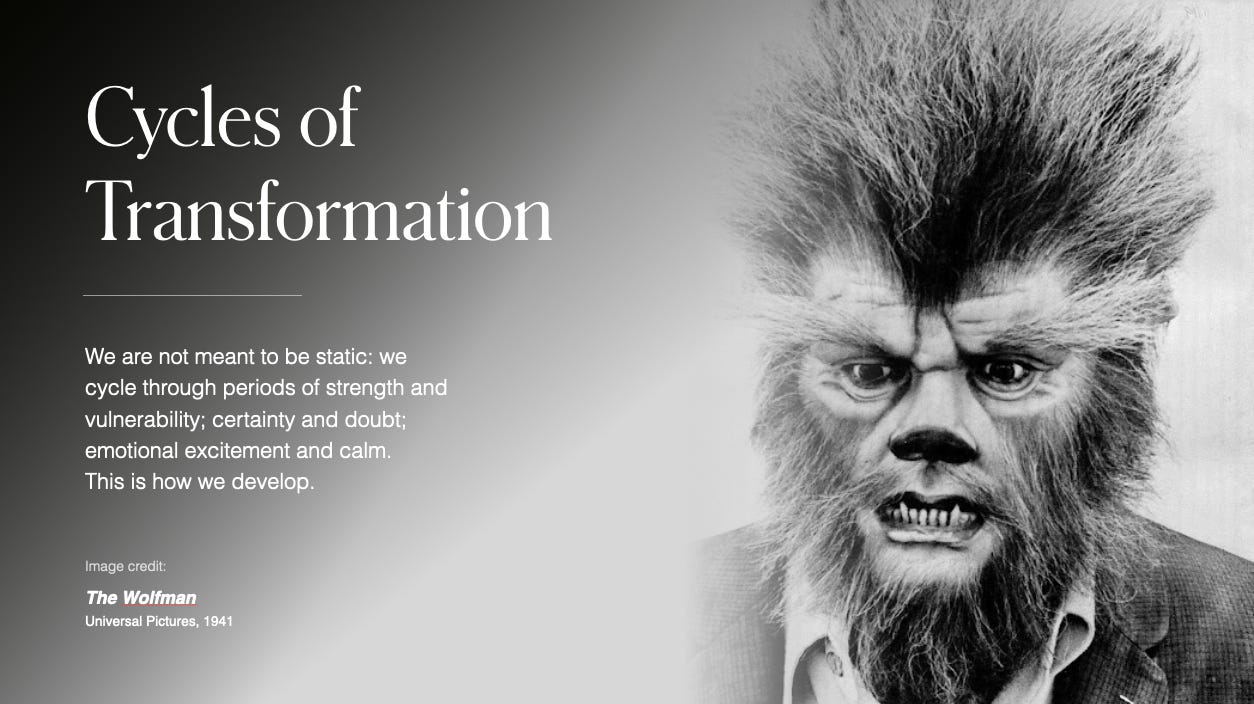
It is worth noting that the wolf’s uprising is not a random event. The moon is faithful. She rises and completes her cycle, again and again, no matter how hard we try to deny her influence. Which means that this confrontation — the pull of the feminine on the shadowed masculine — is inevitable and also natural.
We are not meant to be static: we cycle through periods of strength and vulnerability; certainty and doubt; emotional excitement and calm. This is how we develop. Just like the cycle of breath and the oscillation between neurological arousal and the necessary rest that comes after it, we mature and adapt to life in spurts. Periods of outgoing, assertive exploration are followed by periods of recuperation and integration. We see this in any course of therapy or self-development: breakthroughs are followed by slower moments of processing. And we see it in any creative process, too: explosions of ideas and productivity are followed by lulls in which we do and make very little. This is the natural way of things.
Trying to maintain complete dispassionate control at all times, then, is not a sign of strength so much as a sign of stagnation and disconnection. The primal self within will not stand for it. At some point, the wolf will be forced to howl.
Meeting the wolf within
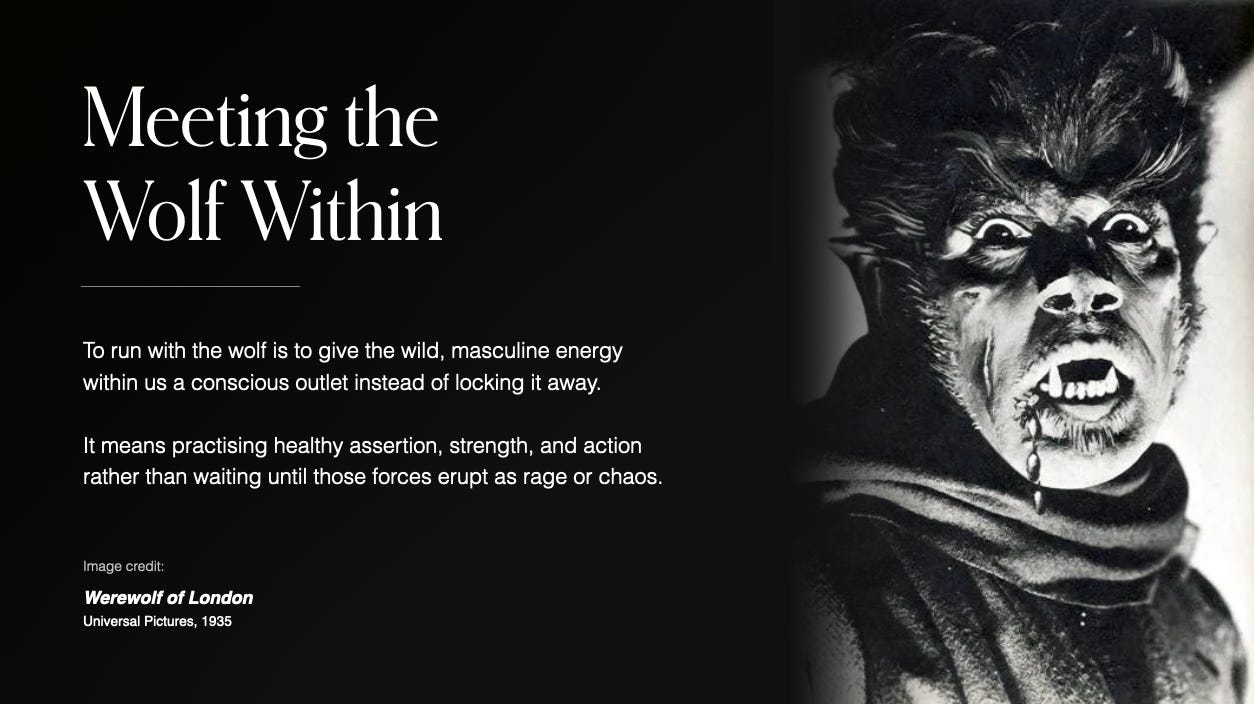
As with all the monsters we’re exploring in this series, the Werewolf itself is not the problem. It’s our repression of it that causes harm. So, what if, instead of running from this energy, we learned to run with it?
To run with the wolf is to give the wild, masculine energy within us a conscious outlet instead of locking it away. It means practising healthy assertion, strength, and action rather than waiting until those forces erupt as rage or dangerous, obsessive pursuit of success.
In real life, it could be as simple as moving your body in ways that feel powerful, or speaking your mind in a room where you’d usually stay silent. It’s about taking up space without apology, setting clear boundaries, or daring to go after the thing you want, even if it feels like a risk.
So let’s try something. Just for a moment, settle yourself, wherever you are. Let your shoulders drop. Let your breath deepen. And if it feels right, gently close your eyes.
Now imagine that it’s night. Not city-night, with streetlights and the hum of traffic, but deep-wilderness night.
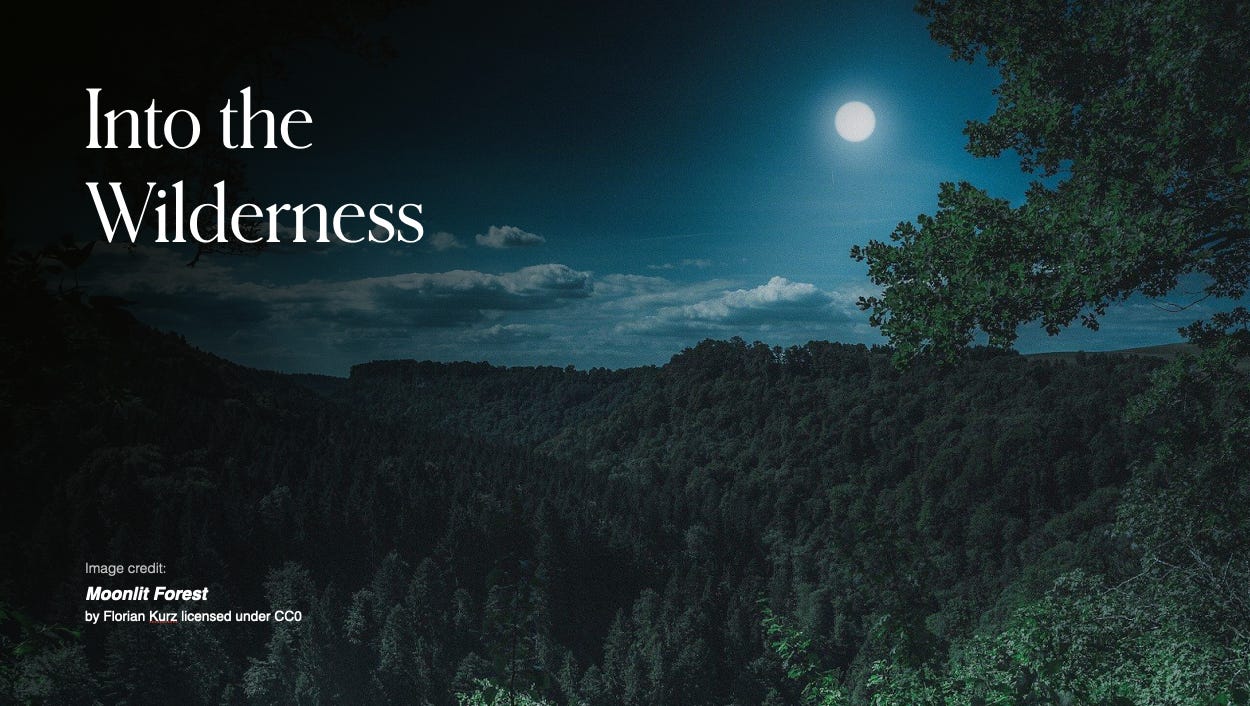
You’re walking alone through a forest, the air sharp with the scent of pine. Above the canopy, the moon is rising – full and bright, casting a silver glow across the leaves of the trees, and the skin of your hands.
There’s a tightness in your chest, you notice. It’s not fear exactly – not quite. It’s more like anticipation: a vibration beneath your skin and the undeniable sense that something – or someone – is near.
Then you hear it: a low growl, primal and present. And, as you turn, you see them. A figure stands across the clearing ahead. Their eyes glow gently in the moonlight, and they feel… familiar.
You realise, now, that you’re not looking at a stranger, but at a part of yourself. This may be a part that you know well. Or it might be a part you buried – one that felt too much, wanted too fiercely, or spoke too loudly.
This figure begins to move towards you, now, slowly and deliberately. And, as it does, it changes form – two legs becoming four, snout lengthening, teeth growing.
Now, just a few steps into the clearing, the wolf stops and stands still, waiting patiently as if it knows you’ll come to meet it when you’re ready.
So, take a breath now, as you imagine this untamed self in the clearing. I’d like you to ask yourself a series of simple (though not necessarily easy) questions:
What part of me have I labelled dangerous just because it’s not what the world considers proper?
Which emotion, instinct, urge or perspective have I tried to cage?
What part of me have I labelled dangerous just because it’s not what the world considers proper?
And what would happen if I stopped running from this wilder self, and ran with it instead?
To run with the wolf is not to submit to difficult instincts but to allow them, to give them somewhere to go, to make it possible for the energy to flow or to pass through, if that’s what’s needed.
So, regardless of whether you had answers to the questions I just asked or if those answers remain a mystery for now, I invite you to simply run with your wolf. You might do so on your own two feet, or you might also transform for the journey – it matters not which form you take if you choose to run, just that you do. Feel the wind rushing across your skin, the blanket of leaves and sticks beneath your feet, the wolf beside you, not fighting, not controlling, not monstrous in the least. It just is.
So, you run.
And perhaps, as you speed through the forest, with the moon as your witness, you might find yourself remembering that untamed is not the opposite of good or wise. Rather, it’s the way back to who you were before the world taught you to behave.
References & Citations
Robert Lamb, ‘The Skinwalker Is No Mere Werewolf’, (science.howstuffworks.com/science-vs-myth/strange-creatures/skinwalker.htm)
Josephine Campbell, ‘Skinwalker (Mythology)’ (https://www.ebsco.com/research-starters/religion-and-philosophy/skinwalker-mythology)
David D. Gilmore, ‘Monsters: Evil Beings, Mythical Beasts, and All Manner of Imaginary Terrors’
Carl Jung, The Archetypes and the Collective Unconscious
Carl Jung, Psychological Aspects of the Persona
Clarissa Pinkola Estés, Women Who Run With the Wolves
Our new game Echoes
Our new game Echoes is available for pre-orders on Kickstarter. It’s a futuristic tale of time travel, magic, myth and tarot, and it’s perhaps our favourite and most awaited project.
There’s a special card deck and other exclusive rewards available only on Kickstarter. Ready to meet the Selves, gather ancient wisdom, and save the future?
I love this. I think that, as an archetype, it particularly resonates, and I think your assesment feels spot on. I am jealous of the wolf. Thank you for sharing this.
So grateful you shared that bit about Animus and Anima, and "Jung’s framework reflected the binary views of his world." I felt like that clarification was needed. I do agree that both energies are available to everyone, I guess back then they couldn't know what we see now. I'm glad we have a wider perception and we're learning to work through it, one step at a time. I loved the scenario you described while meeting the inner wolf, truly beautiful!