


You can listen to this piece on YouTube or read it below.
***
A young warrior stares into a chaotic, incomprehensible void of pure absence. It’s not darkness, because darkness is something. This is Nothing. Where forests and mountains once stood, there’s now a vacuum – and it’s expanding, and consuming everything it touches.
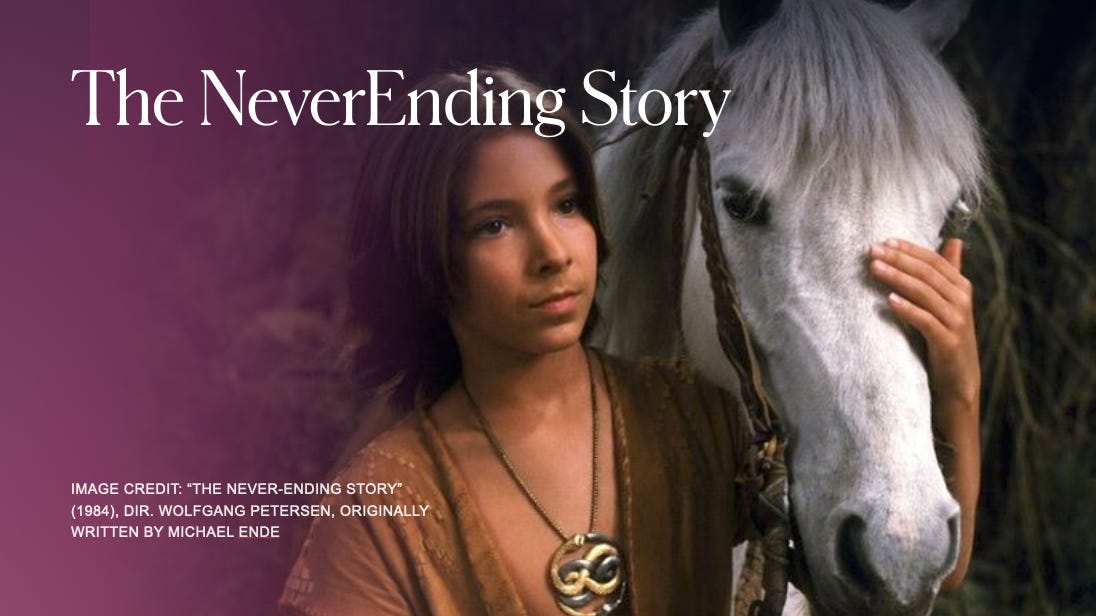
You may recognise this as the premise for the novel and/or movie, The NeverEnding Story (spoiler alert). The realm of Fantasia is dying. The Childlike Empress – pale, small, and distant – grows weaker by the hour. And the only thing that can save her is something that seems impossibly small and easy: the single human child who still believes she’s real needs to give her a name.
Today we’re going to explore one of the most profound depictions of what happens when we systematically destroy the creative force within ourselves and our culture; what it feels like to lose touch with meaning and connectedness; and, crucially, what we can do to bring these things back.
What is The Nothing?
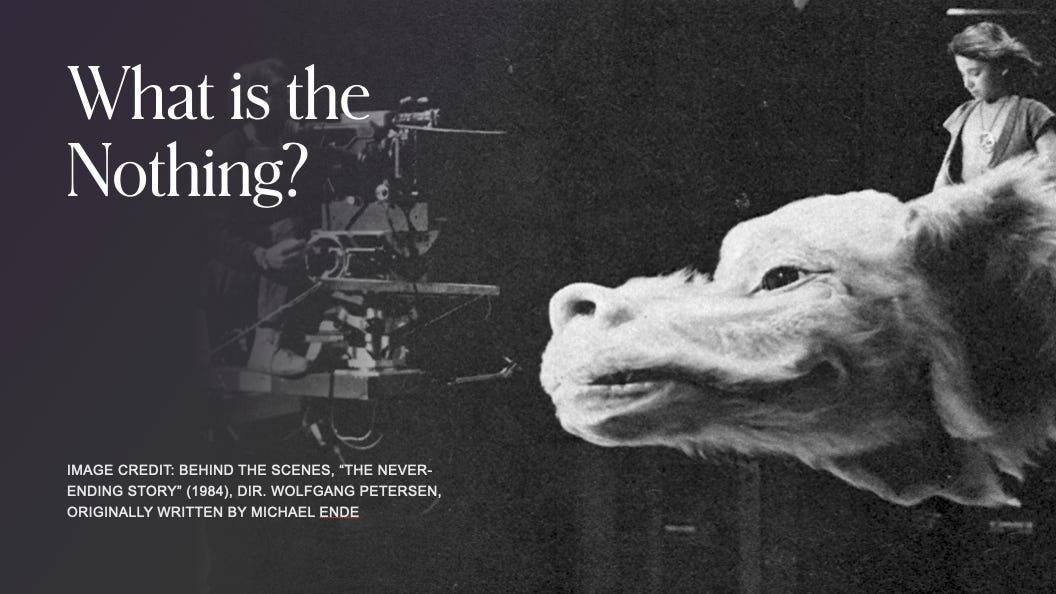
In Michael Ende’s novel The NeverEnding Story and the 1984 film adaptation, the Nothing is a faceless, abstract evil that’s destroying the realm of human imagination, stories and dreams. This is not a monster you can fight; it has no body, no intentions, no substance. It is simple uncreation – the complete erasure of meaning.
The Nothing is essentially the shadow of Chaos. Chaos, a feminine archetype, can be thought of as the Great Mother in her most primordial form. It is the wild, fertile, generative womb from which all things emerge. The Nothing, on the other hand, is a sterile void. This is not to say that The Nothing is Chaos’ masculine opposite, though – that would be Order. Rather, as a death-dealing, destructive and consuming force, the Nothing is what emerges in the absence of Chaos. And it is literally awesome. Totally terrifying.
Even outside of The NeverEnding Story, the very concept of nothing is impossible to comprehend because we can’t think in negatives. In order to understand nothing, we must first think of something, by which point we have already failed. And yet, we get it – this evil is so full of paradoxes that it somehow manages to make both no sense, and complete visceral sense, all at the same time.
Perhaps that is because of our innate fascination with where we really came from: Chaos. Human beings have star-gazed since the beginning of time, endlessly reading meaning into the everything-filled nothing that twinkles in the sky above at night.
As astrophysicist Neil deGrasse Tyson famously said: “We are not figuratively, but literally, stardust.” The atoms in our bodies were forged in the hearts of dying stars billions of years ago, and those stars, as far as we know, started off in a chaotic proliferation of everything out of nothing. We are children of Chaos.
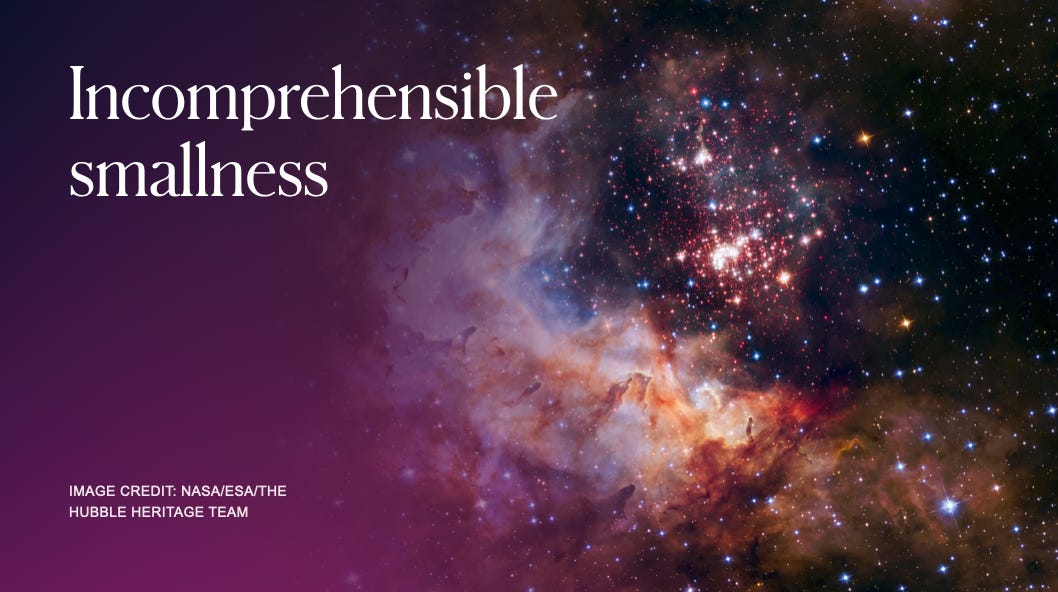
And yet, our tiny human minds can only grasp the smallest fragment of that reality. Our entire existence – everything we’ve ever built, loved, created, or destroyed – occupies both a space and a time so infinitesimally small on the cosmic scale that it may as well not exist at all.
In a way, this is what the Nothing represents: the incomprehensible vastness that makes everything feel meaningless. This truth is unbearable – at least, that’s how it feels when we first encounter it. We can’t live with pure cosmic indifference, so we do what we have always done – we create meaning through stories, imagination and dreams.
In The NeverEnding Story, the Childlike Empress embodies this creative, meaning-making principle. She is Fantasia itself, and she’s dying because we’ve stopped believing in her. Through denial and repression, we have sacrificed her to the Nothing.
The archetypal Nothing
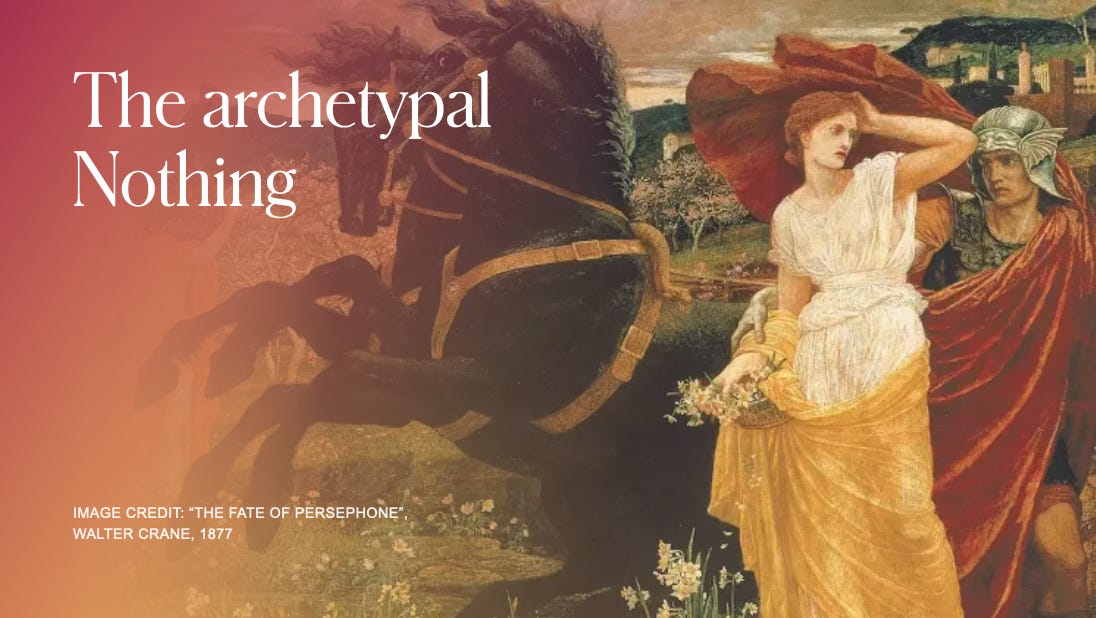
This is not the first time this particular story has been told. Devouring deities, demons, monsters and non-beings have existed since the very beginning, and they all pose the same threat: when the life-giving feminine principle is removed or destroyed, the Nothing spreads.
In Greek mythology, we see this when Persephone is taken to the Underworld, and Demeter’s grief turns the earth barren. In Sleeping Beauty, the princess’s isolation from the world behind a massive barrier of thorns makes the entire kingdom fall into frozen stasis.
This motif repeats across cultures and millennia because we dread the loss of meaning, perhaps more than we fear the loss of life. When the opposing but fundamentally partnered principles within us – action and receptivity, doing and being, logic and intuition, masculine and feminine – become severed from each other, we are forced to stare into the abyss. And the pure absence we glimpse there is more frightening than any monster.
The princess in the tower
So, we tell story after story about these separated energies being reunited. We tell Hero’s Journeys, where the struggling and incomplete masculine principle has to go in search of the lost feminine – the abducted princess, the damsel in distress, the Holy Grail, the Childlike Empress.
Jungian analyst Marie-Louise von Franz notes that you can often tell what era a tale comes from – and how deep into the patriarchal worldview its originators were – by just how distant the princess is.
I need to make clear here that when I talk about patriarchy and patriarchal principles, values and hierarchy, I’m not alluding to a conspiracy of men, and I’m not being anti-men, either. I’m referring to a cultural shift that took place in many parts of the world after the emergence of monotheistic religions, which elevated certain principles coded as “masculine”, while devaluing those coded as “feminine”. This shift is illustrated in the symbolism of the folklore and fairy tales that these cultures produced over the years.
In older stories from cultures not that far into the adoption of monotheism, and where the feminine was still cherished, the princess might be on the roof, or in the next village – relatively accessible for the questing hero.
But as patriarchal systems tightened their grip and anything seen as feminine got systematically devalued, the princess drifted farther and farther away – she was locked in a sky-high tower, overseas on foreign land, or asleep for a hundred years behind a wall of thorns. In the modern-day story we’re focusing on here, of course, she exists in an alternate reality that almost everyone in the world has forgotten.
Empress in tower
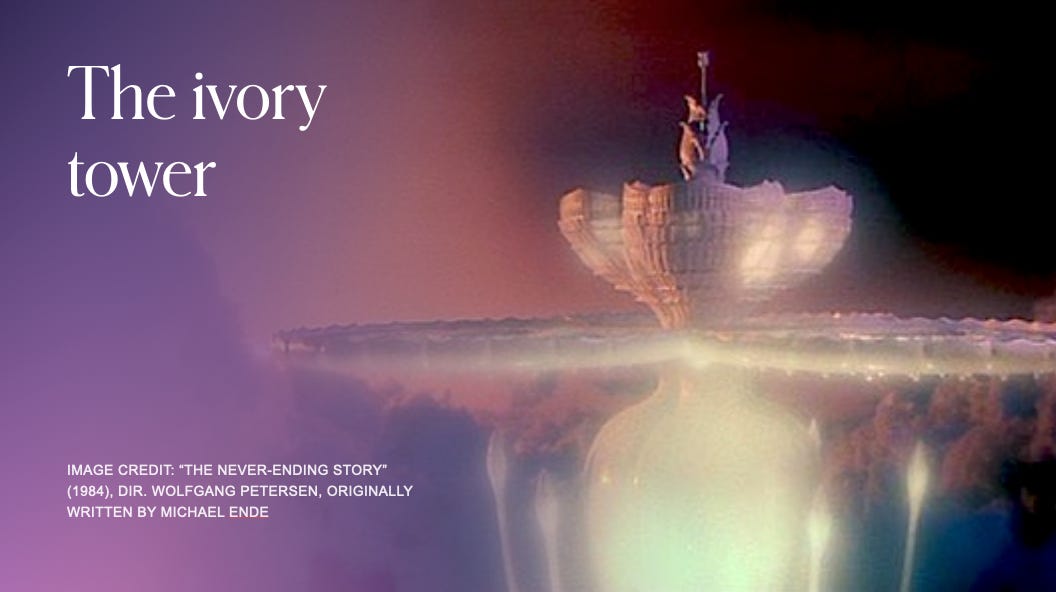
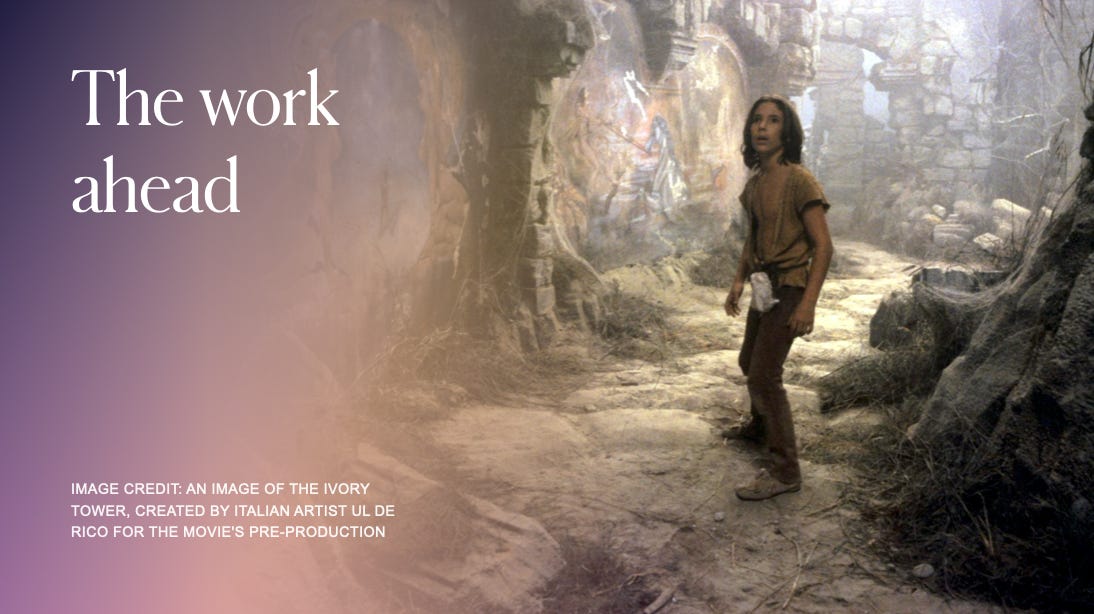
In The NeverEnding Story, the Childlike Empress is dying in the Ivory Tower. She is nameless and unreachable – fading from existence entirely. The fact that she is “childlike” is also telling – part of patriarchy’s systematic devaluing of the feminine has involved the relegation of things like imagination, creativity, emotion, intuition, and meaning-making to the realm of “childish things”. The feminine principle, and by extension anyone and anything we see as feminine, gets infantilised, controlled or made smaller – demoted to a lower level in the hierarchy of things.
Von Franz tells us that tales like The NeverEnding Story are born of a culture in terminal crisis. The feminine principle is on the brink – so close to death that the entire world is dissolving into nothing.
The father god problem
So, how did this happen, exactly?
The argument that, wherever patriarchal monotheism emerged, it systematically suppressed the feminine divine appears across a number of academic fields, particularly feminist theology and Jungian psychology. In The Chalice and the Blade, Riane Eisler documents a historical shift from “partnership” societies that revered the Goddess to “dominator” patriarchies that elevated the male Sky God. Archaeological and mythological evidence from scholars like Marija Gimbutas and Merlin Stone supports this pattern.
This wasn’t a conscious conspiracy, though – there was no council of evil men plotting women’s demise.
Actually, there was a council – the Council of Carthage in 397 CE – where church fathers sat down to decide which texts would form the biblical canon, and in the process excluded writings with more feminine divine imagery: Gnostic gospels featuring Sophia as divine wisdom, texts describing the Holy Spirit in feminine terms, accounts of Mary Magdalene as apostle. But it would be unfair to frame these men as villains. They genuinely believed they were preserving sacred truth and protecting their communities from heresy. The feminine was excluded not through malice, but because it didn’t fit their understanding of God.
Stories are living things that evolve with their tellers. So, over the years, goddesses became saints, demons, or disappeared entirely.
Ultimately, the sacred earth-based, cyclical, body-honouring, and life-giving feminine didn’t fit the new story of a transcendent, eternal, sky-dwelling masculine divinity. So she had to go. And what filled the void where she used to be? Nothing.
Modern-day Nothing
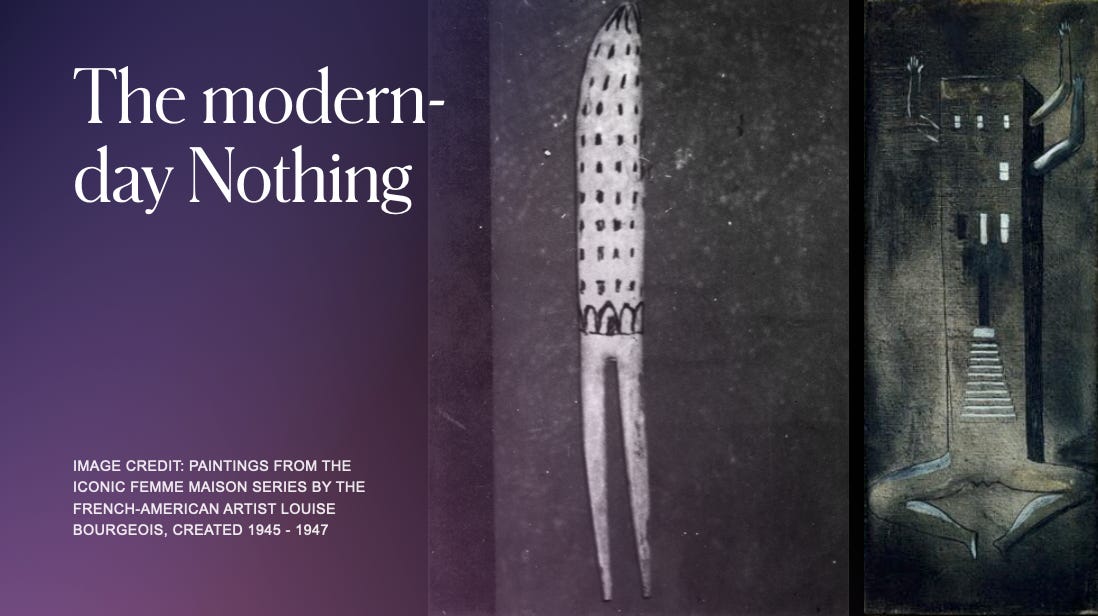
In today’s world, the elevated masculine values (again, not male – masculine) have been at the top of the tree for so long that we rarely question the hierarchy. Reasoned logic is simply considered superior to a hunch or gut feeling. Control and order are automatically assumed to be better than surrender and chaos.
We are so thoroughly conditioned to diminish the feminine that it’s hard for us to comprehend that something fundamental is out of balance. But the imbalance is there, and we feel it nonetheless. Which is why the archetypal quest to retrieve the lost feminine still shows up in story after story today. It is, if you like, never-ending.
The internal wasteland
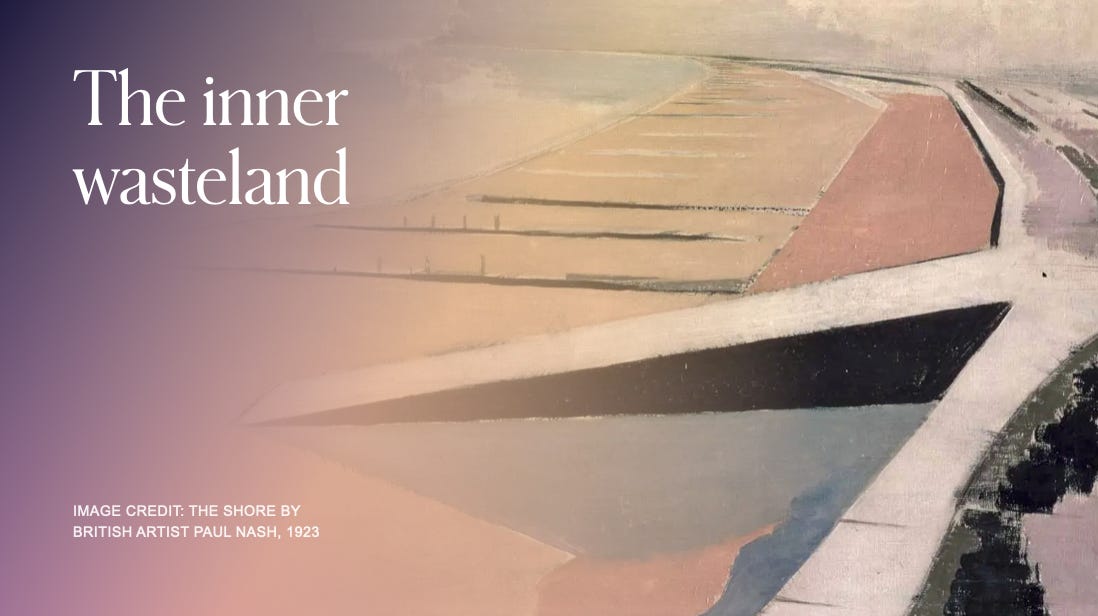
Our inner worlds, by the way, are just as out of whack as the external one. When we internalise all of this, we exile our own Childlike Empresses and the Inner Nothing begins to devour our emotional connection to the world.
So, we go through the motions, achieving goal after goal, all the while feeling… hollow. We may struggle to remember why anything matters, or find ourselves chasing things we’ve never actually wanted. We laugh without feeling it, endure relationships devoid of true connection, and trudge our days away on our respective treadmills as if we have no other choice.
We don’t tend to feel that way as young children – our hollowness is not innate. The Nothing takes a little time to work its way through in secret, moving with stealth between the inner realms we’ve been taught to ignore. By the time we cotton on to the fact that it’s there, we’re already watching our lives from the outside, disconnected and numb.
And so, as it always is, the inner world mirrors the outer, and vice versa. Just as the Earth Mother, generative chaos and human wildness get exiled culturally, the inner feminine principle gets repressed psychologically. But no matter how hard we try to eliminate something as fundamental as chaos, it will never disappear. It’s just forced into shadow, where it consumes and destroys under the cover of darkness.
So, how do we fix this? Well… that’s the tricky bit, because our most familiar approach to overcoming evil – battle, conquer, destroy – just won’t cut it.
Atreyu’s impossible task
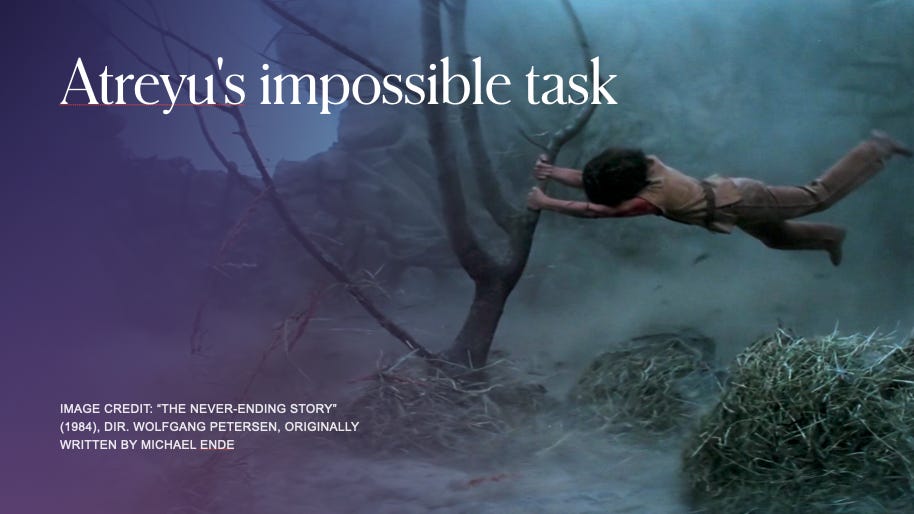
Atreyu – the young warrior in The NeverEnding Story – tries desperately to save the Empress. He fights, he quests, he nearly dies multiple times, and, in undoubtedly one of the most traumatic scenes from 80’s movies, he loses his beloved horse Artax in the Swamps of Sadness.
Just like the rest of the film, that scene is steeped in archetypal meaning. In Jungian psychology, the white horse represents the intuitive life force – vital energy, connection to body and instinct, the animal nature inside us that simply wants to live. When Artax sinks into the swamp, consumed by sadness, he’s showing us what happens when The Nothing spreads: we lose our vitality first, along with our will to keep moving, and our embodied connection to life itself.
Atreyu can scream and beg all he wants, but rational consciousness alone – no matter how brave or determined – cannot complete the quest without the instinctive, embodied energy to carry it forward. Atreyu can’t save the Childlike Empress because he is the masculine principle, and the masculine alone cannot restore the feminine.
Strength simply can’t defeat the void, and rationality cannot solve the problem of lost meaning. The Empress can be saved by just one thing: imagination itself.
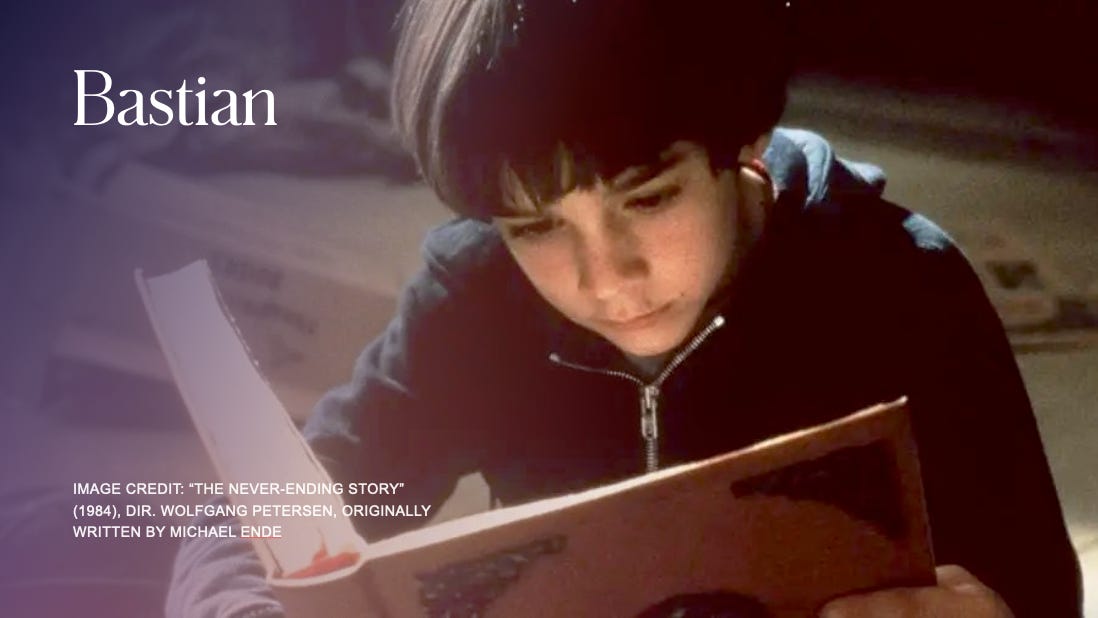
Enter Bastian, the true protagonist of The NeverEnding Story. Bastian is a human child who finds himself entangled in this mythic predicament when he stumbles upon a magical tome in an old bookshop that he ducked into to escape from bullies (I don’t think I need to explain the relevance of that). Anyway, he becomes fascinated by the mysterious book and takes it with him. He then hides in his school’s attic to read it undisturbed.
Bastian’s world-changing power comes from one simple place: he still believes in stories. When Atreyu and the Childlike Empress become aware of Bastian reading their story, they know that he alone can make a difference.
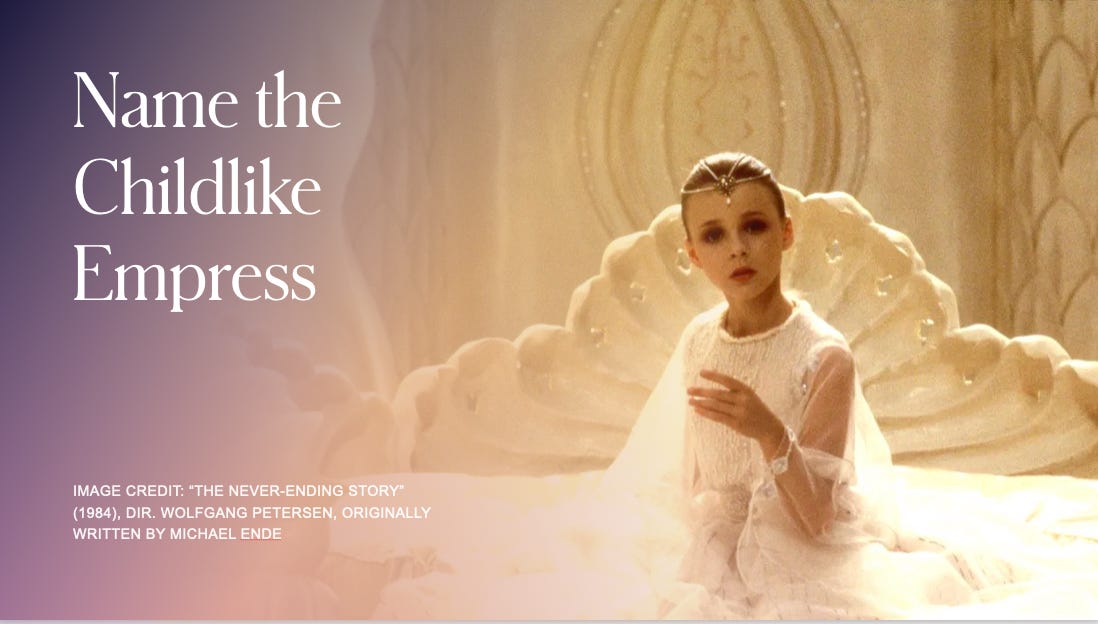
His task is simple: to name the Childlike Empress.
In the iconic climactic scene of the movie, the Empress tearfully explains: “He doesn’t understand that he’s the one who has the power to stop it. He simply can’t imagine that one little boy could be that important.”
And then, to Bastian: “Why don’t you do what you dream, Bastian?”
Meanwhile, Bastian cowers under a blanket, a tempestuous storm tearing the attic around him to bits. “But I can’t,” he replies. “I have to keep my feet on the ground!”
“Save us!” the Empress implores: “Call my name, Bastian!”
Fantasia, by this point, is all but gone, Atreyu has fallen through the cracks, and the Empress stands alone on a single, crumbling fragment of her Ivory Tower, floating in the vast Nothing. Finally, Bastian makes the leap of faith – he runs to the window, torrential rain pouring down his face, and with all the strength he has, he shouts the Empress’ name into the storm: Moon Child!
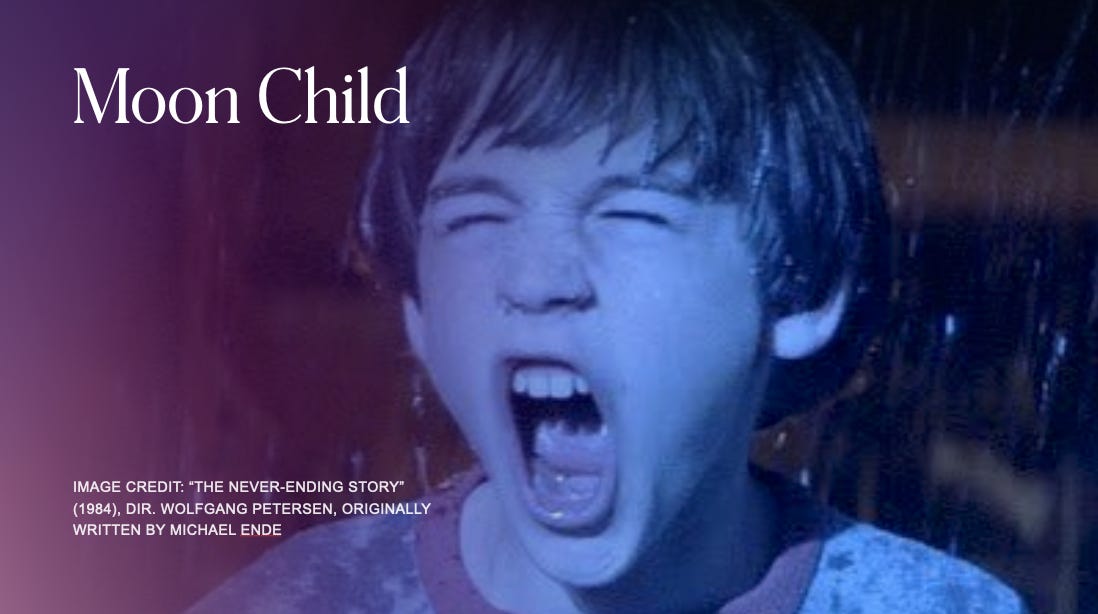
Fantasia is saved not through battle or monster-slaying, not even through understanding or mastering. It is saved by naming that which has been forgotten.
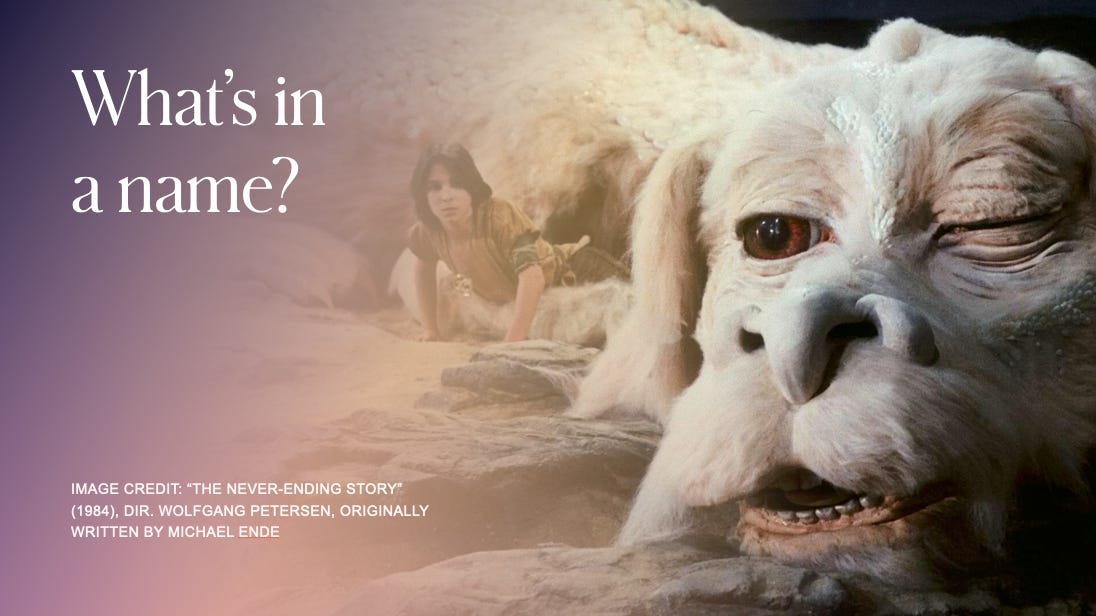
Because naming is empowering. When Bastian screams the Empress’ new name into the void, he’s re-investing the creative force with power, and granting it a place in his world – in the modern world.
Then, when the Nothing retreats and Fantasia begins to rebuild itself, we’re watching the feminine principle – creative, vital, life-giving, wonderful – being rediscovered and allowed.
What it is not – and this is really important – is the feminine rising as superior over the failing masculine.
A couple of days ago, I told someone in the park that I was putting together an analysis of The NeverEnding Story as an illustration of the patriarchy’s systematic devaluation of the feminine (because my enthusiasm frequently gets the better of me like this). And you know what he did? He did a dramatic eye roll and said, “And I suppose the Nothing is toxic masculinity?”
Now, I understand where this comes from, and in his defence, he was joking, but in my view, this conversation says it all. The Nothing isn’t masculinity, not even the toxic kind. It is severance made manifest. It is the polarisation – the disconnect – between masculine and feminine that’s eating us alive. The enemy is the split that makes us feel as though we’re at war, as if one side has to win. And as long as we keep thinking that way, we all lose.
Your inner Fantasia
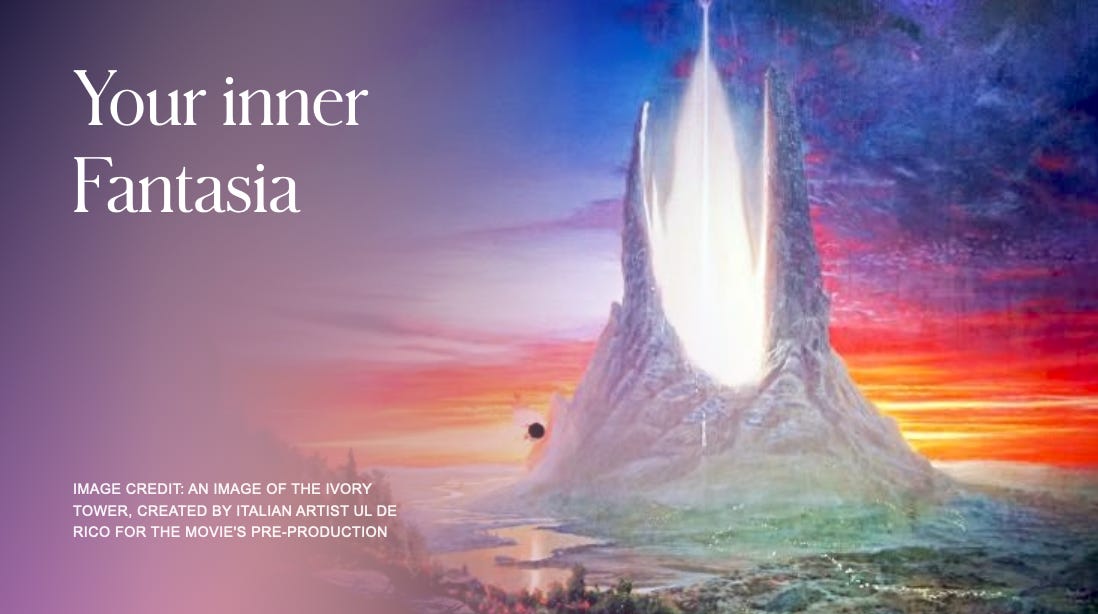
So let’s do what Bastian did instead. Let’s turn towards the creative force within ourselves and give her back her rightful power.
Regardless of whether you’re a visual person, just imagine you’re standing at the edge of the abyss, staring into a churning, devouring void where there used to be trees and plants and rivers, colour, life and meaning. But now, nothing.
Far, far away – almost impossibly far, but not quite – you can just make out an Ivory Tower. And trapped inside it, the Childlike Empress. She’s fading, but not gone just yet. And when she sees you, the tiniest spark of hope ignites in her eyes.
The Childlike Empress is the part of you that creates, imagines, dreams, and makes meaning. She is the part of you and me and everyone else that knows what matters, not because it’s productive or strong or dominant, but because it’s true.
Perhaps you’ve been taught that this part of you is childish, silly, impractical, idealistic or weak. Perhaps you’ve felt afraid to share your dreams or creations with the world for fear of people seeing this aspect of who you are. Perhaps you haven’t even dared to start your dreaming or creating because you’ve pushed her so very far away.
But in this moment, you can see her, and she sees you, and that means your connection has not been entirely severed yet. It will never be entirely severed.
Now, without needing to give this too much thought, because the best answers are those that surface on their own, I’d like you to answer this question:
If the creative, meaning-making force within you had a name, what would it be? If you were to name the part of yourself that makes life feel worth living, even though you can’t explain why, what would you call her?
She may have a human name or a descriptive one. She may be called something archetypal: Creation or Chaos; Lunar Light or the Anima.
And she may have a name that changes with time, too, so it can be anything you want it to be for now, just be sure to call her something.
And, when you do, say it out loud in your mind. Imagine that, just like Bastian, you can scream it into the tempestuous void before you and make her real again.
Save her. Call her name.
Then, just watch what happens to your inner Fantasia. As the Nothing retreats, witness the return of life. If you’re a visual person, see it. If you’re auditory, hear it. If you’re all about feelings, feel it. No matter how you prefer to do it, imagine the inner world beginning to bloom.
Perhaps a simple horizon begins to form, first, connecting the earth to the sky.
Then, water flows. Perhaps the vast swell of the ocean, the trickle of a woodland stream, the tumbling cascade of a giant waterfall.
Plants and flowers break through the earth, fragile and vital in equal measure. What do you notice first? A rainforest, a blossoming meadow, rolling hills or mountains painted green by alpine trees.
Perhaps you see ice caps, tundras or deserts; beaches, gorges, or canyons.
Perhaps you can hear the sound of birdsong, the footfall of an elephant, the rustling of a tiny shrew making its home in the fallen leaves.
And perhaps you can feel the warmth of the sun, the solidity of the earth, the lightness of the breeze, too, as your very own inner creation story unfolds. Because it all belongs to you, when you choose to remember that she’s there. Because she is there within you, is she not?
The work ahead
The Nothing is real. Culturally, it’s the spreading sense that nothing matters, nothing will change, creativity is indulgence, imagination is escapism, and the only things that count are what can be measured or controlled. Internally, it’s the emptiness that grows when we let die our own capacity for creativity, connection and meaning-making. But we don’t have to do that just because ancient retellings of even more ancient stories tell us to.
Like Bastian, you can hold both sides of the polarity, because you are stardust that was born of chaos and will return there someday, too. And that, as terrifying as it might sometimes seem, can be freeing, grounding and magical, as well.
–
REFERENCES:
- Michael Ende, The NeverEnding Story (1979)
- The NeverEnding Story, dir. Wolfgang Petersen (1984)
- Carl Jung, The archetypes and the collective unconscious (1959)
- Erich Neumann, The great mother: an analysis of the archetype (1955)
- Marie-Louise von Franz, The interpretation of fairy tales (1970)
- Marion Woodman, Addiction to perfection: the still unravished bride (1982)
- Riane Eisler, The Chalice and the Blade: Our History, Our Future (1987)
- Marija Gimbutas, The Goddesses and Gods of Old Europe: Myths and Cult Images 1982)
- Merlin Stone, When God Was a Woman (1976)
You have no idea how happy and excited I got when I started reading this! At the sight of "the neverending story" which is my all time fave book (and a movie I love), my inner child did a triple jump. It's so interesting to see the nothing as a pattern that we can find described in some other stories too.
When you said "In a way, this is what the Nothing represents: the incomprehensible vastness that makes everything feel meaningless" I couldn't help but think about another fave movie called "everything, everywhere, all at once" where the nothing is represented by a bagel (the comic relief is needed).
I'd like to highlight this other sentence: "The feminine was excluded not through malice, but because it didn’t fit their understanding of God.
Stories are living things that evolve with their tellers. So, over the years, goddesses became saints, demons, or disappeared entirely."
I feel like this sentence is so important, when some people are still stuck in believing in opposites/extremes; it's the lack of understanding itself that creates conflict and what is misunderstood is often rejected or villainized out of fear.
This was never about one part taking over the other, it's always a matter of balance and inner unity - as you pointed out, beautifully : "The enemy is the split that makes us feel as though we’re at war, as if one side has to win. And as long as we keep thinking that way, we all lose." I am no expert about the Jungian analysis but i guess this is the purpose of integration.
Also, your post included a synchronicity for me that I'd like to share because it made me so joyful and it was this : "In Jungian psychology, the white horse represents the intuitive life force – vital energy, connection to body and instinct, the animal nature inside us that simply wants to live." Just the other day I watched this beautiful animated movie called "the son of the white mare" (1981) and I enjoyed reading about its mythology but your post answered on the symbol of the white horse. Thank you so much for your work, I feel like at this point in time, it's fundamental to talk about such things.
I love the inclusion of images and the long story this tells, I'll be watching that movie for sure, thank you