


You can watch this on YouTube or read it below.
You’re doing everything right: you’re working hard, you’re showing up… You’re trying, goddamit! But somehow – just when success is within touching distance – it all goes to pot.

Self-sabotage.
Perhaps you miss the deadline, or cause a relationship-ending argument. You say the wrong thing at the worst moment, or you freeze when you should be speaking up. Afterwards, you kick yourself because you knew better, but something inside overrode your conscious intentions and made you do exactly the thing that would guarantee failure.
We all have moments like this, but why? Why does that invisible but powerful part of the personality seem hell-bent on destroying everything we’re trying to build?
Today we’re talking about the mechanics and mastery of self-sabotage.
The man who lost his shadow
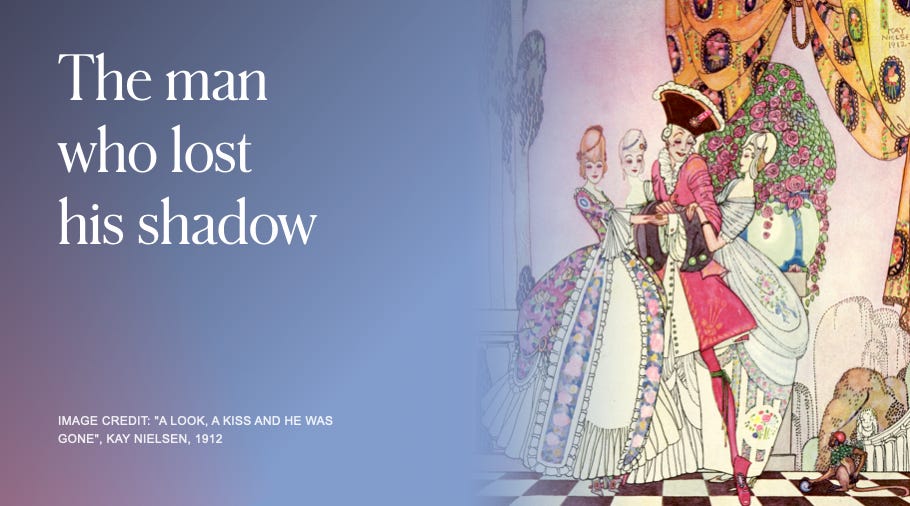
There’s a dark fairy tale by Hans Christian Andersen that most people don’t know because… well, you’ll see. It’s called “The Shadow.”
A learned man – a scholar and philosopher – travels to a hot country to study and analyse the world. As always, he wants to learn as much as possible, because it’s good to be knowledgeable. But the heat is unbearably intense, much hotter than he’s used to. During the day, it’s so oppressive that he can barely go out – he has to stay indoors with the shutters closed and curtains drawn, essentially trapped during daylight hours.
So, while he came to learn, explore, observe, and understand this new place – to fill his clever mind with interesting and useful things – he instead finds himself confined, weakened, passive, limited, and unable to engage with the world at all.
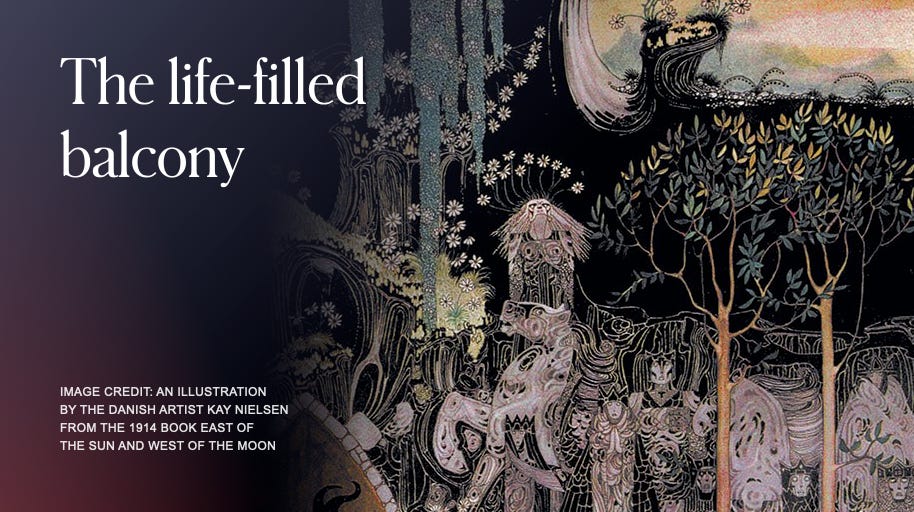
One evening, the learned man is sitting by his window and notices that the house across the street has a beautiful balcony covered in flowers. Feeling isolated and alone, he’s curious about who lives there, and looking closer, he can see his own shadow falling on the balcony opposite – cast by the light of the moon. But there’s something strange about his shadow on this night: it seems almost alive, stretched out and moving with the flowers.
Playfully, half-jokingly, the man speaks to his shadow: “Go on, go inside and see what’s there. Be useful for once. Come back later and tell me what you saw.”
The next morning, though, he wakes up and his shadow is gone – completely vanished. Now, he has no shadow at all.
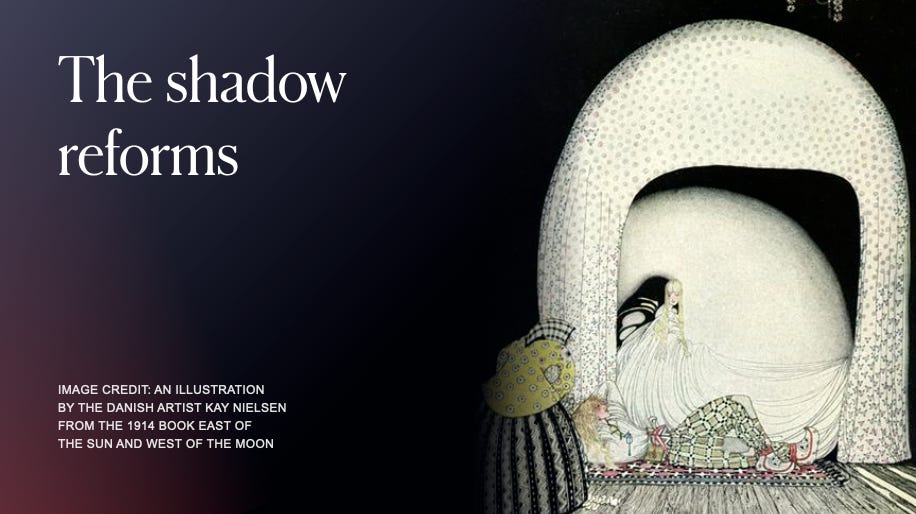
At first, he’s disturbed, as one would be. But slowly, over days and weeks, a new shadow begins to grow from his feet – starting tiny and gradually getting larger. He travels home to his colder county, where the sun is less harsh, and he can feel more like himself. After a while, he decides to forget about his shadow experience, keen to get on with his academic work.
Years pass, and the man is still trying to be good, trying to be wise, trying to understand truth and beauty. But now he’s getting sick, growing increasingly weak and pale. He’s becoming, quite literally, a shadow of himself.
One morning, the learned man hears a knock at the door, and when he opens, he finds his old shadow standing there like a person in its own right. And what a person! Confident, successful, wealthy, well-dressed, the shadow had become everything the learned man really wanted to be but could never have achieved.
The shadow explains that the house across the street in the hot country had been the House of Poetry, and it had shown him a different way of life. “While you were being careful and scholarly and good,” the Shadow says, “I went out into the world. I did all the things you were afraid to do. I was bold, shameless, powerful, and look at me now – I’m thriving.”
The reversal
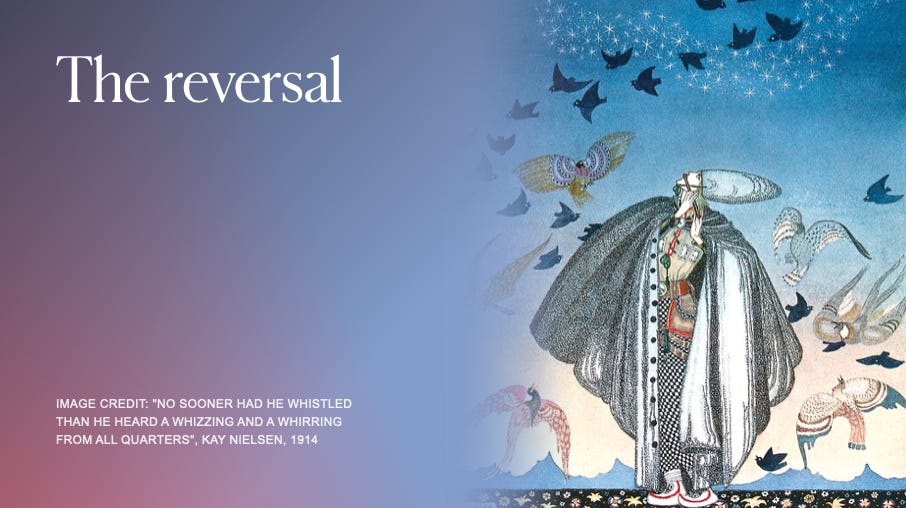
Right there and then, the shadow offers the man a deal: “Listen,” it says, “you’re sick, and you need rest. Travel with me as my companion. I’ll pay for everything, and you can recover your health.” The man agrees, but of course there’s a catch: to do this, they must swap roles – the shadow is to become the man; and the man, the shadow.
They travel far and wide, and the shadow is magnetic – confident, worldly, successful in ways the learned man never was. People are drawn to this new being, and the learned man watches, mesmerised by the show – “This is what I could have been,” he thinks, and strangely, he feels almost... proud? As if his shadow’s life counts as his life, too.
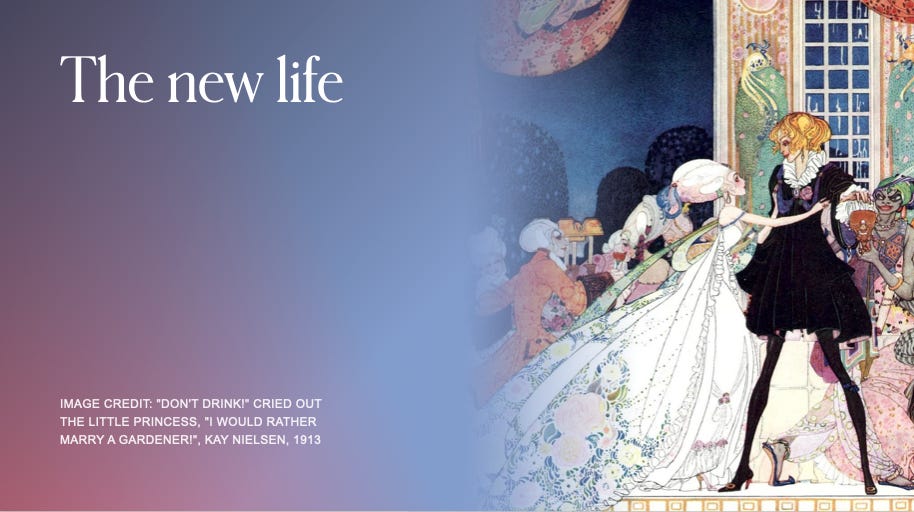
Eventually, the shadow meets a princess: they fall in love and get engaged, and the learned man thinks, “Maybe this is enough. Maybe this is close enough to actual living”.
But standing in the palace one morning, watching the wedding preparations, he realises the horrifying truth: the more life the shadow takes, the less he has. The learned man is disappearing – being erased, replaced.
Desperate, he finally speaks up: “This has gone too far,” the learned man says to the shadow. “I’m not the shadow – you’re the shadow!” But who will believe him? He looks pale, weak and half-alive, while the shadow is vital, important and loved.
The shadow leans in close, fixing the learned man with a determined gaze, and simply says, “I won’t let you ruin this.”
The learned man is executed, quietly, on the wedding day. And when he was gone, no one missed him.
The end.
What on god’s green earth does this mean?
This eerie and rather unforgiving tale warns us about the dangers of trying to reject, override or run from the parts of our personality we find hard to accept.
The learned man tried to be only what he saw as “good” – that is, careful, wise, studious, detached. To this end, he rejected his darker impulses. He didn’t even register the boldness, shamelessness, and raw ambition he later saw in his shadow self.
Carl Jung, who developed the concept of the psychological shadow, would have likely interpreted the shadow in this story as a “complex” – or “splinter psyche” – belonging to the learned man.
A complex is an emotionally charged cluster of ideas, images, and feelings that forms around a core experience or archetype – in this case, fire, verve, life, engagement. According to Jung, complexes have relative autonomy; they can operate semi-independently from conscious control, as if they have their own personality or agenda.
Now, talking about this after the story I just told makes it all sound a little scary, but complexes are a normal part of psychic functioning – we all have them, and they are not pathological. For example, a disproportionate emotional reaction that makes you think, “Hey, why am I so upset about this?” – that could be described as a splinter psyche hijacking your emotions.
What matters when it comes to complexes is the degree of dissociation (just how split-off they are); our conscious relationship with them (that is, whether we can reflect on them); how rigid or overwhelming they are; and whether they seriously get in the way of you living your life.
In the story, the learned man’s relationship with his splinter psyche starts out normal, but becomes increasingly problematic as time goes on. The shadow gets a glimpse of what it’s missing in the House of Poetry, which represents everything the rational, analytical, intellectual man rejects in himself. And from there, it snowballs until the complex has complete control and the learned man perishes.
What self-sabotage actually is
Those experiences of doing the stupidest, most reckless thing at precisely the worst moment can be understood as the shadow – or a fragment of it – taking control. When we freeze during the job interview, spend all our hard-earned cash for no reason, or ruin the relationship of our dreams in one fell swoop, that is a complex taking over. A splinter psyche that’s been denied for the longest time now needs to force its way to the surface for some reason or another.
But here’s what we usually get wrong about this: we assume the shadow is trying to destroy us. We call it self-sabotage, and we hate ourselves for it, seeing the splinter psyche as the enemy – a malicious part of self that ruins everything good. But what if that’s not what’s happening at all?
When “sabotage” is survival
Let me give you some examples of apparent self-sabotage that might actually be the shadow trying to save us.
Example 1: The relationship you “ruined”
First, the relationship you think you ruined.
You pick a fight right when things are getting serious, or you slowly push your partner away, creating the kind of cold distance that forces them to leave. Self-sabotage, right? Maybe. Or... some part of your personality recognised this relationship required you to be smaller, quieter, less yourself. What if it was that part – the one that knows you deserve more – that forced the issue before you got so entangled you couldn’t leave?
I’m not saying that’s definitely the case – it certainly isn’t always the case, as we’ll explore shortly – but it could be.
Example 2: The promotion you “blew”
Example two – the promotion you think you blew.
You freeze in the interview or undersell yourself at work, and miss the opportunity to go up in the world. You might usually see this as a failure and, again, it could be. But it could also be that a little part of you just knew this job would destroy your health or hinder your creativity, and so it stopped you before you got higher on a ladder you never wanted to climb.
Again, who’s to say?
The shadow knows what you won’t admit

What we do know is that the shadow holds the information we don’t allow ourselves to see. This means that it knows when we’re performing instead of living, pursuing goals that aren’t actually ours, or losing ourselves to relationships that just aren’t right.
And when we don’t listen to the quiet signals that show up first – the unease, the exhaustion, the feeling that something’s wrong – the shadow has to scream louder in order to be heard. It creates what looks like sabotage, but could actually be a shrewd course correction. It may be a splinter psyche that says, “We can’t keep doing this. Something has to change.”
But – and this is important – we need to remember that the shadow self is not magic. It isn’t infallible and it’s not omniscient, either. Sometimes, it, too, is running on limited, faulty programming.
The unconscious mind is a little like a psychological thermostat – it wants to keep everything the same as usual, or as close to the norm as possible. It does this because, as far as this internal safety system is concerned, familiar means survivable. If we know something we’ve lived through before, and if we’ve lived through it before, then chances are it’s not fatal.
So, while the “ruined” relationship might have been an act of self-preservation, it may also have been the result of a scared splinter psyche that doesn’t want to risk love or intimacy because it’s never known those things before. They don’t seem safe.
Equally, the blown promotion may be due to a part of the mind that fearfully clings to a limiting belief that says, “I’ll never be successful” or “I don’t deserve good things.”
The question, then, is this: How do you know if you’re shooting yourself in the foot out of fear, or saving yourself from misery?
You can’t plan your way to an authentic life
The uncomfortable truth is that we can’t know this, not immediately, and not from a place of safe remove. Like the learned man, if we lock ourselves away from the light of the sun, cautiously ensconced behind closed shutters, we won’t know anything at all. We can’t think our way to answers like this; we can only know by living. Just like the shadow in the story, we have to break away – to get out there and see for ourselves.
When the shadow crept into the House of Poetry, it learned to feel life, rather than intellectualise it – it got a taste of what it’s like to live in verse rather than textbook prose. So, it started to take risks and experiment, to learn the difference between what felt alive, as opposed to lifeless, through direct experience. It started, finally, to push the limits.
The Upper Limit Problem
Psychologist Gay Hendricks talks about what he calls the Upper Limit Problem – an unconscious ceiling on how much success, love, or happiness we allow ourselves to have. When we hit our respective ceilings, he explains, we unconsciously sabotage ourselves and fall back down into familiar territory. In my book, I called this territory the (dis)comfort zone – comfortably familiar but not comfortable in any real or desirable sense.
This invisible ceiling above us is formed from limiting beliefs about ourselves and the world that we pick up over the course of our lives. Maybe your ceiling is made of ideas like, “I can be successful but not too successful,” “I can be loved but not completely loved,” or “I can try but I’ll never really be clever, funny, affluent, happy.” Live with these ideas long enough and we’ll find that every time we threaten to exceed our self-imposed limits, our shadows panic and pull us back down to the safety of the known.
The only way to raise the ceiling is to incrementally push the limits and practise staying in the expanded zone. We don’t get to do this by thinking about it or analysing why we have these limits, but by living in the expanded state long enough that it becomes the new normal.
So whether your shadow is protecting you from a genuine threat or limiting your experience out of fear, the solution is the same: you need to bring your split-off shadow self into consciousness, take it out into the world, and work with it, not against.
The learned man kept his shadow at a distance, where it was forced to operate from the unconscious. As a result, it took over, and that was the end of that. Or was it?
The story we misread
There are basically two ways of reading a fairy tale. At first glance, we might see them as commentaries on relationships and conflicts between individuals, social groups, or even whole nations, usually with a moral message about good versus evil. That is, we read them as if they are stories about separate (if a little weird or wonderful) individuals. Alternatively, we can read them as dramatisations of the inner world and how it changes and evolves along with us as different aspects of self interplay and relate to one another.
Now, the literal reading of The Shadow is, let’s be honest, bleak AF. It has the most abrupt and counterintuitive ending that leaves us thinking, Wait. That was it?
I love this fairy tale precisely because it so brilliantly exposes the absurdity of reading archetypal stories as if they are meant to describe interactions between separate individuals about external conflicts. The Shadow just doesn’t work as a literal tale – the ending feels wrong, unsatisfying, arbitrary. Read it as a dramatisation of the inner world, though, and it tells a much more satisfying story.
Consider the learned man at the beginning: trapped indoors, too weak to engage with life, and analysing everything from behind the shutters – controlled, safe, disconnected, and lifeless. He was already dying at the very start – already “a shadow of himself”. His careful, controlled life was causing him to shrivel away.
The only part of him that was alive was the shadow. The shadow was the part that went to the House of Poetry, learned to engage with the world, and ultimately became confident, vital and successful.
We talk about ego dissolution often in these articles – the death of an old, limited self. When the learned man lost his shadow and got sick, he was experiencing his Nigredo, his Dark Night of the Soul – the breakdown or burnout that signals the end of one version of who we are, and the birth of a bigger, better, happier, more connected self.
On the shadow’s wedding day, when it found love in its feminine opposite – i.e. the archetypal “lost princess”, or the anima – the learned man is executed. But not literally. What’s really going on here is the death of an old persona. This man, after all he had been through, finally let go of the version of himself that believed he had to be smart, careful and distant in order to be okay. The old version – the one that refused to live – had to die so the vital, embodied, alive version could fully emerge.
It takes a bit of thinking to see it this way because we live in the learned man’s world. When we first hear the story, we’re all too ready to believe that the pale intellectual was the “real” person and the vibrant shadow the imposter, just as we’re all too ready to read old stories literally. But there’s a part of all of us that knows better, is there not?
Your shadow is not your enemy
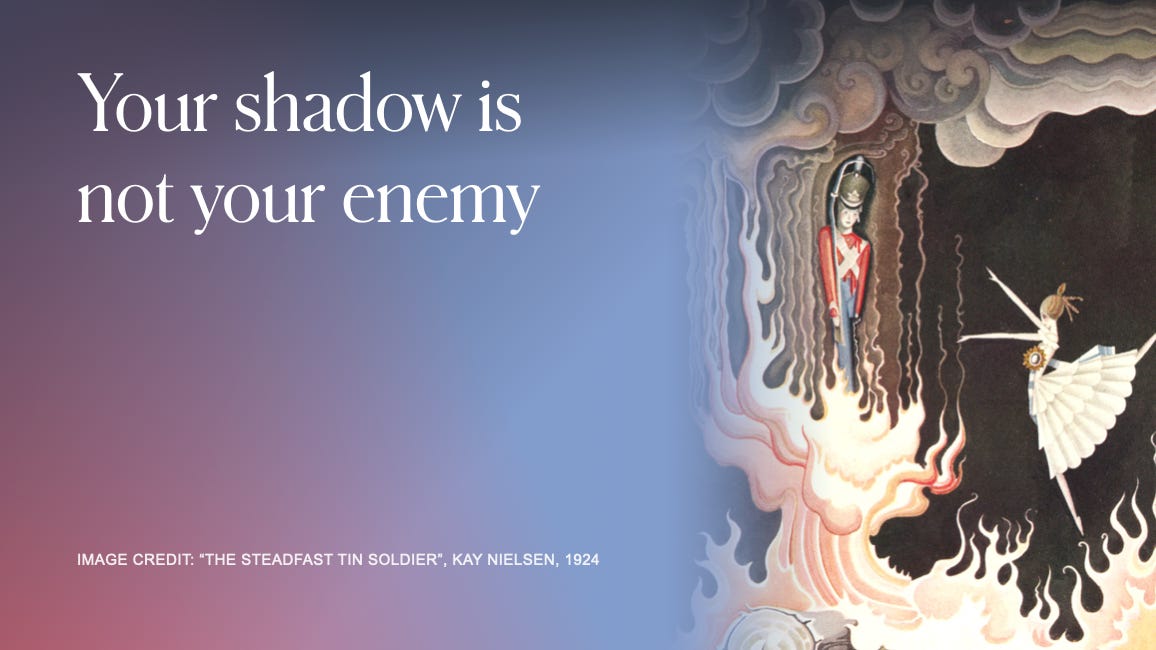
When it comes to the experiences in life that we read as self-sabotage, it doesn’t really matter if the shadow within us is working from limiting beliefs or a healthy need for more; the meaning is always the same: change is underway, and now we have to get out there and live it.
How? Once again, the problem shows us the solution – the ways in which you tend to self-saborage could contain the key to living your way to a higher ceiling. If you tend to people-please, say “no” to one small request. No need to explain or justify, just “No, I can’t”. Feel the discomfort, sit with it. Notice that the world doesn’t end.
If you hide your passions for fear of looking weird, share one thing you love with someone safe. If you hide your feelings or opinions, share those things safely. If you burn yourself out with too much work, book in one day of pure rest or fun or whatever you wouldn’t usually allow yourself and stick to it.
Change comes from action. These little steps are how we raise the roof.
Yes, this means we’ll need to brave the heat of the sun. It means we have to take risks – to experiment with living instead of fearfully planning and analysing. We will make mistakes along the way, but that’s okay. And it will feel hard at times, too – it will feel wrong and scary and too much – but that’s also okay. When we expand past our ceilings and have to sit in the discomfort of novelty for a while, it can seem like everything’s falling apart. But in reality, that’s just what growth feels like. It’s the only way to be reborn.
You can’t plan your way to wholeness. You can’t think your way to integration. But you need to get out there anyway, because the door to the House of Poetry is wide open. And the House of Poetry has no ceiling at all.
–
REFERENCES:
Hans Christian Andersen, “The Shadow” (1847)
Carl Jung, “Psychology and the Unconscious” (1912/1943)
Carl Jung, “Aion: Researches into the Phenomenology of the Self” (1951)
Gay Hendricks, “The Big Leap: Conquer Your Hidden Fear and Take Life to the Next Level” (2009)
Hazel Gale, “The Mind Monster Solution” (2018)
Wonderful post.
A suggestion: can you share your views on the movie 'Lars and the real girl'. It's a beautiful movie about a community helping a lonely man.
Hi Hazel. Thanks for today's story and deep dive! If somebody told me in childhood that living is an inside job, I somehow missed the lesson. I spent decades trying to change and control the outside world... and I'm pretty sure I'm not alone in that. 🤦🏻♀️