


You can listen to this post on our YouTube channel or read it below.
***
How did female beauty become mandatory, while male beauty became something to be suspicious of, and how does this divide affect our inner worlds?
The question of the difference between men and women is, of course, not new, but we’re asking it even more often at this particular moment in time, when people like Andrew and Tristan Tate show us what happens when men build their public persona on a performance of masculinity, wealth and control, while, simultaneously, Ariana Grande fields a wave of public concern and criticism over her weight. On the surface, these may seem like separate conversations, but they’re connected at a more abstract level by a shared bargain struck some time ago, when women inherited the duty to be beautiful, and men the duty to be powerful.
This article is about something you may or may not know of that happened to masculinity a few hundred years ago. It’s known as the Great Male Renunciation, and it still shapes the rules we’re expected to follow today, regardless of gender, along with how we fundamentally relate to ourselves.
The Talented Mr Ripley
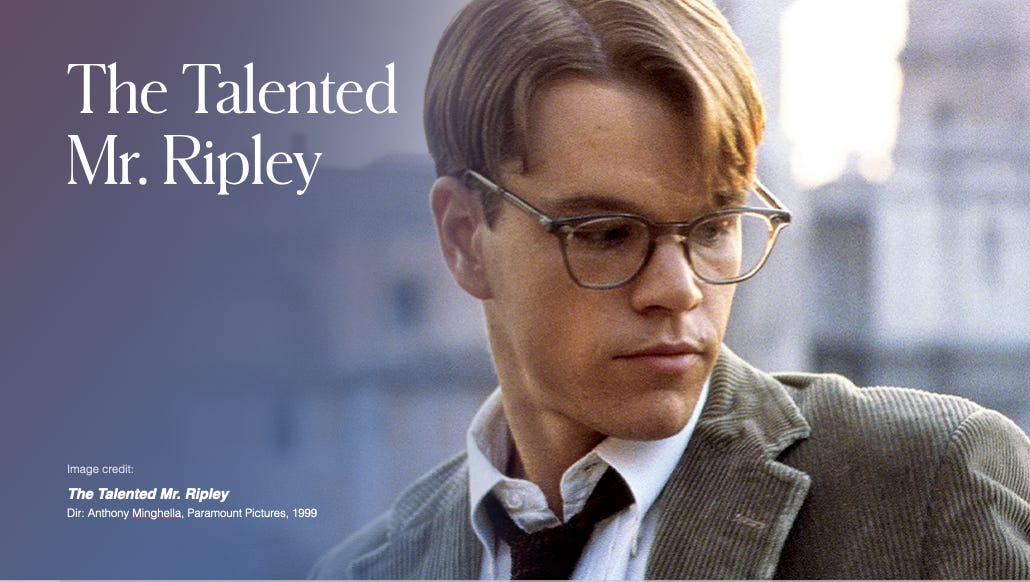
There’s a scene in the film The Talented Mr. Ripley that speaks volumes about performed masculinity and self-worth. Tom Ripley – clever, hungry, and desperately poor – has let himself into Dickie Greenleaf’s apartment while he’s out. He tries on Dickie’s jacket, shirt and sunglasses; sits in Dickie’s chair and speaks into the mirror in Dickie’s voice. In other words, he becomes Dickie, which is to say that, for just a few stolen minutes, he becomes someone who feels as if he belongs in his own skin.
I think we all know what it’s like to covet the way someone else wears themselves. Even if we don’t find ourselves doing this as adults, we surely did as teens. I can’t have been the only one who bought a hat or some jewellery in the hope that it would make me feel as good about myself as I did about the other girls who wore those things. It looks easy to be someone we see as attractive, admirable or cool. And that’s what Tom Ripley sought to take from Dickie Greenleaf – in this case, the ease of being someone with money and status, or, perhaps, the freedom and comfort of being a man of a certain class, at a certain moment in history, who could inhabit a beautiful home, beautiful clothes, and a beautiful lifestyle as if those things were made only for him. Because, in a way, they were.
The Great Renunciation
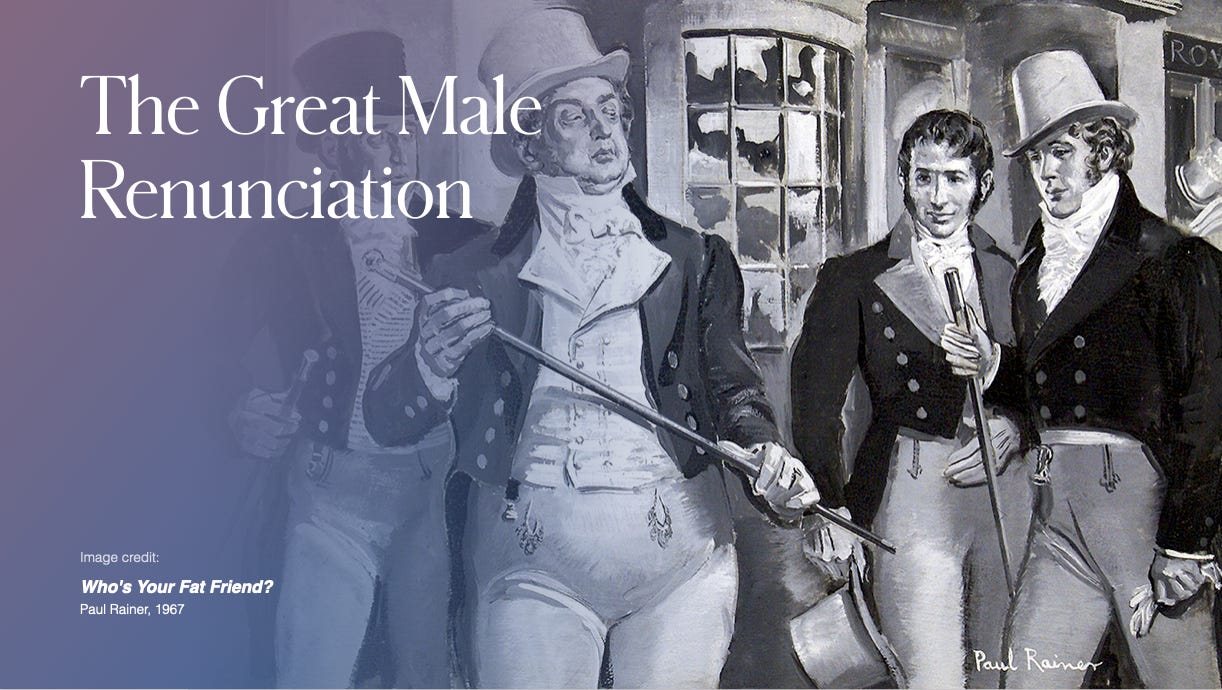
In 1930, a psychologist named John Carl Flügel coined the phrase “the great male renunciation”. He was describing a shift that happened in Western societies roughly around the time of the French Revolution – the moment when men, broadly speaking, stopped competing in terms of beauty, and instead donned the monotone uniform of stoic masculinity we’re more familiar with today.
Before the great renunciation, wealthy white men dressed in colour, lace, embroidery, and elaborate jewellery.
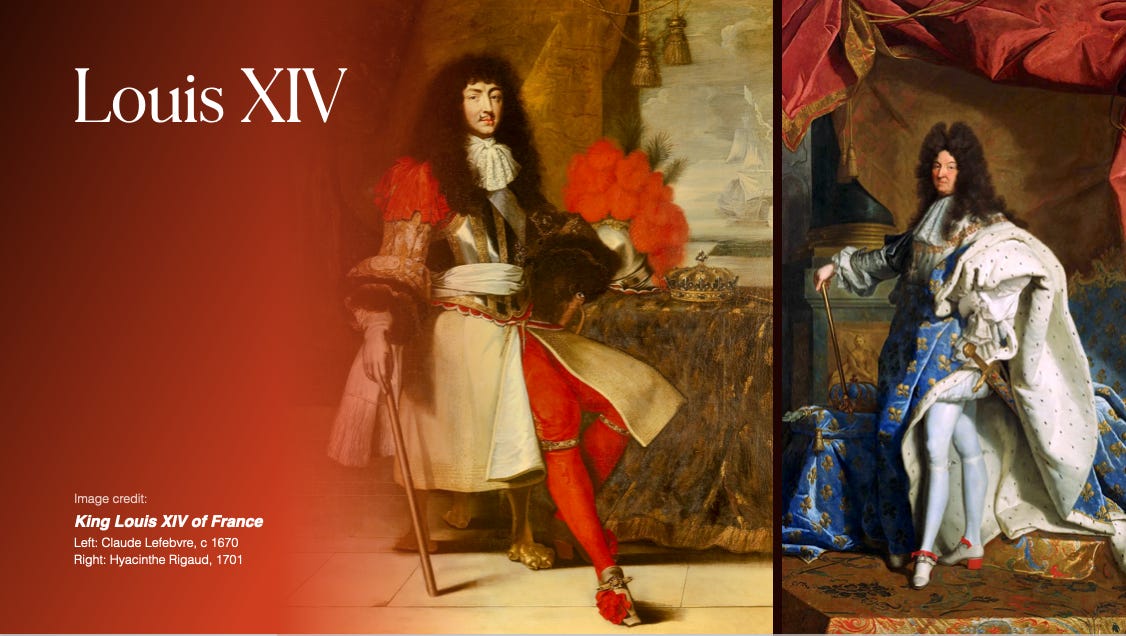
Louis XIV, for example, made his wardrobe into a political instrument, wearing beauty with pride, as if it were power made visible. I mean, look at this guy – slay. Back then, no one considered it unusual, let alone too feminine, to slap on some makeup, heels and a powdered wig before hitting the town.
But then, fairly suddenly in historical terms, everything changed. Ornament became associated with the aristocracy, which the revolution had just eradicated – both literally, in terms of executed individuals, and also in terms of the social class as a whole.
Enter the suit
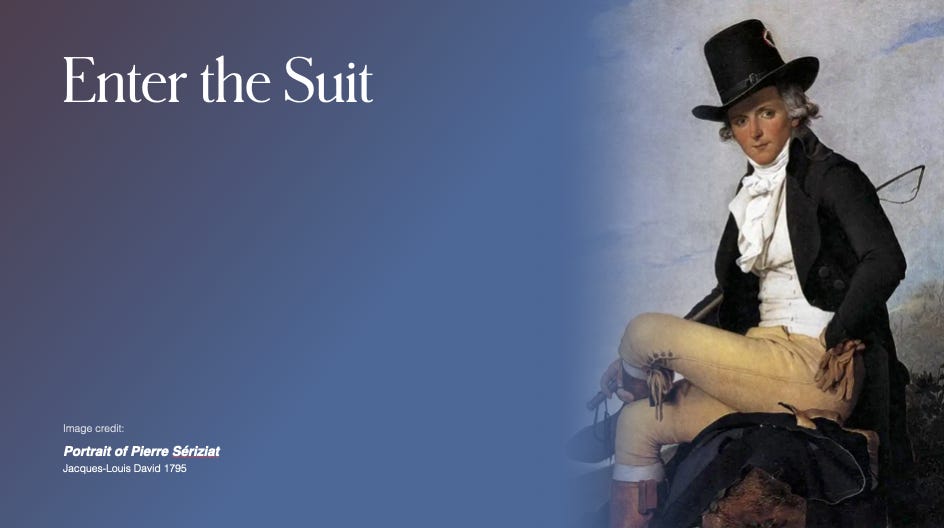
As the renunciation took hold, simplicity became a democratic virtue, along with utility and moral seriousness, and the Protestant work ethic, already a century in the making, found its dress code in the suit. Within a single generation, elaborate, colourful, beautifully presented clothes for men went from being a sign of power to a sign of suspicion. And as the nations of Europe continued to exercise their imperialist ambitions in brutal fashion, they exported this newly restrained aesthetic to every land they colonised.
The essay by the architect Adolf Loos from 1910, entitled “Ornament and Crime”, marks the endpoint of this thinking. Loos argued that ornament was a sign of cultural degeneracy – that the evolved, civilised man had moved beyond the need to decorate himself, and that the impulse to do so was essentially primitive. In other words, within a century of the renunciation, male self-adornment had moved from suspicious and dangerous to a flat-out sign of moral failure.
The Persona
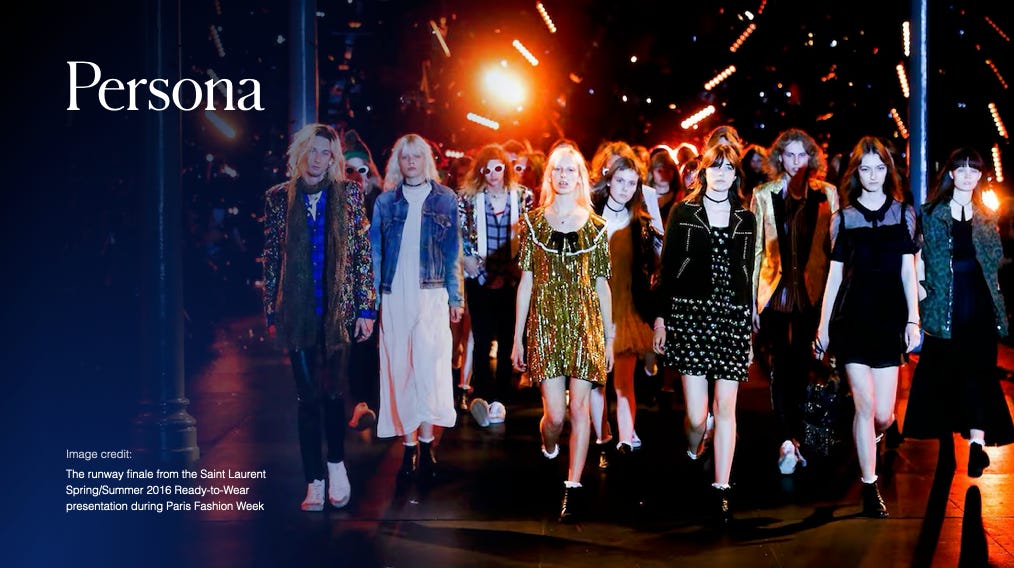
These days, the clothes we wear may seem at first like a fairly superficial consideration. But fashion, as something that is deeply connected to both politics and psychology, is, of course, never just fashion.
In terms of the inner world, what we choose to wear, along with how we do our hair and makeup, and so on, belongs to the realm of the Persona. Carl Jung described the Persona as the mask we wear in the social world – it’s the version of ourselves we present in order to be legible, accepted, and valid. In order to belong.
Of course, the idea of dressing a certain way in order to fit in sometimes gets sniffed as inauthentic try-hardery. We like to think we don’t do this, with our clothes or anything else, and that those who do have some kind of crisis on the horizon where they’ll suddenly see the error in their ways and get real.
But Jung was clear that the Persona is not inherently problematic. We need a curated version of self to present to the world, and no matter how hard we might try to renounce the idea, we do all have one.
There is a particular difficulty tied to the Persona, however, and that’s the propensity to mistake the mask for the whole self. Things can get a little hairy when we lose track of the gap between who we’re performing and who we actually are.
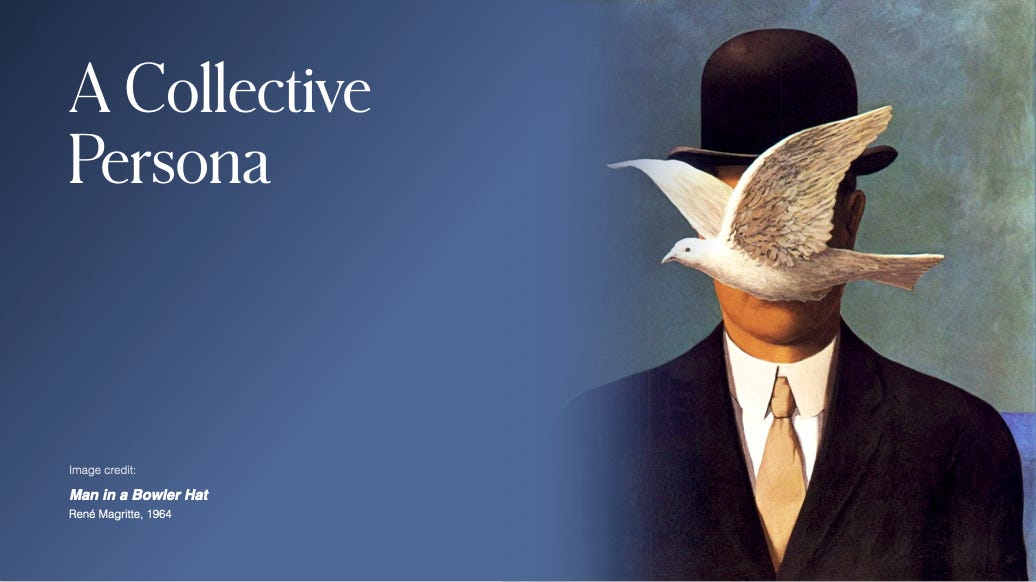
What the great male renunciation created, in Jungian terms, was a collective Persona. A single mask that an entire gender agreed, or were forced, to wear. Over time, that mask ate away at individuality and expression with relentless efficiency. If every man in the room is wearing a version of the same dark suit, the suit stops communicating anything about the person inside it and starts communicating only the role that person is expected to inhabit.
I.e. the professional. The respectable, serious man.
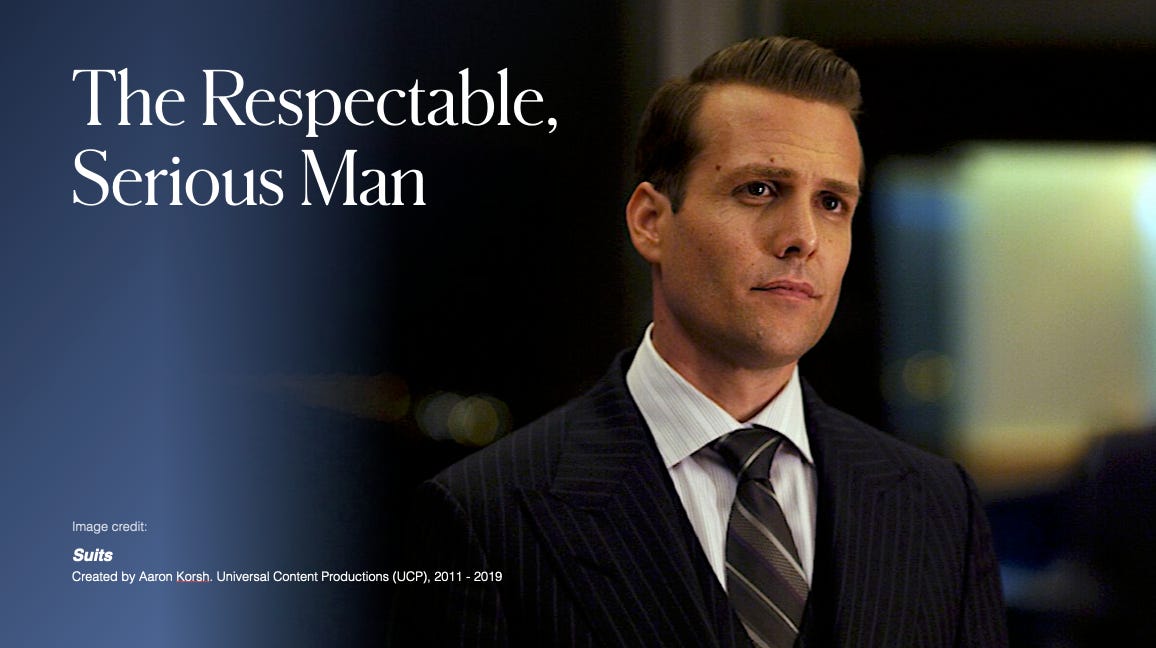
Now, there’s nothing necessarily wrong with respectable, serious professionals. I mean, I don’t want to spend too much time with them, but they can be okay. The problem with the renunciation was that as the sober suit was forced on every man lest they cross a red line, essentially risking poverty, abuse and ostracism. As a result, men lost a primary channel for self-expression – their ability to present as themselves in public was reduced to their choice of tie and cufflinks, and when we can’t express ourselves, we lose touch with ourselves. Thanks to the suit-uniform, the ability to authentically self-connect was rapidly, brutally limited for an entire gender, and a yawning gap opened up between who men actually were on the inside and who they were supposed to be.
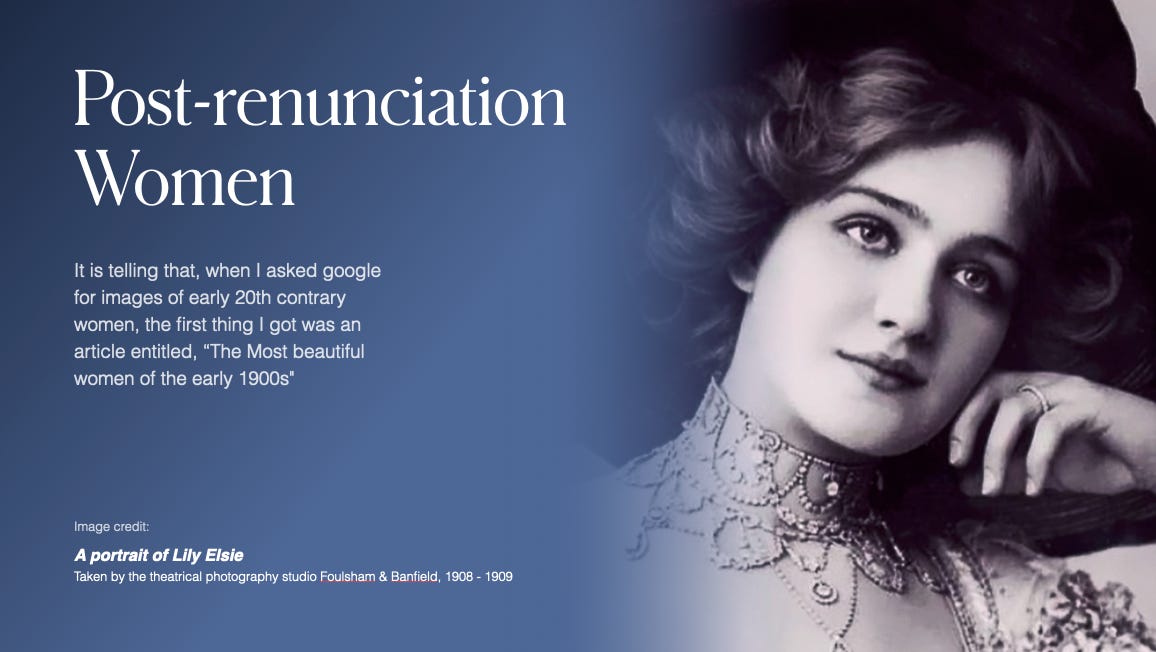
Obviously, this is not to suggest that women were walking around feeling completely self-connected, free to express themselves, and safe in their skins, because obviously they weren’t. And still aren’t. In fact, what happened to the menfolk arguably worsened the plight of women, because this cultural amputation of masculine beauty forced an important part of men’s inner reality into the shadow.
The series Mad Men painted a perfect picture of the repressed post-renunciation man. Don Draper is suave and charming, his suits are flawless, and there’s something genuinely seductive about the authority of all that restraint. But the show is built around the growing horror of what’s concealed underneath it: a stolen identity, buried grief, and a man who has literally constructed himself from nothing and now can’t break free of his self-imposed constraints.
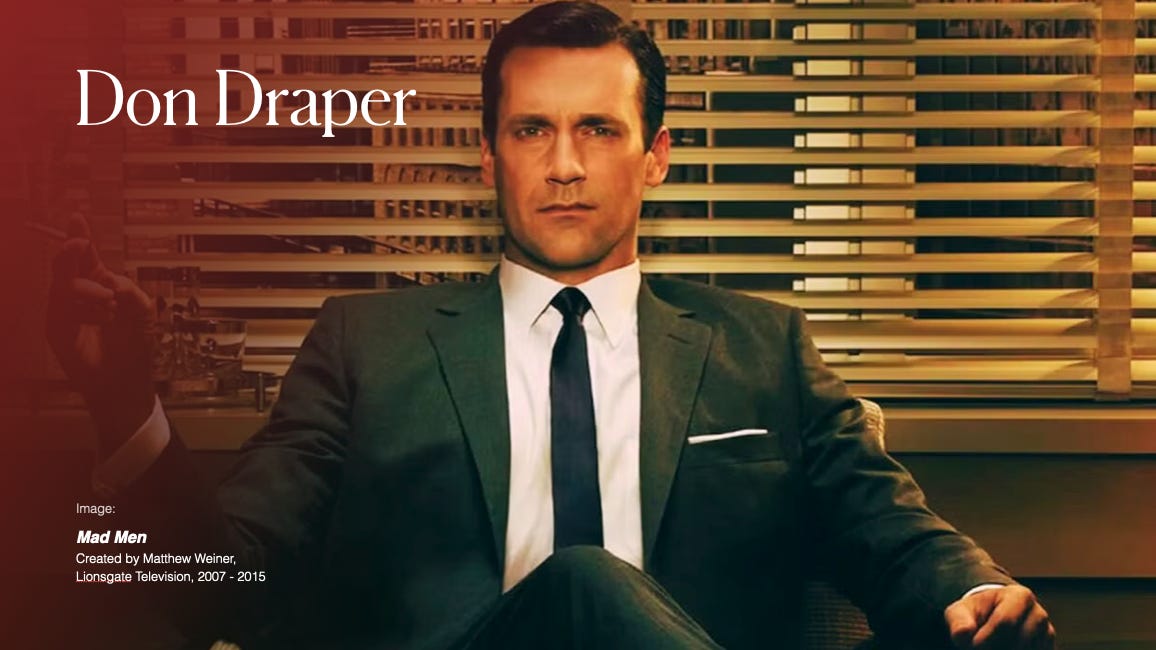
What’s interesting is that Draper’s suits only become more perfect as he falls apart. When everything in his life is disintegrating – his marriages, his relationship with his children, his self-respect – the tailoring just gets sharper and more buttoned down, as if his Persona is some kind of load-bearing wall.
The suit may have been invented by and for rich white men, but it was rapidly adopted by men from every kind of background. Each man who dons a suit makes the same bargain: he exchanges his individual self-expression for social acceptance and access to restricted circles. In the 2000s crime drama The Wire, the drug trade fixer Stringer Bell knows the power of the suit. By swapping out his street clothes for boardroom tailoring around certain people, Bell essentially launders into legitimacy his own image and that of his criminal organisation. He wears the mask to project the integrity, prudence and seriousness of a law-abiding businessman – a persona he especially needs when he’s dealing with people who stereotype Black men as uneducated thugs.
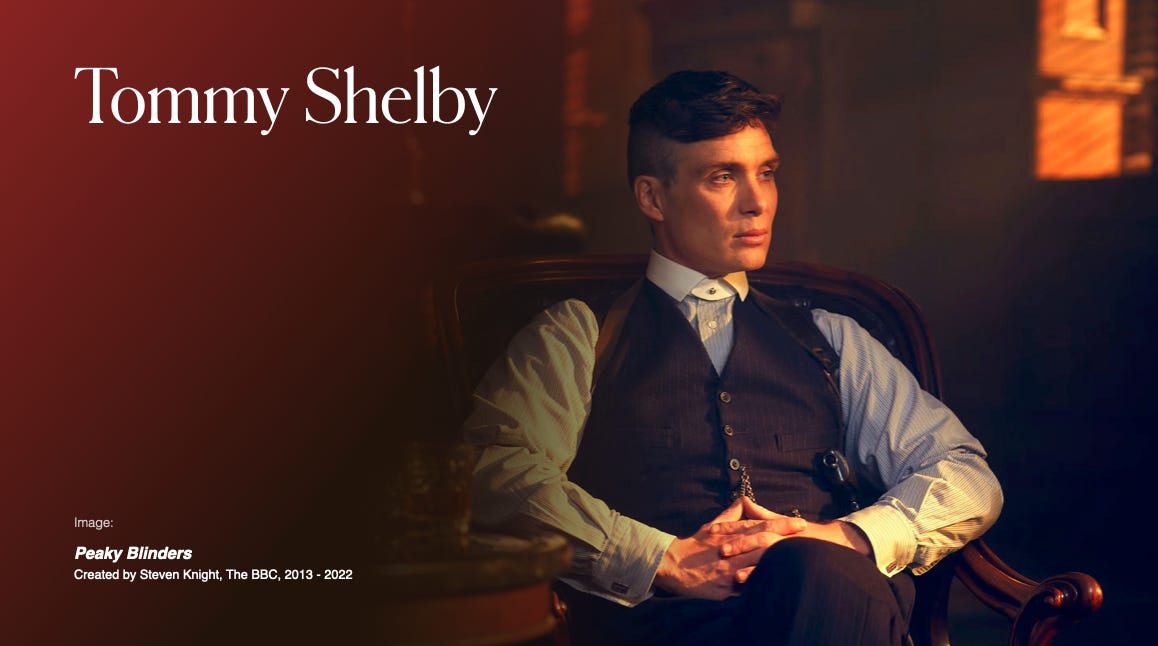
Rewinding a bit, and crossing the Atlantic to smoggy Birmingham, Peaky Blinders shows us a different version of worn masculinity. Tommy Shelby’s suits aren’t about concealment in quite the way Don’s are, or not only about that. What they definitely do offer, though, is armour. Tommy comes back from the First World War, deeply traumatised but, of course, unable to talk about this or even admit it to himself. The fear, anguish and guilt he endures are not allowed out in the open – there is no acceptable masculine expression of such things – and so he builds an exterior so impeccable that it becomes a threat in and of itself.
Sewn into Tommy’s suits, alongside the razor blades, is a truckload of pain and grief. But there is also working-class aspiration, violent self-determination, and the refusal to be dismissed. Once again, the suit may have been invented by the white bourgeoisie, but it has been claimed and adapted by men of every kind of background. Working-class men were given the same mask, and they loaded it with their own losses and disempowerment. Ultimately, the Persona can contain as much rage and defiance as it can respectability and compliance.
Though different, these examples speak to a single shared experience built on the discomfort of a limited sense of self, an impossible bar for belonging, and the sheer distance created between life as men, specifically, are expected to live, and the beauty-loving, pleasure-seeking, soft animal that is the anima within all of us.
The anima projection
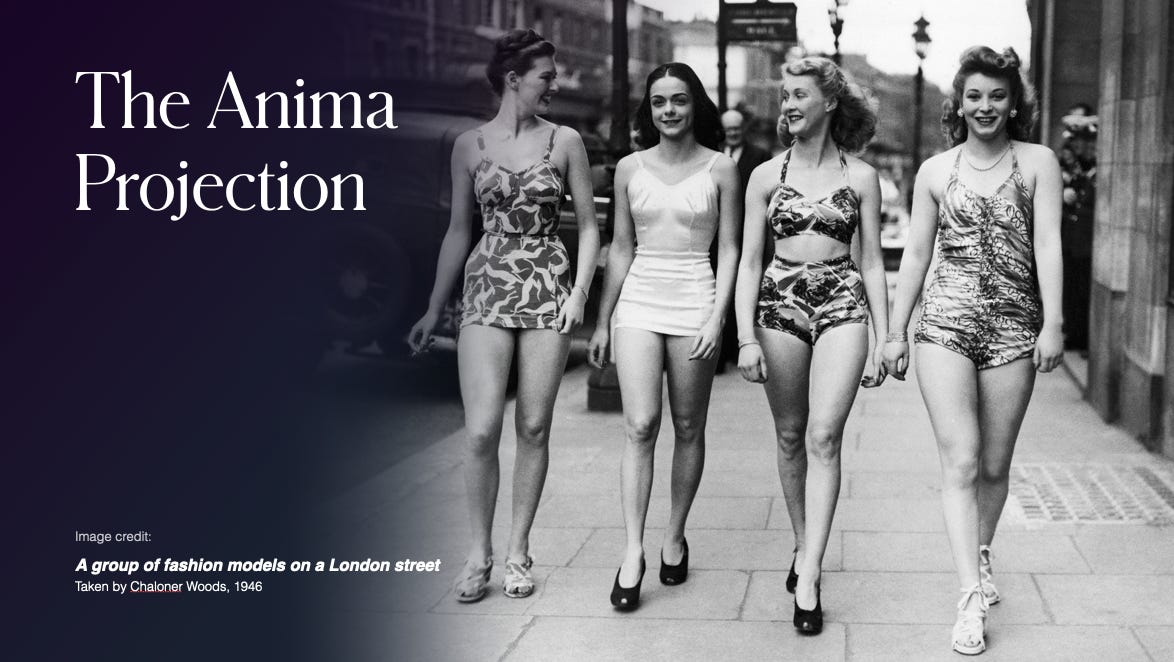
In Jungian psychology, the anima is the interior feminine (traditionally for men only, but let’s just use the term for the feminine principle in general) – this is the part of the psyche that holds aesthetic sensitivity, emotional depth, receptivity, and an appetite for both beauty and pleasure. Jung observed that men who haven’t integrated their anima tend to externalise it, seeking it outside themselves in women rather than recognising it as part of their own inner life. Now, because the great male renunciation made this a cultural mandate, men were essentially forced to stop embodying beauty and therefore began consuming it through women instead.
This is how we women became the surface onto which men’s disowned aesthetic life got projected, and we’ve been lugging that yoke around ever since – required to be beautiful in ways men aren’t, and held to often impossible, and sometimes unhealthy, standards that limit our capacity for self-connection and self-acceptance in a similar way austere masculine dress codes do for men.
This is the bargain struck in the renunciation that still lies at the heart of sexual politics two centuries later. The Tate brothers show us a terrifying vision of masculinity when beauty is renounced and power elevated to be the only thing that matters. On the day of their recent arrest, what Andrew Tate happened to be wearing – a purple, low-buttoned blouse and cropped trousers – got almost as much attention online as the arrest itself. It’s telling that, after everything he’s been accused of, the fact that he wore somewhat feminine clothes that day still felt, to some, like the most hard-hitting insult to throw his way.
Conversely, Ariana Grande’s recent withdrawal from public life provides an example of what happens to femininity when beauty is made compulsory – a standard so total that even concern for her wellbeing gets voiced as commentary, criticism and, of course, judgement concerning her body.
Recently, someone in the comments asked me why gender-related topics come up so often in my articles. Gender is, fairly obviously, something I’m interested and invested in, but not so much because I’m pushing an agenda (though I certainly have opinions). Really, I talk about the tension between masculine and feminine, and the effect this has on us as people in the world, because it’s fundamental to so many of the things we struggle with – identity crises, anxiety, shame, interpersonal conflict, intrapersonal conflict, and on, and on.
The lingering legacy of the male renunciation festers beneath a lot of the arguments and questions that run on repeat in social discourse: why eating disorders and body dysmorphia are so prevalent in women and girls and also go so often undiagnosed in boys and men, because those were never supposed to be male problems; why men are so much less likely to seek therapy for anxiety or depression, and so much more likely to die by suicide; why we have language for women “letting themselves go” that we almost never apply to men; why cosmetic procedures get sold to women as routine maintenance and to men as a shameful secret; why manosphere influencers are shouting louder and louder about their need to control women; and why violence against girls and women is such a huge problem. All of this goes back further than the great male renunciation, of course, but it was brought into screaming focus the moment one gender became the official custodian of beauty and the other its stoic, staid counterpart..
The shadow returns
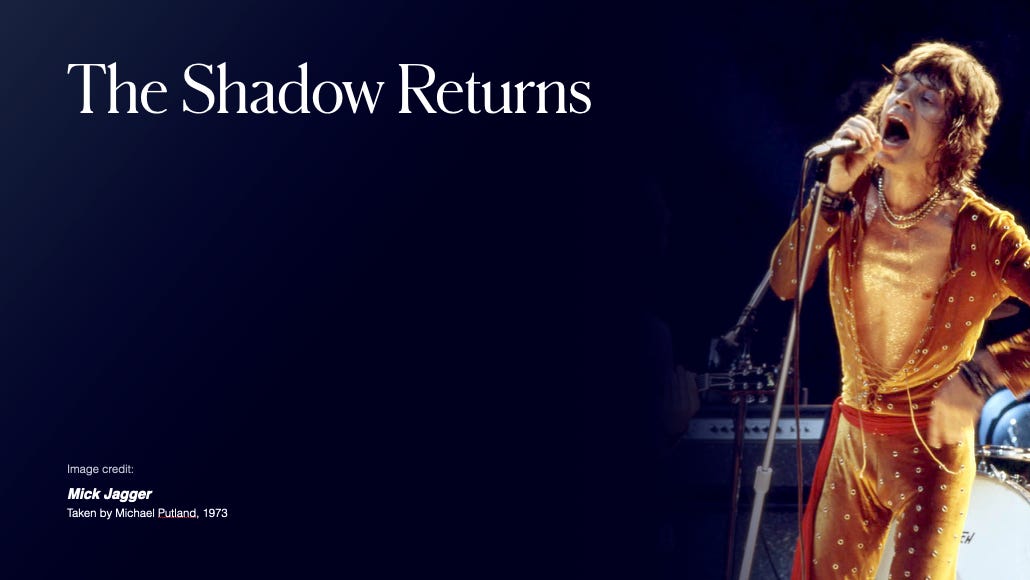
As with all norms, individuals and countercultures have pushed back against the constricting grip of the collar and tie, giving us glimpses of repressed male beauty and glamour that have found a way to rupture the seams.
Shadow content – meaning that which has been disallowed, rejected or repressed – never stays gone, no matter how hard we try. Rather, it accrues pressure during its time in exile and eventually erupts, breaking through the mask of the Persona in behaviours that often look like excess precisely because they’ve been in the dark for so long.
Think: Glam rock; David Bowie in a bodysuit and platform heels; Prince in ruffled shirts and purple velvet. Hell, you could see much of 1970s pop culture as a referendum on what men were allowed to embody.
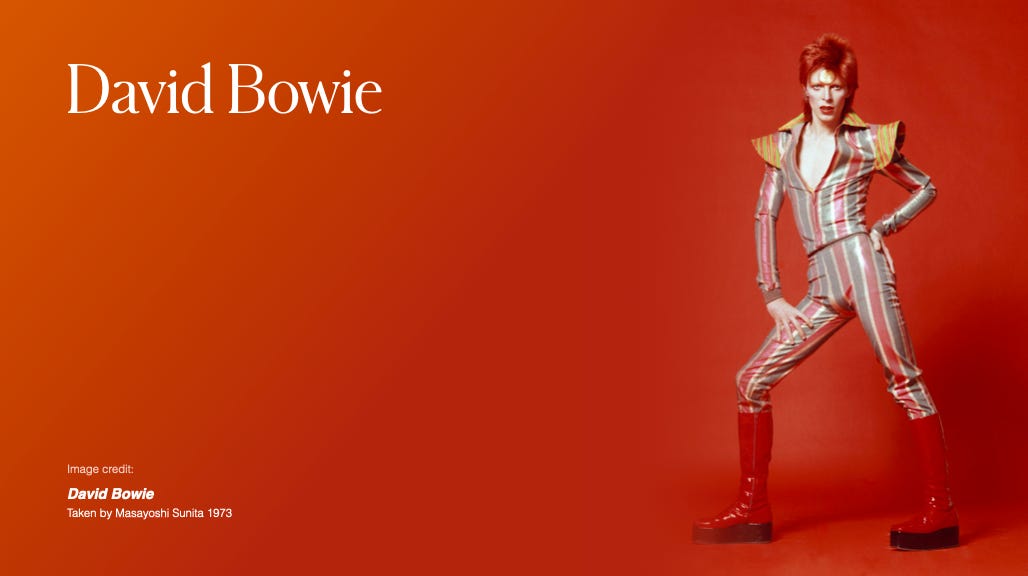
All of these examples, and more, were important psychological events, where the repressed ornamental expression of Western masculinity found its way into the spotlight and was received as scandalous, revolutionary, liberating, joyful, and threatening, often simultaneously.
What’s telling and depressing in equal measure, though, is how predictably each wave of expression just gets commodified, reabsorbed, and then quietly dialled back. The early 2000s, for example, offered a brief mainstream opening for the metrosexual man – moisturiser, grooming, David Beckham’s sarong – but it was quickly reframed as being about attractiveness to women rather than genuine self-expression. It was masculinity making itself more appealing to the female gaze, not masculinity loosening its grip on itself.
So, when Harry Styles wore a dress on the cover of Vogue in 2020, we called it “brave”, which is one hell of a back-handed compliment that does as much to reinforce the norm as it does to challenge it.
None of these things has led to a return to powdered wigs for all. Instead, these expressions often end up being dismissed as mere performative and idiosyncratic style choices by eccentric individuals, rather than intentional responses to a restrictive norm. Alternatively, they are culturally metabolised as queer. From a conservative perspective, this makes them de facto immoral; in liberal circles, it means they can be safely packaged as flamboyant and fun but irrelevant to straight – that is, real, masculine – men. After this social processing takes place, the shock fades and the suit reasserts itself.
The very fact that moral panics still reliably emerge around the idea of a man in a dress, or jewellery, or makeup, tells us something important about where we’re at in the post-renunciation healing process – not that much further along than we were back in Don Draper’s not-so-swinging 60s.
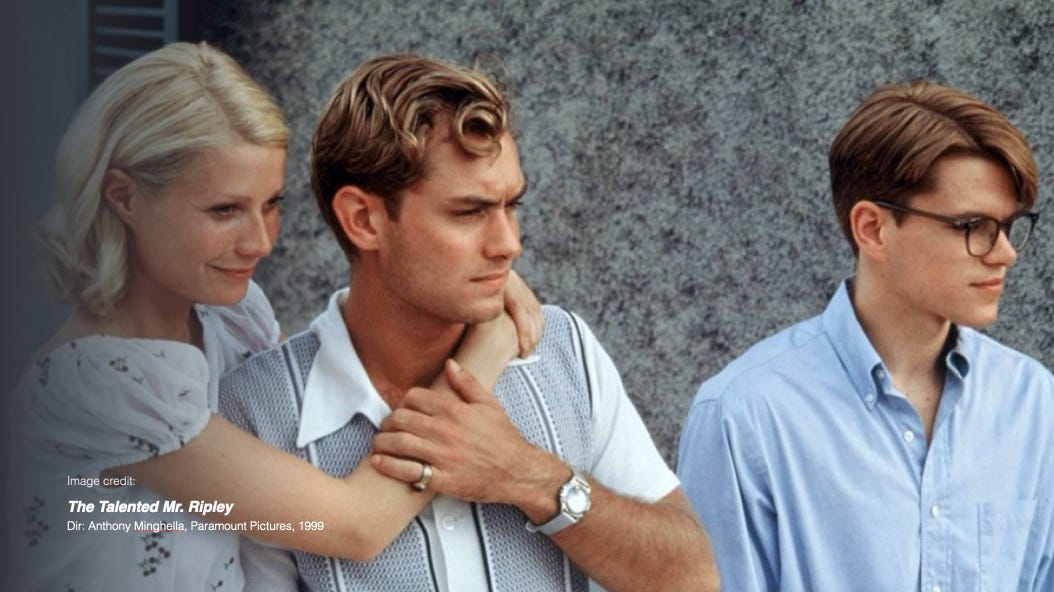
Let’s come back to The Talented Mr. Ripley. Tom Ripley isn’t struggling within the confines of his Persona like Draper or Shelby, so much as struggling with a Persona deficit. He grew up without the cultural and material circumstances that teach a certain kind of man how to wear himself with ease. He knows exactly what the right suit, shirt and tie can do for him, and he knows what it means to carry himself in a certain way, too, because he has studied these things and can replicate them perfectly.
And yet… In Dickie’s apartment, Tom also knows that he’s performing a self he hasn’t earned the right to. The real tragedy here is that he’s been taught to believe that simply wanting the ease of self he sees in Dickie must be some kind of crime.
There’s a concept in developmental psychology – Winnicott’s false self – of a persona that is built as a defence mechanism rather than an expression. The false self is constructed to protect a core self that was never given safe conditions to develop. Tom Ripley’s is clearly a story about the false self, but as we watch him rubbing shoulders with the well-to-do, the deeper question this film asks is whether the men who do comfortably inhabit those suits are doing something fundamentally different, or whether they’ve simply had their performance confirmed by the world so often that it’s started to feel true.
And I think the answer is that the two experiences probably aren’t all that far apart. The difference between Tom Ripley and Dickie Greenleaf is legibility more than authenticity. Dickie was born into wealth and comfort; Tom wasn’t. They’re both fighting the same battle, it’s just that one of them has been doing it for longer.
What this means is that Tom can see the costume for what it is, and Dickie can’t. And while that makes Dickie’s life considerably more comfortable, it also means he may never question the mask. Many a Dickie Greenleaf has died still wearing his suit, having never even taken a glimpse at what his true self looked like underneath it.
Arguably, the person who knows they’re performing is closer to freedom than the one in the fancy mask, because they at least know they could perform something different if they chose to.
Back to reality
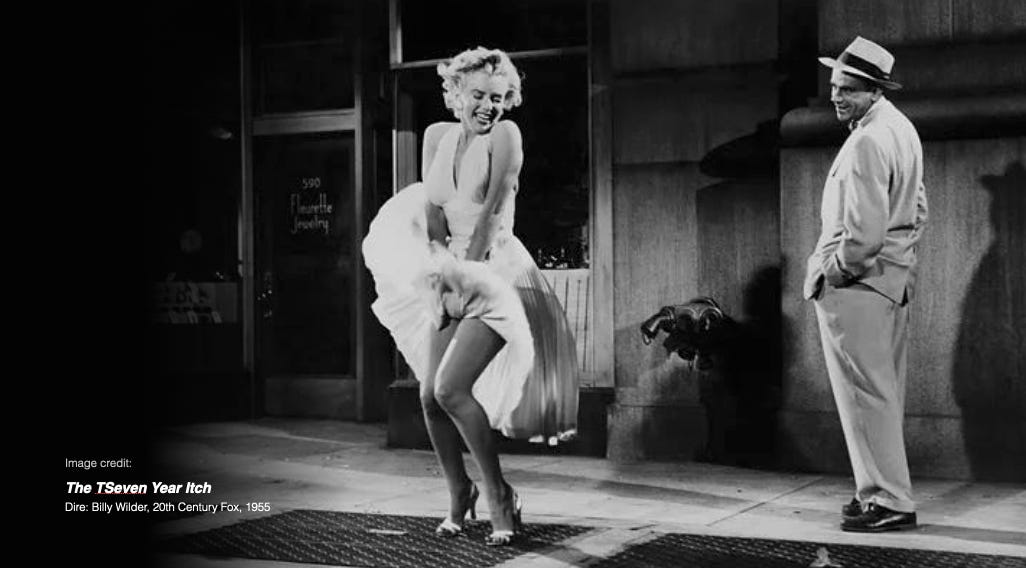
Where does this leave us? We are all born into some version of this reality. The great male renunciation was a collective decision that was made for us, not by us – no individual man sat down and consciously chose to give up beauty, no individual woman signed up to carry the weight of men’s disowned aesthetic life. We were raised by a world that continues to uphold the values set by the renunciation and everything that happened before it, so we don’t truly know anything else.
This is why it isn’t only men who renounce femininity. So many women – myself very much included – have found ourselves rejecting feminine beauty because we’ve absorbed the lesson that to be taken seriously is to be taken as something other than decorative. We’ve therefore also learned to be suspicious of our own pleasure, our own beauty-seeking, and our own desire to adorn ourselves, because those things have been coded as weakness and frivolity for so long that indulging them can feel like a kind of self-betrayal at best and life-endangering at worst.
We are, in a way, all wearing suits. It’s just that some of them are tailor-made, while others had to be taken in a bit.
So, my question for you is what your suit looks like and whether you ever take it off.
When you compare your inner sense of self to the one you’re (quote/unquote) “supposed” to project according to your gender, what do you notice?
Regardless of gender norms, what type of self do you project in your professional, social or family life?
What are the things that feel off-limits to you in situations where masks like these are worn?
And, assuming there is a gap between your projected or expected self and the one on the inside, what does the dissonance feel like to you?
The work here is not to dismantle the Persona, because we need it. The goal isn’t to walk into every situation as your most unfiltered, unmediated self. That would just be a different kind of performance, and one that could get us into a fair amount of trouble.
A better aim is to build awareness of the mask (or masks) we wear, so that we’re able, once in a while, to doff them and have a living relationship with whoever’s underneath – maybe even with the beauty-loving, pleasure-seeking, soft animal I mentioned earlier. You know, that one that’s been waiting, rather patiently, in the dark.
Two hundred years is a long time. But nothing stays in the shadows forever.
References
The Talented Mr. Ripley (1999), dir. Anthony Minghella
Mad Men (2007–2015), creator Matthew Weiner, AMC
Peaky Blinders (2013–2022), creator Steven Knight, BBC
The Wire (2002–2008), creator David Simon, HBO
Flügel, J. C. (1930). The Psychology of Clothes. London: Hogarth Press
Loos, Adolf. “Ornament and Crime.” Lecture delivered Vienna, 1910; first published in French as “Ornement et Crime” in Les Cahiers d’aujourd’hui (1913)
Jung, C. G., The Collected Works of C. G. Jung (Princeton University Press)
Winnicott, D. W. (1960). “Ego Distortion in Terms of True and False Self.” In The Maturation Processes and the Facilitating Environment. London: Hogarth Press
Reading this (really excellent!) article, I am immediately reminded of a different form of expression: tattoos. As these have become mainstream, you see more and more sleeve tattoos, intricate patterns, beauty expressed in body art. Of course, that's a far more acceptable way for men to be beautiful, because it also involves the endurance of pain - a 'tough guy' expression of beauty.
As for myself, I keep circling this issue time and again. Most of the time my looks are there to blend - plain, mostly dark clothing. But then there is the coat I made - ankle length, entirely made up of patches of various cloth. The most colourful thing I own, made as a joke and a comment on people's clothing choices in the pagan world, but when worn will get loads of compliments - it took a lot of time and effort making it. Same with the physical - currently once again in a stage of losing weight (and waist) and with that, contemplating a change of wardrobe.
It's good to be aware of these things, so I can make more informed choices instead of trying to tie self improvement to who I am as a person, as well as my self-worth.
Thanks so much for the article. It was excellent, and I truly enjoyed reading it.
As a self-diagnosed "covert narcissist" who is very well aware of the fact that I've been playing a role (and feeling like an imposter) for much of my life, it was very interesting to consider that we're all playing the same game of "dress up" - it's simply that some of us are more aware of what we're doing than others. And while knowing it's all a game might seem like a good thing, it's generally a cold comfort. Knowing what I know doesn't make me happier. If anything, it's depressing. Most of the time, I just envy others who seem so comfortable "cosplaying" life - so comfortable, in fact (or perhaps just convincing?) that they seem not to realize that we're all just participants in an elaborate costume ball at all. Honestly? I remember seeing "The Matrix" back in '99 and wondering why the hell, if given the choice, anyone would take the Red Pill. I remember thinking to myself, "Wow. Am I really the only one in the audience who would choose the comfort of the Blue Pill every time?" Since then, I've considered that maybe - just maybe - everybody SAID they'd take the Red Pill because it was "cool" and "brave" and of course we'd all love to be able to fly and instantly become a Kung Fu master like oh so handsome Neo. But deep down? I suspect many of us would go for the comfort and ease of the Blue Pill if no one was looking. After all, freedom is terribly frightening and comes with a great deal of responsibility. And although there are legions of ambitious go-getters chasing money and status in this world, isn't the entire rat race to the "top" (whatever that is) ultimately just another performance? How many ridiculously good looking, rich, "successful" people do we read about - almost daily, it seems - who are lost, lonely and utterly miserable? I suppose it's because even those who are blessed with a trust fund, high cheek bones and a marketable hobby realize, once they're "living the dream", that that's exactly what it always was - a dream. A fantasy sold to them by society. Beauty fades. Money is spent. We all die. And as the saying goes, "You can't take it with you". So I suppose the moral of the story is: Just do you, and act like nobody's watching - because they most likely aren't.