


You can listen to this post on YouTube or read it below.
***
You’re standing in the wreckage of the crisis, and there are pieces of yourself scattered everywhere – old beliefs that no longer fit, new insights that haven’t yet settled, patterns you thought you’d broken but that keep showing up, parts of yourself you didn’t know existed until everything fell to bits. Now, your task is to figure out what’s real, what’s salvageable, and what needs to be left behind.
Welcome to the moonlight of the Albedo. This is where you discover who you truly are.
If you read the first part of this series, welcome back. If you’re new to this, here’s what you need to know in a flash. First, true alchemy isn’t about turning lead to gold so much as transforming consciousness – moving from confusion to clarity, connection and integration.
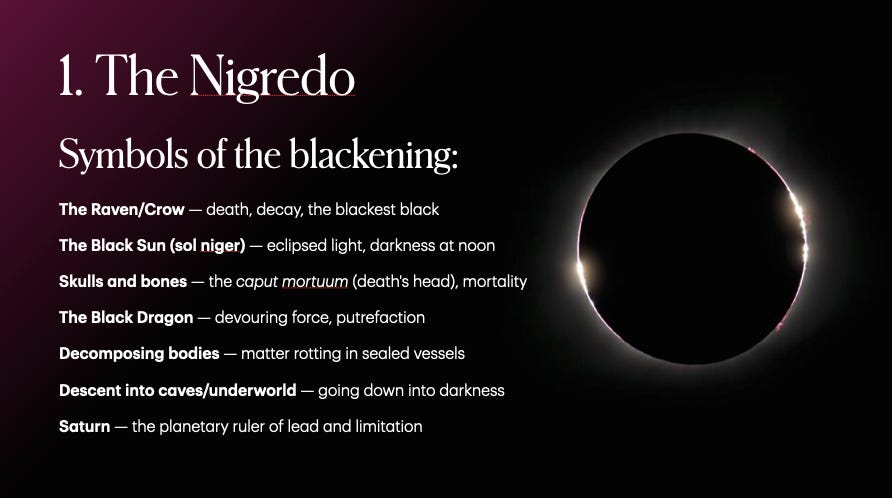
The first stage – the Nigredo – is the blackening or death of the old self.
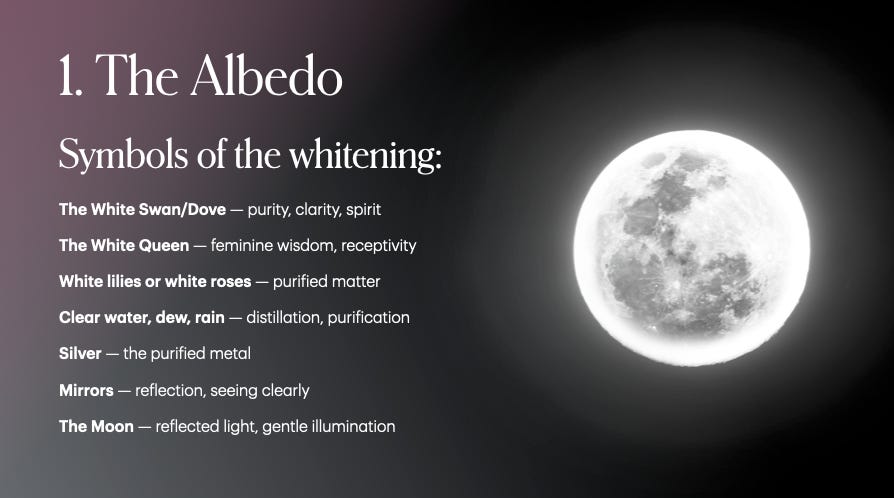
The second stage – the Albedo – is the whitening, and it’s all about purification, discernment, and learning to see clearly.
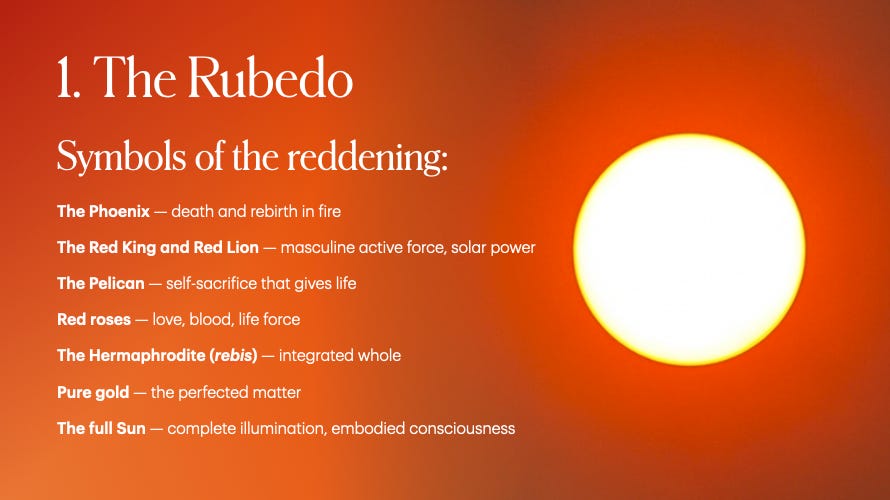
The third stage is the Rubedo, where you actually live as the transformed person. But we’re not there yet. For now, we’re in the moonlight of the Albedo, searching for what’s real.
The Albedo’s core challenge
But there’s a problem, which is that it’s hard to trust yourself in the aftermath of a life-altering breakdown, loss, or failure. The person who created the life that just fell apart? That was you. The person who believed all those things that turned out to be false? Also you. So, how do you know you’re not just building another house of cards?
When discussing the Nigredo in Part I, I used the film Groundhog Day as an example of the desperate dissolution of the first stage (spoiler alert). Bill Murray’s character Phil Connors, forced to live the same day over and over again, hits rock bottom after every attempt to manipulate, cheat or otherwise weasel his way out of the time loop fails, including multiple attempts to end his own life. Eventually, he surrenders and accepts that he’s stuck, which is when he enters a new phase – he starts learning.
Phil takes piano lessons – every day, the same lesson, building skill incrementally. He learns ice sculpting, poetry, and to speak French.He memorises everything about everyone in town – what they need, when they need it, how to serve them.
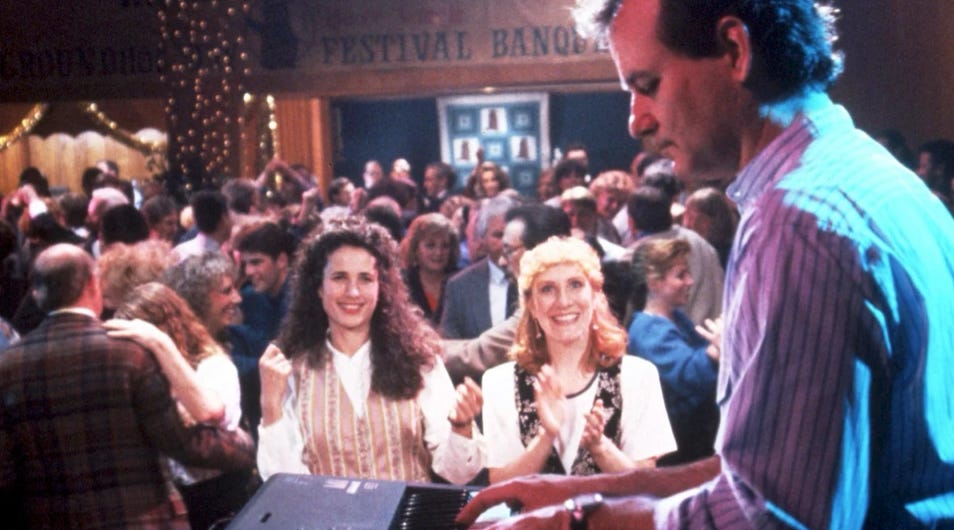
He becomes, on the surface, the perfect person: talented, helpful, knowledgeable and kind. But anyone watching can see that this perfection is problematic – he’s too perfect. If he were on Ru Paul’s Drag Race, he’d be getting told off for lack of realness. And he knows it, too. He’s still not being himself. Rather, he’s accumulating all this skill, knowledge and good-deed karma because he’s trying to win the affections of Rita. He’s trying to figure out the formula.
Phil is in the limbo stage of the Albedo – he’s sorting through his experiences, trying things out, and he is learning. But he hasn’t transformed yet.
It’s only when Phil stops trying to win Rita and starts living for the genuine love of the life he has now that the loop finally breaks. Once he has separated performance from authenticity, that’s when the Albedo completes.
What is the Albedo?
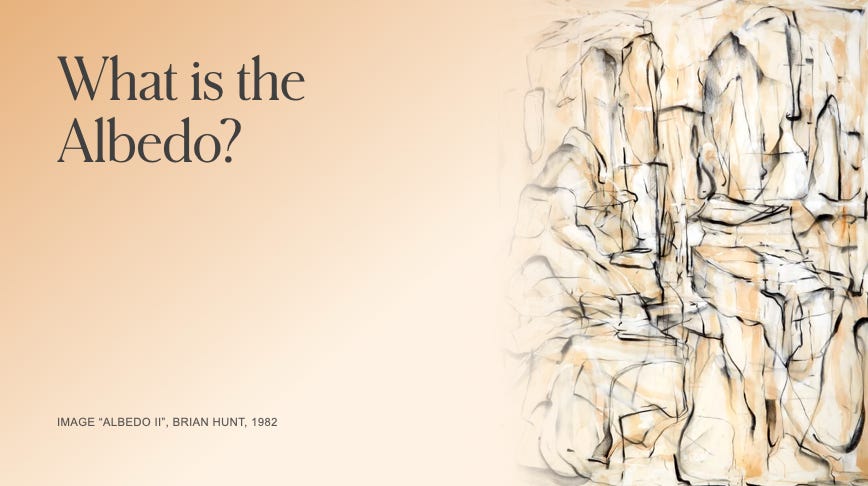
In practical alchemy, after the Nigredo the alchemists would take the black residue and repeatedly wash and distill it to separate it into its component parts. During the blackening, what was false was burned away, but that initial stage of the process was not absolute. It was a crude filter. In the Albedo, discernment happened at a much finer level. Now, they were looking for the essence of the matter – the pure substance underneath all the contamination. Or, the truth beneath the dross.
In his studies of the alchemical texts, Carl Jung understood the Albedo as a stage of psychological purification – the process of gaining clarity about yourself after the confusion and challenge of crisis. This is when you start to see patterns, glimpse aspects of your shadow self, and distinguish between what’s genuinely yours and what you have simply absorbed from the outside world.
However, Jung made an important distinction. The Albedo is a stage of emerging consciousness, but it’s not the bright light of certainty that we tend to think we need. It’s not “solar consciousness”, but “lunar consciousness”.
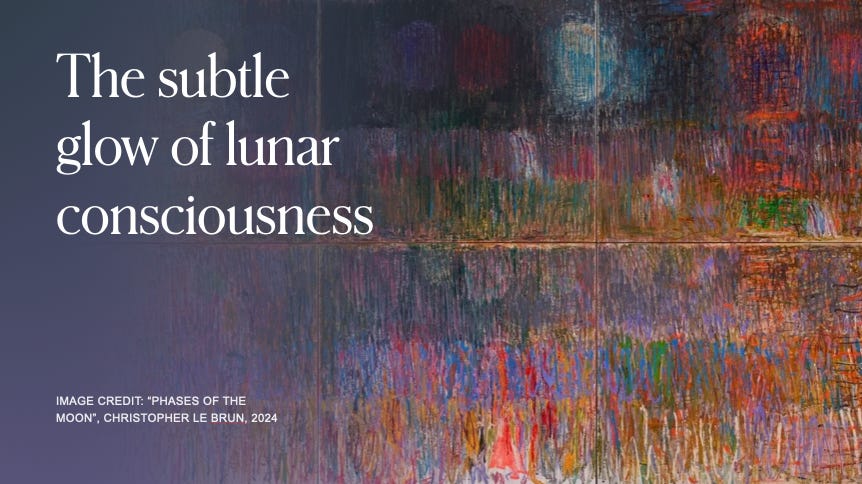
It’s moonlight – a gentle, subtle light that lets you catch your first glimpse of the new landscape you’ve woken up to.
The soft glow of the Albedo moon will show you simple shapes and sizes, but not much more than that. And this is a good thing, because if the sun were to suddenly switch on from complete darkness, we’d be blinded by the light. Flooded and overwhelmed. The lunar light of the Albedo gives us just enough illumination, not enough for perfect answers, but enough to begin to discern and separate – enough to see what’s actually there rather than what we wish were there, or what you were told should be there.
Clarity vs. certainty
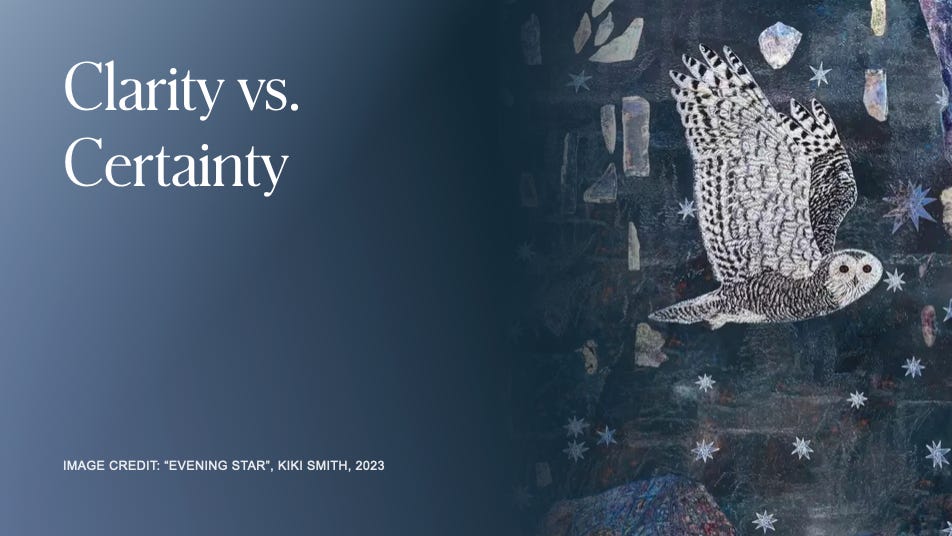
It’s easy to mistake the grasping of the ego for true insight. Psychologist James Hillman, in his lectures on alchemical psychology, emphasised that we often confuse clarity with certainty. We think being clear means being sure and having all the answers, knowing exactly what to do. But that’s solar thinking – the ego wanting to be in control again.
Lunar consciousness is different. It’s the ability to see without needing to force conclusions. It’s discernment as opposed to stubborn rigidity or dogmatism.
This makes sense because in the Albedo, you’re not trying to master the material, but separate it: to see what’s precious and what’s rubbish; what’s yours and what’s borrowed. This is patient, delicate work that requires us to sit with ambiguity while slowly, slowly gaining clarity.
Psyche sorts the seeds
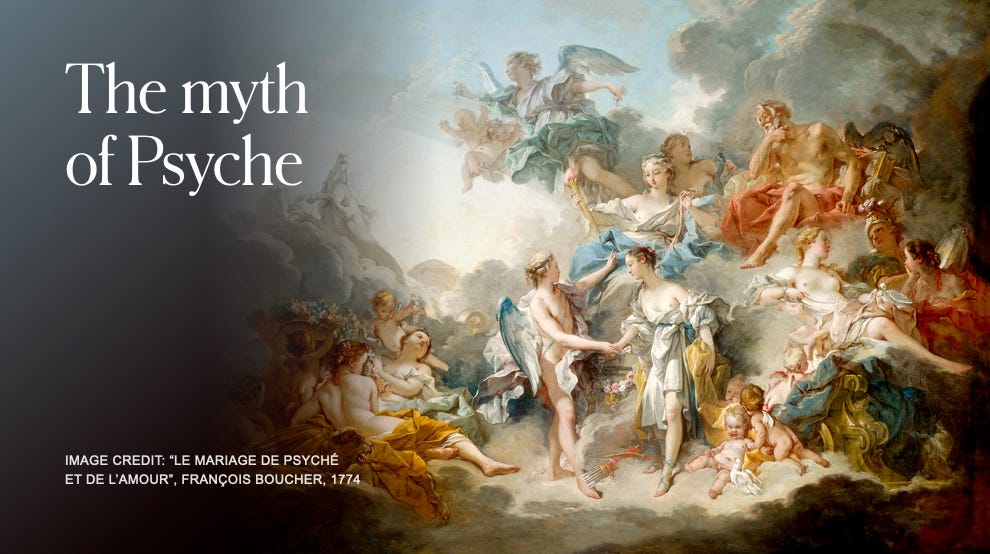
The myth of Psyche and Eros (which I have explored in detail in a previous series; here’s Part I, Part II, Part III, and Part IV, if you’re interested) perfectly captures this process. Psyche, married to Eros but forbidden to see his face, makes the mistake of lighting a lamp to look at him while he sleeps. Betrayed, Eros flees, and Psyche must complete a series of impossible tasks set by his mother, Aphrodite, to win him back.
For the first of these tasks, Aphrodite pours an enormous pile of mixed seeds onto the floor – wheat, barley, millet, poppy seeds, lentils, beans, you name it – all jumbled together. She says to Psyche, “Sort them by nightfall.” This is an impossible goal; there are millions of seeds. No human could do it.
So, when Psyche sits down to the task, she begins to cry. One of those big, sploshy tears falls on a passing ant, who fetches the rest of its troupe to come and help her. With the aid of these ants – small, patient creatures who know how to discern one tiny thing from another – Psyche passes the test. By morning, everything is separated, clarified, and organised.
That’s the Albedo. That’s the work of this stage. But how do we know which seeds are which?
Trust the kindly animals
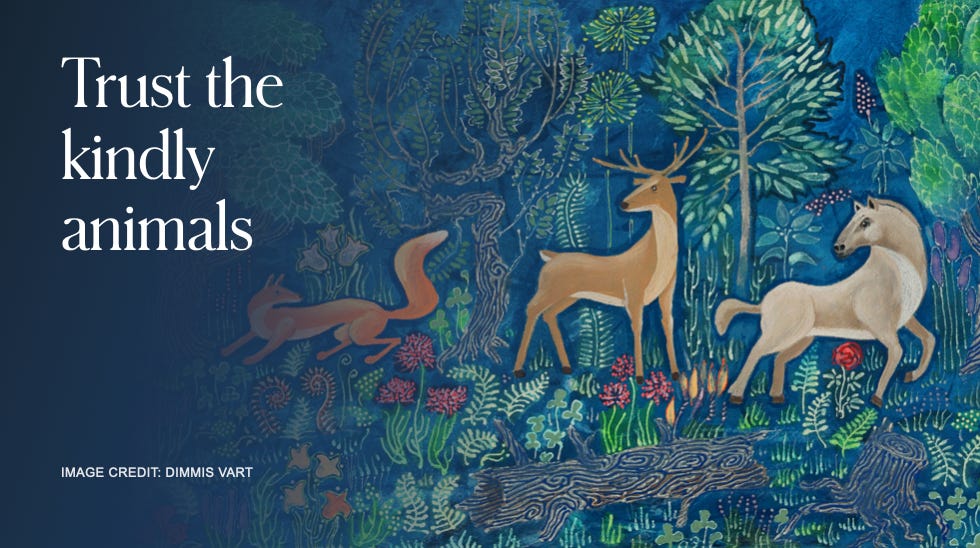
In her book, Shadow and Evil in Fairy Tales, Marie-Louise von Franz writes about this particular motif, which shows up in a few different stories – you see it in Cinderella and in Vasilisa the Beautiful, for example.
Von Franz studied folklore from cultures across the globe and admitted that she once hoped to unlock a kind of secret, universal code for being human or living a good, happy life. But this was not to be the case. Every time she thought she’d found a universal rule, she would come across a tale to break it. That is, except for one particular rule, which held true across every story: the protagonist of a fairytale must always follow the advice of the kindly animals. Accept this advice, and they will succeed; ignore it, or hurt the kindly animals, and the protagonist is doomed.
Von Franz’s interpretation of the meaning of this motif is simple. The kindly animals represent one’s intuition. Now, intuition isn’t infallible, but if you learn to listen to your own inner knowing in situations where the answers aren’t obvious, you will eventually find your way forward. Ignore your intuition in favour of following rules or values set by other people or the world in general, and you may well get lost.
This is what the Albedo is all about. The laborious process of trying, testing, feeling, watching and listening for what has the ring of truth is not only how this stage happens; it is the very point of it. Psyche’s mound of seeds is so large precisely so she has to connect with the kindly animals. We must learn to understand the difference between our authentic knowing and everything else.
Moonlight consciousness
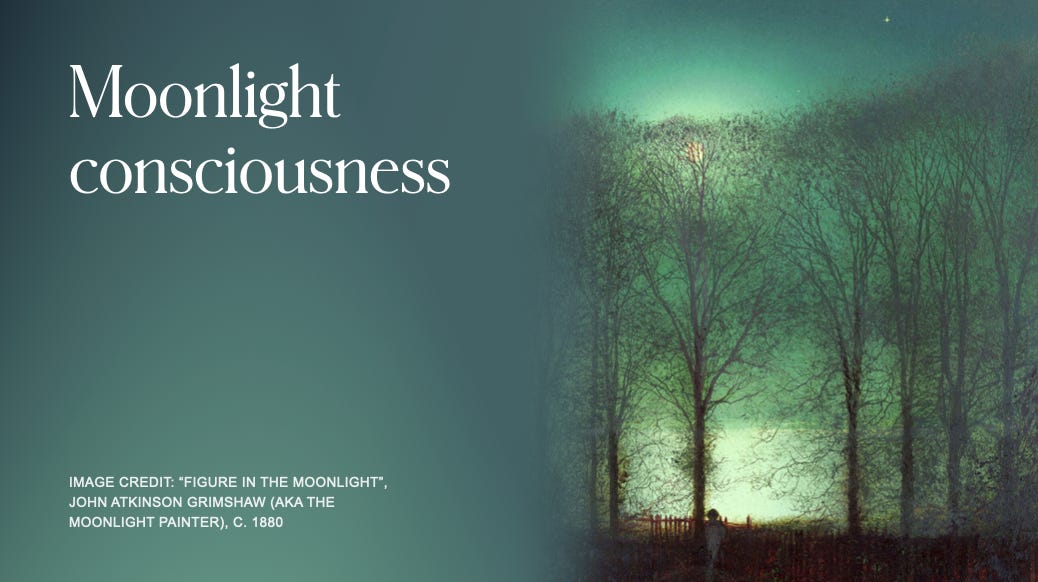
Jung described the Albedo as lunar consciousness because it is the first glimmer of insight emerging from the chaotic, unconscious darkness of the Nigredo. The glow of the moon is different from that of the sun. The moon doesn’t generate its own light. Instead, it reflects the sun, softly and indirectly. In the Albedo, you’re not creating certainty for yourself, but reflecting on truth from a deeper source – your intuition, inner wisdom, bodily knowing, soul, or whatever you want to call it.
The point is to reconnect with the part that knows without needing to explain or justify. This part speaks in a much quieter voice than that of solar certainty. It whispers, suggests and nudges. It shows rather than tells. After the Nigredo shattered all of your certainties, the Albedo provides the time and space for you to learn to trust your own voice again.
The alchemists could sit in the Albedo stage for weeks or months, however long it took for the purification to complete. If the matter didn’t turn white, the stage wasn’t yet over.
Coming back different
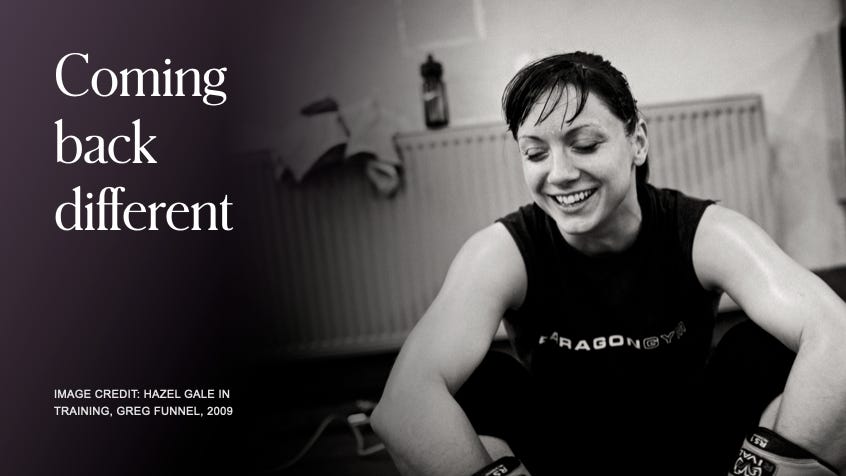
In the previous post, I described my own Nigredo experience from my time competing as a fighter – a physical and emotional breakdown when my assumed warrior identity and false strength dissolved into the dark, foetid sludge of the blackening. I had no idea who I was any more.
My Albedo began when I started the difficult healing journey of therapy and recovery from burnout, and when I eventually walked back into the world of fighting as a different person, testing my newly acquired self-insights and values. Instead of exhausting myself with brutal sessions and starving to make my old fighting weight, I went up a weight class, and I trained easily by comparison, listening to my body instead of overriding it. When the old-school boxing coaches (I had, by this point, switched to boxing from kickboxing) told me to do it the hard way, the punishing way, the “proper” way, I had to learn to stand my ground and say “no”.
This was what the sorting work looked like for me at that stage. Building the skill of discernment meant asking, “What’s mine? What’s theirs? What serves me? What destroys me? What feels right?”
As a result, I separated good training from destructive training, self-respect from self-punishment, my authentic drive from fear-driven performance… and I won. I won the boxing championships I’d always dreamed of winning. But that’s when the moonlight finally broke through. On the way home from that final – sitting in the club’s minibus, trophy on my lap, everyone celebrating – something became undeniably clear.
I didn’t want or need to fight anymore.
I wasn’t a fighter. Actually, I had never been a fighter. Not truly. I’d been using fighting to prove myself, and to become someone I thought would be safe from pain. What I actually wanted, though – and what had been quietly emerging through all the patient sorting and testing of the Albedo – was to work in a more connected, creative space. I wanted to be a therapist, a writer, a dreamer. A lover, not a fighter.
The yellowing
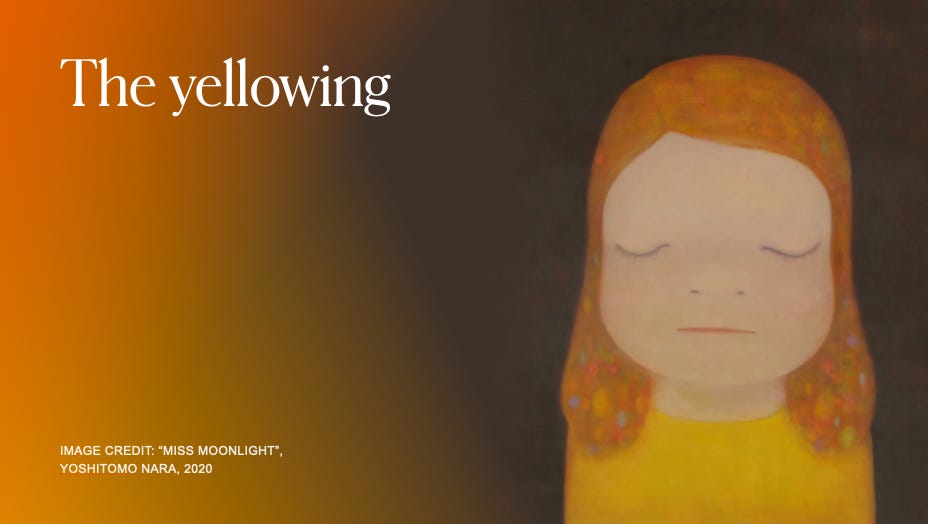
The Albedo stage of alchemy finishes with a sub-stage called the Citrinitas, or the yellowing. It comes when the sorting is nearly complete, and you’ve clarified enough to start seeing and feeling what’s truly yours. The yellowing is the transitional stage where the cool silver moonlight begins to warm. It’s the first hint of dawn – a gentle infusion of insight that signals you’re ready to move from understanding into embodiment, which happens during the Rubedo.
For me, those insights about what I truly wanted to do with my life felt like the warmth of the Citrinitas. By the time of the title fight, clarity had been building for a couple of years. I was already trained as a therapist by this point, but I hadn’t fully committed until after that night. Travelling home with proof of everything I thought I’d wanted, it finally became clear enough to see. The fighting had served its purpose: it taught me discipline, resilience, and how to face my fear. But it wasn’t me. Fighting was never the destination. It was the vessel instead.
I wasn’t struck by this insight. It didn’t come as a surprise so much as a quiet little nod to myself – “Oh, yeah” I thought, “that’s what’s actually true.”
At last, the matter had turned white.
The false-clarity trap
Now, in summary, all of that sounds relatively straightforward, doesn’t it? It wasn’t. The biggest threat during the Albedo is false clarity. While in this stage, all we want is to grab hold of something that feels steady and certain. And we will, along the way, almost certainly grab onto the wrong things without realising it. And we’ll hold tight, too.
Just as Bill Murray’s character in Groundhog Day spent what seemed like an age learning and perfecting his “good guy” skills before he worked out who he actually was, I spent the longest time fooling myself into believing that the skills I was learning from therapy and about my health were meant to make me into some kind of exceptional, enlightened fighter. I had to train for and win that title fight before I finally realised this really wasn’t the point at all.
False certainty can show up as spiritual perfectionism – “I’ve learned so much, now I need to be perfectly healed/awakened/enlightened”. It can show up as the adoption of new dogma – simply replacing the old limiting beliefs with new limiting beliefs that sound cleverer. And it can show up as intellectualisation – conscious understanding without embodiment, which was a big one for me. “I can explain my patterns perfectly,” I thought. “I mean, I keep repeating them, but I understand them so… I’m fine, right? I’ve made it, right? Right?“ Wrong, but I was getting somewhere.
As we find our way through the Albedo, we may collect any number of tools that we don’t actually use – we take course after course, read book after book, and we think and fathom and dissect without truly changing. We might force premature conclusions, too, and fabricate entire worldviews to back them up, but the moonlight has yet to really shine.
These things may sound like failure, but really, they’re part of the process. We need to engage with the fake stuff in order to hear the voice of truth when it finally speaks.
The second descent

In the previous post of this series, we met a stranger who descended into the Alchemist’s dark laboratory to begin the work for themselves.
Now, finally, they have returned to the spiralling steps. Standing at the top, one hand on the cold stone wall, they feel the call of the laboratory below. It’s less urgent this time – more of a quiet sense that something has shifted. So, once again, they descend.
When they reach the bottom of the stairs, the laboratory has transformed. The furnace still burns, but low now – embers, not flames, and the heat is gentler. Moonlight pours in through a window that wasn’t there before, turning everything silver.
The stranger casts about the space. Some tables are now visible in the soft, white light. They’re covered in vessels – glass retorts, ceramic bowls, crystal containers. Each one is filled with liquid, some clear, some cloudy, some separated into layers.
The Alchemist stands at one of the tables, carefully pouring a milky solution from one vessel through a fine filter into another. They look up, unsurprised. “The burning is done,” they say simply. “Now, we separate.”
The cleansing
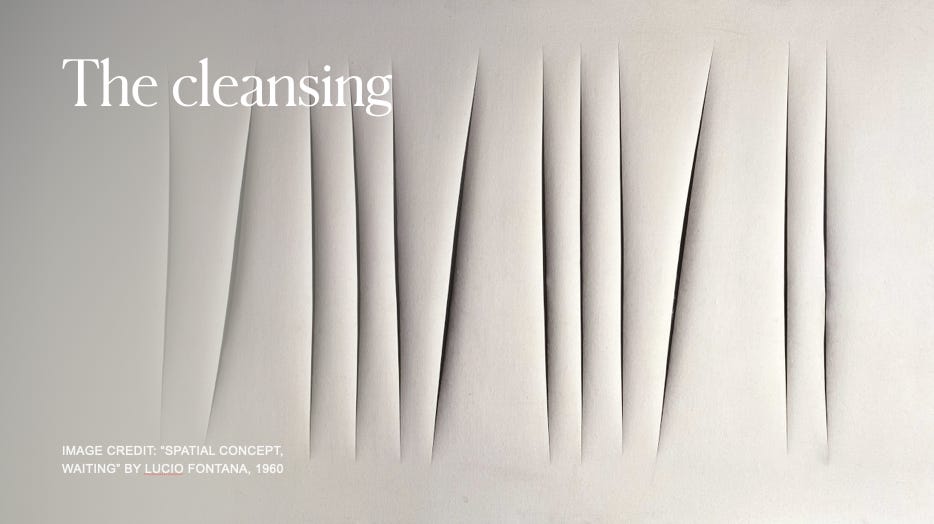
The Alchemist gestures to a large bowl filled with water. Floating in it are the fragments of the stranger’s life that survived the fire. The stranger leans forward to take a closer look, but they can’t work out exactly what they’re seeing just yet. A pattern of swirling lines, some white, some cloudy, coruscates on the surface of the liquid.
“This is what remains,” the Alchemist says, handing over a mesh strainer. “But it’s not pure yet. You need to sort it.”
The stranger dips the mesh into the water. When they lift it, something is caught inside – a value, perhaps, or a belief or rule. Eyeing the strange shape, the Alchemist quietly asks, “Does that belong to you? Or was this given to you by someone else?”
The stranger reaches into the sieve and holds the fragment up to the light. They couldn’t tell you how they know, but they know. This doesn’t belong to them.
The Alchemist nods, “Then put it back in the solution, and let it dissolve away.”
The next element the stranger extracts feels different. It’s a memory with meaning to it – something that feels true. This one is theirs.
Again, the Alchemist nods just once, “Put that one aside.” The stranger places the truth into a second vessel. It’s clean and dry.
Over and over again, they do this. The Alchemist asks if each component is real, or if it is a story, a fabrication, an exaggeration or a mask. The truth is separated from the lies and placed in the new container. The rest dissolves away.
After a little while, the stranger starts to find comfort in the repetition of it all – like sorting seeds or learning a language, the same, careful action is repeated, and the matter, refined and clarified.
Slowly, slowly, slowly, the vessel of true things fills.
One truth
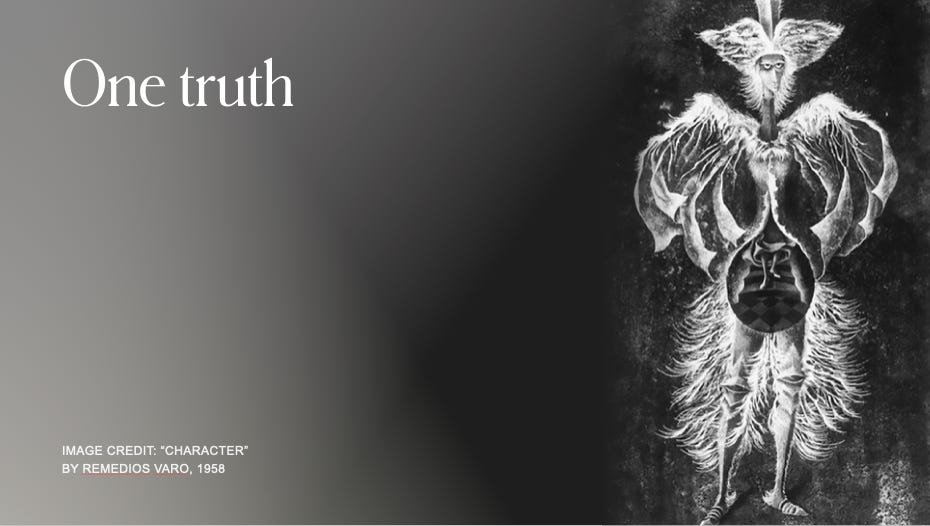
After what might be hours or days – the stranger has no idea how much time has passed – the Alchemist asks, “What’s one thing you know to be true? If just one thing survived the fire, what would that thing be?”
The stranger looks into the vessel of kept components, reaches inside, and pulls out something that feels solid. “This is mine,” they say to the Alchemist. “This one thing is true.”
The Alchemist’s reply is simple. “Good,” they say. “Keep that, and go back to your life for a while. Use it as a filter or a lens for the decisions you make. Come back to it repeatedly to check whether you’re still on track.”
The Alchemist gestures to the stairway, their fingers silver in the light of the moon. “Everything you build needs to rest on what’s actually true, not what you want to be true. So keep sorting, keep cleansing and separating, and keep listening. When you have clarified enough, you’ll know. And that’s when you may return.”
The ascent
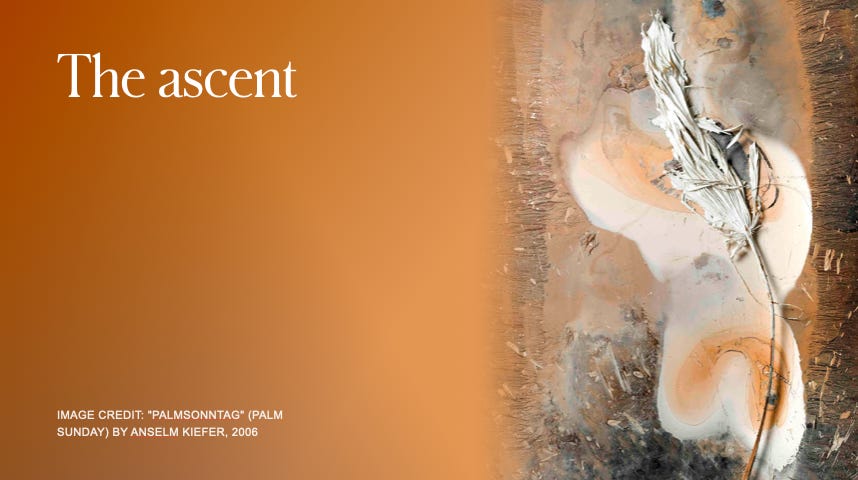
So, just as before, the stranger climbs back up the stone stairs, holding their one true thing. Step by step, they return to the surface.
And as they climb, I wonder:
What’s one thing you thought you needed, but that isn’t actually yours?
What’s one thing you genuinely do need, but that you’ve been ignoring?
And finally, if only one truth were to survive your fire, what would that truth be?
Remember, you don’t need all the answers just yet. The Alchemist is still washing, still sorting, still clarifying in that moonlit laboratory. They’ll be there for as long as is needed. And, in the meantime, the moonlight will show you what you need to see.
REFERENCES:
Carl Jung, Psychology and Alchemy (1944)
Carl Jung, Mysterium Coniunctionis (1955-56)
James Hillman, Alchemical Psychology lectures (Uniform Edition, Vol. 5)
Dennis William Hauck, Complete Idiot’s Guide To Alchemy: The Magic and Mystery of the Ancient Craft Revealed For Today (2008)
Marie-Louise von Franz, Shadow and Evil in Fairy Tales (1974)
Greek myth, The Tasks of Psyche (from Apuleius, The Golden Ass)
Groundhog Day, directed by Harold Ramis (1993)
Have you heard about our new game Echoes?
Our new game Echoes is available for pre-orders on Kickstarter. It’s a futuristic tale of time travel, magic, myth and tarot, and it’s perhaps our favourite and most awaited project.
There’s a special card deck and other exclusive rewards available only on Kickstarter. Ready to meet the Selves, gather ancient wisdom, and save the future?
Thank you for this. I look forward to the warmth of the yellowing...
Nicely done, your analogies utilizing esoteric alchemy combined with the quirky ground hog day movie make for a complimentary old vs new dichotomy. Entertaining but more important a salient vehicle for transferences of subtle nuance . I am inspired to keep going .