


You can listen to this article on YouTube or read it below.
***
Everything is falling apart. Maybe a relationship ended, maybe you lost your job, maybe you lost a loved one or fell ill yourself. Perhaps you just woke up one day and realised: I don’t know who I am any more.
So you start to slip into darkness and confusion. Into what feels like death. But what if it’s not quite the ending you think it is?
This bleak, unmooring experience is part of an ancient pattern of transformation that the alchemists called the Nigredo, or the blackening. It was achieved using fire – the fire that burns away everything false so something true can finally emerge. Something golden.
So, what could that gold look like when it’s yours? And how do you move through the fire without being consumed by it?
Alchemy? Seriously?
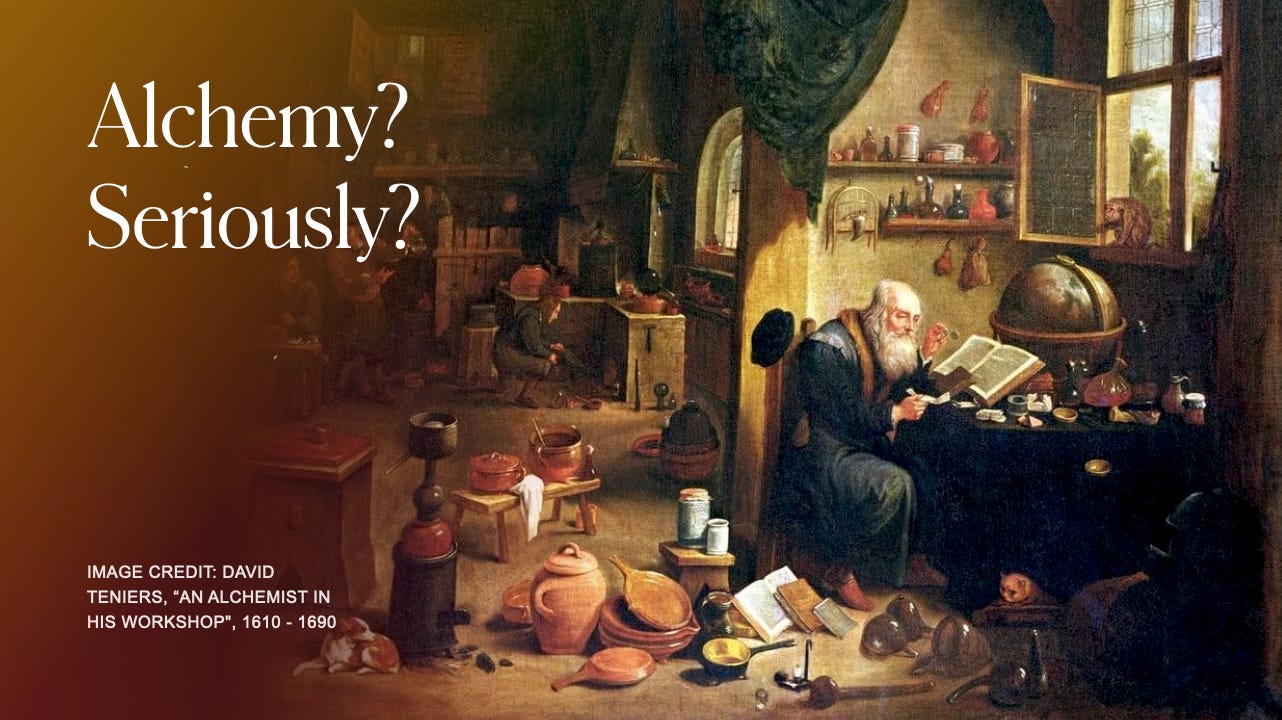
Alchemy fascinates me more than anything. An ancient, largely sniffed-at practice whose wisdom aligns perfectly with what we now understand as the psychology of change? Yes, please.
These days, when we think of alchemy, we’re most likely to imagine medieval charlatans promising untold riches, claiming they could turn lead into gold. These guys certainly did exist. Brilliantly, they were known as “puffers” because they just sat around all day blowing into their fires. But they only knew part of the story. Struggling to decipher Egyptian alchemy texts, which were largely metaphorical, medieval Europeans clung onto the one bit they could (and really wanted to) grasp. Mmm… gold.
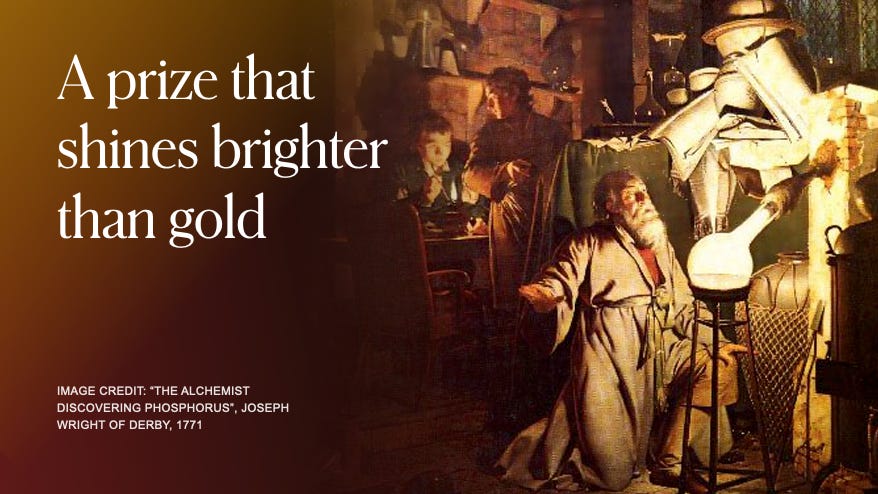
For true alchemists, though, practical alchemy was just one element of a much bigger process that took place across three increasingly abstract planes – the material, the personal or psychological, and the spiritual. Gold was actually a pretty meagre prize compared to the self-actualisation and direct connection with god on offer at the other two levels.
Unfortunately, in medieval Europe, to practice anything that smacked even vaguely of spirituality beyond the church was punishable by death. So the real alchemists had to keep the true nature of their pursuit hidden. To this end, they used an entire language of secret symbols to communicate in code, so only the safe, material aspects of their practice would be visible to outsiders.
Thinkers, researchers and artists like the poet William Blake, the psychiatrist Carl Jung, and the artist and writer Leonora Carrington have since devoted years to the unpacking of those esoteric Egyptian texts. Thanks to their work, we have a far better idea of what the alchemists were onto, and it rings uncannily true.
Before we dive in, I must warn you that alchemy always, always starts in the dark, because transformation cannot happen without dissolution. We can’t grow if we’re clinging to whoever we were before. In other words, the old self has to turn to ash first. We have to find our way through the Nigredo.
That said, we do need some light to go with all that shade, so the film I’m going to use to illustrate the dark desperation of the Nigredo is…
Groundhog Day as alchemy

Groundhog Day is another of my all-time faves – and yes, I do realise that my movie choices are dating me.
Phil Connors, a narcissistic weatherman played by Bill Murray, is trapped in a time loop, reliving the same day over and over in Punxsutawney, Pennsylvania. At first, he tries to manipulate the situation – he learns people’s secrets, he tries to seduce Rita and he exploits the loop for personal gain.
When that doesn’t work and he realises he can’t control or escape this situation, he falls apart completely. Phil tries to kill himself in a plethora of different ways – he drives off a cliff, electrocutes himself, throws himself from a building. But every morning, he wakes up again to the exact same song on the radio.
Finally, he stops trying to escape and surrenders to the situation, which is to say he lets his old life go – he lets his old, arrogant, manipulative, cynical self die. With nowhere to run and no tricks left up his sleeve, he is forced to sit in the wreckage of who he used to be. This is complete dissolution, or “rock bottom”, and it is where the transformation begins. Phil is now safely on his way to a little pot of gold.
The three stages of alchemy
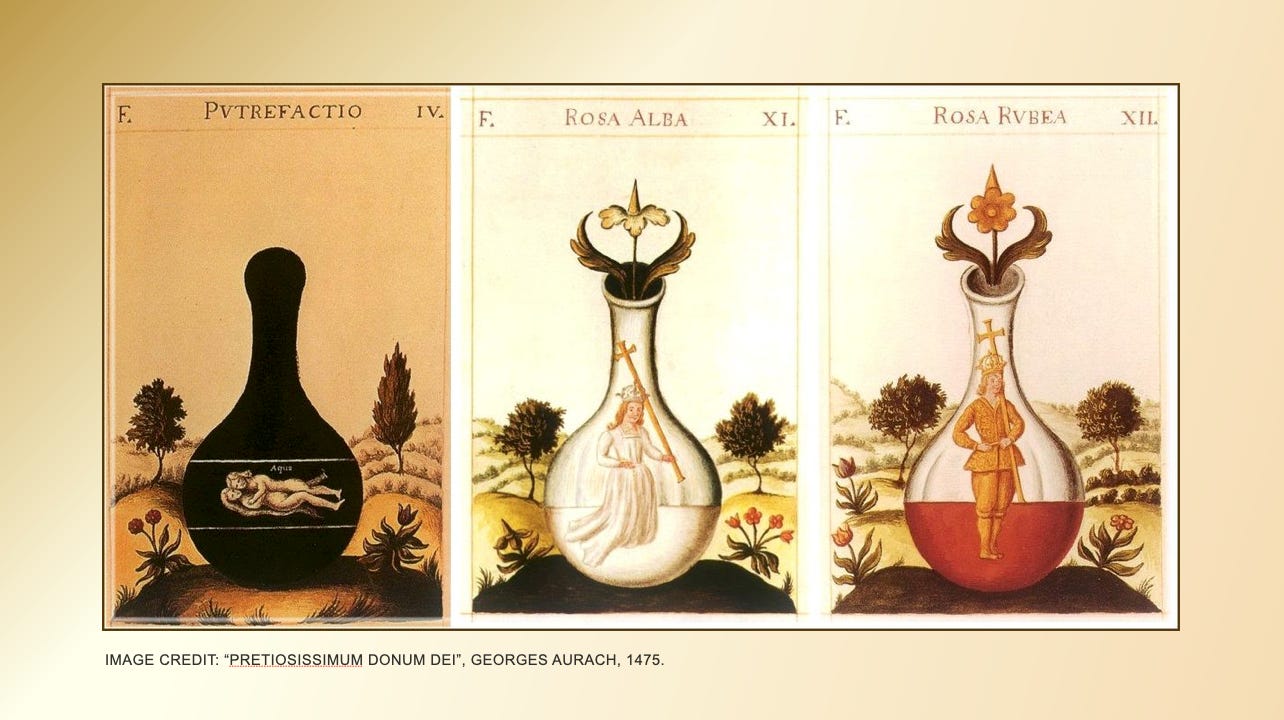
The Nigredo is the first of the three main stages the alchemical work must pass through to achieve what’s known as the philosopher’s stone. At the practical level, the philosopher’s stone is represented by gold, the purest of metals; psychologically, the stone is akin to the birth of the true, authentic self; and spiritually, we’re basically talking about enlightenment.
In brief, the three stages go like this (please don’t worry about retaining everything here because I’ll return to the parts you need to know):
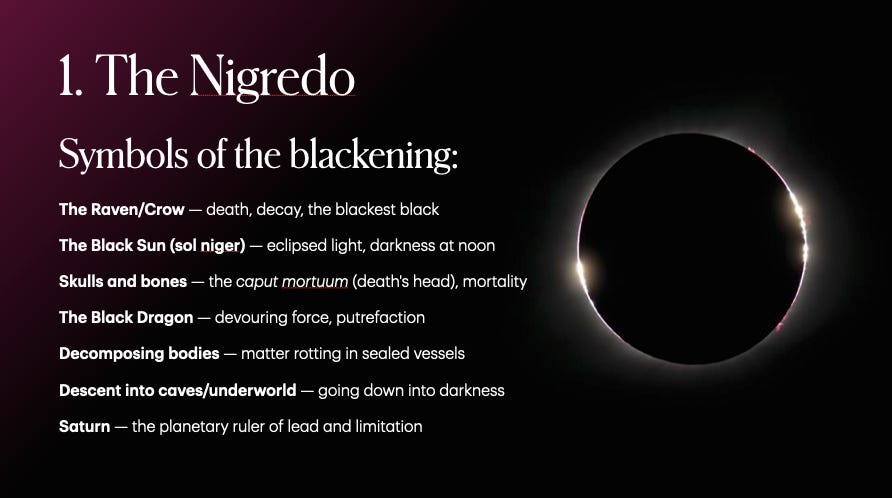
First, the Nigredo, or blackening, in which the base matter is heated to burn away the unnecessary and bring impurities to light. Nigredo symbolism includes the Black Dragon, ravens or crows, bones and decaying bodies, and the Black Sun (or sol niger).
Next, the Albedo, or whitening, in which the matter is separated, distilled, and purified; its essence extracted and released. Albedo symbols include the white swan or dove, the moon, clear water, and the White Queen.
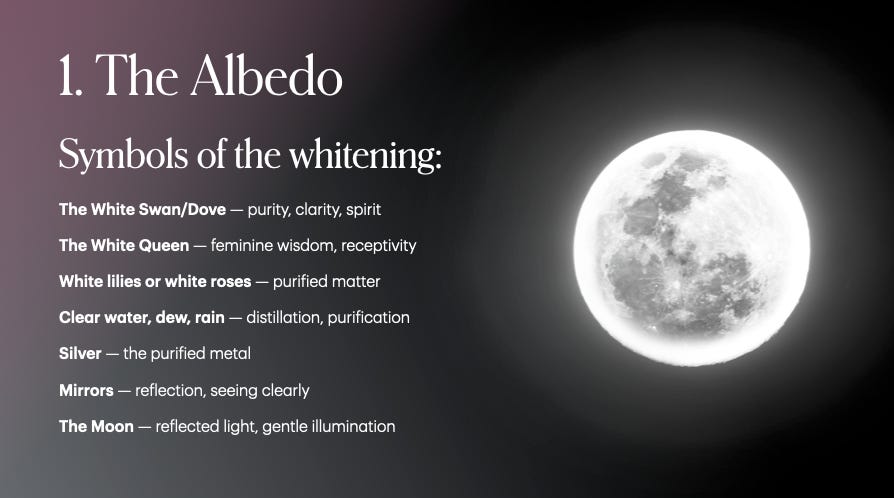
There is a transitional stage next, known as the Citrinitas or the yellowing, which involves the infusion of warmth and spiritual insight, symbolised by honey, ripening wheat, and the sun rising on the new day.
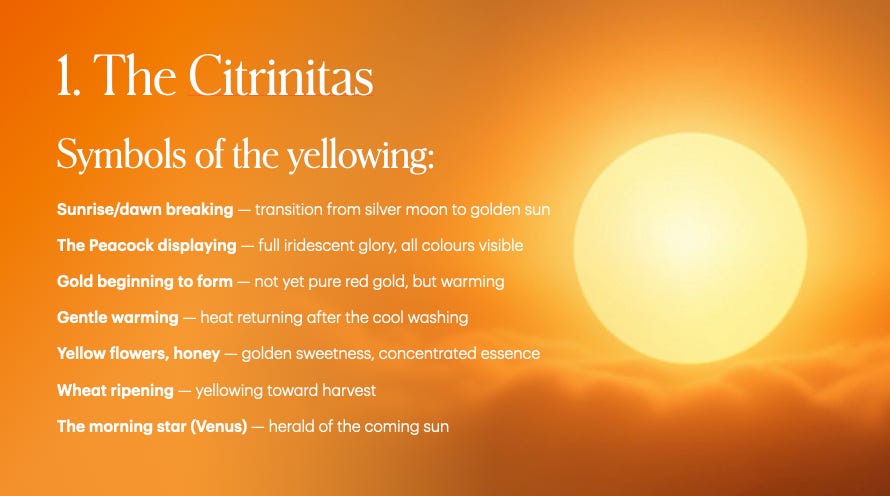
The Rubedo, or the reddening – the final stage of the work – involves the integration of opposites and the experience of the true self, culminating in the Philosopher’s Stone, the perfected work across all three planes: material gold, psychological wholeness, and spiritual enlightenment.
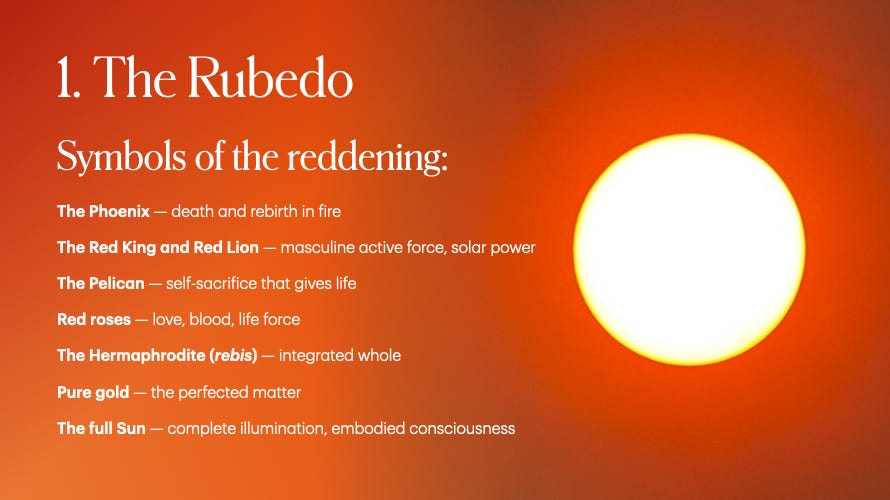
The symbols for this stage include the phoenix, the full sun, the Red King, and the hermaphrodite (or rebis) – which represents the integrated whole, where masculine and feminine are united.
Enter the Nigredo
To get a sense of the first stage, the blackening, picture the alchemist in a darkened laboratory, lit only by the fire of their specialised furnace, the athanor. On the bench sits a sealed glass vessel, the vas hermeticum. It’s filled with crude matter – lead, sulphur, salt – and also moisture from water or mercury. The vessel goes into the flames, causing its contents to rot – to putrefy, blacken and dissolve into a thick, foetid sludge.
Days pass, maybe weeks, and the putrefaction continues, until finally what remains is a black mass at the bottom of the flask, known as the caput mortuum, or “death’s head.” Everything reduced to primordial darkness.
On the surface, this looks like destruction, but the Alchemist knows that you can only purify what has first broken down. It’s only from this black chaos – also known as the Prima Materia, or “first matter” – that something new can emerge.
This is the black dragon of the Nigredo: the necessary death. And it doesn’t only happen in flasks.
Jungian alchemy
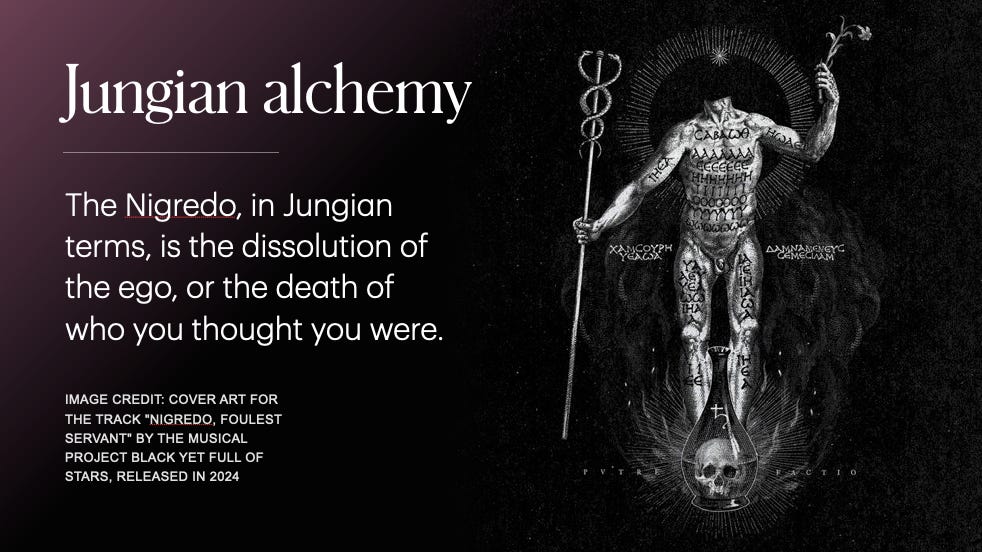
Unlike the puffers, Carl Jung could see that the ancient alchemists’ true goal was bigger than the acquisition of gold. The Nigredo, in Jungian terms, is the dissolution of the ego, or the death of who you thought you were.
Jung writes that the Nigredo represents a confrontation with the shadow – the parts of self that have been repressed, denied, or hidden. It’s when your carefully constructed identity breaks apart, your defences fail, and the persona you’ve been presenting to the world finally cracks open, forcing you to behold what’s actually underneath.
This feels like death because, in a very real way, it is. It’s not physical death, obviously, but it is the end of your old story, your old certainties, and your old way of being in the world. All of this is painful. During the Nigredo, we must allow ourselves time to grieve for who we were.
Down is the way through
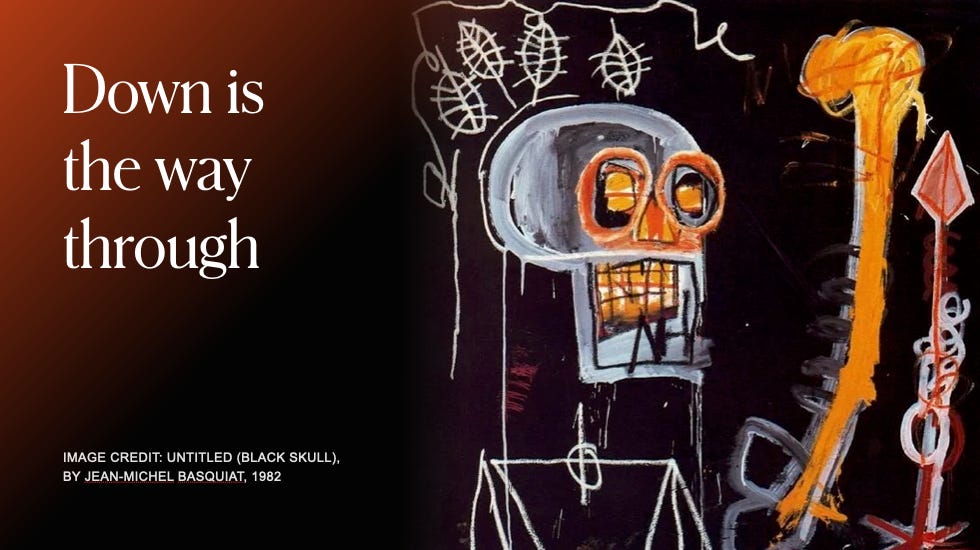
The psychologist James Hillman explores Jung’s work on alchemy in his lectures on alchemical psychology. Hillman emphasises that our culture has a pathological obsession with ascent – that is, rising above, transcending, reaching enlightenment, going up and up toward the light.
But alchemy begins with descent – going down into darkness and into the underworld of the psyche, where everything rots. Hillman proposes that we’ve lost the understanding that depression, dissolution, and darkness aren’t just problems to be solved, but necessary stages of transformation. The soul makes itself through descent, he says, not transcendence.
The Descent of Inanna
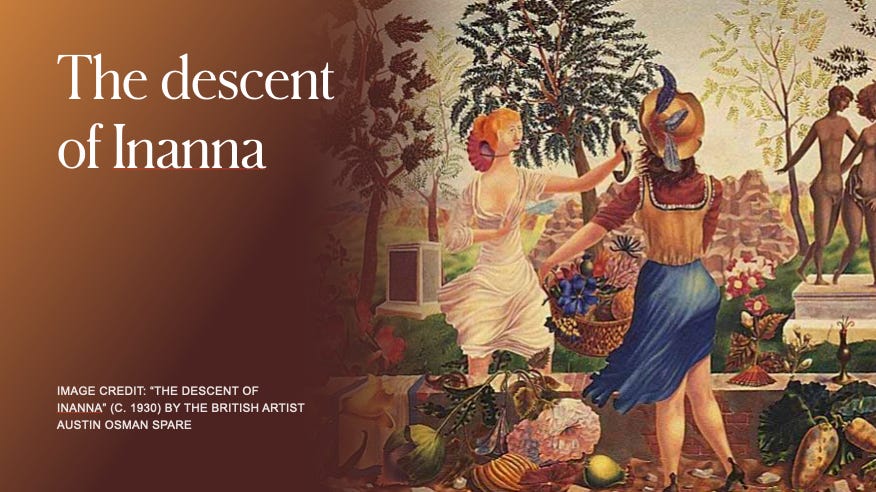
Consider the ancient Sumerian myth, The Descent of Inanna.
Inanna is a goddess. She’s powerful and beautiful, queen of heaven and earth. But although she has everything, she decides to descend into the Underworld to meet her sister Ereshkigal, the dark goddess who rules the realm of death.
As Inanna approaches the first gate to the Underworld, the gatekeeper, acting on Ereshkigal’s orders, stops her. “You may pass,” he says, “but you must remove your crown.” So she does. She removes her crown of divinity and begins her descent.
At the second gate, she hears, “You may pass, but you must remove your jewels.” So she removes her jewels.
At the third gate: “Remove your royal robes.” She removes them.
Gate by gate, Inanna is stripped – her necklace, her breastplate, her rings. Everything that stands for who she is, defines her identity, or gives her power, is taken away.
By the seventh gate, she enters the Underworld completely naked, and when she finally faces her sister, the dark goddess kills her and hangs her corpse on a hook to rot. Inanna – the powerful, beautiful, divine queen – is reduced to a piece of spoiling meat in the darkness.
That’s the Nigredo.
The story doesn’t end there, of course. Inanna is eventually resurrected and returns to the upper world, but not as who she was before. Inanna is fundamentally transformed by the descent, the stripping, and by death into a holistic deity, embodying the full spectrum and the full cycle of life and death – her light and shadow now integrated. In other words, she comes back whole.
What gets stripped away
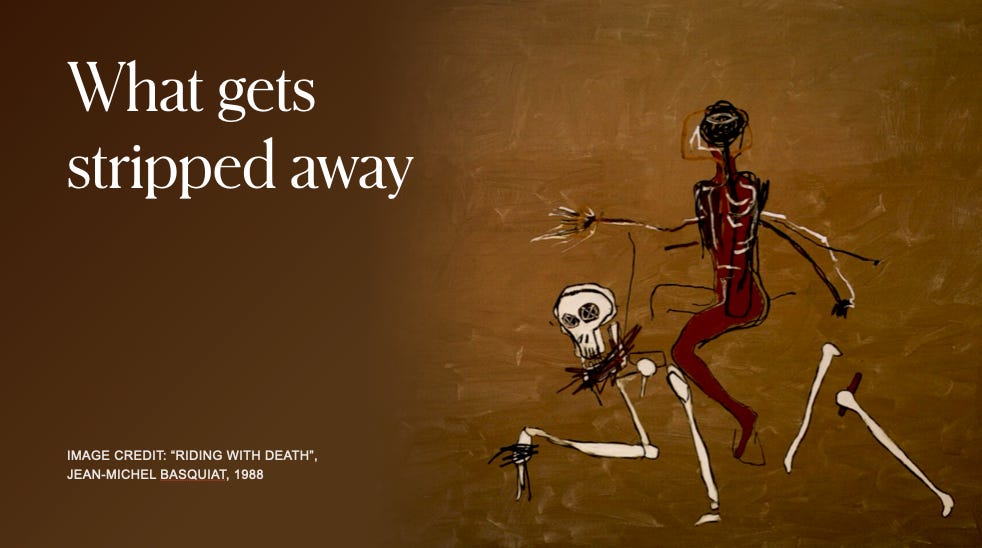
So what does this look like in real life?
In the real world, the Nigredo looks like crisis – like breakdown, burnout, a huge failure, or a life-changing loss. The darkness descends as certain things are torn away. An old identity – like “the strong one” or “the selfless one” – is smashed to pieces. Certainty is stripped, the things we thought we knew about ourselves, our wants and our needs. Our illusions of control decay; our relationships rot; perhaps our health erodes or our faith vanishes. Whatever mask we’ve been wearing falls to the ground and shatters.
When the blackening begins, the natural thing is to search for what we can salvage. But you can’t negotiate with the gatekeeper. You can’t say, “I’ll give you the crown, but I need to keep the robes.” Everything that isn’t essential has to go, and that means everything that’s been propping you up artificially. Everything that’s not really you has to burn.
The fall of a fighter
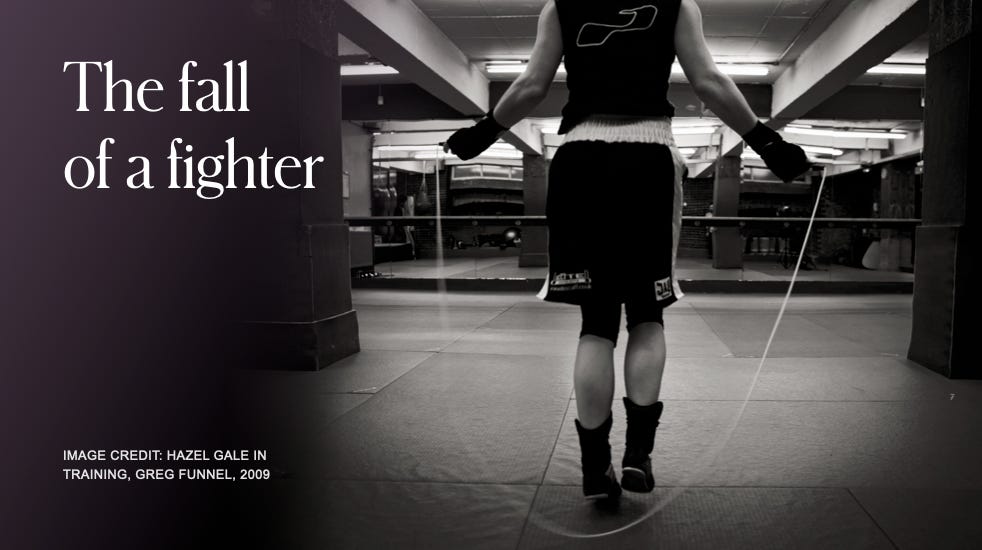
I don’t tend to talk about my personal experience that much here, largely because there’s only so much to share. But the reason I’m making this content now and not still working in the world of combat sports is because of the Nigredo experience I went through around 16 years ago.
I was training for the national championships in full-contact kickboxing. From the outside, I was the picture of strength: disciplined, dedicated, fierce. But inside, I was at war with myself, desperately trying to become the perfect Amazonian warrior because I thought that would make me into someone who couldn’t be hurt, couldn’t be heartbroken, couldn’t fail, and couldn’t be derailed by fear. That was my ingenious plan for a painless existence.
I was performing an identity that obviously wasn’t realistic, but also wasn’t mine. Instead, it had been built on values I’d borrowed, and it was fueled by the terror of being seen as weak. The more I pushed to achieve this impossible ideal, the more I fractured. Until I couldn’t any more.
This is what I wrote about my breakdown when I finally had language for it years later. It’s from a book I published in 2018, which I haven’t looked at in a while. I grabbed it for the purpose of this post, and reading it now, I’m stunned by how closely the description fits alchemy’s Nigredo symbolism – the darkness, heaviness, slow rot and the fire that’s beginning to burn from within. All of the archetypes are there. Check this out.
A fog has descended behind my eyes. It functions like a protective wall of white noise, but I’m no longer sure if it’s there to stop the bad getting in or out.
I don’t know how long I’ve been lying here. Hours? Days? It doesn’t matter. Time is all muddled up, and I can’t see the point in trying to separate things out any more. If I look for it, the future stretches away from me like a long, dark tunnel of nothing; just more and more of the same.
I’m motionless, but my pulse is racing; a quick, erratic heaviness in my chest.
There’s a weighty sickness deep in my stomach and a dull ache surging through my bones. Every movement sends an excruciating, creeping feeling like a slow electric shock through the fibres of my body.
Underneath all that, I can hear the murmurs of a dark and sinister presence.
A knowing that rises up from the depths – like the promise of death, but less welcome than that. It tirelessly follows my every thought in the way that a slow-moving beast in a horror movie might do. My shadow monster has breached the boundaries of my body and has taken up residence under my skin.
I used to be fast enough to outrun it. I used to be strong enough to fight it. But now that my speed and power have left me, the wall of white noise is my only salvation. Without thought, I drift back into the meaningless drone of the TV I’m not watching.
Just like Inanna, I was being stripped by my burnout. Everything I’d meticulously built for myself – the warrior identity, the performance of strength, the belief that I could force my way through fear – was turning to a terrifying sludge that I experienced as a deadly monster within. No amount of positive thinking or regimented training was going to get me out of this one. All I could do was lie there while everything that wasn’t real rotted and burned away.
In retrospect, I can see that I wasn’t breaking down at that moment so much as breaking open. That false self had to die. There was no other option.
Spiritual bypassing
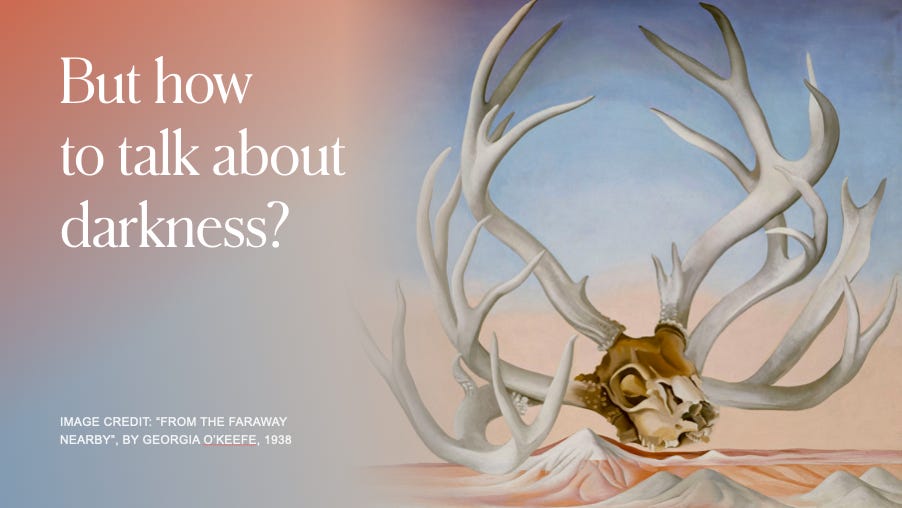
Now, I don’t know where you are in your life right now, obviously. I don’t know if you’ve had an experience like that, or if you’re in that kind of place at this very moment. I do know that no one who lives to be an adult gets through life without at least one Dark Night of the Soul, which is why this kind of exploration is so important to talk about.
That said, it’s difficult to talk about in a motivational kind of way for one simple reason: there is no sugarcoating this experience. Even though it is a necessary part of fundamental, positive transformation, to focus on that while you are blackening would be a huge error.
Our culture urges us to “stay positive”, “look on the bright side,” and to find the silver lining or the growth opportunity. It’s implied that we can learn to transcend our pain through meditation, affirmations, and gratitude practices. Things can be helpful, healthy and important at the right moment, but when you’re in the Nigredo, trying to skip past the darkness and jump straight to the light is known as spiritual bypassing – the Nigredo’s bright and fluffy shadow side, if you like.
Spiritual bypassing is when we use spiritual ideas and practices to avoid dealing with painful feelings or unresolved trauma. It’s the use of “high” consciousness to escape “low” feelings.
The alchemists knew better. They knew you can’t turn lead into gold without first breaking the lead down completely. Without braving the descent.
The Accidental Descent
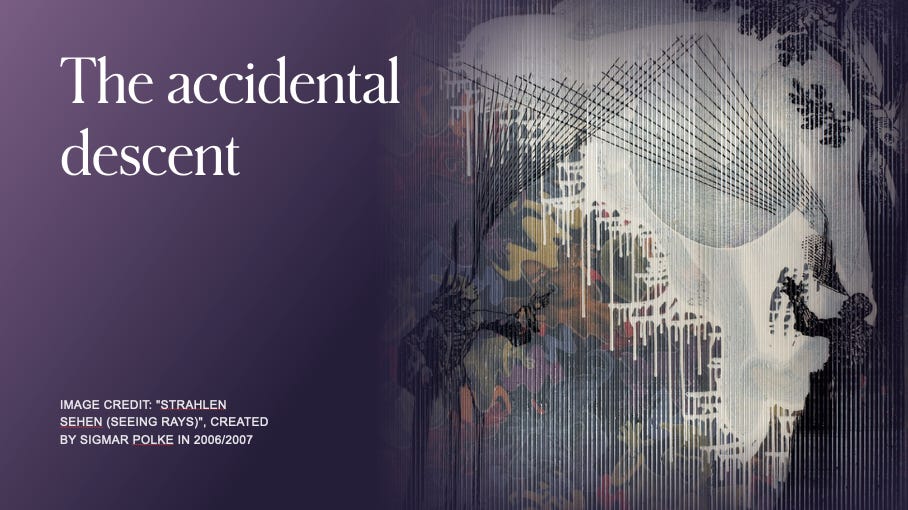
Picture, in your mind, a stranger. Lost, they’ve been walking for hours, not really going anywhere… just moving because sitting still seems impossible when the ground feels like it’s caving in.
Turning down an alley they’ve never noticed before, they come across a stone staircase spiralling down into darkness. Should I just keep walking? they wonder, but something pulls them in: the faint smell of smoke and earth, a warmth rising from below. Before they can think better of it, they’re descending.
At the bottom of the steps, they discover a stone chamber. A massive furnace roars at the centre, flames visible through the grate. There are shelves on every wall, each crammed with strange-looking vessels. Some contain liquids, some ash, and some are filled with bizarre, unidentifiable things. The air here is thick with heat and the smell of scorching.
By the furnace stands the Alchemist – ageless and androgynous, tending the fire with an iron poker. They don’t look surprised to see the wandering stranger.
The Alchemist picks up a heavy, blackened clay crucible from the shelf and hands it over. “Put in what’s dying,” they say, with a voice that sounds like grinding stone. The stranger reaches for the vessel, but before they can take it, the alchemist quickly pulls it just out of reach. “Don’t just put in what you think should die. You need to put in everything that you can sense is already beginning to decay, like it or not.”
With that said, the Alchemist allows the stranger to take the crucible, and as their fingers touch its warm, weathered surface, the laboratory comes alive with shapes and visions, each one formed from the curves of flame and the coils of black smoke.
The stranger watches as their life plays out before them – the relationship that’s ending, the belief that never fit, the work or hobby, friendship or goal that’s falling apart at the seams… Every pretense, every performance, every lie. Appearing before them in visceral clarity, the stranger sees everything they’ve ever used to keep what’s true unspoken.
They feel, now, the heaviness in the room as if it belongs to them – as if it is lead in their stomach. Still, they do as they’re told, reaching for the visions and then placing the false fragments of their world into the vessel, naming each one as they do.
“The person I was trying to be,” they mutter. “The person I thought I had to be… “ The Alchemist watches dispassionately, but not coldly, as every falsehood is collected up.
“This thing that I’ve been clinging to for safety. This lie I’ve been telling my friends. This lie I’ve been telling myself.”
The Fire
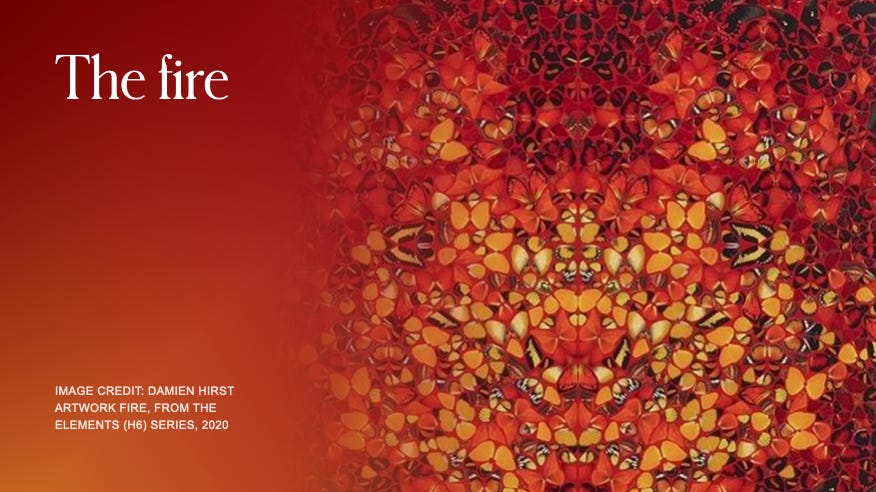
When the work is done, the Alchemist takes the vessel, now heavy and full, and places it in the heart of the athanor, where it heats and heats. Its skin blackens even more, its contents decay and decompose – eventually breaking down so entirely that they’re left unrecognisable.
“Fire cleanses,” the Alchemist says. “Everything false must burn before you can see what’s true.” Then, they turn slowly from the athanor, locking eyes with the stranger. “Your job is simply to sit with this loss. Don’t rush it. Just let it burn.”
The vessel glows now – red hot on the outside, blacker than black on the inside.
The Return
Satisfied with this progress, the Alchemist nods once. “This will one day be gold, but it’s not that time just yet. So, we wait.”
Finally, the Alchemist retrieves a piece of darkened metal from a shelf near the ceiling, hands it to the stranger, and gestures to the stairs. “This is you now – base matter. Keep it. You’ll want to see what it becomes. Now, go. I’ll tend the fire. Whenever you return will be the time for the second stage.”
As the stranger climbs the spiralling stone steps, one by one, I wonder what happens when you ask yourself what the Alchemist would have you pluck from the smoke and place in the flames?
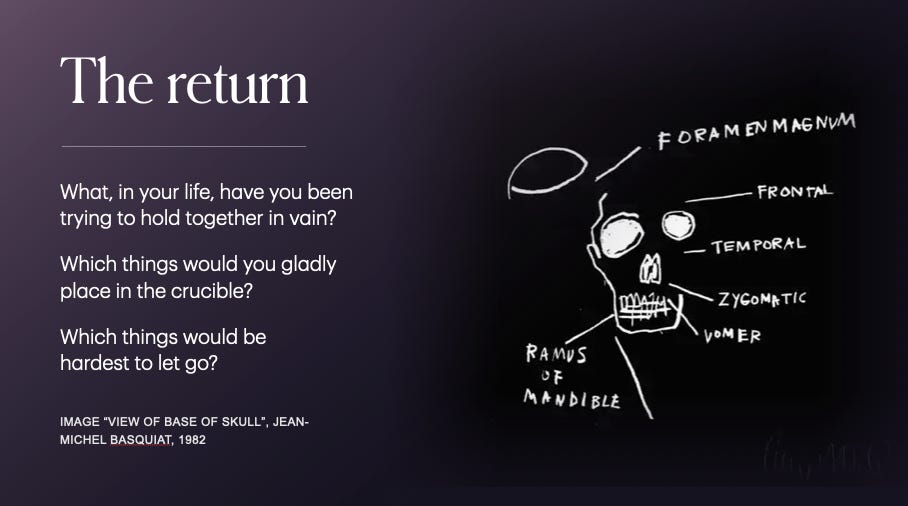
What, in your life, have you been trying to hold together in vain?
Which things would you gladly place in the crucible?
Which things would be hardest to let go?
You don’t need to know the answers to these questions right now. The Alchemist is always tending that fire, and the process is older than any of us. But these questions are worth keeping close, because at some stage, for all of us, there will be a time when we have to let ourselves burn.
REFERENCES:
Carl Jung, Psychology and Alchemy (1944)
Carl Jung, Mysterium Coniunctionis (1955-56)
James Hillman, The Dream and the Underworld (1979)
James Hillman, Alchemical Psychology (Uniform Edition, Vol. 5)
Dennis William Hauck, Complete Idiot’s Guide To Alchemy: The Magic and Mystery of the Ancient Craft Revealed For Today (2008)
Diane Wolkstein and Samuel Noah Kramer, Inanna, Queen of Heaven and Earth: Her Stories and Hymns from Sumer (1983)
Robert Masters, Spiritual Bypassing: When Spirituality Disconnects Us from What Really Matters (2010)
Hazel Gale, The Mind Monster Solution (2018)
Groundhog Day, directed by Harold Ramis (1993)
Have you heard about our new game Echoes?
Our new game Echoes is available for pre-orders on Kickstarter. It’s a futuristic tale of time travel, magic, myth and tarot, and it’s perhaps our favourite and most awaited project.
There’s a special card deck and other exclusive rewards available only on Kickstarter. Ready to meet the Selves, gather ancient wisdom, and save the future?
what a wonderful journey, very profound. Looking forward to next part! Thank you for your work, much appreciated.
I felt this. I fear that I've been attempting spiritual bypass, and I also feel the invitation to decay, to burn. There are some things I don't yet feel ready to allow to burn to see what remains. What if nothing remains? I'm not sure I'm ready for that